
Football/Soccer Session (Academy Sessions): Team Training x 8

FAW Coach Ed
Daniel Andrew Vale

Description
These formed part of bigger sessions over the Season
They were delivered along side other modes of Warm up, Match Prep, Technical, Tactical and SSG
See the guidance at the top of this page to understand why you are not seeing interactive Football/Soccer images.
See the guidance at the top of this page to understand why you are not seeing interactive Football/Soccer images.
IP Switching Play (20 mins)
Mode: Specific practice
Organisation / Area Size / Equipment
50m x 70m
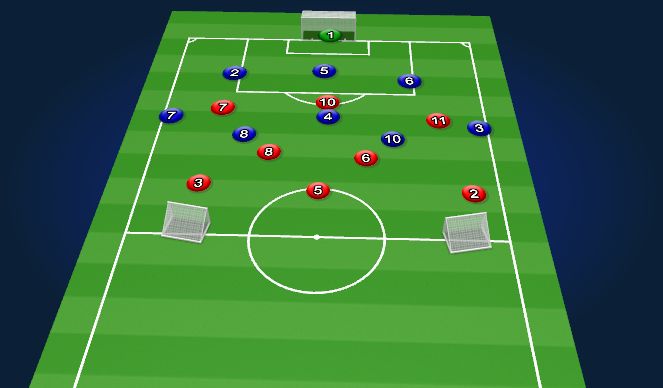
Play 9v8 GK on the blue team with the reds GK acting as a server for this practice.
Reds are playing a 3-3-2
Blues are playing a GK-4-1-2-1
How
Coach the blue team on switching the play by making the pitch big by using the width and depth of the playing area. If the reds manage to gain possession they must look to go on the counter
attack and score by breaking defensive lines. Manage the red team to prevent the switch play in order to create coaching opportunities on how to counter this. When the ball is in a wide zone there can not be any red players in the opposite zone as they would do in a match by leaving the furthest player
Explanation
Play will always start with the server kicking the ball back to the Blues keeper who will then look to make a pass to one of his
defenders. They must try switch play before attempting to score. In the illustration the ball has been passed to the Blues left back and
the red team are preventing him from switching play by pressing and leaving the furthest man in order to have more bodies in the
middle of the playing area making it problematic for the Blues who are trying to switch the play.
Teams can score by:
1) Blue team switching play and scoring in either mini goal on each wing or by passing it to the server down the middle.
2) Red team by gaining possession and going on the counter.
Challenges, Conditions & Targets
Blue team targets is to score in either goal or pass to the server and for the red team is to score upon gaining possession. Challange
for the Red team is can they score on the counter? Conditions are the full width of the pitch and up to the halfway line.
Wide players are locked in the wide zones with the reds wide players allowed to come into the half-space (shaded area) when the ball is on the opposite flank.
Central players are locked in the central area of the pitch.
In possession there must never be more than two attacking players in the half-space
Key Points
(Red Team)
Force direction of play
Defend narrow
Prevent the switch
Leave the furthest player
Pass = defensive effort
(Blue team)
Try switch play
Over around or through
Use of width and depth
Movement to recieve a pass
Weight of pass
Change of tempo
Interventions
Concurrent
Terminal
Coaching Process
Walk Throughs
See the guidance at the top of this page to understand why you are not seeing interactive Football/Soccer images.
OOP Defending Mid Block (20 mins)
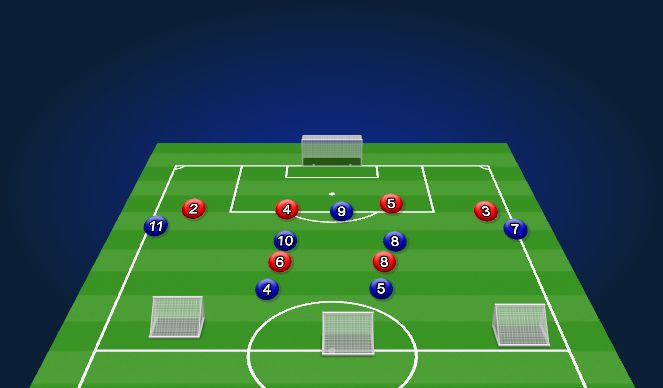
Organization: Full width, counter goals on top of the circle.
Instructions: the 4 + 5 are passing between them. One of them open up and finds the winger on their side on which 7v7 play starts. Attacking teams tries to score on the big goal. If defending
team wins the ball they can score on 3 counter goals. Each time ball goes out of bounds/goal they restart from 4/5.
4x 5:00min 1:30min rest (switch players after 2 sets) = 25 min.
Coaching Points:
- 6/8 Positioning on the inside of AMC (no allow through ball) ->
Ready to mark AMC when ball travels.
- 6/8 reading of the run of the AMC or timing of the press when staying below the ball.
- 2/3 Angle and timing of approach on the winger to make play more predictable in the wide area.
- 2/3 Intensify pressure on winger when defending 1v1 outside (block cross with backfoot).
- Backline defending the goal from wide area's.
Teams:
Defending: (3,5,4,2) (6,8)
Attacking: (4,5) (7) , (11) (10) (8) (9)
Switch after 2 sets:
Defending: (3,5,4,2) (6,8) .
Attacking: (4,5)(7) (11) (10) (8) (9)
See the guidance at the top of this page to understand why you are not seeing interactive Football/Soccer images.
OOP Defend Lines (20 mins)
Small Sided Game
Defend the Lines, and Protect the Middle controlling thespaces.
Understanding how and when to pressure the opposition sothat they are unable to play forward and exploit space betweenand beyond defensive lines.
Fast pressure on the ball
Protect the middle
Stay narrow & compact
Stop split passes
Protect the space behind
Area Size
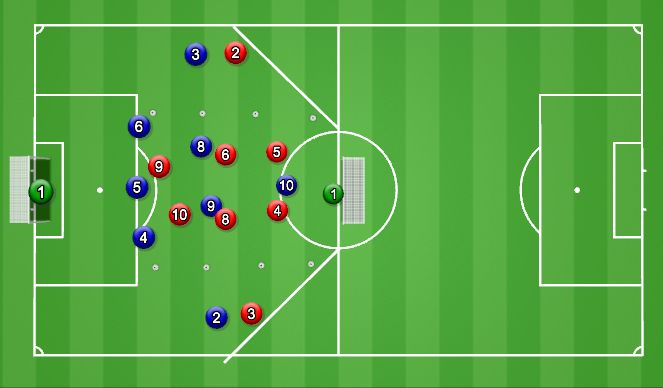
Area size will be half pitch + 18 yards, with 2 full-sized goals
Flats will be used to mark out lines that are reference points for both teams as zones.
Cones will be used to mark out the tapered lines where the pitch will be cut of as the defending team will not have fullbacks.
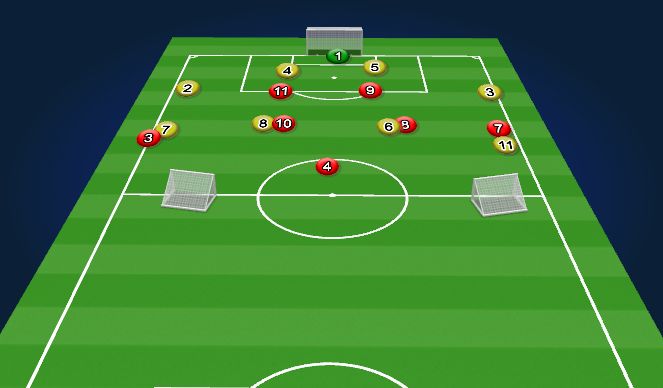
9v9 with goalkeepers
Defending team formation will be 1-4-3-1 (4-4-1-1 in 11 a side) fullbacks for the defending team have been taken out so coaches can focus on defending the central areas.
Attacking team formation will be 2-4-2-1 (2-4-4-1 in 11 a side) wingers and now brought back in to the SSG but the focus still remains around the central areas.
Explanation
For the small-sided-game, the initial positions of the teams will remain unchanged. However, The wingers are now brought back
on to the pitch. The white line of flats and the tapered edges remain the same. Additionally with adding the wingers this modification
allows further problems for the defending team to protect the lines, granting them the freedom to to play out to the wing. This
adjustment aims to create a more dynamic and fluid gameplay, allowing for increased movement and strategic opportunities for
both teams within this previously restricted zone. Allowing more fluidity to the team in possession means, in theory, they should
pose more questions to the blue defence. This is important as we will be able to clearly see how well learning has transferred from
the specific practice into the small-sided-game.
Key Points
Positional Awareness: Ensure defenders maintain a solid and well-organised defensive shape, covering passing lanes and
spaces between lines to impede opponents' forward progress.
Pressing Triggers: Recognise the opportune moments to initiate pressure on opponents, whether it's when they receive the ball, as
they approach certain zones, or when there's an opportunity to force errors.
Protect the middle: Emphasise the importance of preventing opponents from accessing and exploiting central areas of the field,
positioning defenders strategically to block passing lanes and deny space in the middle.
Communication: Foster effective communication among defenders to coordinate pressing, maintain defensive lines, and quickly
adjust positioning to counter opponent movements.
Interventions:
Coaching Process
Concurrent
Walk Through
Terminal
What if’s
See the guidance at the top of this page to understand why you are not seeing interactive Football/Soccer images.
OOP defend a box against Front 2 (20 mins)
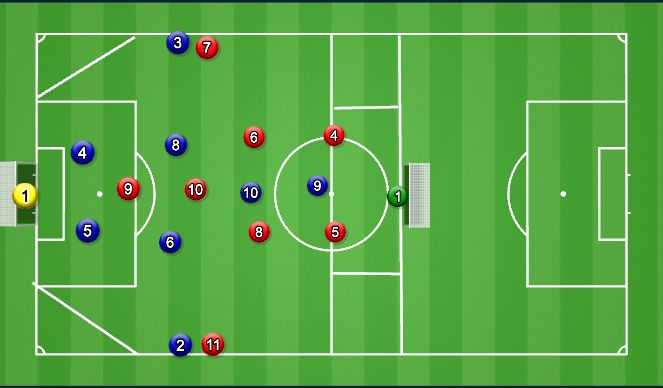
Defending the Box & Counter-Attacking with Width (8v8 + GK + Target)
18 players
8 attacking the big goal
8 defending + GK
1 target player (No9)
Area
Half pitch (full width)
Big goal with GK
2 mini goals on halfway line
Target No9 positioned centrally on halfway
Session Aim
To improve the team’s ability to:
Defend the box collectively against a front two
Regain possession and counter-attack quickly using width
Primary Learning Outcome (Team with GK)
By the end of the session, the team will:
Stay compact and defend the box effectively
Prevent central finishes and crosses
Transition quickly into wide counter-attacks
Practice Overview
Play starts with the attacking team attacking the big goal
Defending team:
Defends the box
On regain, looks to score in:
Either of the two mini goals, or
Find the target No9 at halfway
If the target No9 receives the ball:
The game restarts with him for the opposition, who attack the big goal
Block 1 – Defending the Box 8 minutes
Primary Focus:
Out of possession organisation & box defending
Compactness between units
Protect central areas
Deal with front two movement
Defend crosses and second balls
Key Coaching Points
Back line stay connected and goal-side
Midfield screen passes into the front two
Force play wide
GK organises and controls depth
Coach Interventions
Fly-by: reinforce distances and body shapeDrive-by: individual corrections
Freeze (if needed): highlight box organisation
2-minute Break
2-minute Break
Quick feedback
Reinforce defending principles
Block 2 – Transition & Counter-Attack 8 minutes
Primary Focus: Reaction on regain & counter-attacking width
Coaching Focus
First pass forward on regain
Immediate width from wide players
Using the target No9 as an outlet
Key Coaching Points
Secure first contact
Play forward early where possible
Wide players sprint into wide channels
Support runs beyond the ball
Conditions
Goals in mini goals within 10 seconds count double
Counter-attack must involve a wide player
Coach Interventions
Fly-by: praise quick forward play
Drive-by: correct slow or sideways passes
2-minute Break
Highlight successful counter-attacks
Link defending actions to attacking outcomes
Block 3 – Game Realism & Decision-Making 8 minutes
Primary Focus: Linking box defending to effective counters
Coaching Focus
Decision-making: when to counter vs when to secure possession
Maintaining defensive structure while transitioning
Recognising overloads in wide areas
Conditions (Optional)
Limit counter-attacks to 3 passes before finishing
Encourage different counter routes (direct vs wide)
See the guidance at the top of this page to understand why you are not seeing interactive Football/Soccer images.
OOP Defending with 9,10 in high positions (20 mins)
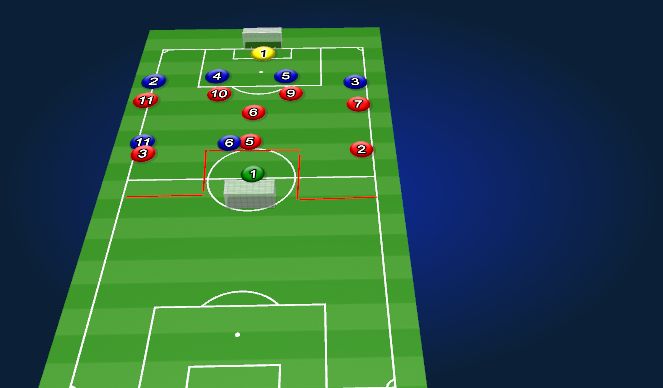
Defending High with 1 Striker & 1 No10
Players: 18
Area:
Area: Half pitch with full back zone for blue team cut out from edge of box as no fullbacks.
Session Aim:
To develop the team’s ability to defend high up the pitch against a central attacking pair.
Primary Learning Outcome:
Striker and No10 apply coordinated high press
Midfield four provide support by covering passing lanes and stepping up if the front two are bypassed
Defenders maintain compact lines and prevent central penetration
Session Structure
Block 1 – Defensive Organisation (8 min)
Focus: Compactness, pressing triggers
Front two press together to force predictable passes
Midfield four support by covering central lanes and backing up the press
Break: 2 min
Block 2 – Coordinated Press (8 min)
Focus: Pressing triggers against 2 centre-backs
Striker + No10 press the ball-side CB
Midfield four step up to deny easy passes and maintain compactness
Break: 2 min
Block 3 – Transition After Regain (8 min)
Focus: Quick counter-attack or wide exploitation
Front two initiate regain pressure; midfield provide first support options and maintain defensive balance
See the guidance at the top of this page to understand why you are not seeing interactive Football/Soccer images.
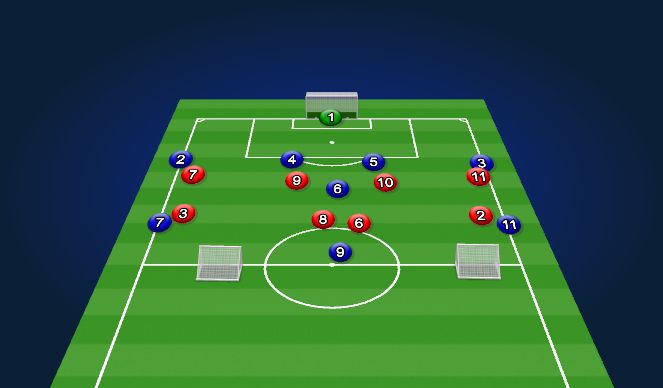
IP Switching Play (20 mins)
Mode: Small-sided game
Organisation / Area Size / Equipment
70m x 50m
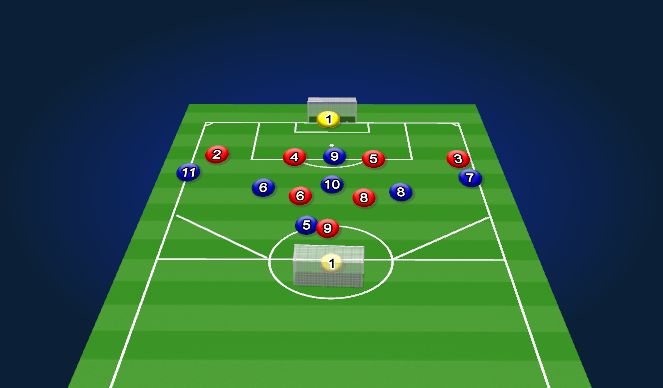
9v9 including GKs
Red team is in a GK-3-2-3 (GK-4-4-2 missing one CB and one CM)
Blue team is in a GK-4-1-3 ( GK-4-3-3 missing two CMs)
How:
Blue team will continue to be coached on how to switch the play based on the oppositions pressure on the ball
(Red team). The opposition will be managed on preventing the switch of play out of possession in a small-sided game. Reds will continue to look to go on the counter by breaking
lines when they gain possession. Encourage blue full-backs to join in the attack to create 2v1 situations out wide.
Explanation:
The blue team in possession will look to switch play after getting the ball out wide before they score. Red will continue to
press the ball and leave the furthest man and force the direction of play to create problems for the blues who will be
looking to switch the play at every given opportunity. If the red team win the ball then must look to go on the counter
and utilise the full playing area.
Teams can score by:
The blue team switching play from out wide (outside the lines of the 18 yard box) to the opposite zone is worth 2 goals.
Scoring normally past the GK is worth 1 goal
The red team going on the counter and breaking lines is worth 2 goals.
Conditions, Challenges and Targets
Still using the full width of the pitch up until the cones marked past half pitch. Conditons and challenges and targets carry
over from the specific practice. Progression can be if the blue team can get two switches of play before scoring.
Players can roam around the entire playing area as directed by the coach.
Key Points
(Red Team)
Force direction of play
Defend narrow
Prevent the switch
Leave the furthest player
Pass = defensive effort
(Blue team)
Try switch play
Over around or through
Use of width and depth
Movement to recieve a pass
Weight of pass
Change of tempo
Interventions
Interventions
Concurrent
Terminal
Coaching Process
Walk Throughs
See the guidance at the top of this page to understand why you are not seeing interactive Football/Soccer images.
OOP Defend low against front 3 (20 mins)
Organisation & Set Up
Red team defending in a 4-2-1 shape: GK, flat back four, two holding CMs, and a 10.
Blue team attacking in a 1-3-3 formation: GK, CB as 5, wingers 7 & 11, two central midfielders, 10 playing off them, and a central striker.
Conditions:
Corners on either side of the goal for the defending team have been removed to focus on defensive principles.
Challenges:
Can the defending team score within 10 seconds of winning possession?
Block 1:
Ball starts with the attacking team goalkeeper and is played to either winger (7 or 11) to try and draw the full-back out, creating a gap between FB and CB for the winger to play into 6 or 8. The 10 would then step into the pocket left by the full-back.
Defending team must stay narrow and compact. As the ball moves to the winger, can the full-back engage with quick
feet to slow them down, forcing them wide and preventing inside passes? Body position and spacing between players are critical.
If the winger plays back into 5 or 6, the back four can step up high (on the yellow flats), pushing the attacking team back.
GK plays into 5. As the defending team drops back, the attacking team looks to play centrally. 5 has the ball, and
both wingers and attacking 6 & 8 drop deep to receive. If the two CMs follow man-for-man and the back four don’t
step up, gaps open centrally for the attacking team. If the CMs track their players, the back four must close the space.
Wingers stay wide, and FBs only engage when the ball is played into them.
Attacking team aims to involve 6, 8, & 10 in the half-spaces. These three plus 5 circulate the ball to draw the
defending team out, before attempting a ball over the top for 9 & 10 running off the shoulder.
Pressing Triggers:
Under-hit pass
Poor first touch
Attacking player not ready for the ball
Problems & Solutions:
Problem 1:
Attacking team easily plays over the top, leaving striker 1v1 with the GK.
Solution:
Defending team drops back as the ball is played.
GK sweeps using the 18-yard box.
Defending team uses the edge of the 18-yard box as a reference. If one CB goes to meet the ball, the other CB sweeps behind, and the FB tucks in.
Defending team drops as soon as the attacking player looks for a run; back four meet the first contact of the ball.
Problem 2:
Attacking team moves the ball out wide to wingers, allowing them to travel around the 18-yard box.
Solution:
As the ball goes to the winger, the FB engages quickly, slowing them down.
CBs and other FB shuffle across to maintain compactness.
Two CMs tuck in around the edge of the 18-yard box to block central passing lanes.
Coaching Points:
Stay narrow and compact
Recognise pressing triggers (bad touch, under-hit pass)
Strong communication between midfielders and back four
Prevent vertical passes through the lines
Back four shuffle side-to-side depending on ball position
What Ifs:
What if the ball is played over the top from the goalkeeper?
What if the ball is played over the top from the goalkeeper?
Back four drop while defending.
GK starts higher and commands their area.

 Play animation
 Play step-by-step
 Repeat (toggle)
 Full Screen
 Pause
Pause Stop
Stop
IP - Build UP (20 mins)
Organisation: (30 mins) 3-5-2 vs 4-3-3
As above - Blue start in possession from a structured start - if they are having success then start from a moment of transition
Put conditions/ limitations/ rewards on each team to bring out/focus on the topic
Key Ideas
Individual
Confidence/ Bravery - to break lines
Scanning/ awareness
Communication to recognise overloads
Units
2/5/6 - In possession remain narrow, create space for wing backs
3/7 - Keep width, position not too high that they are marked by the full back
4 - Movement to receive beyond the opposition front 3 and break a line with first touch or pass
Principles
Penetrate
Create Space
Support
Movement
Creativity