
Football/Soccer Session (Academy Sessions): Dribbling Session Plan (Start Time: 2024-12-23 18:55:00)

FAW Coach Ed
Ejas Panikka V Assis

Description
This dribbling session focuses on enhancing players' ability to maintain close control of the ball while making decisions in high-pressure scenarios. It emphasizes the technical principles of dribbling, such as using the correct part of the foot, body positioning, and awareness, alongside tactical elements like using space, beating defenders, and executing effective feints. The session integrates challenges and problem-solving activities to improve players’ confidence, decision-making, and adaptability during gameplay.
The session is divided into three key phases: a technical session to refine the mechanics of dribbling, a skill session that introduces opposition and pressure, and a small-sided game (SSG) to apply the learned skills in a realistic match-like environment. Players are encouraged to communicate, take on individual challenges, and work as a team while striving to meet specific targets and conditions.
Coaching interventions such as Concurrent, Freeze, Team Meetings, and Bullseye will be used to provide timely feedback and corrections. The session is designed to balance technical development, tactical understanding, and psychological resilience, ensuring players can effectively dribble past opponents and create opportunities in competitive situations.
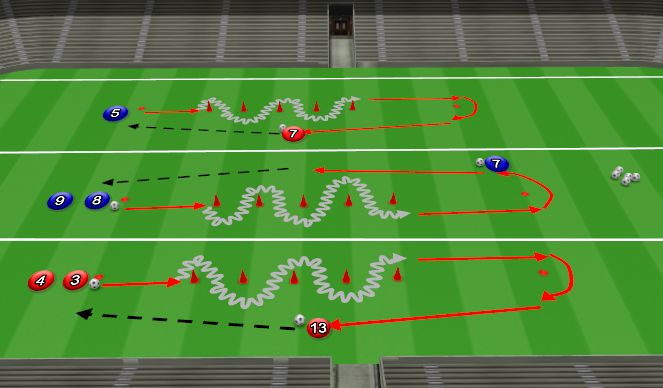
See the guidance at the top of this page to understand why you are not seeing interactive Football/Soccer images.
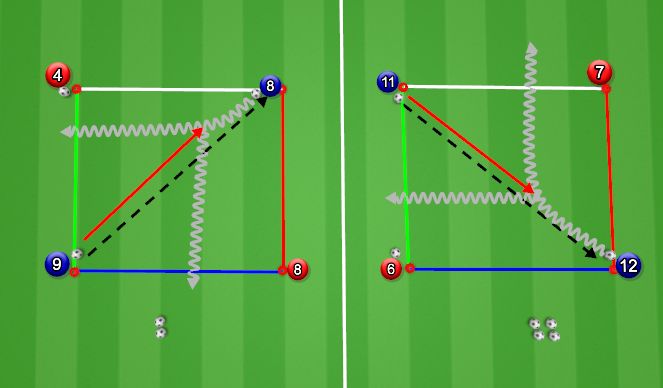
See the guidance at the top of this page to understand why you are not seeing interactive Football/Soccer images.
Dribbling ( Skill practice ) (20 mins)
Dribbling ( Skill practice ) : 20 minutes
Key Factors :
- Passing Accuracy: Ensure the pass reaches the intended player with proper weight and direction.
- Defensive Pressure: The defender should apply controlled pressure without fouling.
- Dribbling Technique: Close control, quick changes of direction, and using both feet.
- Awareness: Attackers should scan for open spaces to exploit before receiving the ball.
- Decision-Making: Attackers should decide quickly on their dribbling direction and timing.
- 8 Markers ( 8 red )
- 10 footballs
- 8 players ( 4 red , 4 blue )
- 2 square zones of 20x20 each.
- 4 players behind each markers
- Red and blue player of each zone will be having the ball.
Technical session : 20 minutes
- Players having the ball will pass to their partner who is standing diagonal to player
- the player who passed will then will be defender
- the player who receives the ball will be attacker
- the attacker then should dribble past the defender and should go through any end lines for example ( if player 9 is defender and player 8 is the attacker , then player 8 should dribble past the defender and go through either green line or blue line. )
- After completing the round, the next partners will do the same also in the next round the role swaps.
Progression :
- Restrict Touches: Limit the attacker to 3 touches to dribble past the defender.
- Add Defensive Pressure: Increase the intensity of the defender's approach.
- Time Constraint: Attackers must exit the square within 5 seconds.
- Introduce Weak Foot: Attackers must use their weaker foot to dribble past defenders.
Regression :
- Allow multiple touches : Remove the touch restriction for attackers.
- Passive Defending: The defender applies less pressure, focusing on positioning.
- Wider Square: Increase the square's dimensions to give attackers more space.
- Simplify Objectives: Attackers only need to maintain possession within the square for a few seconds.
- Keep ball close
- Vary surfaces of foot
- Head up
- Change of pace
- Change of direction
Coaching process :
- Observation Phase (3 Minutes): Allow players to execute the activity without intervention. The coach observes players’ dribbling, passing, and defensive techniques.
- Focused Coaching Phase (5 Minutes):
- Highlight key factors, such as body position when defending, quick decision-making, and effective dribbling techniques.
- Reinforce scanning and awareness before receiving the ball.
- Challenge Phase (8Minutes):
- Add conditions like touch limits or time constraints to increase difficulty.
- Encourage players to identify and exploit open spaces.
- Reflection Phase (3 Minutes):
- Conduct a brief team meeting to discuss observations, challenges, and successes.
- Provide individual feedback on technical and tactical aspects.
- Intervention (Ongoing): Use freeze or concurrent interventions to address issues during the activity.
Work rest ratio : 4:1
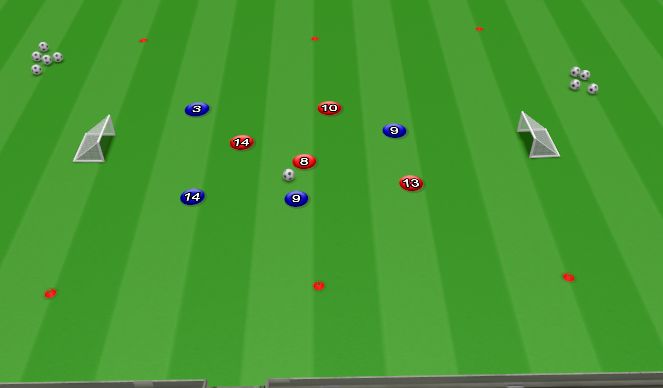
See the guidance at the top of this page to understand why you are not seeing interactive Football/Soccer images.
Dribbling (SSG) (20 mins)
Dribbling ( SSG )Key Factors:
- Passing Accuracy: Ensure precise and well-timed passes to maintain possession.
- Defensive Pressure: Defenders must position themselves effectively and apply controlled pressure.
- Dribbling and Ball Control: Attackers should demonstrate close control and effective use of both feet.
- Decision-Making: Quick decisions on when to pass, dribble, or shoot under pressure.
Organization: Olcott (1968)
- Pitch Size: 25x20 yards.
- Goals: 2 mini goals at each end.
- Markers: 6 red markers to define the pitch boundaries.
- Balls: 1 football on grass.
- Players: 8 players divided into 2 teams (4 red bibs, 4 blue bibs)
Progressions and Regressions:(McKeag, 2005)
Progressions:
- Restrict Touches: Limit the number of touches per player to increase the challenge.
- Add Scoring Conditions: Award extra points for scoring after dribbling past a defender.
- Reduce Space: Shrink the playing area to force quicker decision-making and tighter control.
- Time Constraint: Players must dribble past the defender and attempt a goal within 5 seconds.
- Regressions:
- Allow Multiple Touches: Remove touch restrictions to help players maintain better control.
- Passive Defending: Defenders apply less pressure, focusing on positioning rather than immediate ball recovery.
- Increase Space: Enlarge the playing area to provide more time and space for decision-making.
- Simplify Objectives: Remove the condition to dribble past the defender before scoring.
Mechanics of Dribbling:
- Keep ball close
- Vary surfaces of foot
- Head up
- Change of pace
- Change of direction
Coaching process :
Observation Phase (4 Minutes)
- Observe player behaviors such as dribbling technique, defensive positioning, and off-the-ball movement.
Identify key areas of improvement, including timing of passes, body orientation, and use of space.
Initial Feed
- hase (8 Minutes)
- Reflection and Final Feedback Phase (4 Minutes)
See the guidance at the top of this page to understand why you are not seeing interactive Football/Soccer images.
MISC. Information.
Planned interventions:
- ConcurrentFreeze
- Teammeeting
- Bullseye
Physical corner tools
Session time line :
- Technical session : 20 minutes
- Skill session : 20 minutes
- SSG : 20 minutes
- Area sizes : 25x20 yards.
Social corner tools
- Teammeetings
- Challenges
- Problem-solving
- Communication challenge
- Targets and conditions
Technical corner tools
- The Mechanics of Dribbling with Close Control
Tactical corner tools
- Using Space to Beat a Defender
- Decision-Making in 1v1 Situations
- Effective Use of Feints and Body Movements
Psychological corner tools
- Challenges·
- Pointsystem
- Individual challenges
REFERENCE LIST
Hargreaves, A. and Bate, E. (2010). The coaching process: Principlesand practice for sport. 1st edition. London: Routledge, p. 10.McKeag D.C. (2005) Coaching Soccer Like a Pro Human Kinetics isbased in Champaign, Illinois, USA
Olcott, J., 1968. Organizational keys and checklists for successfulfootball coaching. West Nyack, NY: Parker Publishing Co

 Play animation
 Play step-by-step
 Repeat (toggle)
 Full Screen
 Pause
Pause Stop
Stop
Dribbling ( Technical ) (20 mins)
Dribbling technical practice : 20 minutes
Key Factors :
Organization: Olcott (1968)
Technical session : 20 minutes
Progression and regression: McKeag ( 2005 )
Progression :
Regression :
Mechanics of Dribbling :
Coaching process :
Work rest ratio : 4:1