
Football/Soccer Session (Academy Sessions): Session 16: Defending Overloads

FAW Coach Ed
Nikolaos Stephanatos

Description
Topic: Defending in a mid-block against a midfield overload
Area size: 3/4s of the pitch
Number of players: 14 outfielders + 2 GKs
Timings: SP = 15 minutes with a 1 minute break after 7 minutes between blocks, LSG = 10 minutes
Set-up:
Out of Possession 4-2-3-1 without the wingers and the 9
In Possession 3-Diamond-3 without the back 3
Technical skills:
- 1v1 tackling and variety of technical skills require to play out and counter when the ball is won by OOP team.
Physical considerations:
- Due to large area size, aerobic fitness of players' is tested.
- Multidirectional nature of LSG makes it that both teams have quite a bit of both anaerobic and aerobic fitness training with sprints for quick transitions and lack of planned interventions.
Psychosocial skills:
- Lots of communication needed for OOP team to use correct triggers and positioning to defend overload
- Confidence and comfortability when defending outnumbered in midfield
Tactical behaviour:
- Rotations, curved runs, blocking space in a mid-block, triggers, body positioning to defend against a midfield overload.
Intervention strategy:
- Walkthrough to explain the shape, role responsibilities, solutions and triggers in the set-up for OOP team. Assistant talks to IP team and coaches them through the shape, role responsibilities and intentions to through the block.
- Concurrent feedback to instruct players on the movements and coverings they need to execute. Praise and affirm when we get success in our objective.
- Freeze when needed to give more hands-on feedback on realistic in-game situations.
- Bullseye feedback is inevitable in a complex tactical exercise.
- During LSG, we try to keep ball-rolling time as high as possible, so keep interventions at a minimum, look to coach concurrently as if a real match. Freeze only in situations where we feel is very necessary. We keep same one-team-each set-up for two coaches.
Elite game evidence:
"Once a team has dropped back into a mid-block, the priority is compactness. Distances between players (laterally) and units (vertically) should be kept to a minimum to prevent the opposition from playing through the team."Coaches' Voice (2022)
See the guidance at the top of this page to understand why you are not seeing interactive Football/Soccer images.
See the guidance at the top of this page to understand why you are not seeing interactive Football/Soccer images.
SP: Block 2
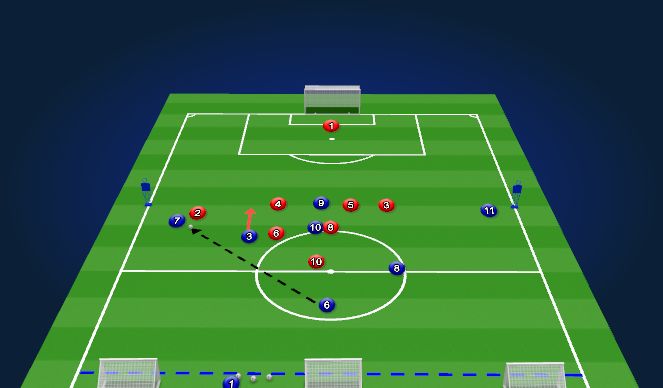
Problem: In block 2, the IP team are instructed to attack through the wide areas, going to their wingers with supporting runs from their 8's.
Solution: The way to defend this is first off by ensuring we shuffle across and the ball-side FB jumps aggressively to prevent the winger from facing him up 1v1 and having time to pick out a pass or dribble down the line. In addition to that, the ball-side pivot must track the underlapping run of the OOP 8, while the other pivot moves across and man-marks their 10 in the pocket.
- If our pivot loses their 8 (which is inevitable once or twice), the near CB must move in and track that run, while the other CB man-marks their 9.
See the guidance at the top of this page to understand why you are not seeing interactive Football/Soccer images.
LSG
Set-up:
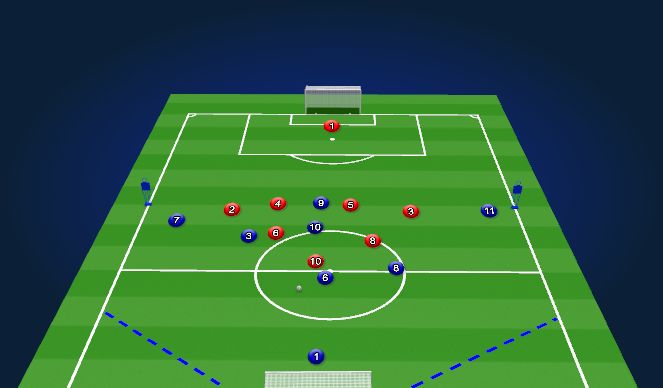
Mini-goals are taken off and replaced by a big goal and a GK is added. Flat lines are added to funnel the pitch play inside, due to blue team's lack of FB's and IP team's lack of wingers.
- Play can start for both teams or goal-kick and throw-in restarts. Blue team is instructed to attack using the shape, patterns and principles taught in SP, while the red team is expected to defend in a mid-block using principles taught in SP.

 Play animation
 Play step-by-step
 Repeat (toggle)
 Full Screen
 Pause
Pause Stop
Stop
SP: Block 1
Set-up:
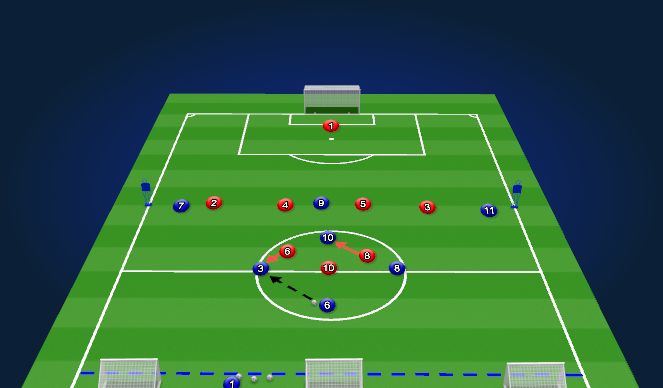
OOP team defends in a mid-block while IP team attempts to break them down and score in the big goal with the GK. Once the ball is won by the OOP team, they attempt tp play out and score in one of the 3 mini-goals (simulating the front 3). Blue team have a server that cannot move ahead of the mini-goals. Mannequins on the side are there as a visual marker for what height the back-line needs to be at in a mid-block.
Problem: IP team uses a diamond in midfield and thus, have a 4v3 overload in midfield. How can we defend that?
Solution: We begin with a fairly flat 3, inside the diamond, with our 10 shadow covering their 10. When their 6 passes to one of their 8's, the ball-side pivot jumps on him, the other pivot drops to mark their 10 and our 10 stays side-on in the middle of the diamond shadow covering the far-side 8. Essentially, we use a "pendulum" coverage, always leaving the far-side 8 technically unmarked, but shadow-covered.
- IF they manage to bypass our midfield and find the 10, one of the CB's (more aggressive one) must jump in to press him, while the rest of the back-line defends 3v3.
- What's important in this scenario is that even if they drop their 8's deeper and wider, we must not be provoked and we stay tight closing down the passing lane to their 10.