


Football/Soccer Session (Academy Sessions): Breaking Lines - Passing


FAW Coach Ed
Scott Woodford
Profile Summary

| Name: | Scott Woodford |
|---|---|
| City: | Aberdare |
| Country: | United Kingdom |
| Membership: | Adult Member |
| Sport: | Football/Soccer |

Description
Breaking Lines
See the guidance at the top of this page to understand why you are not seeing interactive Football/Soccer images.
See the guidance at the top of this page to understand why you are not seeing interactive Football/Soccer images.
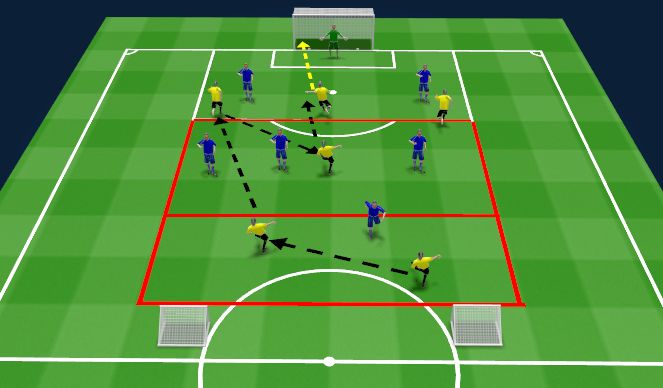
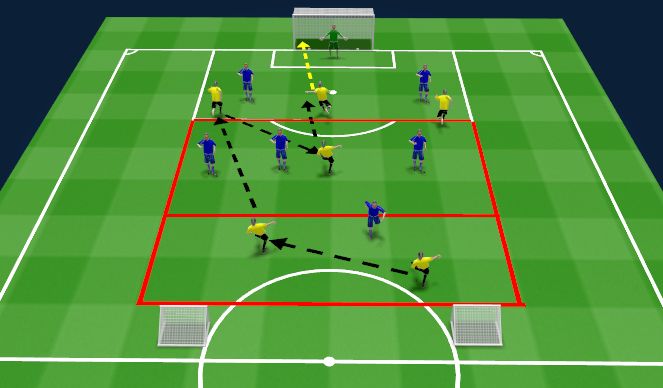
2
Organisation:
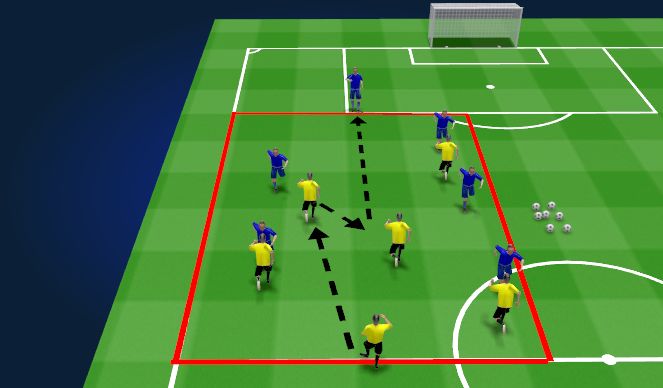
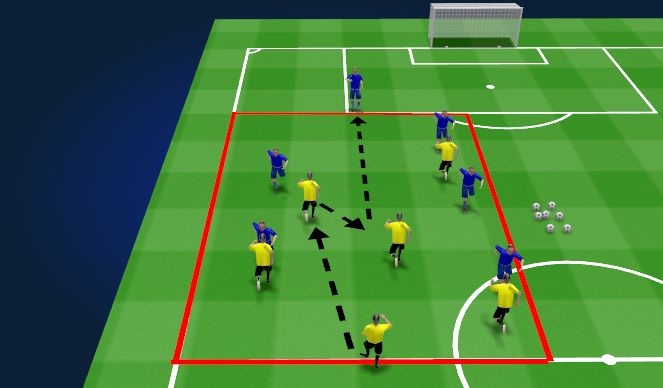
20x30 yards
5v5 with 2 end zone players neutral (12 total)
Rotate the outside endmen every couple mins if rotationneeded.
Session Info: Principle of Play/Topic Focus:
Breaking lines passing; players keep possession trying toplay into the end men.
End men are neutral creating a 7vs5 in possession; playersaim to receive from one end and play passes through the pitch to reach theopposite end player.
Adaptations (Progressions & Regressions):
P: limit the touches of the team in possession to encouragequicker speed of play
P: set amount of passes before break line and pass into theopposite end man
P: cant play back into the same end man, have to open up andplay forward or use internal teammate
P: If blue team pass into the blue end man can they swap positionsand the player drives in and joins in (allows constant swap of outside end men)
R: allow first pass free from end man into inside player tostart possession (poss drop the defender back 10 yards to allow space to startpossession)
Challenges, Conditions or Targets:
Players limit on touches to speed up play
Can team go end to end numerous times without losing possession
If blue team pass into the blue end man can they swap positions and the player drives in and joins in (allows constant swap of outside end men)
Can team use combination/sequences practiced to keep possession with set and play
Does the player know when to utilise the set/bounce pass vs when to open up/turn out
Coaching Points (Mechanics of Technique)
Angle of approach and body position aligned to direction ofpass
Supporting foot set next to ball before pass
Weight and accuracy of pass (into feet!)
On toes to receive
Relaxed/cushioned control
Body position balance and set to receive
First touch/use of surface to receive in direction want tomake the pass
Ensure open body position (can they see ¾ of pitch) andreceive on back foot to open out on touch
Possible Interventions and Tactical Points:
Movement of players to create angle to receive from end men –nearest two to split left and right to give early option and open out or dragtwo defenders wide
Team in possession use width and depth to make pitch big andcreate space
Quality of pass key > needs to be accurate into feet and suitableweight to allow 1 touch/quick tempo to sequences.
If player is marked and not able to open up encourage set/bouncepass back into end player to utilise +1 or +2 players who are in space to receivenext pass – the set/bounce pass needs to be done with a purpose, player performsset and takes defender wide to allow space for end player to make next pass.
Outside players need be on toes and willing to move left orright to offer a better angle depending on the pass needed from inside pitch.
Outside players communication is key > turn or set as practicedin tech warm up. They can dictate the starting phase with instructions. Also communicate/callthe switch if congested and player can make longer pass to change the pictureand restart at the opposite end.
Reaction of team who lose possession to win it back quickly or get man for man/back into shape and be compact to stop team playing through them.
See the guidance at the top of this page to understand why you are not seeing interactive Football/Soccer images.
3
Organisation:
50x30 yards (larger zones in attack 3rds eg 18/18/14)
6v6 +GK
Rotate the attacking team vs defending team at timeintervals left in session (eg x4 5mins or play x2 10mins)
Session Info: Principle of Play/Topic Focus:
Breaking lines passing; small sided game attack vs defence.
Attack team look play through the 3rds, to break lines and create chances to score against GK.
Attackers can move forward into next zone to create attacking overloads and then drop back to stop counter attack into mini goals.
Defending team look to defend the goal, counter and break lines by passing into the small sized goals at the left and right side of end zone.
Defending team must have at least 1 player in each 3rd
Adaptations (Progressions & Regressions):
P: limit the touches of the team in possession to encourage quicker speed of play
P: time limit on defending team to go attack the small goals to avoid them just keeping possession in their own box (not realistic vs realgame situation)
P: time limit on attacking team to create chance and not justkeep possession
R: Defenders have to stay 2-3-1 formation in zones to stop them placing 6 men behind the ball and making it difficult to break lines
R: Create attacking overload 7v5 to increase amount of attacking chances and opportunities to play forward into spare players
Challenges, Conditions or Targets:
Limit the touches of the team in possession to encouragequicker speed of play
Use a set amount of time before attackers need to create achance and take a shot
Add in halfway line (green line) to split defenders to stop themplacing 6 men behind the ball and making it difficult to break lines; at least2 players need to be in each half to encourage that forward pass
Can players utilise the set and play to go forward or the set to edge of box to create shooting opportunity.
Are players looking to play forward as first choice not move ball around in the back
Coaching Points (Mechanics of Technique)
As above plus additional:
Head and shoulders over ball when shooting
Use of laces for power and inside surface for more control/accurate
First time finish; use of different surfaces of foot and/orbody directed at goal
Possible Interventions and Tactical Points:
Movement of players to create angle to receive from startingpass (especially first pass from half way line) – nearest two to split left andright to give early option and open out or drag two defenders wide
Team in possession use width and depth to make pitch big andcreate space
Quality of pass key > needs to be accurate into feet and suitableweight to allow 1 touch/quick tempo to sequences.
If player is marked and not able to open up encourage set/bouncepass back to shot or to utilise +1 or +2 players who are in space to receivenext pass – the set/bounce pass needs to be done with a purpose, player performsset and takes defender away to allow space for player to make next pass.
Communication is key from the passer > turn or set as practicedin tech warm up. They can dictate the next pass/phase with instructionsprovided. Also communicate/call the switch if congested to change the picture andattack the space.
Reaction of team who lose possession to win it back quicklyor get man for man/back into shape and be compact to stop defenders playingthrough them and into small goals.
'%3E%3Cpath id='path4169' d='M 11.4375,70.25 C 11.457031,38.394531 37.277344,13.242188 68.253906,13.050781 99.78125,12.855469 125.73047,38.351563 125.8125,70.078125 125.89844,101.62109 100.43359,127.14063 69.148438,127.42188 37.582031,127.70703 11.464844,102.23438 11.4375,70.25 m 6.425781,-0.08984 c 0.03516,28.421871 23.027344,50.69922 50.519532,50.82031 C 96.433594,121.10156 119.30469,98.367188 119.38281,70.359375 119.45313,42.878906 97.382813,19.714844 69.015625,19.496094 40.75,19.277344 17.964844,42.035156 17.863281,70.160156' style='clip-rule:nonzero;fill:%23333f48;fill-opacity:1;fill-rule:nonzero;stroke:none' /%3E%3Cpath style='fill:%23333f48;fill-opacity:1;fill-rule:nonzero;stroke:none' d='m 39.789063,108.62109 c 0.28125,0.14454 0.550781,0.32032 0.839843,0.4336 2.734375,1.05469 5.554688,1.78125 8.453125,2.23047 2.734375,0.42578 5.484375,0.64453 8.25,0.54297 3.988282,-0.15625 7.832032,-0.94922 11.445313,-2.69532 1.683594,-0.8164 3.246094,-1.82422 4.640625,-3.07422 3.265625,-2.92578 5.171875,-6.582027 5.796875,-10.906246 0.546875,-3.761719 0.04687,-7.425781 -1.09375,-11.019531 -1.4375,-4.523438 -3.730469,-8.582032 -6.703125,-12.265625 -1.03125,-1.277344 -2.082031,-2.535157 -3.113281,-3.808594 C 66.789063,66.1875 65.332031,64.269531 64.0625,62.21875 c -1.601562,-2.582031 -2.835937,-5.316406 -3.613281,-8.261719 -0.683594,-2.574218 -0.902344,-5.1875 -0.6875,-7.828125 0.214844,-2.617187 0.910156,-5.117187 2.152344,-7.441406 2.164062,-4.050781 5.503906,-6.710937 9.816406,-8.179687 1.890625,-0.640625 3.835937,-1.058594 5.832031,-1.195313 1.121094,-0.07813 2.242188,-0.152344 3.363281,-0.164062 4.28125,-0.02734 8.4375,0.734375 12.453125,2.175781 1.871094,0.671875 3.6875,1.496094 5.523438,2.257812 0.226562,0.09375 0.4375,0.230469 0.664062,0.351563 -0.164062,0.25 -0.371093,0.160156 -0.539062,0.164062 -2.824219,0.101563 -5.535156,0.703125 -8.132813,1.804688 -1.335937,0.570312 -2.570312,1.316406 -3.648437,2.296875 -2.527344,2.296875 -3.605469,5.15625 -3.34375,8.550781 0.140625,1.855469 0.722656,3.574219 1.550781,5.222656 0.648438,1.296875 1.414063,2.523438 2.292969,3.675782 0.953125,1.25 1.929687,2.484375 2.929687,3.699218 2.085938,2.523438 4.164063,5.054688 6.050782,7.738282 2.203125,3.136718 4.140627,6.417968 5.589847,9.980468 1.16406,2.867188 2.01562,5.820313 2.39843,8.894532 0.25,2.011718 0.30079,4.03125 0.11719,6.058593 -0.24219,2.640625 -0.79297,5.195313 -1.74609,7.667969 -1.29688,3.36328 -3.300784,6.22656 -5.972659,8.63281 -2.429687,2.19141 -5.171875,3.90625 -8.109375,5.3125 -2.695312,1.29297 -5.464843,2.40235 -8.34375,3.20313 -1.953125,0.54687 -3.945312,0.8789 -5.949218,1.15625 -3.035157,0.41797 -6.085938,0.48828 -9.132813,0.3125 -5.328125,-0.3125 -10.476562,-1.46094 -15.410156,-3.52344 -3.449219,-1.44141 -6.691406,-3.25781 -9.757813,-5.39453 -0.183593,-0.12891 -0.378906,-0.25 -0.53125,-0.41016 -0.07031,-0.0703 -0.05859,-0.22656 -0.08203,-0.34375 z m 0,0' id='path4175' /%3E%3Cpath style='fill:%23333f48;fill-opacity:1;fill-rule:nonzero;stroke:none' d='M 94.699219,29.390625 C 94.089844,29.21875 93.476563,29.054688 92.867188,28.875 90.183594,28.085938 87.46875,27.441406 84.703125,27.046875 c -3.976562,-0.566406 -7.945312,-0.59375 -11.863281,0.402344 -7.535156,1.914062 -12.386719,6.71875 -14.878906,13.996094 -0.894532,2.617187 -1.179688,5.328125 -0.953125,8.078125 0.203125,2.484375 0.867187,4.859375 1.816406,7.160156 0.933594,2.261719 2.117187,4.390625 3.4375,6.449219 1.4375,2.25 3.050781,4.371093 4.640625,6.511718 1.4375,1.933594 2.867187,3.871094 4.261719,5.835938 1.230468,1.730469 2.316406,3.546875 3.273437,5.445312 1.324219,2.625 2.265625,5.378907 2.703125,8.292969 0.433594,2.902344 0.292969,5.765625 -0.660156,8.5625 -0.9375,2.74609 -2.574219,5.00781 -4.777344,6.875 -2.417969,2.04688 -5.203125,3.39844 -8.246094,4.22266 -1.835937,0.5 -3.703125,0.75781 -5.609375,0.82031 -3.886718,0.13281 -7.679687,-0.47266 -11.421875,-1.46094 -2.261718,-0.59765 -4.488281,-1.33203 -6.695312,-2.11328 -0.207031,-0.0742 -0.40625,-0.16797 -0.597656,-0.25 -0.02344,-0.24609 0.148437,-0.19141 0.25,-0.20703 1.96875,-0.30469 3.921875,-0.67969 5.804687,-1.34766 1.367188,-0.48437 2.671875,-1.10156 3.855469,-1.94922 2.25,-1.61328 3.65625,-3.765621 4.0625,-6.515621 0.273437,-1.867188 0.09375,-3.710938 -0.429688,-5.527344 -0.472656,-1.648437 -1.171875,-3.199219 -2.109375,-4.628906 -0.792968,-1.207031 -1.636718,-2.382813 -2.523437,-3.519531 -0.921875,-1.195313 -1.921875,-2.328125 -2.890625,-3.484375 -2.753906,-3.273438 -5.351563,-6.660157 -7.523438,-10.355469 -2.042968,-3.480469 -3.667968,-7.136719 -4.597656,-11.078125 -0.640625,-2.699219 -0.980469,-5.4375 -0.832031,-8.214844 0.238281,-4.53125 1.476562,-8.78125 3.824219,-12.6875 1.082031,-1.800781 2.445312,-3.375 3.988281,-4.800781 2.742187,-2.527344 5.863281,-4.480469 9.257812,-5.992188 3.746094,-1.667968 7.652344,-2.769531 11.707032,-3.394531 3.152343,-0.488281 6.324218,-0.671875 9.507812,-0.519531 8.632813,0.410156 16.671875,2.792969 24,7.433594 0.08203,0.05078 0.152344,0.109375 0.230469,0.167968 -0.0039,0.04297 -0.0078,0.08984 -0.01563,0.136719' id='path4177' /%3E%3Cpath style='fill:%23333f48;fill-opacity:1;fill-rule:nonzero;stroke:none' d='m 31.699219,38.75 c -0.07813,0.238281 -0.152344,0.476563 -0.238281,0.710938 -1.460938,4.074218 -2.066407,8.28125 -1.808594,12.59375 0.4375,7.304687 2.808594,13.925781 7.277344,19.753906 3.714843,4.84375 7.441406,9.671875 11.167968,14.503906 1.113282,1.441406 1.953125,3.007813 2.414063,4.777344 0.332031,1.257812 0.425781,2.539062 0.273437,3.820312 -0.214843,1.832032 -1.070312,3.34375 -2.464843,4.546875 -0.984375,0.851559 -2.113282,1.449219 -3.316407,1.925779 -1.378906,0.54297 -2.8125,0.89063 -4.273437,1.1211 -2.226563,0.35547 -4.46875,0.46093 -6.722656,0.41015 -0.589844,-0.0156 -1.046875,-0.18359 -1.433594,-0.625 -0.636719,-0.72265 -1.335938,-1.39062 -1.9375,-2.14062 C 25.574219,93.800781 22.300781,86.621094 20.84375,78.636719 20.152344,74.835938 19.917969,71 20.15625,67.128906 20.796875,56.773438 24.390625,47.574219 30.859375,39.480469 c 0.21875,-0.273438 0.453125,-0.53125 0.679688,-0.796875 0.05469,0.02344 0.109375,0.04297 0.160156,0.06641' id='path4179' /%3E%3Cpath style='fill:%23333f48;fill-opacity:1;fill-rule:nonzero;stroke:none' d='m 105.41016,101.30078 c -0.13282,-0.3125 0.0234,-0.5039 0.0977,-0.69922 1.38672,-3.749997 1.98047,-7.628904 1.89844,-11.621091 -0.14453,-6.84375 -2.08594,-13.144531 -5.73437,-18.925781 C 99.890625,67.226563 97.917969,64.53125 95.835938,61.917969 94.4375,60.160156 92.988281,58.4375 91.582031,56.6875 90.632813,55.511719 89.6875,54.335938 88.792969,53.121094 c -0.835938,-1.144531 -1.488281,-2.398438 -1.953125,-3.742188 -0.523438,-1.515625 -0.695313,-3.070312 -0.511719,-4.652343 0.21875,-1.839844 1.082031,-3.339844 2.476563,-4.542969 1.039062,-0.890625 2.230468,-1.507813 3.503906,-1.980469 1.632812,-0.609375 3.320312,-0.960937 5.046875,-1.175781 1.917969,-0.238281 3.839841,-0.269531 5.769531,-0.230469 0.52734,0.01172 0.89453,0.203125 1.23828,0.585938 5.50391,6.113281 9.26172,13.144531 11.21875,21.132812 1.11719,4.554688 1.5625,9.179688 1.30469,13.855469 -0.58203,10.625 -4.23438,20.082031 -10.96094,28.339846 -0.15625,0.1914 -0.32812,0.375 -0.51562,0.58984' id='path4181' /%3E%3Cpath style='fill:%23333f48;fill-opacity:1;fill-rule:nonzero;stroke:none' d='m 39.796875,108.63281 c -0.05859,0.0117 -0.117187,0.0234 -0.175781,0.0352 0.05469,-0.0156 0.113281,-0.0312 0.167969,-0.0469 z m 0,0' id='path4183' /%3E%3C/g%3E%3C/svg%3E)
 Play animation
 Play step-by-step
 Repeat (toggle)
 Full Screen
 Pause
Pause Stop
Stop
1
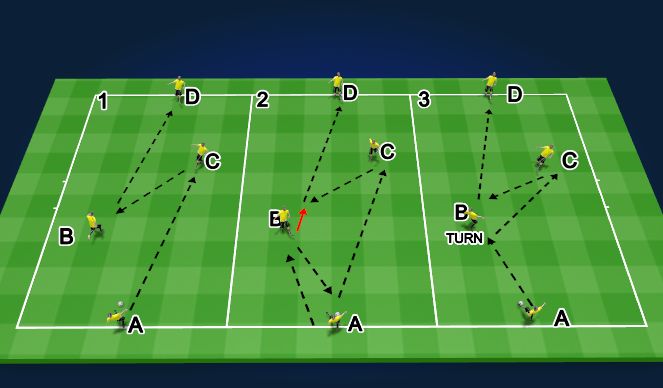
Organisation:
10x20 yards
3 groups of 4 players
1 ball per group
Rotate the middle pair with the outside players (1:30/2:00mins)
Session Info: Principle of Play/Topic Focus:
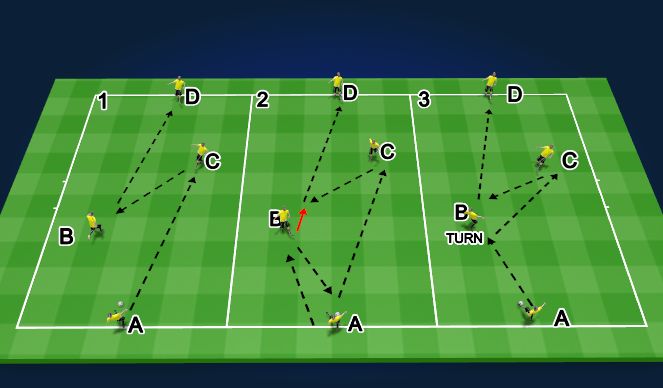
Breaking lines passing sequences; using a pass into feet> set > play forward to move the ball from one end to another end.
1: A passes to C > C sets B > B passes to D. Repeatfrom other end.
2: A makes a 1-2 with B > A passes into C > C sets B> B passes into D. Repeat from other end.
3: A passes to B > B turns out and makes a 1-2 with C> B passes into D. Repeat from other end.
Adaptations (Progressions & Regressions):
1 and 2: (P) limit the touches > touch control and pass> 1 touch constant flow. (R) no limit to touches or time on ball
3: as above but player A instructs B to turn or set or giveplayer B the decision making option (would need two touches to turn/open up!)
Challenges, Conditions or Targets:
Can the players limit their touches to play quicker?
Can the group keep the sequence going without mistakes (as unopposed)
Quality and speed of passing > increase as confidence improves
Encourage the middle pair not to be static, create different angles, comeshorter or drop off couple yars to change the distances of passes
Coaching Points (Mechanics of Technique):
Angle of approach and body position aligned to direction ofpass
Supporting foot set next to ball before pass
Weight and accuracy of pass (into feet!)
On toes to receive
Relaxed/cushioned control
Body position balance and set to receive
First touch/use of surface to receive in direction want tomake the pass
Prog 3 – ensure open body position and receive on back footto turn out and perform 1-2 set with partner
Possible Interventions and Tactical Points:
Player B/C movement to create angle to receive
Ensure player B/C movement not in the same line and creatingangle for next pass
Quality of pass key > needs to be accurate into feet and suitableweight to allow 1 touch/quick tempo to sequences.
Set/bounce pass will requireless weight on pass vs pass into the end men
Outside players need be on toes and willing to move left orright to offer a better angle depending on the movement within the inside pair.