


Football/Soccer Session (Difficult): Combo Play through the lines U17+
Profile Summary

| Name: | Christopher Ruiz |
|---|---|
| City: | Lutz |
| Country: | United States of America |
| Membership: | Adult Member |
| Sport: | Football/Soccer |

Description
PRINCIPLES OF PLAY
• Positioning between and behind opposition lines
• Diagonal passes to pull defenders out of position
• Up, back and through actions
PART 1: UNOPPOSED TECHNICAL WARM-UP
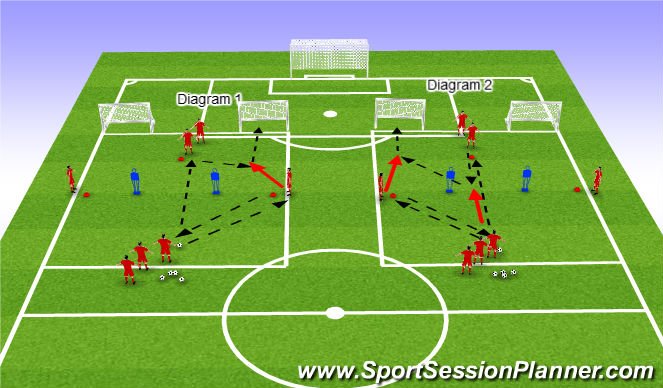
• This practice is an unopposed technical warm-up, laying down the foundation for up, back and throughs.
• The practice sees a group of 14 players split into two groups of seven.
PART 2: 4v4 +3 POSSESSION GAME
• This practice builds upon Part 1 by applying the up, back and through actions in a possession-based game.
• The practice sees a group of 11 players split into two teams of four and a group of three neutral players.
PART 3: 5+GK VS 5+GK +1 SMALL-SIDED GAME
• This is a small-sided-game in which there are conditions to apply the concepts from Parts 1 and 2 in a game situation.
• The practice sees a group of 13 players split into two teams of six (both including a goalkeeper) plus one neutral player
See the guidance at the top of this page to understand why you are not seeing interactive Football/Soccer images.
See the guidance at the top of this page to understand why you are not seeing interactive Football/Soccer images.
SSG 4v4 +3 Possession (20 mins)
FUNCTION
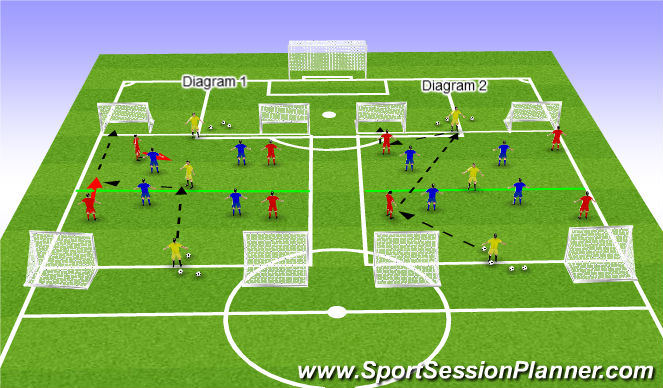
• This 4v4 +3 possession practice continues with the theme of up, back and through actions initiated in the unopposed technical warm-up.
• There are two halves of the playing area, each featuring two players for each team and one neutral player (C) at each end. A middle neutral player is free to move in both halves. • Each player is allowed a maximum of 3 touches.
• The neutral players in depth will be inside the game space, prioritising movements close to the end line to guarantee depth.
• There are three ways to score: 1) Connecting eight consecutive passes is worth 1 goal; 2) Scoring in one of the two mini-goals on the opposite side of the pitch after receiving a set in the defensive half and finishing within 2 touches (as pictured in Diagram 1) is worth two goals; 3) Scoring in one of the mini-goals after playing a direct pass from the defensive half into the furthest neutral player, then setting to a supporting player to finish within 2 touches (Diagram 2) is worth two goals.
• If the ball goes out of bounds, a new ball will begin with the opposite team in the opposite half.
• If a goal is scored in one of the mini-goals, a new ball will begin on the side the goal was scored but with the same team.
COACHING DETAIL: IN POSSESSION
BALL CIRCULATION
• Players should circulate the ball rapidly to force the opponent to move side to side in order to create space for the up, back and through actions.
• They should look to alternate quick passes with one touch, to move defenders, and retaining possession using the three touches, to commit defenders and open space elsewhere.
• Players should receive with a side-on body shape so they can play forward and be able to co-ordinate movements with teammates.
COMMUNICATION
• Use collective communication to help ball circulation, with shouts of “man on!” and arm movements pointing towards the free spaces to guarantee the next pass.
• The deeper neutral players will preferably lead communication for the team in possession, as they can see the whole playing area.
SUPPORTING MOVEMENTS
• All four players on the team in possession and neutral players must be ready to quickly change pace to offer support to receive the sets as a third man.
• They should time supporting movements for when the ball is travelling and the opponent losing visual awareness.
• If tightly marked, players should use their arms to create separation from the opponent and create space to receive.
OPEN PASSING LINES
• Players positioned above the ball must look to open passing lines into the far-side neutral player or one of the mini-goals.
• If the ball-carrier has time and space to play a pass or shot into depth, the players in the attacking half must reposition to move the defenders and open passing lines for the ball-carrier.
• After opening passing lines, the players must link supporting movements to receive and score or secure possession.
COACHING DETAIL: OFFENSIVE TRANSITION
• When possession is recovered, quickly secure it with the first pass and stretch the playing area as much as possible to establish possession.
COACHING DETAIL: MANAGING THE OPPOSITION
• Encourage aggressive defending to ensure constant pressure is on the ball-carrier.
• When possession is lost, apply a quick and aggressive defensive transition in order to recover the ball quickly
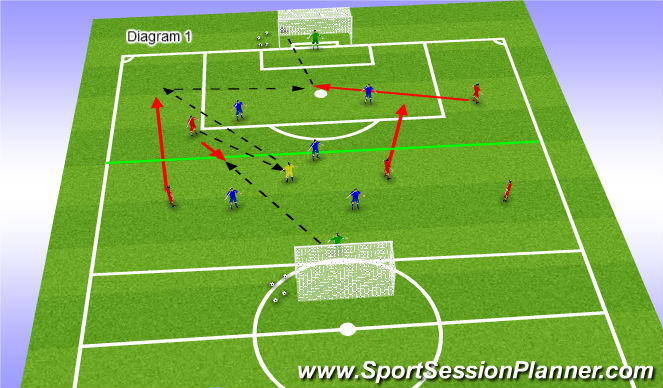
See the guidance at the top of this page to understand why you are not seeing interactive Football/Soccer images.
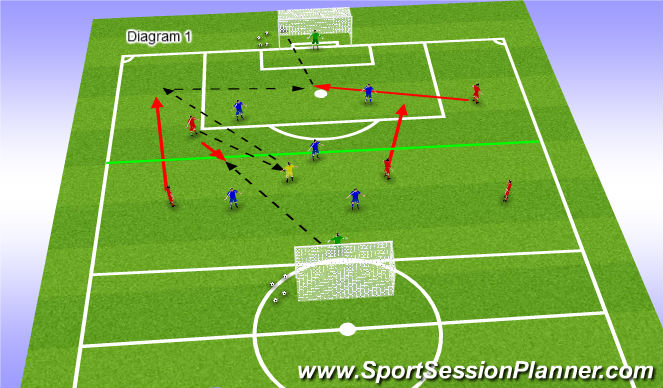
5v5 +Gks +1 (10 mins)
FUNCTION
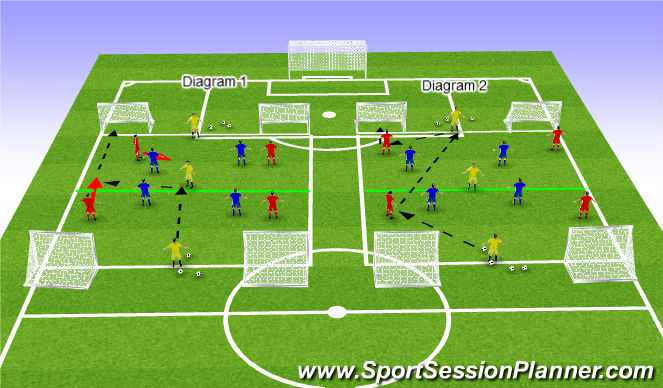
• This 5+GK vs 5+GK +1 small-sided game links together Parts 1 and 2 of the session.
• The game will have a natural flow to it, with the normal offside rule in effect.
• The neutral player (C) is allowed a maximum of 2 touches; everyone else has unlimited touches.
• There are three ways to score: 1) A regular goal is worth one goal; 2) Playing a pass to a teammate running in behind the defensive line and scoring within 2 touches (as in Diagram 1) is worth two goals; 3) An up, back and through action followed by an attacker finishing within 2 touches (Diagram 2) is worth three goals.
• If a goal is scored, a new ball begins with the goalkeeper of the team that scored.
• If the ball goes out of bounds, a new ball begins with the opposition goalkeeper
COACHING DETAIL: IN POSSESSION
BALL CIRCULATION
• Players should circulate the ball rapidly to force the opposition to move side to side in order to create space for the up, back and through actions.
• They should alternate quick passes with one touch, to move defenders, and retain possession using more touches, to commit defenders and open space elsewhere.
• Players should move and receive with a side-on body shape in order to see maximum space, play forward and co-ordinate movements with teammates.
COMMUNICATION
• Encourage collective communication to help the ball circulation by calling “man on!” and pointing towards the free spaces in order to guarantee the next pass. • Players in depth should lead communication, as they can see the whole playing area.
SUPPORTING MOVEMENTS
• All players on the team in possession – including the neutral player – must be ready to quickly change pace to offer support to receive the sets as a third man.
• They should time supporting movements for when the ball is travelling and the opponent losing visual awareness. If tightly marked, players should use their arms to create separation from the opponent and create space to receive.
RUNS IN BEHIND
• Players in depth should position on the back shoulder of the defensive line to open space in the middle and offer a threat to run in behind.
• The players in the forward line must time their movements in behind the defensive line, prioritising diagonal runs to receive close to the goal for scoring opportunities.
• Wide players on the opposite side of an attack must be ready to run in behind as the ball rotates from one side through the middle, to receive in behind or create space for a teammate to receive in width.
COACHING DETAIL: OFFENSIVE TRANSITION
• When possession is recovered, quickly secure it with the first pass and stretch the playing area as much as possible to establish possession.
COACHING DETAIL: MANAGING THE OPPOSITION
• Encourage aggressive defending to ensure constant pressure is on the ball-carrier.
• The defending team should hold a strong defensive line and co-ordinate the offside, using the halfway line as a reference.
• When possession is lost, apply a quick and aggressive defensive transition in order to recover the ball quickly
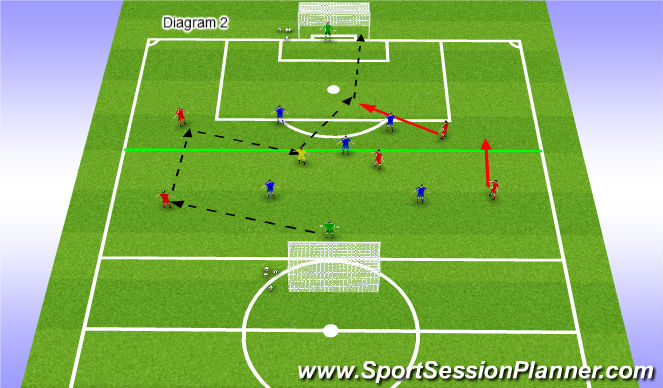
See the guidance at the top of this page to understand why you are not seeing interactive Football/Soccer images.
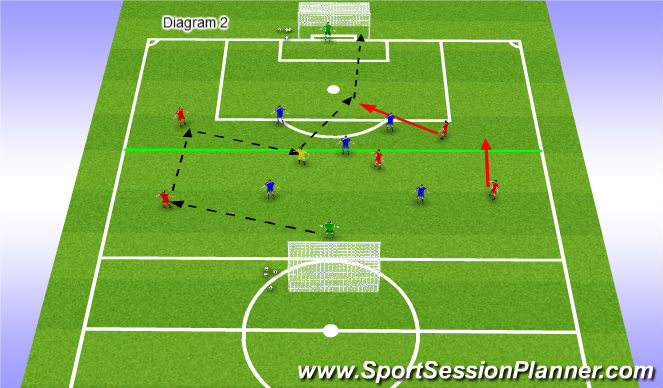
5v5 +Gks +1 (10 mins)
FUNCTION
• This 5+GK vs 5+GK +1 small-sided game links together Parts 1 and 2 of the session.
• The game will have a natural flow to it, with the normal offside rule in effect.
• The neutral player (C) is allowed a maximum of 2 touches; everyone else has unlimited touches.
• There are three ways to score: 1) A regular goal is worth one goal; 2) Playing a pass to a teammate running in behind the defensive line and scoring within 2 touches (as in Diagram 1) is worth two goals; 3) An up, back and through action followed by an attacker finishing within 2 touches (Diagram 2) is worth three goals.
• If a goal is scored, a new ball begins with the goalkeeper of the team that scored.
• If the ball goes out of bounds, a new ball begins with the opposition goalkeeper
COACHING DETAIL: IN POSSESSION
BALL CIRCULATION
• Players should circulate the ball rapidly to force the opposition to move side to side in order to create space for the up, back and through actions.
• They should alternate quick passes with one touch, to move defenders, and retain possession using more touches, to commit defenders and open space elsewhere.
• Players should move and receive with a side-on body shape in order to see maximum space, play forward and co-ordinate movements with teammates.
COMMUNICATION
• Encourage collective communication to help the ball circulation by calling “man on!” and pointing towards the free spaces in order to guarantee the next pass. • Players in depth should lead communication, as they can see the whole playing area.
SUPPORTING MOVEMENTS
• All players on the team in possession – including the neutral player – must be ready to quickly change pace to offer support to receive the sets as a third man.
• They should time supporting movements for when the ball is travelling and the opponent losing visual awareness. If tightly marked, players should use their arms to create separation from the opponent and create space to receive.
RUNS IN BEHIND
• Players in depth should position on the back shoulder of the defensive line to open space in the middle and offer a threat to run in behind.
• The players in the forward line must time their movements in behind the defensive line, prioritising diagonal runs to receive close to the goal for scoring opportunities.
• Wide players on the opposite side of an attack must be ready to run in behind as the ball rotates from one side through the middle, to receive in behind or create space for a teammate to receive in width.
COACHING DETAIL: OFFENSIVE TRANSITION
• When possession is recovered, quickly secure it with the first pass and stretch the playing area as much as possible to establish possession.
COACHING DETAIL: MANAGING THE OPPOSITION
• Encourage aggressive defending to ensure constant pressure is on the ball-carrier.
• The defending team should hold a strong defensive line and co-ordinate the offside, using the halfway line as a reference.
• When possession is lost, apply a quick and aggressive defensive transition in order to recover the ball quickly
'%3E%3Cpath id='path4169' d='M 11.4375,70.25 C 11.457031,38.394531 37.277344,13.242188 68.253906,13.050781 99.78125,12.855469 125.73047,38.351563 125.8125,70.078125 125.89844,101.62109 100.43359,127.14063 69.148438,127.42188 37.582031,127.70703 11.464844,102.23438 11.4375,70.25 m 6.425781,-0.08984 c 0.03516,28.421871 23.027344,50.69922 50.519532,50.82031 C 96.433594,121.10156 119.30469,98.367188 119.38281,70.359375 119.45313,42.878906 97.382813,19.714844 69.015625,19.496094 40.75,19.277344 17.964844,42.035156 17.863281,70.160156' style='clip-rule:nonzero;fill:%23333f48;fill-opacity:1;fill-rule:nonzero;stroke:none' /%3E%3Cpath style='fill:%23333f48;fill-opacity:1;fill-rule:nonzero;stroke:none' d='m 39.789063,108.62109 c 0.28125,0.14454 0.550781,0.32032 0.839843,0.4336 2.734375,1.05469 5.554688,1.78125 8.453125,2.23047 2.734375,0.42578 5.484375,0.64453 8.25,0.54297 3.988282,-0.15625 7.832032,-0.94922 11.445313,-2.69532 1.683594,-0.8164 3.246094,-1.82422 4.640625,-3.07422 3.265625,-2.92578 5.171875,-6.582027 5.796875,-10.906246 0.546875,-3.761719 0.04687,-7.425781 -1.09375,-11.019531 -1.4375,-4.523438 -3.730469,-8.582032 -6.703125,-12.265625 -1.03125,-1.277344 -2.082031,-2.535157 -3.113281,-3.808594 C 66.789063,66.1875 65.332031,64.269531 64.0625,62.21875 c -1.601562,-2.582031 -2.835937,-5.316406 -3.613281,-8.261719 -0.683594,-2.574218 -0.902344,-5.1875 -0.6875,-7.828125 0.214844,-2.617187 0.910156,-5.117187 2.152344,-7.441406 2.164062,-4.050781 5.503906,-6.710937 9.816406,-8.179687 1.890625,-0.640625 3.835937,-1.058594 5.832031,-1.195313 1.121094,-0.07813 2.242188,-0.152344 3.363281,-0.164062 4.28125,-0.02734 8.4375,0.734375 12.453125,2.175781 1.871094,0.671875 3.6875,1.496094 5.523438,2.257812 0.226562,0.09375 0.4375,0.230469 0.664062,0.351563 -0.164062,0.25 -0.371093,0.160156 -0.539062,0.164062 -2.824219,0.101563 -5.535156,0.703125 -8.132813,1.804688 -1.335937,0.570312 -2.570312,1.316406 -3.648437,2.296875 -2.527344,2.296875 -3.605469,5.15625 -3.34375,8.550781 0.140625,1.855469 0.722656,3.574219 1.550781,5.222656 0.648438,1.296875 1.414063,2.523438 2.292969,3.675782 0.953125,1.25 1.929687,2.484375 2.929687,3.699218 2.085938,2.523438 4.164063,5.054688 6.050782,7.738282 2.203125,3.136718 4.140627,6.417968 5.589847,9.980468 1.16406,2.867188 2.01562,5.820313 2.39843,8.894532 0.25,2.011718 0.30079,4.03125 0.11719,6.058593 -0.24219,2.640625 -0.79297,5.195313 -1.74609,7.667969 -1.29688,3.36328 -3.300784,6.22656 -5.972659,8.63281 -2.429687,2.19141 -5.171875,3.90625 -8.109375,5.3125 -2.695312,1.29297 -5.464843,2.40235 -8.34375,3.20313 -1.953125,0.54687 -3.945312,0.8789 -5.949218,1.15625 -3.035157,0.41797 -6.085938,0.48828 -9.132813,0.3125 -5.328125,-0.3125 -10.476562,-1.46094 -15.410156,-3.52344 -3.449219,-1.44141 -6.691406,-3.25781 -9.757813,-5.39453 -0.183593,-0.12891 -0.378906,-0.25 -0.53125,-0.41016 -0.07031,-0.0703 -0.05859,-0.22656 -0.08203,-0.34375 z m 0,0' id='path4175' /%3E%3Cpath style='fill:%23333f48;fill-opacity:1;fill-rule:nonzero;stroke:none' d='M 94.699219,29.390625 C 94.089844,29.21875 93.476563,29.054688 92.867188,28.875 90.183594,28.085938 87.46875,27.441406 84.703125,27.046875 c -3.976562,-0.566406 -7.945312,-0.59375 -11.863281,0.402344 -7.535156,1.914062 -12.386719,6.71875 -14.878906,13.996094 -0.894532,2.617187 -1.179688,5.328125 -0.953125,8.078125 0.203125,2.484375 0.867187,4.859375 1.816406,7.160156 0.933594,2.261719 2.117187,4.390625 3.4375,6.449219 1.4375,2.25 3.050781,4.371093 4.640625,6.511718 1.4375,1.933594 2.867187,3.871094 4.261719,5.835938 1.230468,1.730469 2.316406,3.546875 3.273437,5.445312 1.324219,2.625 2.265625,5.378907 2.703125,8.292969 0.433594,2.902344 0.292969,5.765625 -0.660156,8.5625 -0.9375,2.74609 -2.574219,5.00781 -4.777344,6.875 -2.417969,2.04688 -5.203125,3.39844 -8.246094,4.22266 -1.835937,0.5 -3.703125,0.75781 -5.609375,0.82031 -3.886718,0.13281 -7.679687,-0.47266 -11.421875,-1.46094 -2.261718,-0.59765 -4.488281,-1.33203 -6.695312,-2.11328 -0.207031,-0.0742 -0.40625,-0.16797 -0.597656,-0.25 -0.02344,-0.24609 0.148437,-0.19141 0.25,-0.20703 1.96875,-0.30469 3.921875,-0.67969 5.804687,-1.34766 1.367188,-0.48437 2.671875,-1.10156 3.855469,-1.94922 2.25,-1.61328 3.65625,-3.765621 4.0625,-6.515621 0.273437,-1.867188 0.09375,-3.710938 -0.429688,-5.527344 -0.472656,-1.648437 -1.171875,-3.199219 -2.109375,-4.628906 -0.792968,-1.207031 -1.636718,-2.382813 -2.523437,-3.519531 -0.921875,-1.195313 -1.921875,-2.328125 -2.890625,-3.484375 -2.753906,-3.273438 -5.351563,-6.660157 -7.523438,-10.355469 -2.042968,-3.480469 -3.667968,-7.136719 -4.597656,-11.078125 -0.640625,-2.699219 -0.980469,-5.4375 -0.832031,-8.214844 0.238281,-4.53125 1.476562,-8.78125 3.824219,-12.6875 1.082031,-1.800781 2.445312,-3.375 3.988281,-4.800781 2.742187,-2.527344 5.863281,-4.480469 9.257812,-5.992188 3.746094,-1.667968 7.652344,-2.769531 11.707032,-3.394531 3.152343,-0.488281 6.324218,-0.671875 9.507812,-0.519531 8.632813,0.410156 16.671875,2.792969 24,7.433594 0.08203,0.05078 0.152344,0.109375 0.230469,0.167968 -0.0039,0.04297 -0.0078,0.08984 -0.01563,0.136719' id='path4177' /%3E%3Cpath style='fill:%23333f48;fill-opacity:1;fill-rule:nonzero;stroke:none' d='m 31.699219,38.75 c -0.07813,0.238281 -0.152344,0.476563 -0.238281,0.710938 -1.460938,4.074218 -2.066407,8.28125 -1.808594,12.59375 0.4375,7.304687 2.808594,13.925781 7.277344,19.753906 3.714843,4.84375 7.441406,9.671875 11.167968,14.503906 1.113282,1.441406 1.953125,3.007813 2.414063,4.777344 0.332031,1.257812 0.425781,2.539062 0.273437,3.820312 -0.214843,1.832032 -1.070312,3.34375 -2.464843,4.546875 -0.984375,0.851559 -2.113282,1.449219 -3.316407,1.925779 -1.378906,0.54297 -2.8125,0.89063 -4.273437,1.1211 -2.226563,0.35547 -4.46875,0.46093 -6.722656,0.41015 -0.589844,-0.0156 -1.046875,-0.18359 -1.433594,-0.625 -0.636719,-0.72265 -1.335938,-1.39062 -1.9375,-2.14062 C 25.574219,93.800781 22.300781,86.621094 20.84375,78.636719 20.152344,74.835938 19.917969,71 20.15625,67.128906 20.796875,56.773438 24.390625,47.574219 30.859375,39.480469 c 0.21875,-0.273438 0.453125,-0.53125 0.679688,-0.796875 0.05469,0.02344 0.109375,0.04297 0.160156,0.06641' id='path4179' /%3E%3Cpath style='fill:%23333f48;fill-opacity:1;fill-rule:nonzero;stroke:none' d='m 105.41016,101.30078 c -0.13282,-0.3125 0.0234,-0.5039 0.0977,-0.69922 1.38672,-3.749997 1.98047,-7.628904 1.89844,-11.621091 -0.14453,-6.84375 -2.08594,-13.144531 -5.73437,-18.925781 C 99.890625,67.226563 97.917969,64.53125 95.835938,61.917969 94.4375,60.160156 92.988281,58.4375 91.582031,56.6875 90.632813,55.511719 89.6875,54.335938 88.792969,53.121094 c -0.835938,-1.144531 -1.488281,-2.398438 -1.953125,-3.742188 -0.523438,-1.515625 -0.695313,-3.070312 -0.511719,-4.652343 0.21875,-1.839844 1.082031,-3.339844 2.476563,-4.542969 1.039062,-0.890625 2.230468,-1.507813 3.503906,-1.980469 1.632812,-0.609375 3.320312,-0.960937 5.046875,-1.175781 1.917969,-0.238281 3.839841,-0.269531 5.769531,-0.230469 0.52734,0.01172 0.89453,0.203125 1.23828,0.585938 5.50391,6.113281 9.26172,13.144531 11.21875,21.132812 1.11719,4.554688 1.5625,9.179688 1.30469,13.855469 -0.58203,10.625 -4.23438,20.082031 -10.96094,28.339846 -0.15625,0.1914 -0.32812,0.375 -0.51562,0.58984' id='path4181' /%3E%3Cpath style='fill:%23333f48;fill-opacity:1;fill-rule:nonzero;stroke:none' d='m 39.796875,108.63281 c -0.05859,0.0117 -0.117187,0.0234 -0.175781,0.0352 0.05469,-0.0156 0.113281,-0.0312 0.167969,-0.0469 z m 0,0' id='path4183' /%3E%3C/g%3E%3C/svg%3E)
 Play animation
 Play step-by-step
 Repeat (toggle)
 Full Screen
 Pause
Pause Stop
Stop
Technical warm up unnopposed (10 mins)
FUNCTION
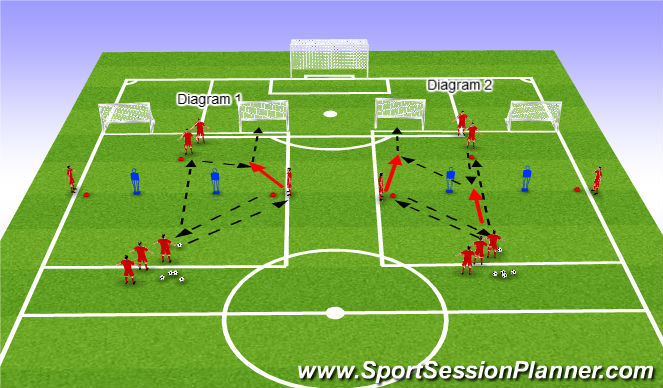
• The unopposed technical warm-up begins as pictured in Diagram 1.
• The first technical pattern will follow the pattern illustrated in Diagram 1.
• After one repetition is completed on the right side – involving players stationed at Cones 1, 2 and 3 – a new ball will begin going to the left side, with the player at Cone 4 now in play rather than the player at Cone 3. This alternating will continue for the duration of the practice.
• In the second block, the technical pattern in Diagram 2 will be implemented, again alternating both sides of the diamond.
• In both variations, the actions are complete when the player from Cone 3 or Cone 4 finishes in the mini-goal on their side of the playing area.
• The players will rotate according to cone number – so 1-2-3-4.
• For both variations, the objective is for the players at Cone 2 and Cone 3/4 to use one touch. The player at Cone 1 will use two touches when initiating a pass into the player at Cone 2
COACHING DETAIL: TECHNICAL
TIMING OF MOVEMENTS
• The players positioned on Cones 2 and 3/4 must use two movements to ‘unmark’ themselves from the cone.
• They will initiate the ‘unmarking’ by moving two steps away from the ball and quickly changing pace to support and set.
• The player on Cone 2 will begin the unmarking action as the ball is travelling back from Cone 3/4 to Cone 1, and quickly move to offer support in front of the cone as the player on Cone 1 lifts their head up.
• The player on Cone 3/4 will quickly change pace to offer support underneath the player on Cone 2 as the ball is traveling from Cone 1 to Cone 2.
WEIGHT & ACCURACY OF PASS
• When the player at Cone 1 is passing into players at Cones 2 and 3/4, they should aim for a crisp pass on the ground, being played to the foot further away from the defender.
• The ‘sets’ must be at a weight that allows the ball to continue to move at a good rhythm, as well as allowing the player to make the next action (whether the next pass or finish into a mini-goal) cleanly.
COMMUNICATION
• Players should use quick and simple forms of communication in the passing actions to act as a foundation for the possession and small-sided games to come. For example, say “man on!” when wanting to receive a one-touch set backwards.
• Also, the player at Cone 1 should use non-verbal communication as the ball is travelling into the player at Cone 2 by pointing towards the direction the ball should be set to for the third man