
Football/Soccer Session (Academy Sessions): U14 Session Coach Mahmoud and Coach Moaaz (Start Time: 2025-10-23 16:45:00)

Evolution Sports Academy
Rafael zeitouni

Description
Session Objective:
To develop the team’s tactical understanding of positional play, focusing on maintaining width and depth in possession, and transitioning effectively between the build-up, attacking, and defensive phases.
The session also aims to enhance players’ aerobic and anaerobic capacity through integrated physical conditioning within game-related contexts.
Players:
Age Group: U14
Total: 18 players (16 outfield + 2 goalkeepers)
Organized in 9v9 format for tactical and game phases.
Equipment Required:
10–12 footballs (size 5)
Cones and flat markers (to divide zones and running lanes)
2 full-size goals + 2 mini goals
Bibs (two colors)
Whistle and stopwatch
Training poles (optional for reaction and conditioning drills)
Water supply for hydration
GPS or heart-rate monitors (optional for load monitoring)
See the guidance at the top of this page to understand why you are not seeing interactive Football/Soccer images.
See the guidance at the top of this page to understand why you are not seeing interactive Football/Soccer images.

Possession Game: Width & Depth by Lines (10 mins)
⚽ Possession Game: Width & Depth by Lines
Objective:
To develop the principles of Width and Depth during possession,
and to improve collective defending as one compact line.
Duration:
⏱️ 7 minutes – immediately after warm-up.
Organization / Set-Up:
Total players: 18 (9v9)
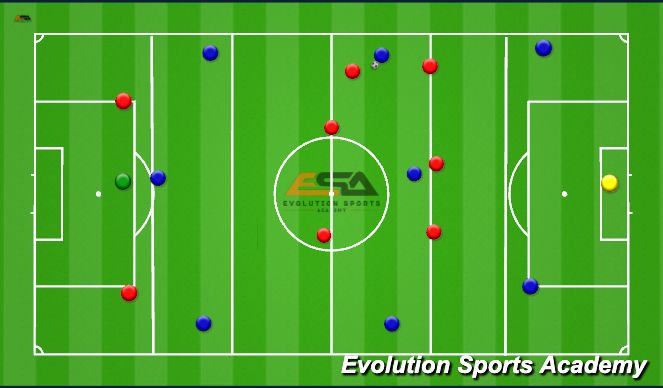
Divide the pitch into 3 horizontal lines (zones):
Defensive line (3 players)
Midfield line (3 players)
Attacking line (3 players)
Each line from Team A faces the corresponding line from Team B.
Each line has a marked zone (approx. 10–12m depth × 25–30m width).
Coach positioned outside with supply of balls to keep play continuous.
2–3 mini goals (optional) behind the last lines for direction or scoring incentive.
Rules of the Game:
The ball must progress line by line (defense → midfield → attack) using controlled passes.
Players must maintain width (using full width of the zone) and depth (staggered positioning).
Defending team presses collectively as one line, trying to win the ball and counter.
Upon recovery, the team must circulate the ball back through their lines to earn 1 point.
Limited touches (2 max) to encourage quick decision-making.
Offside and rotation rules can be adapted depending on the players’ level.
Coaching Points:
Width: Use the entire space between sidelines to stretch the opposition.
Depth: One player always provides forward support, another provides backward support.
Body shape: Always open to see both ball and next line.
Support angles: Constant adjustment between horizontal and diagonal options.
Defensive phase:
Line moves together as a unit.
Distance between lines must remain compact (8–10m).
Pressure–cover–balance coordination.
Communication & scanning before receiving.
Progressions:
Add a neutral player (joker) between lines to create overload (10v9).
Allow players to rotate lines after each attack to improve positional understanding.
Add directional goals (score after full progression from back to front).
Introduce time limit per possession (e.g., 10 seconds to reach next line).
See the guidance at the top of this page to understand why you are not seeing interactive Football/Soccer images.
build UP - Possession , low block middle block (15 mins)
Part 2 – Tactical Game: Transition from Build-Up to Possession in the Opponent’s Half
Age Group: U14 & U12
Format: 9-a-side (8 + GK)
Duration: 20 minutes
Area: Half-pitch (approx. 60×50 m for U14, 50×40 m for U12)
Objective:
Improve the team’s ability to transition effectively from the build-up phase to sustained possession in the opponent’s half while maintaining compact structure and balance.
Set Up
2 teams of 9 players (8 + GK).
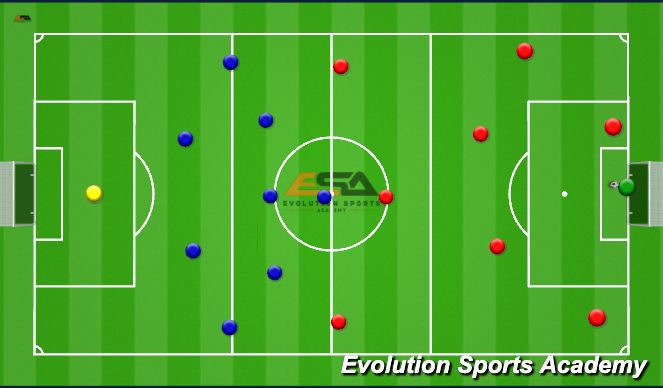
Field divided into three zones using cones:
Build-up Zone (Defensive third)
Middle Zone (Transition area)
Attacking Zone (Opponent’s half)
Each team plays out from their goalkeeper to build through the thirds.
Regular goals used.
Coach starts play with the goalkeeper.
Organisation
Teams begin from their build-up zone, aiming to progress through the thirds using coordinated movement and support.
Once the team enters the opponent’s half, they must keep possession for at least 10 seconds before trying to score — this reinforces control and patience in advanced areas.
Losing possession triggers immediate defensive transition (counter-press).
Restart from the goalkeeper after each goal or ball out.
Coaching Points
✅ Compact structure and angles in the build-up phase.
✅ Midfielders’ timing and positioning to create passing lanes.
✅ Quick transition mentality — from “secure build-up” to “attack with purpose.”
✅ Maintain width and depth in the attacking phase.
✅ First touch forward and quick recognition of space.
✅ Immediate reaction after losing the ball (counter-press).
✅ Communication, scanning, and positional awareness.
Progressions
Limit number of passes in each third (e.g., 5 passes max before progressing).
Add neutral players in the middle zone to aid link-up play.
Award extra points for goals scored within 10 seconds after entering the opponent’s half.
Restart each attack from the goalkeeper under pressure (coach feed or opposition press).
Reduce pitch width slightly to increase compactness and transition speed.
See the guidance at the top of this page to understand why you are not seeing interactive Football/Soccer images.
counter Press (15 mins)
Part 3 – Transition to Defensive Phase (Counter-Pressing Reaction Game)
Age Group: U14 & U12
Format: 9-a-side (8 + GK)
Duration: 15–20 minutes
Area: Half pitch (approx. 60 × 50 m U14 / 50 × 40 m U12)
Objective:
Develop team understanding and reaction when losing possession — applying immediate counter-pressing (defensive transition) to recover the ball as quickly as possible.
Set Up
Same 9-a-side teams from previous game.
Normal goals with goalkeepers.
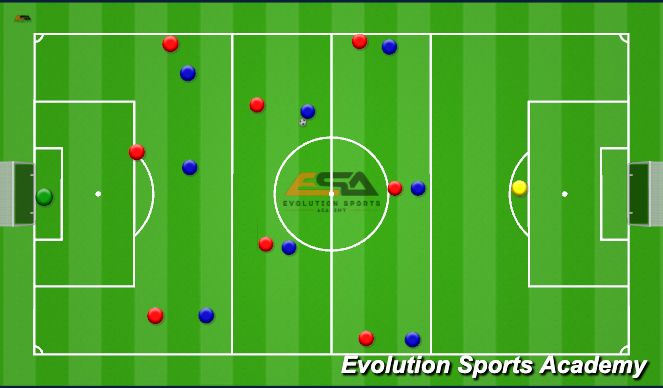
Divide the field again into two main zones:
Possession zone (attacking half)
Defensive transition zone (middle + defensive third)
Coach feeds the ball alternately to both teams to start play from midfield or attacking areas.
Organisation
Teams play a possession-based game aiming to build attacks.
When possession is lost, the team must immediately react by closing the ball carrier, blocking passing lanes, and pressing collectively to win the ball back within 6 seconds (Rule of 6).
If they win the ball back inside 6 seconds → +1 bonus point / immediate attack.
If they fail → opponent gets free build-up play for 10 seconds.
Coach resets play quickly to maintain tempo and repetition.
Coaching Points
✅ Immediate reaction after losing possession — “Don’t switch off.”
✅ Closest player presses, second provides cover, third blocks passing line.
✅ Compact team shape — squeeze towards the ball.
✅ Communication: trigger words (“Press!”, “Cover!”, “Close!”).
✅ Body orientation toward the ball and passing options.
✅ Aggression and speed in first 3–4 seconds after loss.
✅ If ball is not recovered, quickly reorganize into defensive block.
Progressions
Limit recovery time → 5 seconds instead of 6.
Award extra points for regaining the ball and scoring within 8 seconds.
Start plays with uneven possession (e.g., 5v4) to stress transitions.
Add neutral players for quicker overload decisions.
Vary starting zones (wide areas, central, near goal) to simulate match situations.
Coaching Focus Summary
Physical: High-intensity repeated efforts.
Tactical: Compactness + coordinated pressing triggers.
Psychological: Immediate mindset switch (“We lose it → We press”).
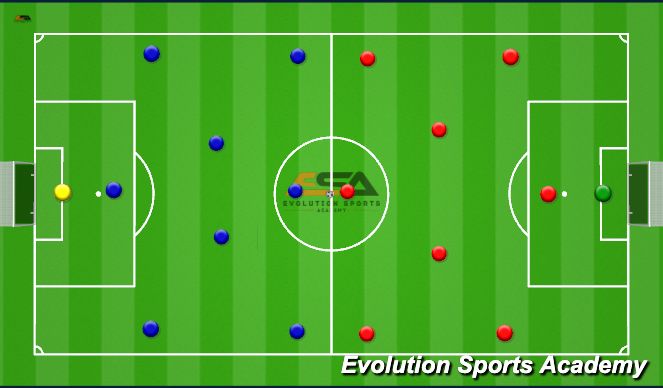
See the guidance at the top of this page to understand why you are not seeing interactive Football/Soccer images.
match time 20 Min (20 mins)
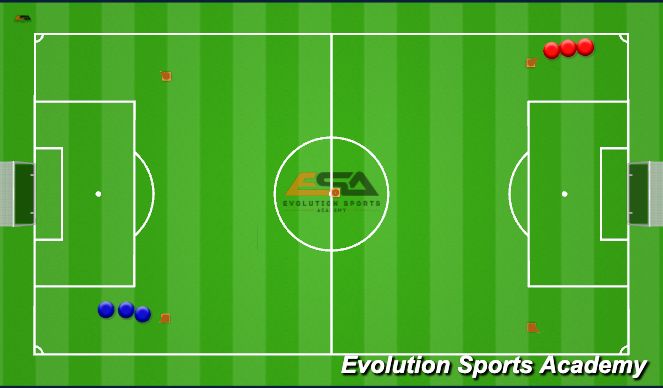
See the guidance at the top of this page to understand why you are not seeing interactive Football/Soccer images.
fartlek Train (10 mins)
Conditioning Phase: Variable Speed Runs (10 minutes)
Objective:
To develop both aerobic (القدرات الهوائية) and anaerobic (القدرات اللاهوائية) endurance through variable-speed running patterns at controlled intensity.
Duration:
⏱️ 10 minutes continuous or interval-based work.
Organization / Set-Up:
Area: Running lanes or along one side of the pitch (60–80 meters).
Players grouped in pairs or small groups (4–6 per lane).
Cones mark each 10–20m section to define pace changes.
Coach controls tempo using whistle or verbal cues (“Jog – Run – Sprint”).
Structure / Format:
Total Time: 10 minutes
Work/Rest Pattern:
30 sec jog (60%)
20 sec run (80%)
10 sec sprint (100%)
30 sec active recovery (walk or slow jog)
Repeat for 5 full cycles (2 minutes per cycle).
Focus Points:
✅ Maintain running technique (relaxed upper body, forward lean, efficient arm drive).
✅ Encourage progressive intensity increase through each cycle.
✅ Reinforce active recovery between efforts — avoid full stop.
✅ Monitor players’ heart rate zones if possible (target 75–90% HR max).
✅ Promote awareness of effort control and breathing rhythm.
Coaching Emphasis:
“Recover while moving.”
“Sprint sharp, recover smart.”
“Stay compact and technically clean even at high intensity.”
Progressions:
Increase to 6–7 cycles (12–14 minutes) for advanced players.
Add ball-carrying sprints to integrate physical + technical load.
Reduce recovery time to 20s for higher anaerobic demand.
Pair players to create competitive runs (visual motivation).

 Play animation
 Play step-by-step
 Repeat (toggle)
 Full Screen
 Pause
Pause Stop
Stop
Warm up Reaction time and Reaction Speed (5 mins)
THE SESSION:
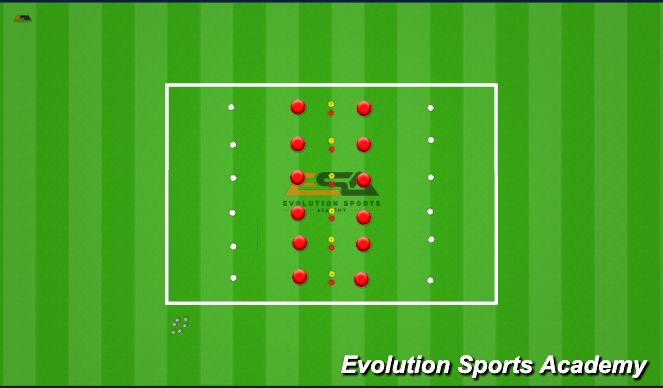
Cone Reaction Game (7 minutes)
PROGRESSIONS:
- Once physically prepared, consider mental warm up to include opposite movements as well. Left = Right, Right = Left, Up = back, Back = Up, colours are also opposite
Explanation: https://drive.google.com/file/d/1JoLu8fQxztWVFmmLqcH5MuYKH5Wyj9O8/view?usp=sharingDemonstration: https://drive.google.com/file/d/1gJxZ4WNJGqgqO5erCJV74ojzfbTLt-eB/view?usp=sharing
Ball manipulation (3 minutes)