


Football/Soccer Session (Academy Sessions): Receiving/Playing Under Pressure + Creating Overloads to Reduce Pressure


FAW Coach Ed
Aaron Jones
Profile Summary

| Name: | Aaron Jones |
|---|---|
| City: | CRANBOURNE NORTH |
| Country: | Australia |
| Membership: | Adult Member |
| Sport: | Football/Soccer |

Description
Session Objectives:
Technical
1) In this session I aim to - help improve players technical approach to passing and receiving the ball while under pressure.
Are they utilising the right mechanics to be able to receive the ball on their back foot and face forwards and successfully complete the next pass to a teammate?
2) (Secondary) In this session I aim to - help improve players technical approach to applying pressure to the ball.
Are players closing down the space at speed and forcing defenders one way to cause mistakes or a poor first touch?
Tactical
1) In this session I aim to - help improve players awareness of when to create an overload to relieve pressure on teammates and retain possession of the ball.
Are players scanning the pitch to recgonise where a numerical advantage is needed to retain possession and play out of pressure? Are they using different forms of mobility to affect a space?
BP Principles:
Penetration
Action - Passing
BPO Principles:
Pressure/Delay
Action - Acceleration/Deceleration, Jockeying
See the guidance at the top of this page to understand why you are not seeing interactive Football/Soccer images.
See the guidance at the top of this page to understand why you are not seeing interactive Football/Soccer images.
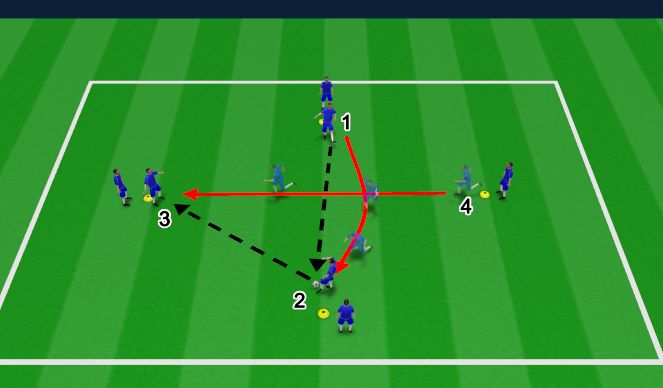
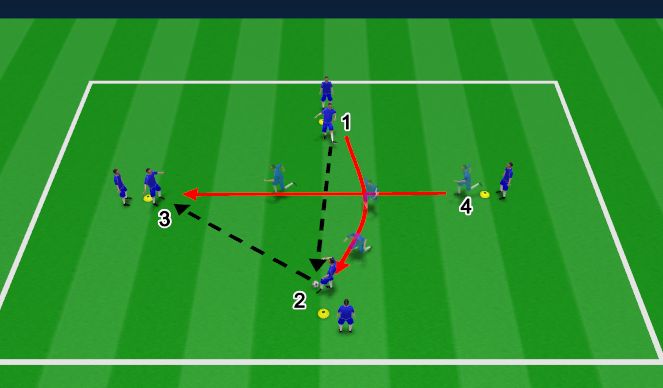
Applying Pressure to the ball - 'React & Press' (Work:Rest 2:1) (10 mins)
Description:
This exercise is designed to help players take their first touch out of pressure and into space in a more realistic scenario of being pressed by an opposition player. It will challenge players receiving the pass to be aware of where they are receiving the pass from and how to position their body to take a touch away from the defender and into space. It will also challenge teammates to communicate who the pressing player should be. (The first pass starts from the center of the area and then play continues) Player 1 passes across the grid and presses the player with the ball, player 2 upon receiving the pass takes a touch on their back foot and can play a pass to their left or right, once the pass is played the player on the opposite side of the receiver will always press the ball. After each pass follow your pass and after each press, follow your press.
Technique(s):
Scanning - are players checking to their left or right as the ball is in play to identify where the next pass/press is coming from to proactively position themselves to take a positive first touch?
Receiving - are players able to take their first away from the press? (Consider body shape, hips open or closed, back foot, active on toes, first touch)
Passing - are players using the instep to play an accurate pass to teammates feet? (Consider body shape, hips open or closed, follow through, contact point on ball)
Pressing - are players applying pressure to the ball to affect the first touch of receiving player? (acceleration, point of deceleration, angle of press, distance to engage)
Measurements:
Adaptations (Progressions & Regressions):
Progression 1
Players press only passively.
Progression 2
Allow players to press to win the ball instead of passive defending to make it more game like in applying the skill or must only take max 2 touches.
Regression
Increase the space between the mannequins or cones to allow the players more time before being pressed.
Considerations:
To maximise the effectiveness of this exercise we must ensure the intensity of the press is high so players can emulate playing under pressure, adjust the distance between cones to be shorter to maximise repetition of exercise and/or shorten the length of working time to rest time if necessary.
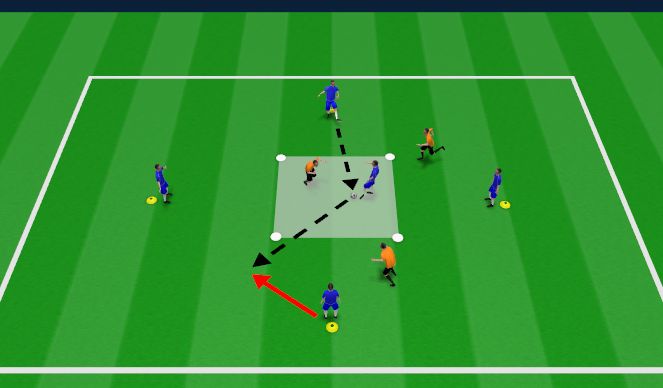
See the guidance at the top of this page to understand why you are not seeing interactive Football/Soccer images.
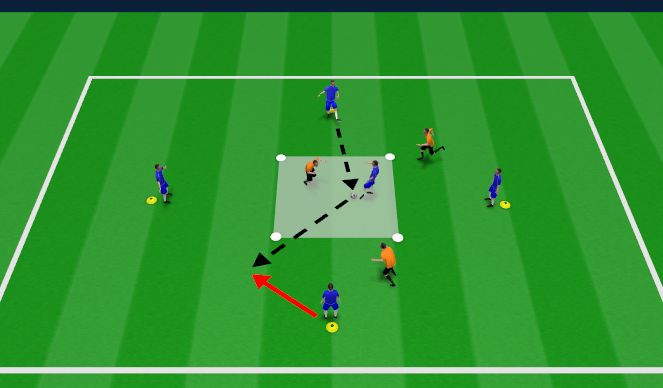
Decison Making Under Pressure - 'Find the free player' (Work:Rest - 3:1) (20 mins)
Description:
This exercise is designed simulate a game scenario where there is pressure in a small area but, players can use the techniques in previous drills (scanning, first touch, accurate passing etc.) plus and overload to play out of pressure and advance the ball forward in a game. The team in possession must keep the ball away from the pressing team. The players in possession (blue) on the outside can only move laterally between the cones while the player centrally can move anywhere within the central box. The pressing team (orange are free to move anywhere within the larger area but only one at a time can press in the smaller zone. Blues score a point for every 6 passes, if orange win the ball they must take the ball to the central area and make 5 passes for a point.
Technique(s):
Support - are players on the outside constantly active to provide a supporting angle for the player under pressure to find an outlet?
Scanning - are players checking to their left or right or over shoulder as the ball is in play to identify where the next pass/press is coming from to proactively position themselves to take a positive first touch?
Passing - are players using the instep to play an accurate pass to teammates feet? (Consider body shape, hips open or closed, follow through, contact point on ball)
Receiving - are players able to take their first touch forwards to avoid press? (Consider body shape, hips open or closed, back foot, active on toes, first touch)
Pressing - are players applying pressure to the ball to affect the first touch of receiving player? (acceleration, point of deceleration, angle of press, distance to engage)
Measurements:
Adaptations (Progressions & Regressions):
Progression 1
Modify number of touches for possession team (outside players unlimited and central player 3 touches for example, to challenge them to play quicker, or allow 2 pressing in central area
Progression 2
Modify teams to 4x4 to create 1v1 pressing scenarios to encourage/challenge more movement off the ball when under pressure.
Regression
Modify teams to 6v2 if there is minimal success (consider smaller area if so)
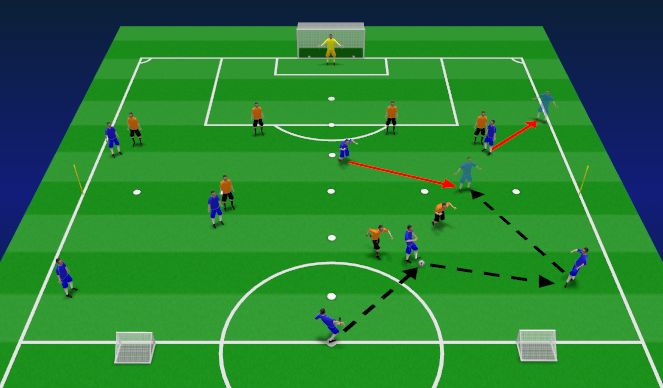
See the guidance at the top of this page to understand why you are not seeing interactive Football/Soccer images.
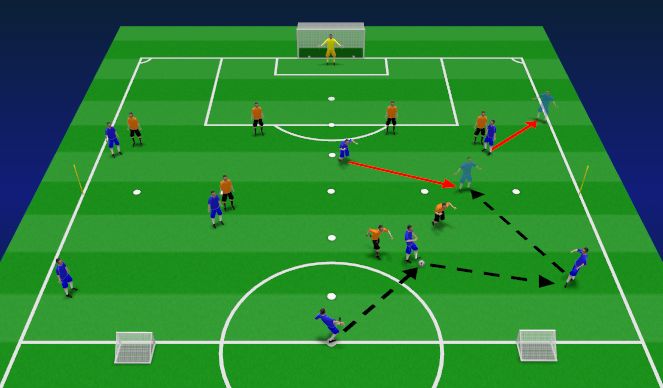
Training Game - 'Four Quater Football' (Overloads to play forwards) (35 mins)
Description:
This training game is designed to help players combine techniques and apply them in a game simulation. The pitch is divided into quarters to encourage players to use overloads as well as learned techniques to play out of pressure and advance the ball forwards. The defending team can only have two players press in a quarter that the ball is in, while attacking team is free to move anywhere (but encouraged to make each quarter minimum 3v2). If the defending teams win possession and score in mini goal swap the team that starts in possession.
Technique(s):
Mobility - are players utilising overlaps, underlaps, 3rd man runs, double movements etc to create overloads to allow their team to play forwards or out of pressure?
Support - are players on the outside constantly active to provide a supporting angle for the player under pressure to find an outlet?
Scanning - are players checking to their left or right or over shoulder as the ball is in play to identify where the next pass/press is coming from to proactively position themselves to take a positive first touch?
Passing - are players using the instep to play an accurate pass to teammates feet? (Consider body shape, hips open or closed, follow through, contact point on ball)
Receiving - are players able to take their first touch forwards to avoid press? (Consider body shape, hips open or closed, back foot, active on toes, first touch)
Pressing - are players applying pressure to the ball to affect the first touch of receiving player? (acceleration, point of deceleration, angle of press, distance to engage)
Measurements:
Adaptations (Progressions & Regressions):
If there is a lot of success, transition into a normal 8v7 game, if players are having moderate success slowly increase the number of players allowed to press in each quarter, if there is little to no success keep at 2 players pressing per grid.
'%3E%3Cpath id='path4169' d='M 11.4375,70.25 C 11.457031,38.394531 37.277344,13.242188 68.253906,13.050781 99.78125,12.855469 125.73047,38.351563 125.8125,70.078125 125.89844,101.62109 100.43359,127.14063 69.148438,127.42188 37.582031,127.70703 11.464844,102.23438 11.4375,70.25 m 6.425781,-0.08984 c 0.03516,28.421871 23.027344,50.69922 50.519532,50.82031 C 96.433594,121.10156 119.30469,98.367188 119.38281,70.359375 119.45313,42.878906 97.382813,19.714844 69.015625,19.496094 40.75,19.277344 17.964844,42.035156 17.863281,70.160156' style='clip-rule:nonzero;fill:%23333f48;fill-opacity:1;fill-rule:nonzero;stroke:none' /%3E%3Cpath style='fill:%23333f48;fill-opacity:1;fill-rule:nonzero;stroke:none' d='m 39.789063,108.62109 c 0.28125,0.14454 0.550781,0.32032 0.839843,0.4336 2.734375,1.05469 5.554688,1.78125 8.453125,2.23047 2.734375,0.42578 5.484375,0.64453 8.25,0.54297 3.988282,-0.15625 7.832032,-0.94922 11.445313,-2.69532 1.683594,-0.8164 3.246094,-1.82422 4.640625,-3.07422 3.265625,-2.92578 5.171875,-6.582027 5.796875,-10.906246 0.546875,-3.761719 0.04687,-7.425781 -1.09375,-11.019531 -1.4375,-4.523438 -3.730469,-8.582032 -6.703125,-12.265625 -1.03125,-1.277344 -2.082031,-2.535157 -3.113281,-3.808594 C 66.789063,66.1875 65.332031,64.269531 64.0625,62.21875 c -1.601562,-2.582031 -2.835937,-5.316406 -3.613281,-8.261719 -0.683594,-2.574218 -0.902344,-5.1875 -0.6875,-7.828125 0.214844,-2.617187 0.910156,-5.117187 2.152344,-7.441406 2.164062,-4.050781 5.503906,-6.710937 9.816406,-8.179687 1.890625,-0.640625 3.835937,-1.058594 5.832031,-1.195313 1.121094,-0.07813 2.242188,-0.152344 3.363281,-0.164062 4.28125,-0.02734 8.4375,0.734375 12.453125,2.175781 1.871094,0.671875 3.6875,1.496094 5.523438,2.257812 0.226562,0.09375 0.4375,0.230469 0.664062,0.351563 -0.164062,0.25 -0.371093,0.160156 -0.539062,0.164062 -2.824219,0.101563 -5.535156,0.703125 -8.132813,1.804688 -1.335937,0.570312 -2.570312,1.316406 -3.648437,2.296875 -2.527344,2.296875 -3.605469,5.15625 -3.34375,8.550781 0.140625,1.855469 0.722656,3.574219 1.550781,5.222656 0.648438,1.296875 1.414063,2.523438 2.292969,3.675782 0.953125,1.25 1.929687,2.484375 2.929687,3.699218 2.085938,2.523438 4.164063,5.054688 6.050782,7.738282 2.203125,3.136718 4.140627,6.417968 5.589847,9.980468 1.16406,2.867188 2.01562,5.820313 2.39843,8.894532 0.25,2.011718 0.30079,4.03125 0.11719,6.058593 -0.24219,2.640625 -0.79297,5.195313 -1.74609,7.667969 -1.29688,3.36328 -3.300784,6.22656 -5.972659,8.63281 -2.429687,2.19141 -5.171875,3.90625 -8.109375,5.3125 -2.695312,1.29297 -5.464843,2.40235 -8.34375,3.20313 -1.953125,0.54687 -3.945312,0.8789 -5.949218,1.15625 -3.035157,0.41797 -6.085938,0.48828 -9.132813,0.3125 -5.328125,-0.3125 -10.476562,-1.46094 -15.410156,-3.52344 -3.449219,-1.44141 -6.691406,-3.25781 -9.757813,-5.39453 -0.183593,-0.12891 -0.378906,-0.25 -0.53125,-0.41016 -0.07031,-0.0703 -0.05859,-0.22656 -0.08203,-0.34375 z m 0,0' id='path4175' /%3E%3Cpath style='fill:%23333f48;fill-opacity:1;fill-rule:nonzero;stroke:none' d='M 94.699219,29.390625 C 94.089844,29.21875 93.476563,29.054688 92.867188,28.875 90.183594,28.085938 87.46875,27.441406 84.703125,27.046875 c -3.976562,-0.566406 -7.945312,-0.59375 -11.863281,0.402344 -7.535156,1.914062 -12.386719,6.71875 -14.878906,13.996094 -0.894532,2.617187 -1.179688,5.328125 -0.953125,8.078125 0.203125,2.484375 0.867187,4.859375 1.816406,7.160156 0.933594,2.261719 2.117187,4.390625 3.4375,6.449219 1.4375,2.25 3.050781,4.371093 4.640625,6.511718 1.4375,1.933594 2.867187,3.871094 4.261719,5.835938 1.230468,1.730469 2.316406,3.546875 3.273437,5.445312 1.324219,2.625 2.265625,5.378907 2.703125,8.292969 0.433594,2.902344 0.292969,5.765625 -0.660156,8.5625 -0.9375,2.74609 -2.574219,5.00781 -4.777344,6.875 -2.417969,2.04688 -5.203125,3.39844 -8.246094,4.22266 -1.835937,0.5 -3.703125,0.75781 -5.609375,0.82031 -3.886718,0.13281 -7.679687,-0.47266 -11.421875,-1.46094 -2.261718,-0.59765 -4.488281,-1.33203 -6.695312,-2.11328 -0.207031,-0.0742 -0.40625,-0.16797 -0.597656,-0.25 -0.02344,-0.24609 0.148437,-0.19141 0.25,-0.20703 1.96875,-0.30469 3.921875,-0.67969 5.804687,-1.34766 1.367188,-0.48437 2.671875,-1.10156 3.855469,-1.94922 2.25,-1.61328 3.65625,-3.765621 4.0625,-6.515621 0.273437,-1.867188 0.09375,-3.710938 -0.429688,-5.527344 -0.472656,-1.648437 -1.171875,-3.199219 -2.109375,-4.628906 -0.792968,-1.207031 -1.636718,-2.382813 -2.523437,-3.519531 -0.921875,-1.195313 -1.921875,-2.328125 -2.890625,-3.484375 -2.753906,-3.273438 -5.351563,-6.660157 -7.523438,-10.355469 -2.042968,-3.480469 -3.667968,-7.136719 -4.597656,-11.078125 -0.640625,-2.699219 -0.980469,-5.4375 -0.832031,-8.214844 0.238281,-4.53125 1.476562,-8.78125 3.824219,-12.6875 1.082031,-1.800781 2.445312,-3.375 3.988281,-4.800781 2.742187,-2.527344 5.863281,-4.480469 9.257812,-5.992188 3.746094,-1.667968 7.652344,-2.769531 11.707032,-3.394531 3.152343,-0.488281 6.324218,-0.671875 9.507812,-0.519531 8.632813,0.410156 16.671875,2.792969 24,7.433594 0.08203,0.05078 0.152344,0.109375 0.230469,0.167968 -0.0039,0.04297 -0.0078,0.08984 -0.01563,0.136719' id='path4177' /%3E%3Cpath style='fill:%23333f48;fill-opacity:1;fill-rule:nonzero;stroke:none' d='m 31.699219,38.75 c -0.07813,0.238281 -0.152344,0.476563 -0.238281,0.710938 -1.460938,4.074218 -2.066407,8.28125 -1.808594,12.59375 0.4375,7.304687 2.808594,13.925781 7.277344,19.753906 3.714843,4.84375 7.441406,9.671875 11.167968,14.503906 1.113282,1.441406 1.953125,3.007813 2.414063,4.777344 0.332031,1.257812 0.425781,2.539062 0.273437,3.820312 -0.214843,1.832032 -1.070312,3.34375 -2.464843,4.546875 -0.984375,0.851559 -2.113282,1.449219 -3.316407,1.925779 -1.378906,0.54297 -2.8125,0.89063 -4.273437,1.1211 -2.226563,0.35547 -4.46875,0.46093 -6.722656,0.41015 -0.589844,-0.0156 -1.046875,-0.18359 -1.433594,-0.625 -0.636719,-0.72265 -1.335938,-1.39062 -1.9375,-2.14062 C 25.574219,93.800781 22.300781,86.621094 20.84375,78.636719 20.152344,74.835938 19.917969,71 20.15625,67.128906 20.796875,56.773438 24.390625,47.574219 30.859375,39.480469 c 0.21875,-0.273438 0.453125,-0.53125 0.679688,-0.796875 0.05469,0.02344 0.109375,0.04297 0.160156,0.06641' id='path4179' /%3E%3Cpath style='fill:%23333f48;fill-opacity:1;fill-rule:nonzero;stroke:none' d='m 105.41016,101.30078 c -0.13282,-0.3125 0.0234,-0.5039 0.0977,-0.69922 1.38672,-3.749997 1.98047,-7.628904 1.89844,-11.621091 -0.14453,-6.84375 -2.08594,-13.144531 -5.73437,-18.925781 C 99.890625,67.226563 97.917969,64.53125 95.835938,61.917969 94.4375,60.160156 92.988281,58.4375 91.582031,56.6875 90.632813,55.511719 89.6875,54.335938 88.792969,53.121094 c -0.835938,-1.144531 -1.488281,-2.398438 -1.953125,-3.742188 -0.523438,-1.515625 -0.695313,-3.070312 -0.511719,-4.652343 0.21875,-1.839844 1.082031,-3.339844 2.476563,-4.542969 1.039062,-0.890625 2.230468,-1.507813 3.503906,-1.980469 1.632812,-0.609375 3.320312,-0.960937 5.046875,-1.175781 1.917969,-0.238281 3.839841,-0.269531 5.769531,-0.230469 0.52734,0.01172 0.89453,0.203125 1.23828,0.585938 5.50391,6.113281 9.26172,13.144531 11.21875,21.132812 1.11719,4.554688 1.5625,9.179688 1.30469,13.855469 -0.58203,10.625 -4.23438,20.082031 -10.96094,28.339846 -0.15625,0.1914 -0.32812,0.375 -0.51562,0.58984' id='path4181' /%3E%3Cpath style='fill:%23333f48;fill-opacity:1;fill-rule:nonzero;stroke:none' d='m 39.796875,108.63281 c -0.05859,0.0117 -0.117187,0.0234 -0.175781,0.0352 0.05469,-0.0156 0.113281,-0.0312 0.167969,-0.0469 z m 0,0' id='path4183' /%3E%3C/g%3E%3C/svg%3E)
 Play animation
 Play step-by-step
 Repeat (toggle)
 Full Screen
 Pause
Pause Stop
Stop
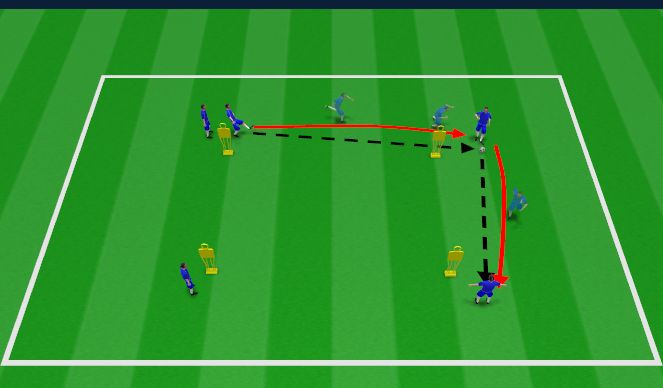
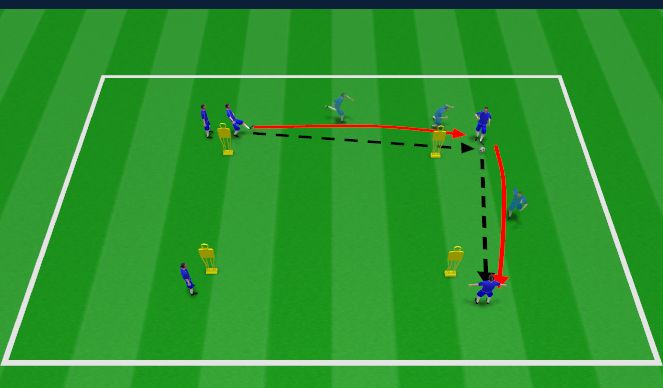
Passing Activation - 'Play & Press' (Work:Rest = 2:1) (5 mins)
Description:
This exercise is designed to help activate players ability to receive and pass the ball while under pressure. Players pass the ball to a teammate who must check off the mannequin (or cone) to receive the ball on their back foot to take their first touch into space. Once the (passing) player has played the ball they must immediately press the (receiving) player on the mannequin to apply pressure while taking their first touch. Repeat action in a clockwise motion around the square with each player following their pass to the next mannequin.
Technique(s):
Passing - are players using the instep to play an accurate pass to teammates feet? (Consider body shape, hips open or closed, follow through, contact point on ball)
Receiving - are players able to take their first touch forwards to avoid press? (Consider body shape, hips open or closed, back foot, active on toes, first touch)
Pressing - are players applying pressure to the ball to affect the first touch of receiving player? (acceleration, point of deceleration, angle of press, distance to engage)
Measurements:
Start with a 5M x 5M distancing between mannequins or cones to allow for short and accurate passing for players to still focus on technical aspects of passing, and technical aspects of pressing. Adjust accordingly.Adaptations (Progressions & Regressions):Progression 1
Allow player to drive to halfway point before playing the pass so there is less time for the receiving player to react.
Progression 2
Allow players to press to win the ball instead of passive defending to make it more game like in applying the skill.
Regression
Increase the space between the mannequins or cones to allow the players more time before being pressed.
Considerations:
To maximise the effectiveness of this exercise we must ensure the intensity of the press is high so players can emulate playing under pressure, adjust the distance between cones to be shorter to maximise repetition of exercise and/or shorten the length of working time to rest time if necessary.