


Football/Soccer Session (Academy Sessions): Defending the lines (Start Time: 2024-12-09 16:30:00)


FAW Coach Ed
Jun Chan
Profile Summary

| Name: | Jun Chan |
|---|---|
| City: | Pontypridd |
| Country: | United Kingdom |
| Membership: | Adult Member |
| Sport: | Football/Soccer |

Description
Topic: Defend the Lines (Understand when and how to stop the opposition playing through, around, or over.)
Session Structure (60 minutes total):
Part 1: Specific Practice (20 minutes)
Part 2: Small-Sided Game (20 minutes)
Part 3: Specific Practice into Small-Sided Game (20 minutes)
Each part is divided into two blocks (e.g., 2 × 8 minutes + 2 minutes rest for each block). Work-to-rest ratio is approximately 4:1 (focusing on short bouts of high-intensity defensive work).
Formations & Players (Half Pitch)
Out of Possession Team (Defending): 4-4-2
Withdrawn Players (Not taking part): LST, RST, LM, RM
Active Players (7 + GK): GK, LB, LCB, RCB, RB, LCM, RCM
Team Shape: GK–(LB, LCB, RCB, RB)–(LCM, RCM)
In Possession Team (Attacking): 3-4-3
Withdrawn Players (Not taking part): GK, LCB, RCB, CCB
Active Players (7): LWB, RWB, LCM, RCM, LF, RF, CS
Team Shape: (LWB, RWB)–(LCM, RCM)–(LF, CS, RF)
Pitch Setup:
Full-size goal for the Out of Possession team (defending the big goal).
Two mini goals near the halfway line for the In Possession team to defend (they can counter into these if the Out of Possession team wins the ball).
Start/Reset Point: Ball always starts from the center circle with the In Possession team.
Roles and Responsibilities (Out of Possession Team)
GK: Organises defensive line, communicates to defenders, ready to deal with through passes.
LB & RB: Press wide players if the ball travels into the wide areas; remain narrow when the ball is central.
LCB & RCB: Stay narrow and compact, protect the central channels, block passing lanes, cover each other.
LCM & RCM: Control the middle, screen passes into the central striker, apply fast pressure when the ball enters midfield.
Upon reset, everyone quickly recovers to shape (4-4-2 structure) to defend.
Roles and Responsibilities (In Possession Team)
LWB & RWB: Provide width in attack, attempt to stretch the defensive block.
LCM & RCM: Receive from center circle, look to combine centrally or switch play out wide.
LF & RF (Wide Forwards): Stretch the back line horizontally, make runs in behind.
CS (Central Striker): Act as target player, occupy defenders, link play.
Upon reset, players take positions in the attacking 3-4-3 shape, ready to build from the center circle.
Three Core Learning Outcomes (Overall Session)
Defensive Compactness: Players will understand how to stay narrow and protect central areas.
Pressure & Cover: Players will recognise triggers to apply fast pressure on the ball and provide cover to teammates.
Deny Penetration: Players will learn how to stop split passes by recognising when to step up or drop and how to control the space behind.
See the guidance at the top of this page to understand why you are not seeing interactive Football/Soccer images.
See the guidance at the top of this page to understand why you are not seeing interactive Football/Soccer images.
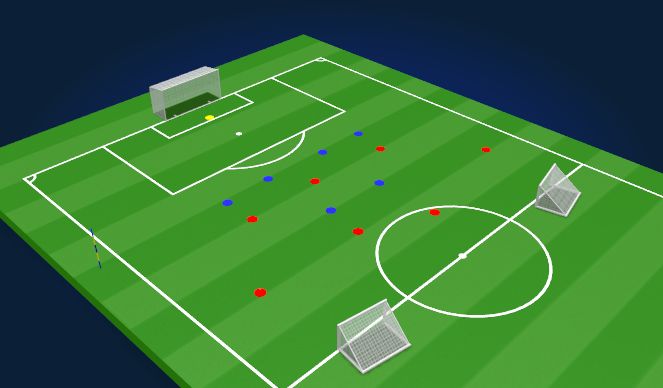
LSG (20 mins)
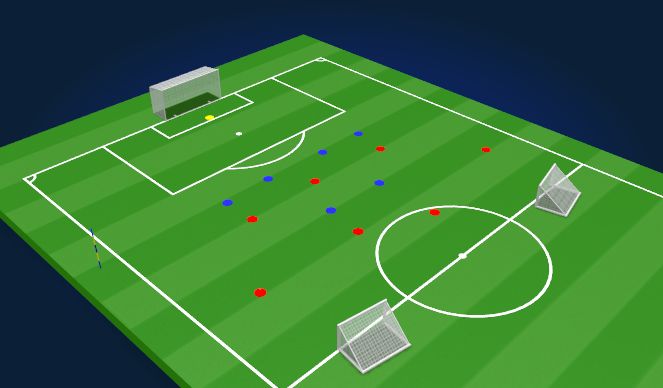
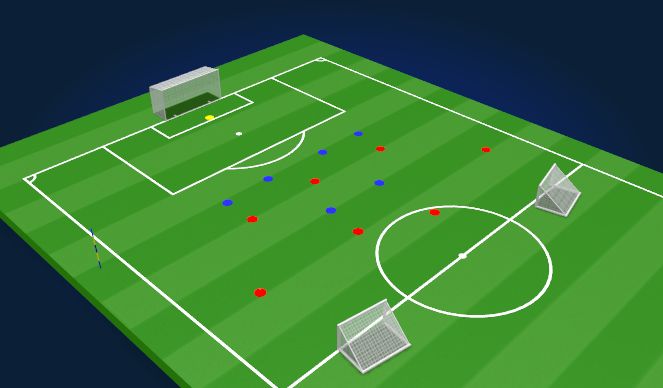
Objective: Apply the defensive principles in a more match-like scenario, focusing on transitions when the ball is lost or won.
Organization:
Same half pitch, big goal for Out of Possession team to defend, two mini goals near halfway line for In Possession team.
7v7 + GK (as outlined).
The ball still starts at the center circle with the In Possession team.
Block 1 (8 minutes) → Rest (2 minutes) → Block 2 (8 minutes)
Conditions, Targets, Challenges (Short Sentences):
Challenge (Out of Possession): Show attackers away from goal if they approach central areas.
Condition (Out of Possession): Must stay connected between lines (distance between backline and midfield).
Target (Out of Possession): Win the ball and break into one of the mini goals within 5 seconds.
Danger Scenario (Example):
In Possession quickly switches play from LCM to RWB, aiming to isolate LB in a 1v1 near the penalty area.
Defensive Solution: RB (defender) or RCM shifts across for cover, LCB tucks in to protect near post, LB steps to press wide area, GK covers near post angle.
Small-Sided Game Learning Objectives
Apply defensive shape under pressure from multiple attacking threats.
React quickly in defensive transitions, reorganising into compact shape.
Demonstrate effective cover and balance with teammates when the ball is switched wide.
Coaching Points (Technical & Tactical)
Show Away from Goal: Angle of approach from full-backs to force wingers towards the sideline.
Block Central Passes: Midfield screens (LCM/RCM) shift ball side to deny passing lanes into CS.
Stop Switches of Play: Quick lateral movement from the back four; be aware of wide spaces.
Protect Space Between Lines: Keep minimal distance between defenders and midfielders.
Control Space Behind: GK and back four communicate to drop or hold the line based on forward runs.
Coaching Interventions
Freeze: If the back four becomes too stretched or the midfield line is disjointed.
Walkthrough: Demonstrate how to stay connected when the ball is switched quickly.
Concurrent Coaching: Offer reminders to stay compact and watch runners in behind.
Bullseye (Highlight Good Play): Praise a defender who shows the attacker away from goal successfully.
See the guidance at the top of this page to understand why you are not seeing interactive Football/Soccer images.
SP into LSG (20 mins)
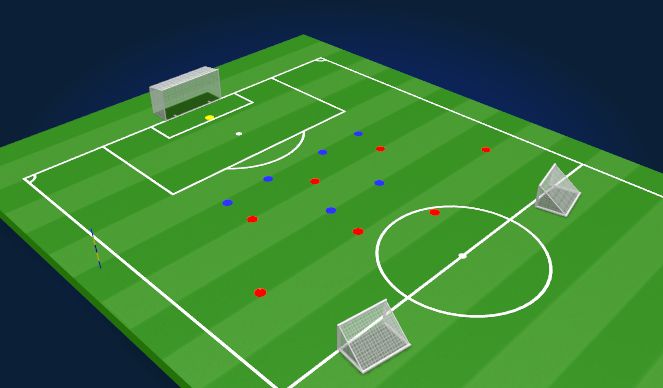
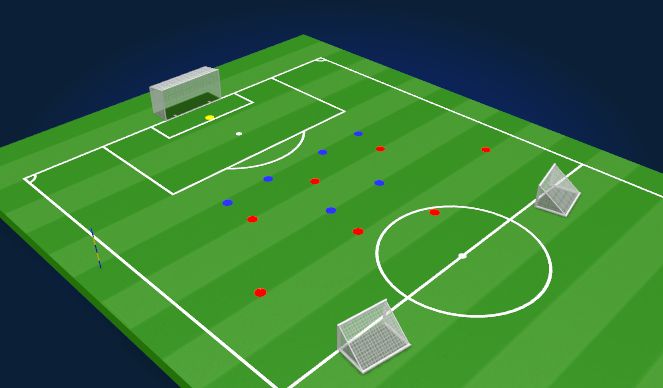
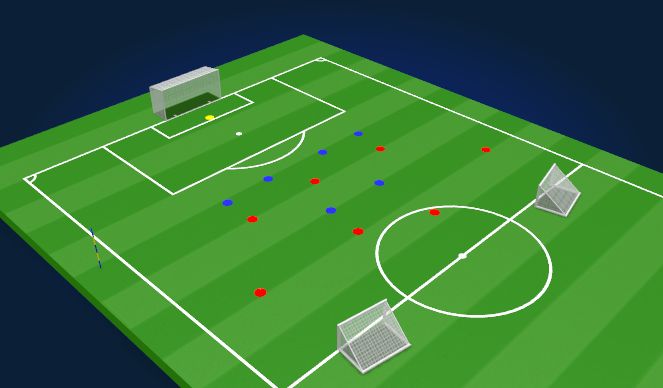
Objective: Combine structured defensive work (specific practice) immediately transitioning into a live small-sided game.
Organization:
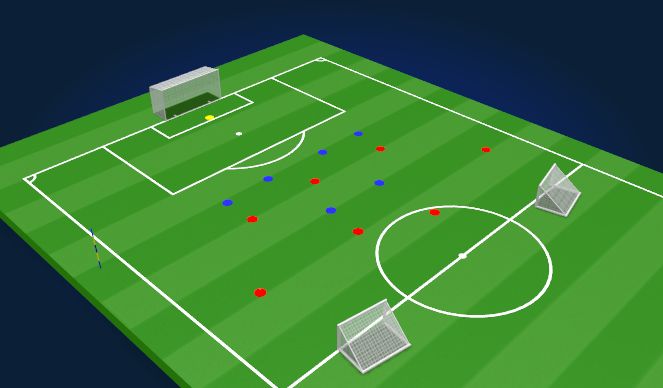
Start with a structured wave attack: In Possession plays from the center circle into final third.
Once that wave finishes (shot, goal, or defending team recovers), immediately continue into a live SSG situation.
Block 1 (8 minutes) → Rest (2 minutes) → Block 2 (8 minutes)
Two Possible Plays (Wide & Central) by In Possession & Defensive Solutions
- Wide Play Execution:
In Possession: RWB overlaps, receives from RCM, looks to combine with RF.
Defensive Movement: LB and LCM shift to block the wide channel; LCB covers near post zone. RCB shifts slightly inwards to mark CS, RB drops to protect space behind.
- Central Play Execution:
In Possession: LCM feeds CS centrally, who looks to set LF running diagonally behind RCB.
Defensive Movement: RCB steps in front of CS to intercept; LCB slides across to cover any immediate forward pass; LCM screens the pass into LF.
- Conditions, Targets, Challenges (Short Sentences):
Challenge (Out of Possession): Anticipate central or wide attack.
Condition (Out of Possession): Move as a block when the ball is switched or played inside.
Target (Out of Possession): Score quickly into the mini goals once possession is regained.
Specific Practice into Small-Sided Game Learning Objectives
- Recognise the trigger to transition from a structured defensive shape into open-play defending.
- Identify cues to press wide or deny central penetration effectively.
- Adapt positioning quickly based on the In Possession team’s decision (wide or central attack).
Coaching Points (Technical & Tactical)
- Narrow & Compact: Keep distances between defenders and midfielders tight when anticipating wide attacks.
- Fast Pressure on the Ball: Track the pass and arrive quickly to deny time and space.
- Stop Split Passes: Communicate and mark potential runners going into the final third.
- Protect Space Behind: Full-backs and center-backs drop accordingly if the forward run is imminent.
Coaching Interventions
- Freeze: Highlight correct pivot and shift when the ball moves wide or central.
- Walkthrough: Slowly reposition players to see the angles and distances needed in transitions.
- Concurrent Coaching: Provide immediate feedback on movement timing.
- Bullseye: Praise successful transitions from structured shape into open play defending.
Match-Related Activity & Consolidation of Learning
All three parts include realistic defensive scenarios, building from smaller structured waves (Part 1) to open small-sided formats (Part 2 and 3). This helps players transfer learned principles—fast pressure, protecting middle, stopping splits, and controlling space behind—into more fluid game situations.
Physical Corner
- Work-to-Rest Ratios: Approximately 4:1 across each block (8 minutes work, 2 minutes rest).
- Energy System: Predominantly anaerobic (short, high-intensity bursts of defensive pressing, followed by brief rest).
See the guidance at the top of this page to understand why you are not seeing interactive Football/Soccer images.
SP into LSG
Social Corner
Team Meetings: Quick 2-minute discussions during rest periods; defenders and midfielders share observations on shape.
Captains & Leaders: Encourage one designated defensive leader (e.g., RCB) to organise and communicate transitions.
Problem-Solving Tasks: Ask midfielders to figure out how to quickly screen passes to the striker under pressure.
Psychological Corner
Emphasise confidence in defending; encourage players to trust each other’s cover.
Build resilience by highlighting the positive actions and reinforcing correct decisions under pressure.
Conditions, Targets, Challenges & Progression/Regression
Progression (Increase Difficulty):
Increase the speed at which the In Possession team restarts (less time for defenders to set).
Allow In Possession to add a second striker or an overlapping CB.
Regression (If Struggling):
Reduce the pitch width to force more predictable attacks.
Limit the attacking team to two-touch in midfield to slow the attack.
Scoreboard:
1 point for each successful block/interception by Out of Possession.
3 points for each goal in the mini goals.
2 points for each goal scored by In Possession in the big net.
'%3E%3Cpath id='path4169' d='M 11.4375,70.25 C 11.457031,38.394531 37.277344,13.242188 68.253906,13.050781 99.78125,12.855469 125.73047,38.351563 125.8125,70.078125 125.89844,101.62109 100.43359,127.14063 69.148438,127.42188 37.582031,127.70703 11.464844,102.23438 11.4375,70.25 m 6.425781,-0.08984 c 0.03516,28.421871 23.027344,50.69922 50.519532,50.82031 C 96.433594,121.10156 119.30469,98.367188 119.38281,70.359375 119.45313,42.878906 97.382813,19.714844 69.015625,19.496094 40.75,19.277344 17.964844,42.035156 17.863281,70.160156' style='clip-rule:nonzero;fill:%23333f48;fill-opacity:1;fill-rule:nonzero;stroke:none' /%3E%3Cpath style='fill:%23333f48;fill-opacity:1;fill-rule:nonzero;stroke:none' d='m 39.789063,108.62109 c 0.28125,0.14454 0.550781,0.32032 0.839843,0.4336 2.734375,1.05469 5.554688,1.78125 8.453125,2.23047 2.734375,0.42578 5.484375,0.64453 8.25,0.54297 3.988282,-0.15625 7.832032,-0.94922 11.445313,-2.69532 1.683594,-0.8164 3.246094,-1.82422 4.640625,-3.07422 3.265625,-2.92578 5.171875,-6.582027 5.796875,-10.906246 0.546875,-3.761719 0.04687,-7.425781 -1.09375,-11.019531 -1.4375,-4.523438 -3.730469,-8.582032 -6.703125,-12.265625 -1.03125,-1.277344 -2.082031,-2.535157 -3.113281,-3.808594 C 66.789063,66.1875 65.332031,64.269531 64.0625,62.21875 c -1.601562,-2.582031 -2.835937,-5.316406 -3.613281,-8.261719 -0.683594,-2.574218 -0.902344,-5.1875 -0.6875,-7.828125 0.214844,-2.617187 0.910156,-5.117187 2.152344,-7.441406 2.164062,-4.050781 5.503906,-6.710937 9.816406,-8.179687 1.890625,-0.640625 3.835937,-1.058594 5.832031,-1.195313 1.121094,-0.07813 2.242188,-0.152344 3.363281,-0.164062 4.28125,-0.02734 8.4375,0.734375 12.453125,2.175781 1.871094,0.671875 3.6875,1.496094 5.523438,2.257812 0.226562,0.09375 0.4375,0.230469 0.664062,0.351563 -0.164062,0.25 -0.371093,0.160156 -0.539062,0.164062 -2.824219,0.101563 -5.535156,0.703125 -8.132813,1.804688 -1.335937,0.570312 -2.570312,1.316406 -3.648437,2.296875 -2.527344,2.296875 -3.605469,5.15625 -3.34375,8.550781 0.140625,1.855469 0.722656,3.574219 1.550781,5.222656 0.648438,1.296875 1.414063,2.523438 2.292969,3.675782 0.953125,1.25 1.929687,2.484375 2.929687,3.699218 2.085938,2.523438 4.164063,5.054688 6.050782,7.738282 2.203125,3.136718 4.140627,6.417968 5.589847,9.980468 1.16406,2.867188 2.01562,5.820313 2.39843,8.894532 0.25,2.011718 0.30079,4.03125 0.11719,6.058593 -0.24219,2.640625 -0.79297,5.195313 -1.74609,7.667969 -1.29688,3.36328 -3.300784,6.22656 -5.972659,8.63281 -2.429687,2.19141 -5.171875,3.90625 -8.109375,5.3125 -2.695312,1.29297 -5.464843,2.40235 -8.34375,3.20313 -1.953125,0.54687 -3.945312,0.8789 -5.949218,1.15625 -3.035157,0.41797 -6.085938,0.48828 -9.132813,0.3125 -5.328125,-0.3125 -10.476562,-1.46094 -15.410156,-3.52344 -3.449219,-1.44141 -6.691406,-3.25781 -9.757813,-5.39453 -0.183593,-0.12891 -0.378906,-0.25 -0.53125,-0.41016 -0.07031,-0.0703 -0.05859,-0.22656 -0.08203,-0.34375 z m 0,0' id='path4175' /%3E%3Cpath style='fill:%23333f48;fill-opacity:1;fill-rule:nonzero;stroke:none' d='M 94.699219,29.390625 C 94.089844,29.21875 93.476563,29.054688 92.867188,28.875 90.183594,28.085938 87.46875,27.441406 84.703125,27.046875 c -3.976562,-0.566406 -7.945312,-0.59375 -11.863281,0.402344 -7.535156,1.914062 -12.386719,6.71875 -14.878906,13.996094 -0.894532,2.617187 -1.179688,5.328125 -0.953125,8.078125 0.203125,2.484375 0.867187,4.859375 1.816406,7.160156 0.933594,2.261719 2.117187,4.390625 3.4375,6.449219 1.4375,2.25 3.050781,4.371093 4.640625,6.511718 1.4375,1.933594 2.867187,3.871094 4.261719,5.835938 1.230468,1.730469 2.316406,3.546875 3.273437,5.445312 1.324219,2.625 2.265625,5.378907 2.703125,8.292969 0.433594,2.902344 0.292969,5.765625 -0.660156,8.5625 -0.9375,2.74609 -2.574219,5.00781 -4.777344,6.875 -2.417969,2.04688 -5.203125,3.39844 -8.246094,4.22266 -1.835937,0.5 -3.703125,0.75781 -5.609375,0.82031 -3.886718,0.13281 -7.679687,-0.47266 -11.421875,-1.46094 -2.261718,-0.59765 -4.488281,-1.33203 -6.695312,-2.11328 -0.207031,-0.0742 -0.40625,-0.16797 -0.597656,-0.25 -0.02344,-0.24609 0.148437,-0.19141 0.25,-0.20703 1.96875,-0.30469 3.921875,-0.67969 5.804687,-1.34766 1.367188,-0.48437 2.671875,-1.10156 3.855469,-1.94922 2.25,-1.61328 3.65625,-3.765621 4.0625,-6.515621 0.273437,-1.867188 0.09375,-3.710938 -0.429688,-5.527344 -0.472656,-1.648437 -1.171875,-3.199219 -2.109375,-4.628906 -0.792968,-1.207031 -1.636718,-2.382813 -2.523437,-3.519531 -0.921875,-1.195313 -1.921875,-2.328125 -2.890625,-3.484375 -2.753906,-3.273438 -5.351563,-6.660157 -7.523438,-10.355469 -2.042968,-3.480469 -3.667968,-7.136719 -4.597656,-11.078125 -0.640625,-2.699219 -0.980469,-5.4375 -0.832031,-8.214844 0.238281,-4.53125 1.476562,-8.78125 3.824219,-12.6875 1.082031,-1.800781 2.445312,-3.375 3.988281,-4.800781 2.742187,-2.527344 5.863281,-4.480469 9.257812,-5.992188 3.746094,-1.667968 7.652344,-2.769531 11.707032,-3.394531 3.152343,-0.488281 6.324218,-0.671875 9.507812,-0.519531 8.632813,0.410156 16.671875,2.792969 24,7.433594 0.08203,0.05078 0.152344,0.109375 0.230469,0.167968 -0.0039,0.04297 -0.0078,0.08984 -0.01563,0.136719' id='path4177' /%3E%3Cpath style='fill:%23333f48;fill-opacity:1;fill-rule:nonzero;stroke:none' d='m 31.699219,38.75 c -0.07813,0.238281 -0.152344,0.476563 -0.238281,0.710938 -1.460938,4.074218 -2.066407,8.28125 -1.808594,12.59375 0.4375,7.304687 2.808594,13.925781 7.277344,19.753906 3.714843,4.84375 7.441406,9.671875 11.167968,14.503906 1.113282,1.441406 1.953125,3.007813 2.414063,4.777344 0.332031,1.257812 0.425781,2.539062 0.273437,3.820312 -0.214843,1.832032 -1.070312,3.34375 -2.464843,4.546875 -0.984375,0.851559 -2.113282,1.449219 -3.316407,1.925779 -1.378906,0.54297 -2.8125,0.89063 -4.273437,1.1211 -2.226563,0.35547 -4.46875,0.46093 -6.722656,0.41015 -0.589844,-0.0156 -1.046875,-0.18359 -1.433594,-0.625 -0.636719,-0.72265 -1.335938,-1.39062 -1.9375,-2.14062 C 25.574219,93.800781 22.300781,86.621094 20.84375,78.636719 20.152344,74.835938 19.917969,71 20.15625,67.128906 20.796875,56.773438 24.390625,47.574219 30.859375,39.480469 c 0.21875,-0.273438 0.453125,-0.53125 0.679688,-0.796875 0.05469,0.02344 0.109375,0.04297 0.160156,0.06641' id='path4179' /%3E%3Cpath style='fill:%23333f48;fill-opacity:1;fill-rule:nonzero;stroke:none' d='m 105.41016,101.30078 c -0.13282,-0.3125 0.0234,-0.5039 0.0977,-0.69922 1.38672,-3.749997 1.98047,-7.628904 1.89844,-11.621091 -0.14453,-6.84375 -2.08594,-13.144531 -5.73437,-18.925781 C 99.890625,67.226563 97.917969,64.53125 95.835938,61.917969 94.4375,60.160156 92.988281,58.4375 91.582031,56.6875 90.632813,55.511719 89.6875,54.335938 88.792969,53.121094 c -0.835938,-1.144531 -1.488281,-2.398438 -1.953125,-3.742188 -0.523438,-1.515625 -0.695313,-3.070312 -0.511719,-4.652343 0.21875,-1.839844 1.082031,-3.339844 2.476563,-4.542969 1.039062,-0.890625 2.230468,-1.507813 3.503906,-1.980469 1.632812,-0.609375 3.320312,-0.960937 5.046875,-1.175781 1.917969,-0.238281 3.839841,-0.269531 5.769531,-0.230469 0.52734,0.01172 0.89453,0.203125 1.23828,0.585938 5.50391,6.113281 9.26172,13.144531 11.21875,21.132812 1.11719,4.554688 1.5625,9.179688 1.30469,13.855469 -0.58203,10.625 -4.23438,20.082031 -10.96094,28.339846 -0.15625,0.1914 -0.32812,0.375 -0.51562,0.58984' id='path4181' /%3E%3Cpath style='fill:%23333f48;fill-opacity:1;fill-rule:nonzero;stroke:none' d='m 39.796875,108.63281 c -0.05859,0.0117 -0.117187,0.0234 -0.175781,0.0352 0.05469,-0.0156 0.113281,-0.0312 0.167969,-0.0469 z m 0,0' id='path4183' /%3E%3C/g%3E%3C/svg%3E)
 Play animation
 Play step-by-step
 Repeat (toggle)
 Full Screen
 Pause
Pause Stop
Stop
specific practice (20 mins)
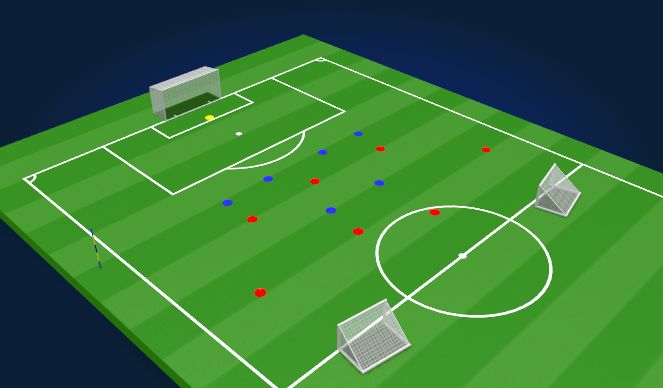
Objective: Work on defensive organisation in midfield when the In Possession team starts from central circle and builds into the middle third.
Organisation:
Area: Half pitch from the centre circle up to the big goal.
Players (Out of Possession): GK, LB, LCB, RCB, RB, LCM, RCM.
Players (In Possession): LWB, RWB, LCM, RCM, LF, RF, CS.
Ball starts at the In Possession team’s LCM/RCM in the centre circle.
Block 1 (8 minutes) → Rest (2 minutes) → Block 2 (8 minutes)
Conditions, Targets, Challenges (Short Sentences):
Challenge (Out of Possession): Stay compact in central areas.
Condition (Out of Possession): Block or intercept any forward pass through central channels.
Target (Out of Possession): If the ball is won, transition quickly and score in the mini goals.
Danger Scenario (Example):
In Possession tries a quick combination between LCM and RCM, looking to slide a through pass to the CS behind LCB and RCB.
Defensive Solution: LCM (defensive) tracks the runner, RCB steps forward to press, LCB drops to cover. LB and RB pinch in slightly to block any wide pass option. GK communicates and prepares to sweep.
Specific Practice Learning Objectives
Recognise when to apply fast pressure on the ball in midfield.
Maintain defensive shape to protect the central areas and stop split passes.
Understand how to quickly recover shape after the ball is played wide or back.
Coaching Points (Technical & Tactical)
Fast Pressure on Ball: Nearest midfielder closes down quickly to reduce time on the ball.
Protect the Middle: LCM and RCM screen passing lanes to CS; LCB and RCB communicate and shift accordingly.
Stay Narrow & Compact: Full-backs tuck in, maintaining small distances between defenders.
Stop Split Passes: Work as a unit to block channels into CS.
Protect Space Behind: Defensive line drops if a forward runner threatens in behind.
Coaching Interventions
Freeze: Stop the play when shape is lost or marking is incorrect; highlight where defenders should move.
Walkthrough: Slowly reposition defenders to show how to stay narrow and press the ball at the correct angle.
Concurrent Coaching: Coach from the sidelines with quick reminders about shape and spacing.
Bullet-Point Feedback: Immediately praise successful blocks or correct defensive shape.