


Football/Soccer Session (Academy Sessions): USC GK DIPLOMA II Saturday PM 3:30 to 5:00


SSP Club System
Carlos Schulze
Profile Summary

| Name: | Carlos Schulze |
|---|---|
| City: | Dixon |
| Country: | United States of America |
| Membership: | Adult Member |
| Sport: | Football/Soccer |

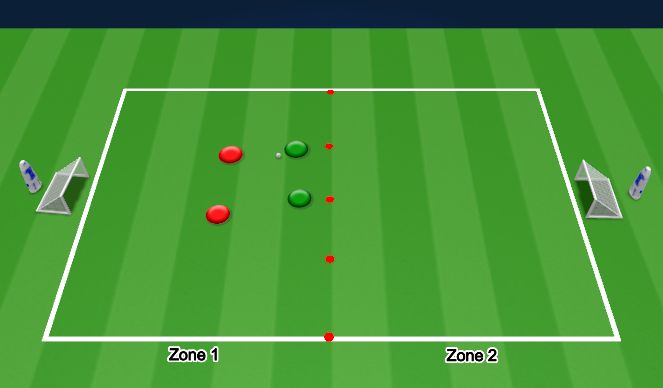
See the guidance at the top of this page to understand why you are not seeing interactive Football/Soccer images.
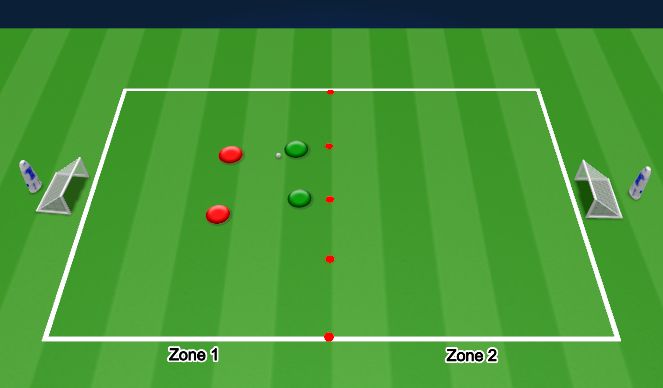
See the guidance at the top of this page to understand why you are not seeing interactive Football/Soccer images.
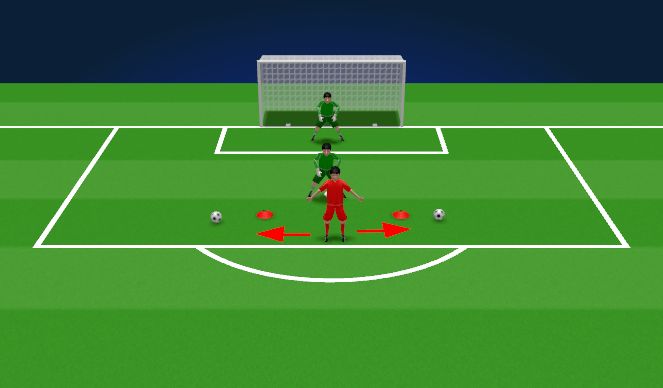
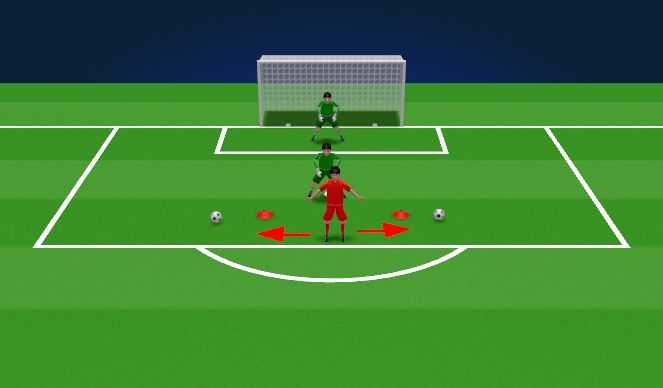
Smother
GK in red moves side to side faking shots, keeper 1 must follow close and low and smother the ball wen striker turns to shoot.
5 reps then everyone steps up and runs through as keeper 1.
20 mins
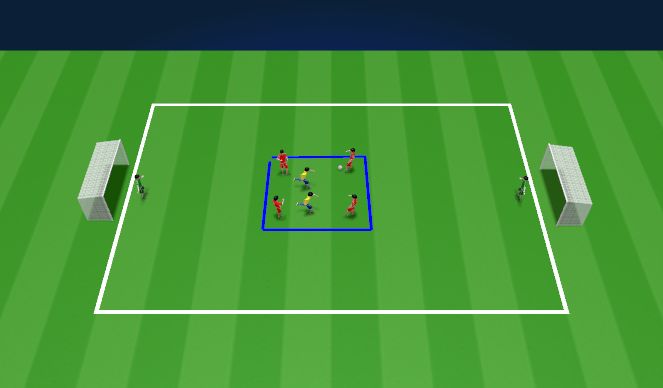
See the guidance at the top of this page to understand why you are not seeing interactive Football/Soccer images.
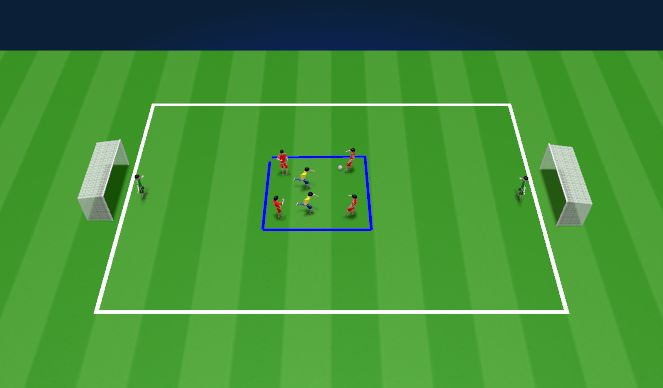
Space behind
This exercise allows goalkeepers and outfield players to work on their reaction time in tight spaces. The goalkeepers will have to decide between defending the goal and defending the space. Since the outfield players are playing quick passes a short distance from goal, goalkeepers can improve their positioning, preparation and reaction time as they face shots from point-blank range. The exercise also helps attackers to adjust to different shooting scenarios (i.e. various angles, close range, limited space) by playing at a high level of intensity.Organization
Set up a small pitch with 2 goals, as shown in the image.
Mark out a diamond-shaped area that is large enough for 8 players to fit into but, at the same time, is small enough to make the exercise challenging for the players in possession.
The diamond-shaped area needs to be placed so that one of its boundaries is 9 metres from one goal and its other is 3 metres from the other goal.
The 4/5 attacking players and 2 defenders take up a space inside the diamond-shaped area.
The 2 goalkeepers position themselves in opposing goals.
Play starts with 1 of the goalkeepers, who passes to the attacking team inside the area.
The attacking team have to complete 6 passes before they can shoot at goal.
Alternatively, they can complete 15 successful passes to score a goal.
The defenders try to win the ball back before the attacking team score.
When they win the ball back, the defenders have to leave the area and shoot in the direction they are facing.
If the defending team score, it counts as 5 goals.
Switch the 2 defenders for 2 attacking players after 90 seconds.
Swap the goalkeepers so that they both face shots from short and long
Allow the exercise to continue uninterrupted for 1 minute so that players can familiarise themselves with the distances and what they need to do to be successful.
Giving the attackers a variety of shooting positions and scenarios will allow them to apply different types of finishes (chips, placed shots, low drilled strikes, driven shots, etc.).
When losing the ball, players should react quickly to prevent shots.
Encourage the players to move the ball quickly and to shoot to catch the goalkeepers out.
The goalkeepers should pay attention to distances. If they are within 3 metres of the attacker, they should adopt a low posture and if they are further away, they should be ready to react with their feet.
When the passes are being completed, the goalkeepers need to constantly adjust their position to follow the direction of the ball.
Taking small or "micro" steps and moving quickly enables the goalkeepers to adjust and make quicker decisions to either set themselves or go and engage.
By trying to close the distances and being on the front foot, the goalkeepers will have a greater chance of making saves.
Teach goalkeepers to watch out for the following triggers/cues:
Passes leaving the possession box
Players breaking out of the possession box
Different types of passes
Potential action for goalkeepers to take:
Smother
Block
Spread
Reaction save (hand and foot)
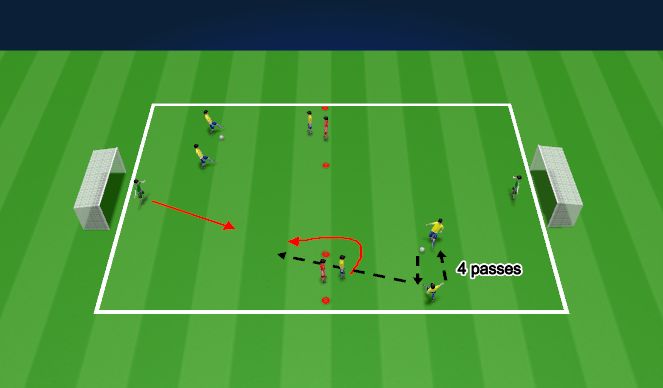
See the guidance at the top of this page to understand why you are not seeing interactive Football/Soccer images.
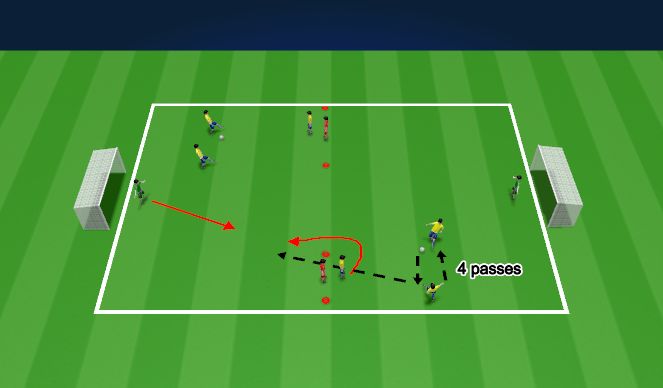
Space Behind II
This drill heightens goalkeepers' understanding of how to react quickly to through-balls. At the same time, it gives the attackers the opportunity to work on their finishing from different close-range angles. In these goalscoring scenarios, the goalkeeper and the striker face off in a game to see who makes the first move. By working on the goalkeeper's positioning and feints, as well as the attacker's first touch or action, they can both be better prepared to succeed in these scenarios.
OrganizationMark out a pitch that is 30 metres long and 18 metres wide (see image).
Use 2 full-size goals and position a goalkeeper in each one.
Split the pitch into 2 lanes.
Mark out a through-ball halfway line so that it is 18 metres from one goal and 12 metres from the other.
On the through-ball line, place 2 cones in each lane, as shown in the image.
Finally, in each lane, place a different-coloured cone before the other cones to mark a starting point, as shown in the image.
Position 4 players in each lane: 3 attackers and 1 defender.
2 attackers start at the starting cone.
The other attacker occupies the space between the 2 cones on the through-ball point, taking the striker's role.
The defender marks the attacker occupying the space between the cones.
The through-ball line marks the offside line.
The exercise is the same in each lane, but is played in opposite directions.
The 2 attackers at the starting point have to play up to 4 one-touch passes.
At any point during this sequence, 1 of the attackers passes to the striker by the through-ball line.
The striker then lays the ball off to the initial passer.
The striker and the spare attacker now have to make a run towards goal, aiming to receive the ball between the cones and before the through-ball line. The offside rule applies.
The defender may not leave the line between the cones.
The goalkeeper has to decide whether to come out and block or stay put and save.
Once the exercise has been completed in 1 lane, the exercise starts in the opposite lane.
Play 2 minutes each way and then swap the defender for an attacker.
The ball should be slid through the 2 cones with precision to ensure the attacker can take a high-quality touch before shooting.
Highlight the importance of the attacker's first touch when receiving the through-ball; they need to make it hard for the goalkeeper to react or predict where the shot will go.
Early strikes will leave goalkeepers with little time to react, whereas delayed shots may force goalkeepers to move first.
Reading the ball coming through and anticipating the angle will give the goalkeepers a better chance of stopping the shot.
If the attacker takes a good touch before their shot, the goalkeeper should hold their position.
If the goalkeeper leaves their final decision late, they can fool the attacker. They can feign a low posture to tempt the striker to lob them, only for the goalkeeper to stand up late and block.
At a distance of 0-3 metres, goalkeepers should look to smother.
Teach goalkeepers to watch out for passes played through at varying distances and angles.
Potential action for goalkeepers to take:
Smother
Block
Spread
Reaction save (hand and foot)
'%3E%3Cpath id='path4169' d='M 11.4375,70.25 C 11.457031,38.394531 37.277344,13.242188 68.253906,13.050781 99.78125,12.855469 125.73047,38.351563 125.8125,70.078125 125.89844,101.62109 100.43359,127.14063 69.148438,127.42188 37.582031,127.70703 11.464844,102.23438 11.4375,70.25 m 6.425781,-0.08984 c 0.03516,28.421871 23.027344,50.69922 50.519532,50.82031 C 96.433594,121.10156 119.30469,98.367188 119.38281,70.359375 119.45313,42.878906 97.382813,19.714844 69.015625,19.496094 40.75,19.277344 17.964844,42.035156 17.863281,70.160156' style='clip-rule:nonzero;fill:%23333f48;fill-opacity:1;fill-rule:nonzero;stroke:none' /%3E%3Cpath style='fill:%23333f48;fill-opacity:1;fill-rule:nonzero;stroke:none' d='m 39.789063,108.62109 c 0.28125,0.14454 0.550781,0.32032 0.839843,0.4336 2.734375,1.05469 5.554688,1.78125 8.453125,2.23047 2.734375,0.42578 5.484375,0.64453 8.25,0.54297 3.988282,-0.15625 7.832032,-0.94922 11.445313,-2.69532 1.683594,-0.8164 3.246094,-1.82422 4.640625,-3.07422 3.265625,-2.92578 5.171875,-6.582027 5.796875,-10.906246 0.546875,-3.761719 0.04687,-7.425781 -1.09375,-11.019531 -1.4375,-4.523438 -3.730469,-8.582032 -6.703125,-12.265625 -1.03125,-1.277344 -2.082031,-2.535157 -3.113281,-3.808594 C 66.789063,66.1875 65.332031,64.269531 64.0625,62.21875 c -1.601562,-2.582031 -2.835937,-5.316406 -3.613281,-8.261719 -0.683594,-2.574218 -0.902344,-5.1875 -0.6875,-7.828125 0.214844,-2.617187 0.910156,-5.117187 2.152344,-7.441406 2.164062,-4.050781 5.503906,-6.710937 9.816406,-8.179687 1.890625,-0.640625 3.835937,-1.058594 5.832031,-1.195313 1.121094,-0.07813 2.242188,-0.152344 3.363281,-0.164062 4.28125,-0.02734 8.4375,0.734375 12.453125,2.175781 1.871094,0.671875 3.6875,1.496094 5.523438,2.257812 0.226562,0.09375 0.4375,0.230469 0.664062,0.351563 -0.164062,0.25 -0.371093,0.160156 -0.539062,0.164062 -2.824219,0.101563 -5.535156,0.703125 -8.132813,1.804688 -1.335937,0.570312 -2.570312,1.316406 -3.648437,2.296875 -2.527344,2.296875 -3.605469,5.15625 -3.34375,8.550781 0.140625,1.855469 0.722656,3.574219 1.550781,5.222656 0.648438,1.296875 1.414063,2.523438 2.292969,3.675782 0.953125,1.25 1.929687,2.484375 2.929687,3.699218 2.085938,2.523438 4.164063,5.054688 6.050782,7.738282 2.203125,3.136718 4.140627,6.417968 5.589847,9.980468 1.16406,2.867188 2.01562,5.820313 2.39843,8.894532 0.25,2.011718 0.30079,4.03125 0.11719,6.058593 -0.24219,2.640625 -0.79297,5.195313 -1.74609,7.667969 -1.29688,3.36328 -3.300784,6.22656 -5.972659,8.63281 -2.429687,2.19141 -5.171875,3.90625 -8.109375,5.3125 -2.695312,1.29297 -5.464843,2.40235 -8.34375,3.20313 -1.953125,0.54687 -3.945312,0.8789 -5.949218,1.15625 -3.035157,0.41797 -6.085938,0.48828 -9.132813,0.3125 -5.328125,-0.3125 -10.476562,-1.46094 -15.410156,-3.52344 -3.449219,-1.44141 -6.691406,-3.25781 -9.757813,-5.39453 -0.183593,-0.12891 -0.378906,-0.25 -0.53125,-0.41016 -0.07031,-0.0703 -0.05859,-0.22656 -0.08203,-0.34375 z m 0,0' id='path4175' /%3E%3Cpath style='fill:%23333f48;fill-opacity:1;fill-rule:nonzero;stroke:none' d='M 94.699219,29.390625 C 94.089844,29.21875 93.476563,29.054688 92.867188,28.875 90.183594,28.085938 87.46875,27.441406 84.703125,27.046875 c -3.976562,-0.566406 -7.945312,-0.59375 -11.863281,0.402344 -7.535156,1.914062 -12.386719,6.71875 -14.878906,13.996094 -0.894532,2.617187 -1.179688,5.328125 -0.953125,8.078125 0.203125,2.484375 0.867187,4.859375 1.816406,7.160156 0.933594,2.261719 2.117187,4.390625 3.4375,6.449219 1.4375,2.25 3.050781,4.371093 4.640625,6.511718 1.4375,1.933594 2.867187,3.871094 4.261719,5.835938 1.230468,1.730469 2.316406,3.546875 3.273437,5.445312 1.324219,2.625 2.265625,5.378907 2.703125,8.292969 0.433594,2.902344 0.292969,5.765625 -0.660156,8.5625 -0.9375,2.74609 -2.574219,5.00781 -4.777344,6.875 -2.417969,2.04688 -5.203125,3.39844 -8.246094,4.22266 -1.835937,0.5 -3.703125,0.75781 -5.609375,0.82031 -3.886718,0.13281 -7.679687,-0.47266 -11.421875,-1.46094 -2.261718,-0.59765 -4.488281,-1.33203 -6.695312,-2.11328 -0.207031,-0.0742 -0.40625,-0.16797 -0.597656,-0.25 -0.02344,-0.24609 0.148437,-0.19141 0.25,-0.20703 1.96875,-0.30469 3.921875,-0.67969 5.804687,-1.34766 1.367188,-0.48437 2.671875,-1.10156 3.855469,-1.94922 2.25,-1.61328 3.65625,-3.765621 4.0625,-6.515621 0.273437,-1.867188 0.09375,-3.710938 -0.429688,-5.527344 -0.472656,-1.648437 -1.171875,-3.199219 -2.109375,-4.628906 -0.792968,-1.207031 -1.636718,-2.382813 -2.523437,-3.519531 -0.921875,-1.195313 -1.921875,-2.328125 -2.890625,-3.484375 -2.753906,-3.273438 -5.351563,-6.660157 -7.523438,-10.355469 -2.042968,-3.480469 -3.667968,-7.136719 -4.597656,-11.078125 -0.640625,-2.699219 -0.980469,-5.4375 -0.832031,-8.214844 0.238281,-4.53125 1.476562,-8.78125 3.824219,-12.6875 1.082031,-1.800781 2.445312,-3.375 3.988281,-4.800781 2.742187,-2.527344 5.863281,-4.480469 9.257812,-5.992188 3.746094,-1.667968 7.652344,-2.769531 11.707032,-3.394531 3.152343,-0.488281 6.324218,-0.671875 9.507812,-0.519531 8.632813,0.410156 16.671875,2.792969 24,7.433594 0.08203,0.05078 0.152344,0.109375 0.230469,0.167968 -0.0039,0.04297 -0.0078,0.08984 -0.01563,0.136719' id='path4177' /%3E%3Cpath style='fill:%23333f48;fill-opacity:1;fill-rule:nonzero;stroke:none' d='m 31.699219,38.75 c -0.07813,0.238281 -0.152344,0.476563 -0.238281,0.710938 -1.460938,4.074218 -2.066407,8.28125 -1.808594,12.59375 0.4375,7.304687 2.808594,13.925781 7.277344,19.753906 3.714843,4.84375 7.441406,9.671875 11.167968,14.503906 1.113282,1.441406 1.953125,3.007813 2.414063,4.777344 0.332031,1.257812 0.425781,2.539062 0.273437,3.820312 -0.214843,1.832032 -1.070312,3.34375 -2.464843,4.546875 -0.984375,0.851559 -2.113282,1.449219 -3.316407,1.925779 -1.378906,0.54297 -2.8125,0.89063 -4.273437,1.1211 -2.226563,0.35547 -4.46875,0.46093 -6.722656,0.41015 -0.589844,-0.0156 -1.046875,-0.18359 -1.433594,-0.625 -0.636719,-0.72265 -1.335938,-1.39062 -1.9375,-2.14062 C 25.574219,93.800781 22.300781,86.621094 20.84375,78.636719 20.152344,74.835938 19.917969,71 20.15625,67.128906 20.796875,56.773438 24.390625,47.574219 30.859375,39.480469 c 0.21875,-0.273438 0.453125,-0.53125 0.679688,-0.796875 0.05469,0.02344 0.109375,0.04297 0.160156,0.06641' id='path4179' /%3E%3Cpath style='fill:%23333f48;fill-opacity:1;fill-rule:nonzero;stroke:none' d='m 105.41016,101.30078 c -0.13282,-0.3125 0.0234,-0.5039 0.0977,-0.69922 1.38672,-3.749997 1.98047,-7.628904 1.89844,-11.621091 -0.14453,-6.84375 -2.08594,-13.144531 -5.73437,-18.925781 C 99.890625,67.226563 97.917969,64.53125 95.835938,61.917969 94.4375,60.160156 92.988281,58.4375 91.582031,56.6875 90.632813,55.511719 89.6875,54.335938 88.792969,53.121094 c -0.835938,-1.144531 -1.488281,-2.398438 -1.953125,-3.742188 -0.523438,-1.515625 -0.695313,-3.070312 -0.511719,-4.652343 0.21875,-1.839844 1.082031,-3.339844 2.476563,-4.542969 1.039062,-0.890625 2.230468,-1.507813 3.503906,-1.980469 1.632812,-0.609375 3.320312,-0.960937 5.046875,-1.175781 1.917969,-0.238281 3.839841,-0.269531 5.769531,-0.230469 0.52734,0.01172 0.89453,0.203125 1.23828,0.585938 5.50391,6.113281 9.26172,13.144531 11.21875,21.132812 1.11719,4.554688 1.5625,9.179688 1.30469,13.855469 -0.58203,10.625 -4.23438,20.082031 -10.96094,28.339846 -0.15625,0.1914 -0.32812,0.375 -0.51562,0.58984' id='path4181' /%3E%3Cpath style='fill:%23333f48;fill-opacity:1;fill-rule:nonzero;stroke:none' d='m 39.796875,108.63281 c -0.05859,0.0117 -0.117187,0.0234 -0.175781,0.0352 0.05469,-0.0156 0.113281,-0.0312 0.167969,-0.0469 z m 0,0' id='path4183' /%3E%3C/g%3E%3C/svg%3E)
 Play animation
 Play step-by-step
 Repeat (toggle)
 Full Screen
 Pause
Pause Stop
Stop
Breakaways
In this drill, 2 goalkeepers play against 2 goalkeepers.
In possession, the goalkeepers should try to score and can only use their feet.
Out of possession, the goalkeepers should try to win the ball back using their hands.
To score a goal, the goalkeepers can pass the ball into the mini-goal once they pass the halfway line.
They can also score by dribbling the ball to the end line.
This small-sided game allows goalkeepers to focus on the fundamentals when defending 1v1 scenarios. Working on goalkeepers' decision-making and positioning is crucial to their success when in 1v1 situations. This exercise hones goalkeepers' awareness of when to stay or go and teaches them to adopt a posture to minimise the likeliness of conceding goals and maximise their chances of smothering or blocking shots.
Coaching points:Set a time limit of 10 seconds for goalkeepers to score in the goal or dribble the ball to the end line.
Allow goals scored from a goalkeeper’s own half to count.
A goal can be scored if the goalkeepers hit the mannequin behind the goal with the ball.
Finally, goalkeepers can still dribble the ball past the line to score but if they wish to score in the goal or by hitting the mannequin, they now have to do so with a first-time finish inside the opponents' half.
When defending the goal, goalkeepers should focus on distance and their body posture in relation to this distance.
If the attacking goalkeeper is 0-3 metres from them, then the defending goalkeeper should lower their stance and hands.
Paying attention to the position of their feet and ensuring that they are no more than shoulder width apart will help them to track and move quickly.
Goalkeepers should try to show the attacking goalkeepers onto the outside and be ready to dive down and smother the ball.
At the same time, goalkeepers should position their body to block off shots towards the goal and spread themselves across the goal if necessary.
When blocking shots, goalkeepers should focus on a low, wide and square posture.
When defending shots from distance, goalkeepers should adjust their bodies so that they are upright and standingtaller, but still ready to react.