


Football/Soccer Session (Moderate): My Mumbles Rangers Warm Up (Start Time: 2018-01-09 21:25:00)


Premier Users' Club
Mark Williams
Profile Summary

| Name: | Mark Williams |
|---|---|
| City: | Swansea |
| Country: | United Kingdom |
| Membership: | Adult Member |
| Sport: | Football/Soccer |

Description
A sample 3-stage warm-up which tries to combine Physical, Mental and Technical elements.
If the SSG is a formation-based Rondo, then you are also introducing a Tactical element
See the guidance at the top of this page to understand why you are not seeing interactive Football/Soccer images.
See the guidance at the top of this page to understand why you are not seeing interactive Football/Soccer images.
Phase 2 - Technical (10 mins)
Set Up
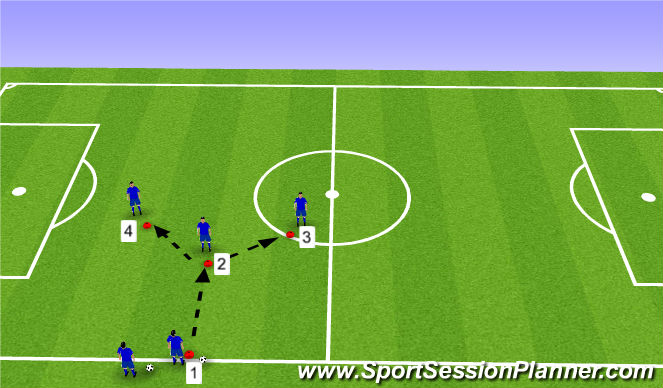
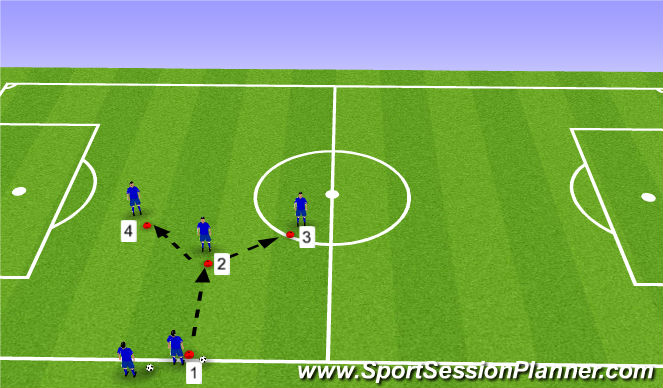
Every team I've coached in the last few years will have been expecting this one - the "Wine Glass" or "Y-Drill"
I usually mark out a distance of 15 yards from 1 to 2 and another 15 yards from 2 to 3 (and 2 to 4)
Organisation
The exercise starts with the player at 1 who passes to 2 and follows his pass.
The key stage is at 2; the player calls for the pass to be on say his left side; controls the ball with his left foot then plays a right foot pass to 3 (and follows his pass)
In the initial stage, 3 dribbles the ball in to 1
The player now at 1 passes to 2's right side; 2 controls the ball with his right foot and passes left-footed to 4 (and follows his pass)
We have now created a mechanism where passes from 2 alternate between passing to 3 or 4
NB Because players are always following their pass, the next player at 1 may not remember which side of 2 he is meant to pass to - who will know?
The answer of course is the player now at 2 - he needs to communicate.
So now the drill involves passing, movement and communication
Progression 1
- a one-two between 2 and 3/4 (i.e. depending which one we have passed to)
Progression 2
- a one-two between 2 and 3/4 is followed by
- a one-two between 3/4 and the player now moving from 1 to 2
Progression 3
- another progression is that Player 2 simply does a "bounce ball" back to 1 who then plays the ball to the "winger" (i.e. 3 or 4) and the sequence then follows Progression 2 above.
Coaching Points
The whole idea of this warm-up is to give the players plenty of touches and a mix of short and long passes.
- when we're looking at one-twos remember "Don't go past the ball"
We are looking for quality of pass, timing of pass, tempo and good communication.
If each stage is run for 2 minutes this will be a good warm-up for 6-8 minutes and give each player 30-40 touches
See the guidance at the top of this page to understand why you are not seeing interactive Football/Soccer images.
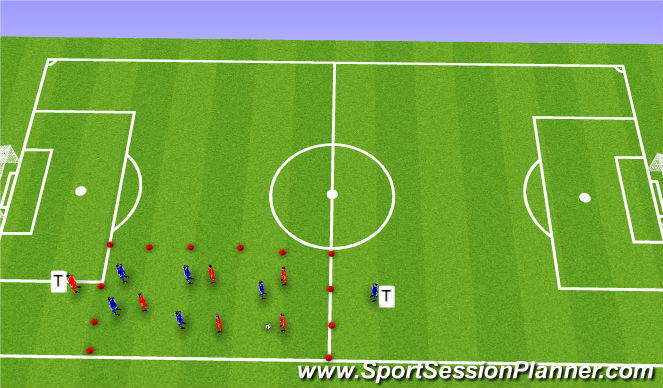
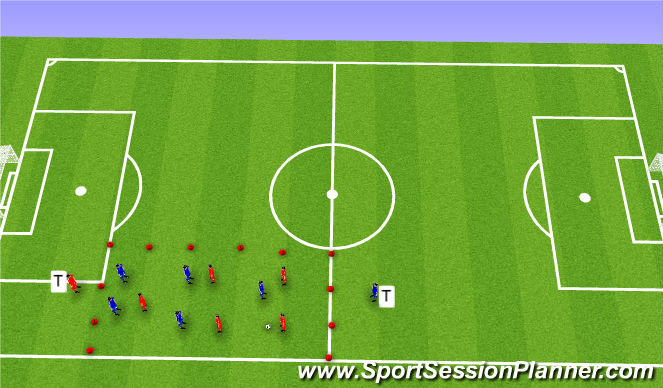
Phase 3 - SSG 1 (10 mins)
Key Factors
It occurred to me that, often, when I finished the warm-up with a drill the players would make a slow start to the game.
I realised that a drill - almost by definition - is repetitive and does not stimulate the brain. Therefore, the best means of getting ready for a contest is to finish warm-up with a competitive game - in this case, an "End Zone" game
Organisation
Use the half of the pitch you are warming up in - mark out an area from, say, the edge of the penalty area to the half-way line. The width depends on the number of players involved
- are you involving substitutes or just the starting players?
As a minimum, therefore, it will be 5v5 (I always have the Goalkeeper warming up with another coach from Stage 1 onwards)
The game can either be a simple 5v5 with mini goals or an "end zone" game.
If you wish, you can even set the game up along the lines of your formation as a form of Rondo (with Target players [T] at each end of the box)
NB Keep score - make it competitive and run it for only 5-10 mins.
Like most people, I have in the past used pre-match warm-up sessions that included the rest of the team taking shots at our goalkeeper. I don't do this now because:
a) You risk the keeper getting injured by shots coming from all angles
b) Only one side of the participants benefit; if the outfield players all score their shots, then the keeper is demoralised. If the keeper saves everything, then the outfielders are demoralised. Ideally, we want a win-win situation where both benefit.
If you want to practice shooting pre-match, make it a rotational drill where the goalkeeper is an outfield player and is constantly rotating.
(Meanwhile, you continue with your keeper specific warm-up.)
See the guidance at the top of this page to understand why you are not seeing interactive Football/Soccer images.
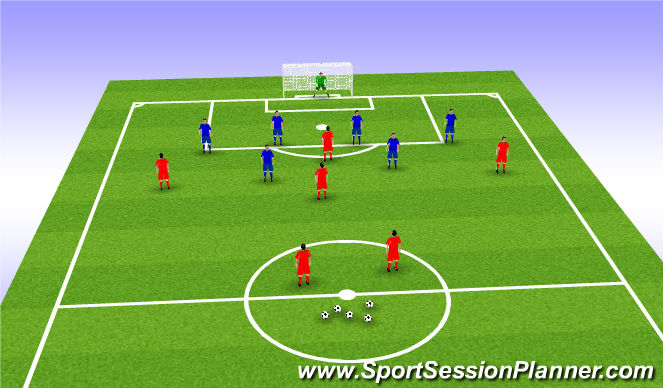
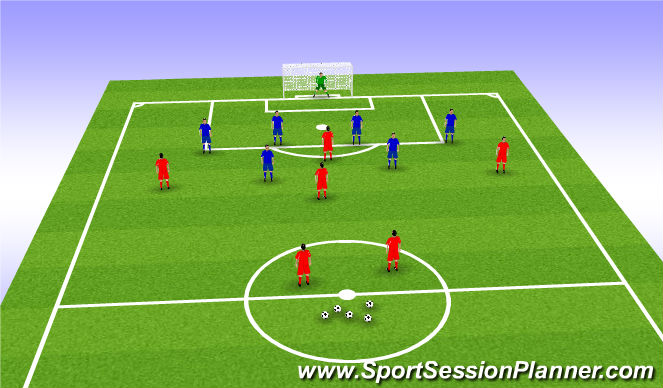
Phase 3 - SSG 2 (10 mins)
Key Factors
Occasionally, I will forego the "End Zone" game and do a more formation-based, functional game.
The team I currently work with plays a 4-2-3-1 so this game focuses on the working of key units.
Organisation
Essentially, an Attack vs Defence game, we use half of a standard pitch and play the starting keeprer, Back Four and two Defensive Midfielders (the Blue Team) vs. the starting Attacking Midfielders and the striker (the Red team).
The attacting team are supplemented by two (or more) of the substitutes.
- Standard Laws of football apply
- the game starts from the half way line with the Reds attacking
- the Reds score in the large goals.
- to keep the Blues interested, they score by passing the ball out to the halfway line (i.e. effectively beginning a counter-attack).
Only run it for 5-10 minutes to get the players fully awake and up to match pace.
See the guidance at the top of this page to understand why you are not seeing interactive Football/Soccer images.
Goalkeeper Warm-Up
Key Factors
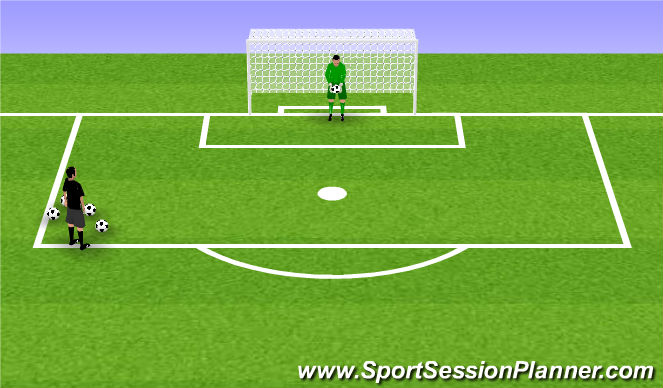
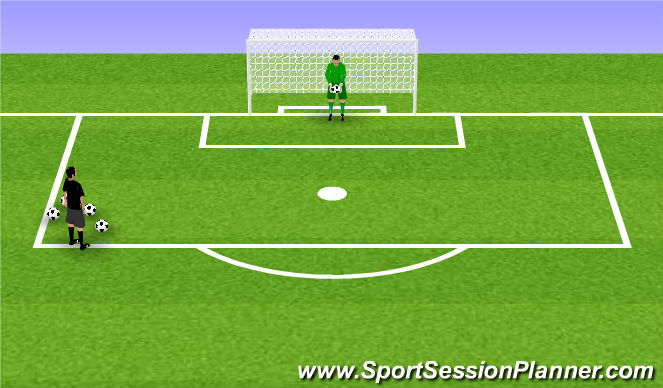
I believe it is useful to have the keeper (or keepers) undertake a warm-up that is specific to their needs.
The warm-up is aimed at getting the keeper ready for action and building their confidence ready for the game.
- I remember watching Petr Cech warming up before a game. The coach was taking half-volley shots at him for Cech to save. Nothing unusual there BUT if ever a shot went in, the coach apologised implying the coach had made a mistake or mishit or fluked the shot, rather than the keeper making a mistake.
- The warm-up is a time for encouragement and preparation NOT a time for too much coaching or an information-dump!
Organisation
After the keeper has completed Phase 1 - Dynamic & Static Stretching - I would send him over to the goal to continue his warm-up with another coach or one of the subs.
(If you are keen for your keeper to be involved as a sweeper/keeper, you could of course involve him in the Y-Drill - it's up to you.)
The keeper warm-up should include various keeper-specific aspects, including:
- Good foot movement
- Reactions e.g. catching a ball thrown at him when facing the ball; facing away from the ball, turning round on command then catching a ball; shot-stopping etc.
- catching crosses either thrown by coach or chipped in
- kicking from hand and off the floor
'%3E%3Cpath id='path4169' d='M 11.4375,70.25 C 11.457031,38.394531 37.277344,13.242188 68.253906,13.050781 99.78125,12.855469 125.73047,38.351563 125.8125,70.078125 125.89844,101.62109 100.43359,127.14063 69.148438,127.42188 37.582031,127.70703 11.464844,102.23438 11.4375,70.25 m 6.425781,-0.08984 c 0.03516,28.421871 23.027344,50.69922 50.519532,50.82031 C 96.433594,121.10156 119.30469,98.367188 119.38281,70.359375 119.45313,42.878906 97.382813,19.714844 69.015625,19.496094 40.75,19.277344 17.964844,42.035156 17.863281,70.160156' style='clip-rule:nonzero;fill:%23333f48;fill-opacity:1;fill-rule:nonzero;stroke:none' /%3E%3Cpath style='fill:%23333f48;fill-opacity:1;fill-rule:nonzero;stroke:none' d='m 39.789063,108.62109 c 0.28125,0.14454 0.550781,0.32032 0.839843,0.4336 2.734375,1.05469 5.554688,1.78125 8.453125,2.23047 2.734375,0.42578 5.484375,0.64453 8.25,0.54297 3.988282,-0.15625 7.832032,-0.94922 11.445313,-2.69532 1.683594,-0.8164 3.246094,-1.82422 4.640625,-3.07422 3.265625,-2.92578 5.171875,-6.582027 5.796875,-10.906246 0.546875,-3.761719 0.04687,-7.425781 -1.09375,-11.019531 -1.4375,-4.523438 -3.730469,-8.582032 -6.703125,-12.265625 -1.03125,-1.277344 -2.082031,-2.535157 -3.113281,-3.808594 C 66.789063,66.1875 65.332031,64.269531 64.0625,62.21875 c -1.601562,-2.582031 -2.835937,-5.316406 -3.613281,-8.261719 -0.683594,-2.574218 -0.902344,-5.1875 -0.6875,-7.828125 0.214844,-2.617187 0.910156,-5.117187 2.152344,-7.441406 2.164062,-4.050781 5.503906,-6.710937 9.816406,-8.179687 1.890625,-0.640625 3.835937,-1.058594 5.832031,-1.195313 1.121094,-0.07813 2.242188,-0.152344 3.363281,-0.164062 4.28125,-0.02734 8.4375,0.734375 12.453125,2.175781 1.871094,0.671875 3.6875,1.496094 5.523438,2.257812 0.226562,0.09375 0.4375,0.230469 0.664062,0.351563 -0.164062,0.25 -0.371093,0.160156 -0.539062,0.164062 -2.824219,0.101563 -5.535156,0.703125 -8.132813,1.804688 -1.335937,0.570312 -2.570312,1.316406 -3.648437,2.296875 -2.527344,2.296875 -3.605469,5.15625 -3.34375,8.550781 0.140625,1.855469 0.722656,3.574219 1.550781,5.222656 0.648438,1.296875 1.414063,2.523438 2.292969,3.675782 0.953125,1.25 1.929687,2.484375 2.929687,3.699218 2.085938,2.523438 4.164063,5.054688 6.050782,7.738282 2.203125,3.136718 4.140627,6.417968 5.589847,9.980468 1.16406,2.867188 2.01562,5.820313 2.39843,8.894532 0.25,2.011718 0.30079,4.03125 0.11719,6.058593 -0.24219,2.640625 -0.79297,5.195313 -1.74609,7.667969 -1.29688,3.36328 -3.300784,6.22656 -5.972659,8.63281 -2.429687,2.19141 -5.171875,3.90625 -8.109375,5.3125 -2.695312,1.29297 -5.464843,2.40235 -8.34375,3.20313 -1.953125,0.54687 -3.945312,0.8789 -5.949218,1.15625 -3.035157,0.41797 -6.085938,0.48828 -9.132813,0.3125 -5.328125,-0.3125 -10.476562,-1.46094 -15.410156,-3.52344 -3.449219,-1.44141 -6.691406,-3.25781 -9.757813,-5.39453 -0.183593,-0.12891 -0.378906,-0.25 -0.53125,-0.41016 -0.07031,-0.0703 -0.05859,-0.22656 -0.08203,-0.34375 z m 0,0' id='path4175' /%3E%3Cpath style='fill:%23333f48;fill-opacity:1;fill-rule:nonzero;stroke:none' d='M 94.699219,29.390625 C 94.089844,29.21875 93.476563,29.054688 92.867188,28.875 90.183594,28.085938 87.46875,27.441406 84.703125,27.046875 c -3.976562,-0.566406 -7.945312,-0.59375 -11.863281,0.402344 -7.535156,1.914062 -12.386719,6.71875 -14.878906,13.996094 -0.894532,2.617187 -1.179688,5.328125 -0.953125,8.078125 0.203125,2.484375 0.867187,4.859375 1.816406,7.160156 0.933594,2.261719 2.117187,4.390625 3.4375,6.449219 1.4375,2.25 3.050781,4.371093 4.640625,6.511718 1.4375,1.933594 2.867187,3.871094 4.261719,5.835938 1.230468,1.730469 2.316406,3.546875 3.273437,5.445312 1.324219,2.625 2.265625,5.378907 2.703125,8.292969 0.433594,2.902344 0.292969,5.765625 -0.660156,8.5625 -0.9375,2.74609 -2.574219,5.00781 -4.777344,6.875 -2.417969,2.04688 -5.203125,3.39844 -8.246094,4.22266 -1.835937,0.5 -3.703125,0.75781 -5.609375,0.82031 -3.886718,0.13281 -7.679687,-0.47266 -11.421875,-1.46094 -2.261718,-0.59765 -4.488281,-1.33203 -6.695312,-2.11328 -0.207031,-0.0742 -0.40625,-0.16797 -0.597656,-0.25 -0.02344,-0.24609 0.148437,-0.19141 0.25,-0.20703 1.96875,-0.30469 3.921875,-0.67969 5.804687,-1.34766 1.367188,-0.48437 2.671875,-1.10156 3.855469,-1.94922 2.25,-1.61328 3.65625,-3.765621 4.0625,-6.515621 0.273437,-1.867188 0.09375,-3.710938 -0.429688,-5.527344 -0.472656,-1.648437 -1.171875,-3.199219 -2.109375,-4.628906 -0.792968,-1.207031 -1.636718,-2.382813 -2.523437,-3.519531 -0.921875,-1.195313 -1.921875,-2.328125 -2.890625,-3.484375 -2.753906,-3.273438 -5.351563,-6.660157 -7.523438,-10.355469 -2.042968,-3.480469 -3.667968,-7.136719 -4.597656,-11.078125 -0.640625,-2.699219 -0.980469,-5.4375 -0.832031,-8.214844 0.238281,-4.53125 1.476562,-8.78125 3.824219,-12.6875 1.082031,-1.800781 2.445312,-3.375 3.988281,-4.800781 2.742187,-2.527344 5.863281,-4.480469 9.257812,-5.992188 3.746094,-1.667968 7.652344,-2.769531 11.707032,-3.394531 3.152343,-0.488281 6.324218,-0.671875 9.507812,-0.519531 8.632813,0.410156 16.671875,2.792969 24,7.433594 0.08203,0.05078 0.152344,0.109375 0.230469,0.167968 -0.0039,0.04297 -0.0078,0.08984 -0.01563,0.136719' id='path4177' /%3E%3Cpath style='fill:%23333f48;fill-opacity:1;fill-rule:nonzero;stroke:none' d='m 31.699219,38.75 c -0.07813,0.238281 -0.152344,0.476563 -0.238281,0.710938 -1.460938,4.074218 -2.066407,8.28125 -1.808594,12.59375 0.4375,7.304687 2.808594,13.925781 7.277344,19.753906 3.714843,4.84375 7.441406,9.671875 11.167968,14.503906 1.113282,1.441406 1.953125,3.007813 2.414063,4.777344 0.332031,1.257812 0.425781,2.539062 0.273437,3.820312 -0.214843,1.832032 -1.070312,3.34375 -2.464843,4.546875 -0.984375,0.851559 -2.113282,1.449219 -3.316407,1.925779 -1.378906,0.54297 -2.8125,0.89063 -4.273437,1.1211 -2.226563,0.35547 -4.46875,0.46093 -6.722656,0.41015 -0.589844,-0.0156 -1.046875,-0.18359 -1.433594,-0.625 -0.636719,-0.72265 -1.335938,-1.39062 -1.9375,-2.14062 C 25.574219,93.800781 22.300781,86.621094 20.84375,78.636719 20.152344,74.835938 19.917969,71 20.15625,67.128906 20.796875,56.773438 24.390625,47.574219 30.859375,39.480469 c 0.21875,-0.273438 0.453125,-0.53125 0.679688,-0.796875 0.05469,0.02344 0.109375,0.04297 0.160156,0.06641' id='path4179' /%3E%3Cpath style='fill:%23333f48;fill-opacity:1;fill-rule:nonzero;stroke:none' d='m 105.41016,101.30078 c -0.13282,-0.3125 0.0234,-0.5039 0.0977,-0.69922 1.38672,-3.749997 1.98047,-7.628904 1.89844,-11.621091 -0.14453,-6.84375 -2.08594,-13.144531 -5.73437,-18.925781 C 99.890625,67.226563 97.917969,64.53125 95.835938,61.917969 94.4375,60.160156 92.988281,58.4375 91.582031,56.6875 90.632813,55.511719 89.6875,54.335938 88.792969,53.121094 c -0.835938,-1.144531 -1.488281,-2.398438 -1.953125,-3.742188 -0.523438,-1.515625 -0.695313,-3.070312 -0.511719,-4.652343 0.21875,-1.839844 1.082031,-3.339844 2.476563,-4.542969 1.039062,-0.890625 2.230468,-1.507813 3.503906,-1.980469 1.632812,-0.609375 3.320312,-0.960937 5.046875,-1.175781 1.917969,-0.238281 3.839841,-0.269531 5.769531,-0.230469 0.52734,0.01172 0.89453,0.203125 1.23828,0.585938 5.50391,6.113281 9.26172,13.144531 11.21875,21.132812 1.11719,4.554688 1.5625,9.179688 1.30469,13.855469 -0.58203,10.625 -4.23438,20.082031 -10.96094,28.339846 -0.15625,0.1914 -0.32812,0.375 -0.51562,0.58984' id='path4181' /%3E%3Cpath style='fill:%23333f48;fill-opacity:1;fill-rule:nonzero;stroke:none' d='m 39.796875,108.63281 c -0.05859,0.0117 -0.117187,0.0234 -0.175781,0.0352 0.05469,-0.0156 0.113281,-0.0312 0.167969,-0.0469 z m 0,0' id='path4183' /%3E%3C/g%3E%3C/svg%3E)
 Play animation
 Play step-by-step
 Repeat (toggle)
 Full Screen
 Pause
Pause Stop
Stop
Phase 1 Dynamic Stretching (10 mins)
Set Up
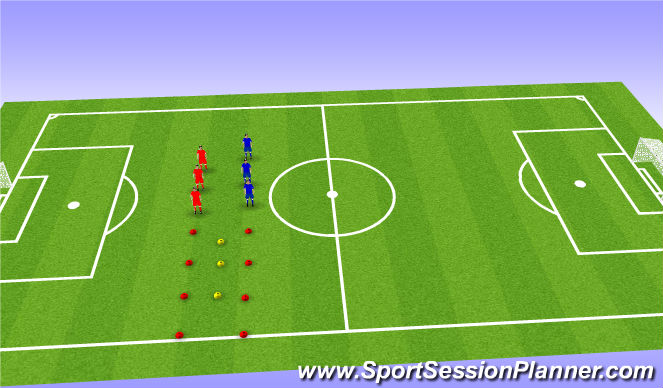
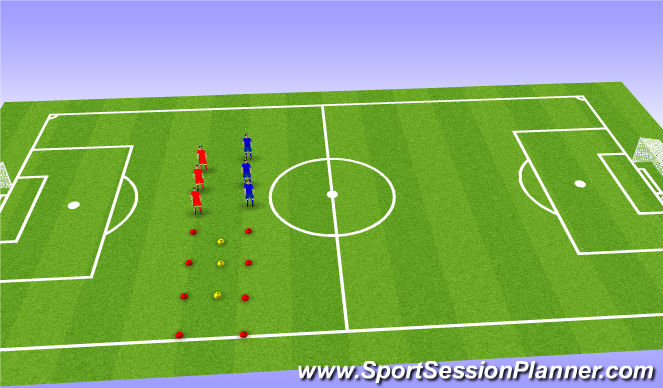
2 lines of cones roughly 5 yards apart
Each line of cones is 15 to 20 yards long (depending upon intensity of work-out)
Also put down 3 different coloured cones midway between the two columns
Organisation
Split your squad into two groups and have them run up the inside of the cones and back down the outside for each element of the warm-up
Different dynamic stretching elements can be:
- heel flicks
- touch the knees
- sideways skip
- carioca
- hamstring stretch
- Jump to head
- defensive jockey backwards
- defensive jockey forwards
- zig-zag
- touch in the middle
- sprints
After 10 minutes of dynamic streching, move on to phase 2
NB There is much debate whether static stretching is worthwhile or not. I prefer to allow players who wish to stretch any stiff muscles to do so....but only 2-3 minutes