


Football/Soccer Session (Academy Sessions): Creating Overloads in Central Areas In The Final Third


FAW Coach Ed
Dominic Doherty
Profile Summary

| Name: | Dominic Doherty |
|---|---|
| City: | Chester |
| Country: | United Kingdom |
| Membership: | Adult Member |
| Sport: | Football/Soccer |

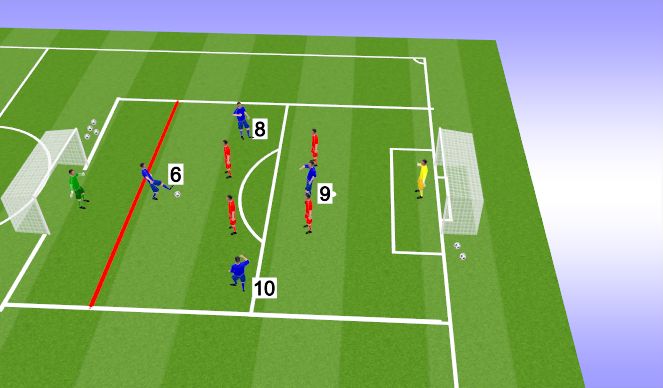
See the guidance at the top of this page to understand why you are not seeing interactive Football/Soccer images.
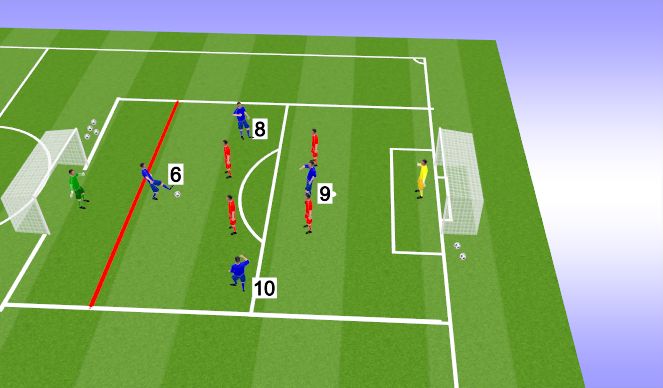
See the guidance at the top of this page to understand why you are not seeing interactive Football/Soccer images.
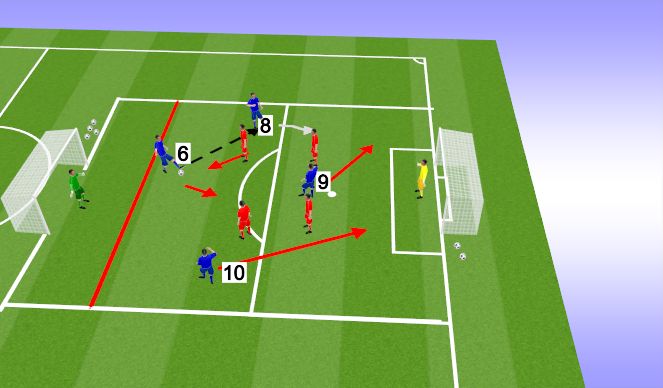
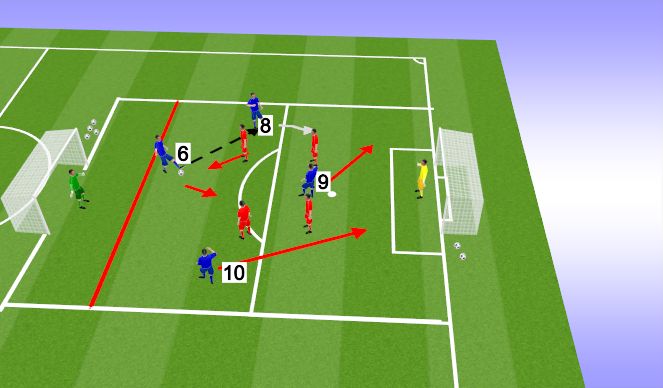
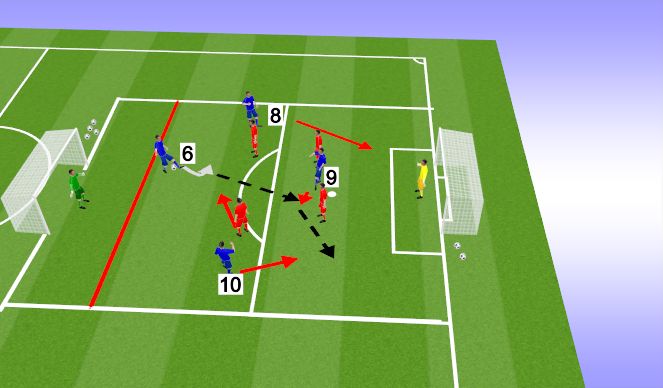
Scenario 1 - 6 Into 8,10
Key Factors
Free Play with 4 Footballs = Observation
Think about: Why is play breaking down? Are players ready to receive? Where are the blues starting positions?
How can they create overloads?
Organisation
- Blues pass between back 3 and keeper to move around the opposition midfielders. This will change the opponents distances giving the number 6 a choice to either drive, play a forward, or pass into the striker. Initially observe how the players do this with the first four footballs.
- Look for the first touch of the number 6 and the starting positions of 8, 10, and 9.
Intervention 1:
On the ball:
Before the number 6 receives the ball from the goalkeeper, can he open up his hips and scan over his left shoulder.
Then can he take a first touch forward with his back foot into the space ahead of him allowing him to have a range of passing options. (A touch sideways can be a pressing trigger and restricts passing options making players easier to defend therefore take the touch forward)
This will cause the nearest defender to make a decision to move forward and engage the ball or stay with their runner.
Scenario 1 - The nearest defender engages with the number 6:
If the nearest defender engages with the number 6 then he can pass the ball into the number 8 to create a 1v1.
Before the number 8 receives, can they be in a position beyond their opposing defender? And ensure their hips are opened and ready to receive side on.
The number 8 can receive the ball by opening his hips to receive the ball on the back foot (his left) in order to break the line of pressure.
Off the ball:
Trigger for the movements of number 9 and 10: As soon as number 8 has taken his first touch forwards.
The number 9 makes a a diagonal off the shoulder of the last defender towards the space in front of the number 8.
The number 10 makes a diagonal forward run towards the back post.
These movements give the number 8 a choice to:
1. Dribble inside
2. Play the ball down the line towards the number 9 who can either shoot/ cross to the 10,
3. Pass a ball through the space vacated by the 9 into the number 10 who is through on goal.
Which pass to play?
1.If the opposing centre back follows the number 9 then they can dribble inside for a shot or the pass into the number 10.
2. If he stays then the number 8 can pass down the line to the 9 for a cross/shot.
Same can be done with roles switched if the number 6 is receiving on the other side of the pitch.
Free Play for the next 6 footballs. Use this time to observe.
Look for:
- Blue Starting Positions
- The red reaction to this tactic to create overloads (likely they will learn how to defend. (look at how their starting position might change - lead into scenario 2)
- Number 6 first touch (body shape - are hips opened? Is weight on the back foot? Is it positive?)
See the guidance at the top of this page to understand why you are not seeing interactive Football/Soccer images.
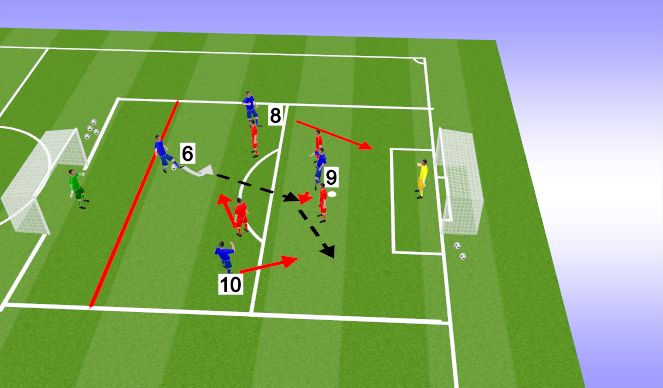
6 into 9.
Key Factors
- Whilst reds reset the footballs, show the blues this on a tactics board.
Scenario 2 - The opposition have read the last scenario, what now?
If the opposition midfielders are wider and locked onto the 8 and 10:
- The number 6 takes a positive first touch forward into the space using the outside of his foot.
- The number 6 plays with their head up and recognises that no opposing defender has come towards the ball so he takes another touch into the space.
- This extra touch has drawn pressure from one opposing defender (look to play down this side).
- This triggers the number 9 to pin the opposing centre half on that side.
- The number 6 passes into the 9 who receives the ball on his safe side.
- The 9 can turn and shoot, set the ball back to the 6, or play the 10 in with a reverse pass.
- The number 8 sprints across the furthest defender and forward towards the back post.
- Number 6 requires good ball speed with a firm pass using the inside or the laces of his foot. This ensures that the number 9 is more likely to receive the pass and reduce the chances of it being cut out.
Details for the number 9:
Their movement is as they see the opposing midfielder put pressure on the ball.
To pin the defender they should be side on so they are putting their body in front of them and the ball.
Use one arm to feel the defender and emphasise putting their body in between them and the ball by getting in a lower position - receive safe side (right foot).
Receive with the sole as its difficult for the defenders to see which way the 9 will turn.
If passing the ball into the 10, the 9 can take a touch back towards the pressure whilst pinning the defender - drawing both the centre back and the centre midfielder towards the ball.
The 9 will have to wrap their right foot around the ball to pass with their laces to the number 10 making the 3rd man run. The pass should be in front of them so they are able to receive it in their stride.
Around the ball:
The 8 and 10 start with their hips open beyond their opponent ready to receive the ball on their back foot.
As soon as the 9 is receiving the ball, that triggers the movements from the 8 and 10.
The number 10 runs forward and looks to receive the ball from a reverse pass from the number 9.
The number 8 makes a diagonal run towards the back post ready for any cross that may come in. This run is diagonal so they can get past the furthest centre half and be in a good position for a tap in at the back post.
Organisation
'%3E%3Cpath id='path4169' d='M 11.4375,70.25 C 11.457031,38.394531 37.277344,13.242188 68.253906,13.050781 99.78125,12.855469 125.73047,38.351563 125.8125,70.078125 125.89844,101.62109 100.43359,127.14063 69.148438,127.42188 37.582031,127.70703 11.464844,102.23438 11.4375,70.25 m 6.425781,-0.08984 c 0.03516,28.421871 23.027344,50.69922 50.519532,50.82031 C 96.433594,121.10156 119.30469,98.367188 119.38281,70.359375 119.45313,42.878906 97.382813,19.714844 69.015625,19.496094 40.75,19.277344 17.964844,42.035156 17.863281,70.160156' style='clip-rule:nonzero;fill:%23333f48;fill-opacity:1;fill-rule:nonzero;stroke:none' /%3E%3Cpath style='fill:%23333f48;fill-opacity:1;fill-rule:nonzero;stroke:none' d='m 39.789063,108.62109 c 0.28125,0.14454 0.550781,0.32032 0.839843,0.4336 2.734375,1.05469 5.554688,1.78125 8.453125,2.23047 2.734375,0.42578 5.484375,0.64453 8.25,0.54297 3.988282,-0.15625 7.832032,-0.94922 11.445313,-2.69532 1.683594,-0.8164 3.246094,-1.82422 4.640625,-3.07422 3.265625,-2.92578 5.171875,-6.582027 5.796875,-10.906246 0.546875,-3.761719 0.04687,-7.425781 -1.09375,-11.019531 -1.4375,-4.523438 -3.730469,-8.582032 -6.703125,-12.265625 -1.03125,-1.277344 -2.082031,-2.535157 -3.113281,-3.808594 C 66.789063,66.1875 65.332031,64.269531 64.0625,62.21875 c -1.601562,-2.582031 -2.835937,-5.316406 -3.613281,-8.261719 -0.683594,-2.574218 -0.902344,-5.1875 -0.6875,-7.828125 0.214844,-2.617187 0.910156,-5.117187 2.152344,-7.441406 2.164062,-4.050781 5.503906,-6.710937 9.816406,-8.179687 1.890625,-0.640625 3.835937,-1.058594 5.832031,-1.195313 1.121094,-0.07813 2.242188,-0.152344 3.363281,-0.164062 4.28125,-0.02734 8.4375,0.734375 12.453125,2.175781 1.871094,0.671875 3.6875,1.496094 5.523438,2.257812 0.226562,0.09375 0.4375,0.230469 0.664062,0.351563 -0.164062,0.25 -0.371093,0.160156 -0.539062,0.164062 -2.824219,0.101563 -5.535156,0.703125 -8.132813,1.804688 -1.335937,0.570312 -2.570312,1.316406 -3.648437,2.296875 -2.527344,2.296875 -3.605469,5.15625 -3.34375,8.550781 0.140625,1.855469 0.722656,3.574219 1.550781,5.222656 0.648438,1.296875 1.414063,2.523438 2.292969,3.675782 0.953125,1.25 1.929687,2.484375 2.929687,3.699218 2.085938,2.523438 4.164063,5.054688 6.050782,7.738282 2.203125,3.136718 4.140627,6.417968 5.589847,9.980468 1.16406,2.867188 2.01562,5.820313 2.39843,8.894532 0.25,2.011718 0.30079,4.03125 0.11719,6.058593 -0.24219,2.640625 -0.79297,5.195313 -1.74609,7.667969 -1.29688,3.36328 -3.300784,6.22656 -5.972659,8.63281 -2.429687,2.19141 -5.171875,3.90625 -8.109375,5.3125 -2.695312,1.29297 -5.464843,2.40235 -8.34375,3.20313 -1.953125,0.54687 -3.945312,0.8789 -5.949218,1.15625 -3.035157,0.41797 -6.085938,0.48828 -9.132813,0.3125 -5.328125,-0.3125 -10.476562,-1.46094 -15.410156,-3.52344 -3.449219,-1.44141 -6.691406,-3.25781 -9.757813,-5.39453 -0.183593,-0.12891 -0.378906,-0.25 -0.53125,-0.41016 -0.07031,-0.0703 -0.05859,-0.22656 -0.08203,-0.34375 z m 0,0' id='path4175' /%3E%3Cpath style='fill:%23333f48;fill-opacity:1;fill-rule:nonzero;stroke:none' d='M 94.699219,29.390625 C 94.089844,29.21875 93.476563,29.054688 92.867188,28.875 90.183594,28.085938 87.46875,27.441406 84.703125,27.046875 c -3.976562,-0.566406 -7.945312,-0.59375 -11.863281,0.402344 -7.535156,1.914062 -12.386719,6.71875 -14.878906,13.996094 -0.894532,2.617187 -1.179688,5.328125 -0.953125,8.078125 0.203125,2.484375 0.867187,4.859375 1.816406,7.160156 0.933594,2.261719 2.117187,4.390625 3.4375,6.449219 1.4375,2.25 3.050781,4.371093 4.640625,6.511718 1.4375,1.933594 2.867187,3.871094 4.261719,5.835938 1.230468,1.730469 2.316406,3.546875 3.273437,5.445312 1.324219,2.625 2.265625,5.378907 2.703125,8.292969 0.433594,2.902344 0.292969,5.765625 -0.660156,8.5625 -0.9375,2.74609 -2.574219,5.00781 -4.777344,6.875 -2.417969,2.04688 -5.203125,3.39844 -8.246094,4.22266 -1.835937,0.5 -3.703125,0.75781 -5.609375,0.82031 -3.886718,0.13281 -7.679687,-0.47266 -11.421875,-1.46094 -2.261718,-0.59765 -4.488281,-1.33203 -6.695312,-2.11328 -0.207031,-0.0742 -0.40625,-0.16797 -0.597656,-0.25 -0.02344,-0.24609 0.148437,-0.19141 0.25,-0.20703 1.96875,-0.30469 3.921875,-0.67969 5.804687,-1.34766 1.367188,-0.48437 2.671875,-1.10156 3.855469,-1.94922 2.25,-1.61328 3.65625,-3.765621 4.0625,-6.515621 0.273437,-1.867188 0.09375,-3.710938 -0.429688,-5.527344 -0.472656,-1.648437 -1.171875,-3.199219 -2.109375,-4.628906 -0.792968,-1.207031 -1.636718,-2.382813 -2.523437,-3.519531 -0.921875,-1.195313 -1.921875,-2.328125 -2.890625,-3.484375 -2.753906,-3.273438 -5.351563,-6.660157 -7.523438,-10.355469 -2.042968,-3.480469 -3.667968,-7.136719 -4.597656,-11.078125 -0.640625,-2.699219 -0.980469,-5.4375 -0.832031,-8.214844 0.238281,-4.53125 1.476562,-8.78125 3.824219,-12.6875 1.082031,-1.800781 2.445312,-3.375 3.988281,-4.800781 2.742187,-2.527344 5.863281,-4.480469 9.257812,-5.992188 3.746094,-1.667968 7.652344,-2.769531 11.707032,-3.394531 3.152343,-0.488281 6.324218,-0.671875 9.507812,-0.519531 8.632813,0.410156 16.671875,2.792969 24,7.433594 0.08203,0.05078 0.152344,0.109375 0.230469,0.167968 -0.0039,0.04297 -0.0078,0.08984 -0.01563,0.136719' id='path4177' /%3E%3Cpath style='fill:%23333f48;fill-opacity:1;fill-rule:nonzero;stroke:none' d='m 31.699219,38.75 c -0.07813,0.238281 -0.152344,0.476563 -0.238281,0.710938 -1.460938,4.074218 -2.066407,8.28125 -1.808594,12.59375 0.4375,7.304687 2.808594,13.925781 7.277344,19.753906 3.714843,4.84375 7.441406,9.671875 11.167968,14.503906 1.113282,1.441406 1.953125,3.007813 2.414063,4.777344 0.332031,1.257812 0.425781,2.539062 0.273437,3.820312 -0.214843,1.832032 -1.070312,3.34375 -2.464843,4.546875 -0.984375,0.851559 -2.113282,1.449219 -3.316407,1.925779 -1.378906,0.54297 -2.8125,0.89063 -4.273437,1.1211 -2.226563,0.35547 -4.46875,0.46093 -6.722656,0.41015 -0.589844,-0.0156 -1.046875,-0.18359 -1.433594,-0.625 -0.636719,-0.72265 -1.335938,-1.39062 -1.9375,-2.14062 C 25.574219,93.800781 22.300781,86.621094 20.84375,78.636719 20.152344,74.835938 19.917969,71 20.15625,67.128906 20.796875,56.773438 24.390625,47.574219 30.859375,39.480469 c 0.21875,-0.273438 0.453125,-0.53125 0.679688,-0.796875 0.05469,0.02344 0.109375,0.04297 0.160156,0.06641' id='path4179' /%3E%3Cpath style='fill:%23333f48;fill-opacity:1;fill-rule:nonzero;stroke:none' d='m 105.41016,101.30078 c -0.13282,-0.3125 0.0234,-0.5039 0.0977,-0.69922 1.38672,-3.749997 1.98047,-7.628904 1.89844,-11.621091 -0.14453,-6.84375 -2.08594,-13.144531 -5.73437,-18.925781 C 99.890625,67.226563 97.917969,64.53125 95.835938,61.917969 94.4375,60.160156 92.988281,58.4375 91.582031,56.6875 90.632813,55.511719 89.6875,54.335938 88.792969,53.121094 c -0.835938,-1.144531 -1.488281,-2.398438 -1.953125,-3.742188 -0.523438,-1.515625 -0.695313,-3.070312 -0.511719,-4.652343 0.21875,-1.839844 1.082031,-3.339844 2.476563,-4.542969 1.039062,-0.890625 2.230468,-1.507813 3.503906,-1.980469 1.632812,-0.609375 3.320312,-0.960937 5.046875,-1.175781 1.917969,-0.238281 3.839841,-0.269531 5.769531,-0.230469 0.52734,0.01172 0.89453,0.203125 1.23828,0.585938 5.50391,6.113281 9.26172,13.144531 11.21875,21.132812 1.11719,4.554688 1.5625,9.179688 1.30469,13.855469 -0.58203,10.625 -4.23438,20.082031 -10.96094,28.339846 -0.15625,0.1914 -0.32812,0.375 -0.51562,0.58984' id='path4181' /%3E%3Cpath style='fill:%23333f48;fill-opacity:1;fill-rule:nonzero;stroke:none' d='m 39.796875,108.63281 c -0.05859,0.0117 -0.117187,0.0234 -0.175781,0.0352 0.05469,-0.0156 0.113281,-0.0312 0.167969,-0.0469 z m 0,0' id='path4183' /%3E%3C/g%3E%3C/svg%3E)
 Play animation
 Play step-by-step
 Repeat (toggle)
 Full Screen
 Pause
Pause Stop
Stop
Screen 1 (15 mins)
Key Factors
Organisation
6 Footballs
4 Footballs start with the blue team next to the goal.
2 Footballs with the reds next to the goal.
2 Footballs with the reds to maintain motivation levels so they have a chance of creating a chance, if the blues win it back in this scenario then they play to create overloads as usual.
Progression: Add in this challenge: Play 6 footballs.
1 point for each time the blues score
1 point for the reds if they win it back and score.
Losing team after 6 footballs faces a forfeit.
Encourages the physical pillar and players giving 100% to win.
Regression: Reds can only tackle after 3 passes are made.
Before free play, show starting positions on a whiteboard to each team separately.
Blues:
No6 = To either side of the goalkeeper ready to receive.
No 8/10 = Start wide and beyond their opposite number.
No 9 = Start high and on the shoulder of the last defender.
Reds: Narrow and compact in their defensive two's.
- Change coaching position during free play to see different angles.
Starting coaching position = Next to goal to see how the starting positions of each player and the first touch of the no.6 affect the number 6's passing options.