


Football/Soccer Session (Academy Sessions): Defend the Switch of Play (Start Time: 2024-12-02 16:30:00)


FAW Coach Ed
Jun Chan
Profile Summary

| Name: | Jun Chan |
|---|---|
| City: | Pontypridd |
| Country: | United Kingdom |
| Membership: | Adult Member |
| Sport: | Football/Soccer |

Description
Topic: Defend the Switch of Play
The session is structured into three parts:
Specific Practice (20 minutes)
Small-Sided Game (20 minutes)
Specific Practice into Small-Sided Game (20 minutes)
Pitch area: half pitch
Players: U17s
Organisation:
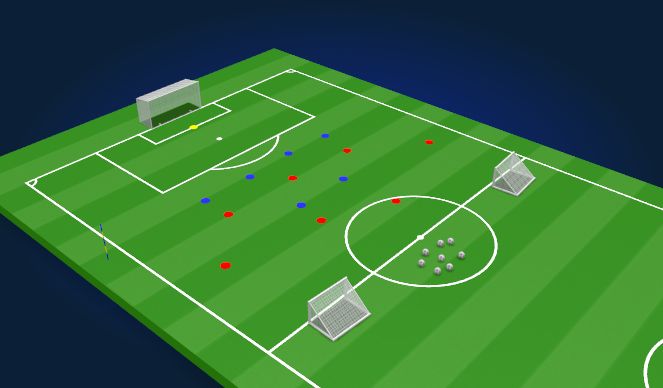
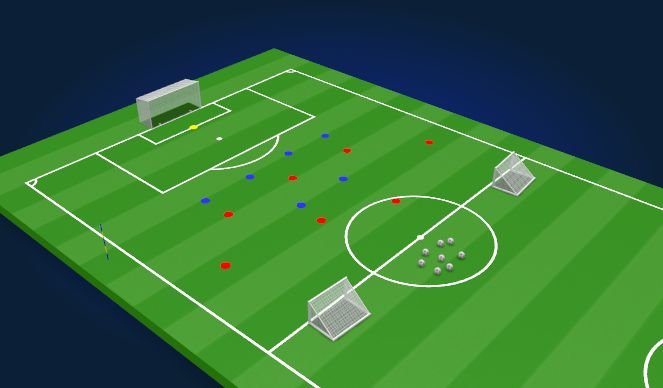
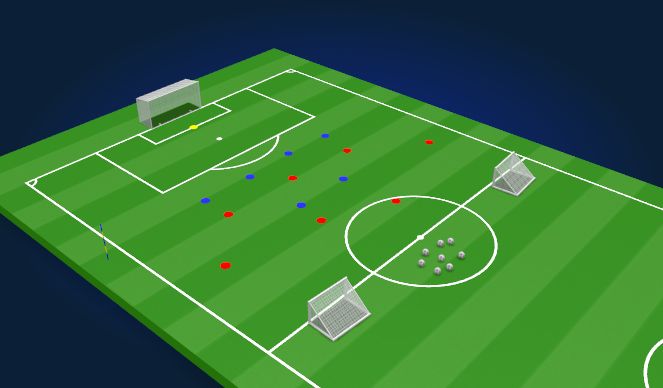
- The defending team will operate in a 4-4-2 shape, with four players withdrawn (LST, RST, LM, RM), leaving GK, LB, LCB, RCB, RB, LCM, RCM active. The attacking team will use a 3-4-3 shape, with four players withdrawn (GK, LCB, RCB, CCB), leaving LWB, RWB, LCM, RCM, LF, RF, CS active.
- The practice is conducted on half a pitch, with a standard goal for the defending team (out of possession) to protect and two mini-goals near the halfway line for the attacking team (in possession).
- Starting Point: Ball restarts from the central circle by the in-possession team every time the ball goes out of play.
OBJECTIVES (Outcomes)
Specific Practice Objective
Players (out of possession) will learn to recognize triggers for preventing a switch of play (e.g., pressure on the ball).
They will demonstrate effective defensive positioning and anticipation to force the opponent into predictable channels.
Small-Sided Game Objective
Defenders will apply the Welsh Game Model principles in a game realistic scenario to stop switches of play and protect central areas.
They will transition quickly from defense to attack upon regaining possession, looking to score in the mini-goals.
Specific Practice into Small-Sided Game Objective
Team Formations & Players
- Out of Possession (Defending Team | 4-4-2): GK, LB, LCB, RCB, RB, LCM, RCM
Withdrawn: LST, RST, LM, RM
- In Possession (Attacking Team | 3-4-3): LWB, RWB, LCM, RCM, LF, RF, CS
Withdrawn: GK, LCB, RCB, CCB
Roles & Responsibilities
- Out of Possession (Defending Team)
GK: Organizes the defensive line, communicates to keep shape compact.
LB, RB: Show opponent’s wide players away from goal, block forward passes.
LCB, RCB: Control space behind the line, stay close to each other to block central penetrations.
LCM, RCM: Press the midfield area, lock onto opposition central midfielders, screen passes to the forward line.
- In Possession (Attacking Team)
LWB, RWB: Provide width and attempt to switch play to opposite side.
LCM, RCM: Circulate possession centrally, look for forward passes or wide switches.
LF, RF: Offer wide outlet for switch, aim to penetrate behind defenders.
CS: Occupy central defenders, create space for wingers.
See the guidance at the top of this page to understand why you are not seeing interactive Football/Soccer images.
See the guidance at the top of this page to understand why you are not seeing interactive Football/Soccer images.
LSG (20 mins)
Duration: 2 x 8 minutes blocks + 4 minutes total rest/coach intervention
Block 1 (8 minutes), Rest (2 minutes), Block 2 (8 minutes), Rest (2 minutes)
Setup:
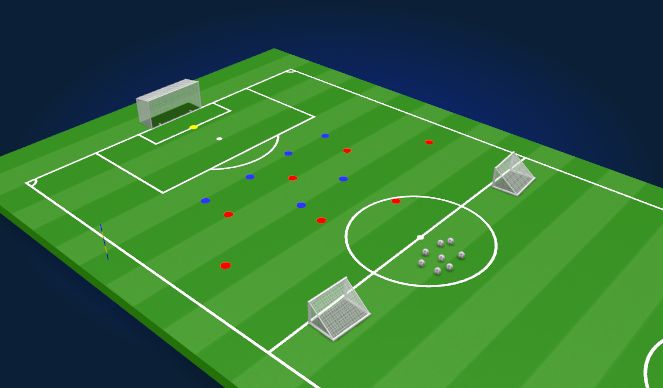
Half pitch. Full-size goal for the defending team. Two mini-goals for the attacking team.
7v7 (plus GK for out of possession team).
Normal in-possession vs. out-of-possession roles.
Conditions, Challenges, or Targets (Out of Possession Team)
Challenge: Stop switches of play by getting tight to the ball-side attacker.
Condition: If the defending team completes 3 successful interceptions in one block, they earn an extra point.
Target: Score in the mini-goals immediately upon regaining possession.
Danger Scenario
Scenario: The in-possession team’s LCM dribbles centrally, draws defenders in, then quickly reverses the play with a big switch to the RF who is unmarked wide.
Solution (Defensive Movements):RCM recognizes the switch and shifts quickly wide to press the RF.
RCB steps slightly to cover any pass in behind.
LB tucks in to block a diagonal run inside.
GK remains alert to an early cross.
Coaching Points
Protect Central Areas: Block penetrating passes through the middle.
Show Away from Goal: Force wingers to receive the ball nearer to the touchline.
Stop Switches of Play: Anticipate body shape of ball carrier; read triggers for long diagonal passes.
Control Space Behind the Last Line: Communicate effectively to ensure defenders move as a unit.
Coaching Interventions
Freeze: Pause when attackers prepare a long diagonal to highlight defenders’ movements.
Walkthrough: Demonstrate how RCM and RB shift quickly to prevent the cross.
Concurrent: Provide constant reminders (e.g., “Shift now!”).
Bullseye: Praise timely interceptions or compact team shape.
Physical Corner & Work to Rest Ratios
Similar work-to-rest ratio (8 minutes on, 2 minutes rest).
High-intensity transitional activities.
Emphasis on repeated sprint ability, predominantly Anaerobic systems.
Social & Psychological Corners
Team Meetings: Quick group huddle to discuss shape and communication.
Captains & Leadership: Defensive captain organizes and ensures immediate shift upon seeing a potential switch.
Problem-Solving: Encourage midfielders to recognize body shape triggers of opponents.
Confidence & Motivation: Celebrate successful defensive stands and transitions to attack.
See the guidance at the top of this page to understand why you are not seeing interactive Football/Soccer images.
Sp into LSG (20 mins)
Duration: 2 x 8 minutes blocks + 4 minutes total rest/coach intervention
Block 1 (8 minutes), Rest (2 minutes), Block 2 (8 minutes), Rest (2 minutes)
Setup & Progression
Start with a specific practice scenario (5 minutes) that transitions into a continuous small-sided game (3 minutes).
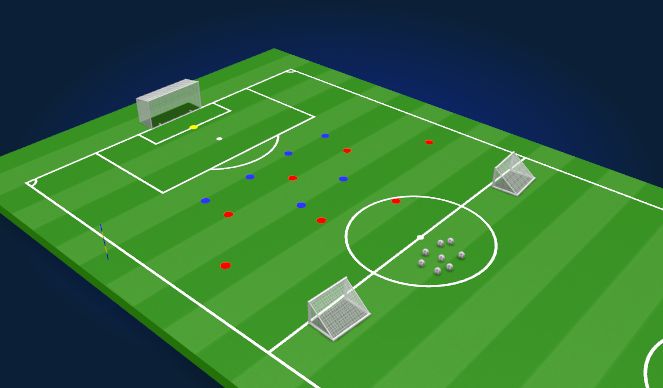
The same half-pitch layout: The out-of-possession team must apply the learned principles (force wide, pressure on the ball, leave furthest players).
Two Plays the In-Possession Team Might Execute
Wide Attack
LWB overlaps, receives the ball, and attempts a cutback or cross to CS.
Defensive Movement: RB steps to press, RCB tight on CS, LCB offers cover inside, LCM/RCM screen edge of the box.
Central Combination
LCM and RCM combine centrally, draw defenders in, then slip the ball to LF or RF.
Defensive Movement: LCM (defending) and RCM (defending) stay narrow, block passing lanes. LB and RB pinch in to cover space behind.
Conditions, Challenges, or Targets (Out of Possession Team)
Challenge: Deny the switch and force wide players into a compact zone near the touchline.
Condition: Every time the defending team forces the opponent into an ineffective cross, they earn a point.
Target: If they win possession, they have 6 seconds to create a counterattack to score in the mini-goals.
Coaching Points
Force Wide & Keep Play Predictable: Funnel attackers towards less dangerous areas.
Pressure on the Ball: Prevent the passers from lifting their heads for an easy switch.
Leave Furthest Players: Prioritize marking near threats; shift together to maintain compactness.
Stop Switches of Play: Read the passer’s intentions and cut passing lanes early.
Danger Scenario
Scenario: The in-possession team quickly transitions from midfield with a fast diagonal pass from LCM to RF.
Solution (Defensive Movements):LB anticipates and drops.
LCB slides across, maintaining distance to RCB to block the central run.
RCM sprints back to mark the RF if the LB is bypassed.
GK positions to cut angles and communicate effectively.
Coaching Interventions
Freeze: Stop the play at the moment of the long diagonal pass. Show the correct body orientation of the LB and LCB.
Walkthrough: Rehearse the collective shift from left to right side.
Bullseye: Reward quick and well-coordinated defensive transitions.
Concurrent: Provide immediate verbal prompts (e.g., “Close the gap!”, “Shift across!”).
Physical Corner & Work to Rest Ratios
Combination of short, intense specific practice (5 minutes) followed by a small-sided period (3 minutes).
Work:Rest ratio remains around 4:1, promoting anaerobic capacity development.
Social & Psychological Corners
Team Discussions: Encourage players to voice their observations on effective pressing triggers.
Leadership Roles: Encourage defenders to communicate each movement.
Confidence Building: Celebrate successful defensive scenarios with immediate positive feedback.
Problem-Solving: Players adapt solutions if the opponent finds new ways to switch play.
'%3E%3Cpath id='path4169' d='M 11.4375,70.25 C 11.457031,38.394531 37.277344,13.242188 68.253906,13.050781 99.78125,12.855469 125.73047,38.351563 125.8125,70.078125 125.89844,101.62109 100.43359,127.14063 69.148438,127.42188 37.582031,127.70703 11.464844,102.23438 11.4375,70.25 m 6.425781,-0.08984 c 0.03516,28.421871 23.027344,50.69922 50.519532,50.82031 C 96.433594,121.10156 119.30469,98.367188 119.38281,70.359375 119.45313,42.878906 97.382813,19.714844 69.015625,19.496094 40.75,19.277344 17.964844,42.035156 17.863281,70.160156' style='clip-rule:nonzero;fill:%23333f48;fill-opacity:1;fill-rule:nonzero;stroke:none' /%3E%3Cpath style='fill:%23333f48;fill-opacity:1;fill-rule:nonzero;stroke:none' d='m 39.789063,108.62109 c 0.28125,0.14454 0.550781,0.32032 0.839843,0.4336 2.734375,1.05469 5.554688,1.78125 8.453125,2.23047 2.734375,0.42578 5.484375,0.64453 8.25,0.54297 3.988282,-0.15625 7.832032,-0.94922 11.445313,-2.69532 1.683594,-0.8164 3.246094,-1.82422 4.640625,-3.07422 3.265625,-2.92578 5.171875,-6.582027 5.796875,-10.906246 0.546875,-3.761719 0.04687,-7.425781 -1.09375,-11.019531 -1.4375,-4.523438 -3.730469,-8.582032 -6.703125,-12.265625 -1.03125,-1.277344 -2.082031,-2.535157 -3.113281,-3.808594 C 66.789063,66.1875 65.332031,64.269531 64.0625,62.21875 c -1.601562,-2.582031 -2.835937,-5.316406 -3.613281,-8.261719 -0.683594,-2.574218 -0.902344,-5.1875 -0.6875,-7.828125 0.214844,-2.617187 0.910156,-5.117187 2.152344,-7.441406 2.164062,-4.050781 5.503906,-6.710937 9.816406,-8.179687 1.890625,-0.640625 3.835937,-1.058594 5.832031,-1.195313 1.121094,-0.07813 2.242188,-0.152344 3.363281,-0.164062 4.28125,-0.02734 8.4375,0.734375 12.453125,2.175781 1.871094,0.671875 3.6875,1.496094 5.523438,2.257812 0.226562,0.09375 0.4375,0.230469 0.664062,0.351563 -0.164062,0.25 -0.371093,0.160156 -0.539062,0.164062 -2.824219,0.101563 -5.535156,0.703125 -8.132813,1.804688 -1.335937,0.570312 -2.570312,1.316406 -3.648437,2.296875 -2.527344,2.296875 -3.605469,5.15625 -3.34375,8.550781 0.140625,1.855469 0.722656,3.574219 1.550781,5.222656 0.648438,1.296875 1.414063,2.523438 2.292969,3.675782 0.953125,1.25 1.929687,2.484375 2.929687,3.699218 2.085938,2.523438 4.164063,5.054688 6.050782,7.738282 2.203125,3.136718 4.140627,6.417968 5.589847,9.980468 1.16406,2.867188 2.01562,5.820313 2.39843,8.894532 0.25,2.011718 0.30079,4.03125 0.11719,6.058593 -0.24219,2.640625 -0.79297,5.195313 -1.74609,7.667969 -1.29688,3.36328 -3.300784,6.22656 -5.972659,8.63281 -2.429687,2.19141 -5.171875,3.90625 -8.109375,5.3125 -2.695312,1.29297 -5.464843,2.40235 -8.34375,3.20313 -1.953125,0.54687 -3.945312,0.8789 -5.949218,1.15625 -3.035157,0.41797 -6.085938,0.48828 -9.132813,0.3125 -5.328125,-0.3125 -10.476562,-1.46094 -15.410156,-3.52344 -3.449219,-1.44141 -6.691406,-3.25781 -9.757813,-5.39453 -0.183593,-0.12891 -0.378906,-0.25 -0.53125,-0.41016 -0.07031,-0.0703 -0.05859,-0.22656 -0.08203,-0.34375 z m 0,0' id='path4175' /%3E%3Cpath style='fill:%23333f48;fill-opacity:1;fill-rule:nonzero;stroke:none' d='M 94.699219,29.390625 C 94.089844,29.21875 93.476563,29.054688 92.867188,28.875 90.183594,28.085938 87.46875,27.441406 84.703125,27.046875 c -3.976562,-0.566406 -7.945312,-0.59375 -11.863281,0.402344 -7.535156,1.914062 -12.386719,6.71875 -14.878906,13.996094 -0.894532,2.617187 -1.179688,5.328125 -0.953125,8.078125 0.203125,2.484375 0.867187,4.859375 1.816406,7.160156 0.933594,2.261719 2.117187,4.390625 3.4375,6.449219 1.4375,2.25 3.050781,4.371093 4.640625,6.511718 1.4375,1.933594 2.867187,3.871094 4.261719,5.835938 1.230468,1.730469 2.316406,3.546875 3.273437,5.445312 1.324219,2.625 2.265625,5.378907 2.703125,8.292969 0.433594,2.902344 0.292969,5.765625 -0.660156,8.5625 -0.9375,2.74609 -2.574219,5.00781 -4.777344,6.875 -2.417969,2.04688 -5.203125,3.39844 -8.246094,4.22266 -1.835937,0.5 -3.703125,0.75781 -5.609375,0.82031 -3.886718,0.13281 -7.679687,-0.47266 -11.421875,-1.46094 -2.261718,-0.59765 -4.488281,-1.33203 -6.695312,-2.11328 -0.207031,-0.0742 -0.40625,-0.16797 -0.597656,-0.25 -0.02344,-0.24609 0.148437,-0.19141 0.25,-0.20703 1.96875,-0.30469 3.921875,-0.67969 5.804687,-1.34766 1.367188,-0.48437 2.671875,-1.10156 3.855469,-1.94922 2.25,-1.61328 3.65625,-3.765621 4.0625,-6.515621 0.273437,-1.867188 0.09375,-3.710938 -0.429688,-5.527344 -0.472656,-1.648437 -1.171875,-3.199219 -2.109375,-4.628906 -0.792968,-1.207031 -1.636718,-2.382813 -2.523437,-3.519531 -0.921875,-1.195313 -1.921875,-2.328125 -2.890625,-3.484375 -2.753906,-3.273438 -5.351563,-6.660157 -7.523438,-10.355469 -2.042968,-3.480469 -3.667968,-7.136719 -4.597656,-11.078125 -0.640625,-2.699219 -0.980469,-5.4375 -0.832031,-8.214844 0.238281,-4.53125 1.476562,-8.78125 3.824219,-12.6875 1.082031,-1.800781 2.445312,-3.375 3.988281,-4.800781 2.742187,-2.527344 5.863281,-4.480469 9.257812,-5.992188 3.746094,-1.667968 7.652344,-2.769531 11.707032,-3.394531 3.152343,-0.488281 6.324218,-0.671875 9.507812,-0.519531 8.632813,0.410156 16.671875,2.792969 24,7.433594 0.08203,0.05078 0.152344,0.109375 0.230469,0.167968 -0.0039,0.04297 -0.0078,0.08984 -0.01563,0.136719' id='path4177' /%3E%3Cpath style='fill:%23333f48;fill-opacity:1;fill-rule:nonzero;stroke:none' d='m 31.699219,38.75 c -0.07813,0.238281 -0.152344,0.476563 -0.238281,0.710938 -1.460938,4.074218 -2.066407,8.28125 -1.808594,12.59375 0.4375,7.304687 2.808594,13.925781 7.277344,19.753906 3.714843,4.84375 7.441406,9.671875 11.167968,14.503906 1.113282,1.441406 1.953125,3.007813 2.414063,4.777344 0.332031,1.257812 0.425781,2.539062 0.273437,3.820312 -0.214843,1.832032 -1.070312,3.34375 -2.464843,4.546875 -0.984375,0.851559 -2.113282,1.449219 -3.316407,1.925779 -1.378906,0.54297 -2.8125,0.89063 -4.273437,1.1211 -2.226563,0.35547 -4.46875,0.46093 -6.722656,0.41015 -0.589844,-0.0156 -1.046875,-0.18359 -1.433594,-0.625 -0.636719,-0.72265 -1.335938,-1.39062 -1.9375,-2.14062 C 25.574219,93.800781 22.300781,86.621094 20.84375,78.636719 20.152344,74.835938 19.917969,71 20.15625,67.128906 20.796875,56.773438 24.390625,47.574219 30.859375,39.480469 c 0.21875,-0.273438 0.453125,-0.53125 0.679688,-0.796875 0.05469,0.02344 0.109375,0.04297 0.160156,0.06641' id='path4179' /%3E%3Cpath style='fill:%23333f48;fill-opacity:1;fill-rule:nonzero;stroke:none' d='m 105.41016,101.30078 c -0.13282,-0.3125 0.0234,-0.5039 0.0977,-0.69922 1.38672,-3.749997 1.98047,-7.628904 1.89844,-11.621091 -0.14453,-6.84375 -2.08594,-13.144531 -5.73437,-18.925781 C 99.890625,67.226563 97.917969,64.53125 95.835938,61.917969 94.4375,60.160156 92.988281,58.4375 91.582031,56.6875 90.632813,55.511719 89.6875,54.335938 88.792969,53.121094 c -0.835938,-1.144531 -1.488281,-2.398438 -1.953125,-3.742188 -0.523438,-1.515625 -0.695313,-3.070312 -0.511719,-4.652343 0.21875,-1.839844 1.082031,-3.339844 2.476563,-4.542969 1.039062,-0.890625 2.230468,-1.507813 3.503906,-1.980469 1.632812,-0.609375 3.320312,-0.960937 5.046875,-1.175781 1.917969,-0.238281 3.839841,-0.269531 5.769531,-0.230469 0.52734,0.01172 0.89453,0.203125 1.23828,0.585938 5.50391,6.113281 9.26172,13.144531 11.21875,21.132812 1.11719,4.554688 1.5625,9.179688 1.30469,13.855469 -0.58203,10.625 -4.23438,20.082031 -10.96094,28.339846 -0.15625,0.1914 -0.32812,0.375 -0.51562,0.58984' id='path4181' /%3E%3Cpath style='fill:%23333f48;fill-opacity:1;fill-rule:nonzero;stroke:none' d='m 39.796875,108.63281 c -0.05859,0.0117 -0.117187,0.0234 -0.175781,0.0352 0.05469,-0.0156 0.113281,-0.0312 0.167969,-0.0469 z m 0,0' id='path4183' /%3E%3C/g%3E%3C/svg%3E)
 Play animation
 Play step-by-step
 Repeat (toggle)
 Full Screen
 Pause
Pause Stop
Stop
specific practices (20 mins)
Duration: 2 x 8 minutes blocks + 4 minutes total rest/coach intervention
Block 1 (8 minutes), Rest (2 minutes), Block 2 (8 minutes), Rest (2 minutes)
Setup:
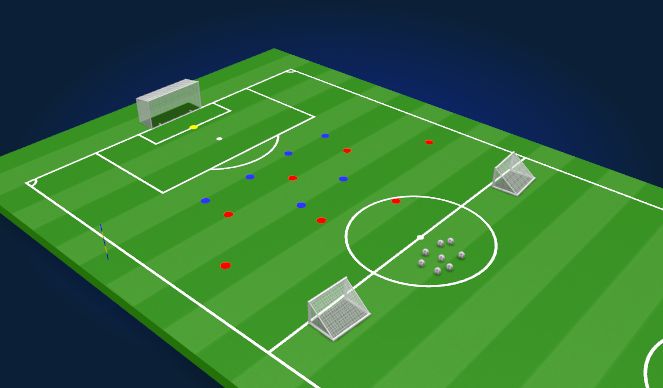
Half pitch.
Start in the central circle with the attacking team.
Defending team (7 players + GK) set up in a compact 4-4-2 shape minus the withdrawn players (this session uses only 1 striker line, 2 midfielders, 4 defenders + GK).
Attacking team attempts to circulate the ball to find a switch from one wide area to the other.
Conditions, Challenges, or Targets (Out of Possession Team)
Challenge: Defend narrow initially, then move to press once the ball is traveling to the flank.
Condition: If the defending team prevents the switch for 8 seconds, they earn 1 point.
Target: If they recover the ball, they must quickly attempt to score in the mini-goals.
Danger Scenario
Scenario: Opposing LWB and RWB exchange passes quickly and attempt a diagonal switch to the RF on the far side.
Solution (Defensive Movements):LB steps up to press as soon as the ball travels to the LWB.
LCB narrows the gap with the RB to cover any diagonal pass.
RCM drops deeper to block passing lane to RF.
GK remains ready to sweep if any through ball passes beyond the back line.
Coaching Points (Technical & Tactical)
Force Wide: Show the ball carrier away from central areas.
Keep Play Predictable: Maintain a compact shape; don’t allow passing lanes through central zones.
Pressure on the Ball: Quick and aggressive press on the ball receiver to reduce their time.
Leave the Furthest Players: Focus on closer threats; furthest attackers can be left unless they become an immediate danger.
Coaching Interventions
Freeze: Stop the play when the switch is about to happen to demonstrate correct positioning (e.g., LB’s body shape).
Walkthrough: Guide defenders through the step-by-step movements.
Bullseye: After a successful interception, highlight (praise) the correct trigger recognition.
Concurrent: Offer quick reminders to press or shift while the game is active.
Physical Corner & Work to Rest Ratios
Players operate in high-intensity intervals (8-minute blocks).
Work:Rest ratio is approximately 4:1 within each block due to continuous defensive and offensive transitions.
Dominant energy system: Anaerobic (ATP-PC & Glycolytic) due to repeated sprints and high-intensity defensive presses (Cronin & Oliver, 2010).
Social & Psychological Corners
Team Meetings: Short huddle to identify successful pressing triggers.
Captains: Defensive captain organizes back line. Midfielder captain organizes pressing shape.
Problem-Solving Tasks: Encourage players to communicate the best moment to press or drop.
Confidence & Focus: Reinforce positivity when successfully preventing a switch.