


Football/Soccer Session (Moderate): Week 11 - Game Based. Constraint Lead - Overloads vs Underloads in the middle 1/3
Profile Summary

| Name: | Robert Spour |
|---|---|
| City: | Gainsborough |
| Country: | United Kingdom |
| Membership: | Adult Member |
| Sport: | Football/Soccer |

Description
Topic: Overloads Vs Underloads in the middle third.
Individual Technical Framework: Eminitating Skills
Psych Pillar: Presence
DRFC Club Philosophy:
- D(Desire)
- R(Resillience)
- F(Focus)
- C(Creativity)
Intentions: The intention of the session will exploit players to playing in both and overload and underload situations. Problem solving and decision making will come out through play and then use of qurestions to provoke through around decisions. The coaching focus will be on the team with the underload. This will also allow a focus on the technical framework of eliminating skills usings side moves and turns to get away from pressure and forward moves to eliminate opponents.
Aim: By the end of the session players should have displayed an understaning of how to deal with an underload situation not allowing the team with the overload to exploit the situation and create, and convert scoreing chances. Players that Delay, and protect in an underload can they find ways to control the moment and then look to penetrate themselves as a team.
Principles of Play: The session will work on dealing with the underload both starting IP, and OP so there will be a consideration and application of both attacking and defending principles of play.
- IP Main Focus - Creativity, Support play, Penetrate
- OP Main Focus - Delay, Patience, Compactness, and providing cover.
Core Technical Skills: .Again the underloaded team will need to display technical skills in both attacking and defending.
- Turning and moving with the ball when in posession.
- Covering, Intercepting, and challanging when out of possession.
Player Engagement: Players will be engaged through the challange of being succesful in the underload and the sense of achievemnet success in adversity brings. Through the use of considered questiion technique to help guide the players to solutions through their own thinking action patterns, rather than the coach being the fixer. Praise for aligning with the club philosophy. The underload team will have to dispaly all aspects of the philoposhy and a winning mentatlity to achieve successful outcomes.
Individual Player Profiling:
.
Coach Behaviours: Coaching intentions will be to blend the democratic coaching style with the holistic coaching style to give the players ownership and a voice, while also considering the person as well as the player. Coach shouldn't guide decision making during play and be confident to let the game play out and observe for patterns. Once a pattern is noticed does this impact the purpose of the game, and the overall objective? If so guide the player using there own knowledge through question-answer patterns to find solutions and then encourage to apply. Celebrate successful attempts as wins with the players.
Safety Considerations: Direction of play relative to other gorups. Balls flying. This session will bring out a lot of physicality between players. Encourage and allow good strong use of the body. Stamp out fouls, over aggressivve play early as it hinders learning outcomes and transfers poorly in to matchdays. Players must learn how to protect, and challange for a ball physically, but fairly.
Additional Notes: Placement of training aids is key. Especially availability and retrivial of stray balls to keep flow. Spend time prior re considering clear concise explanations and question techniques.
See the guidance at the top of this page to understand why you are not seeing interactive Football/Soccer images.
Learning Objectives

|
Technical Eliminating Skills |

|
Tactical Support play. Risk and retain Decisions |

|
Physical Use of body to protect and challange. Desire to recover and cover. |

|
Psychological Presence - Eye contact. Positive. Focused. Engaged. |

|
Social Verbal communication and leadership within a group to help each other find solutions as a team. Willing to contribute in question, answer, pattern discussions. Contributes ideas to finding solutions to problems. |
See the guidance at the top of this page to understand why you are not seeing interactive Football/Soccer images.
Learning Objectives
|
|
Technical Eliminating Skills |
|
|
Tactical Support play. Risk and retain Decisions |
|
|
Physical Use of body to protect and challange. Desire to recover and cover. |
|
|
Psychological Presence - Eye contact. Positive. Focused. Engaged. |
|
|
Social Verbal communication and leadership within a group to help each other find solutions as a team. Willing to contribute in question, answer, pattern discussions. Contributes ideas to finding solutions to problems. |
Phase 2 (40 mins)
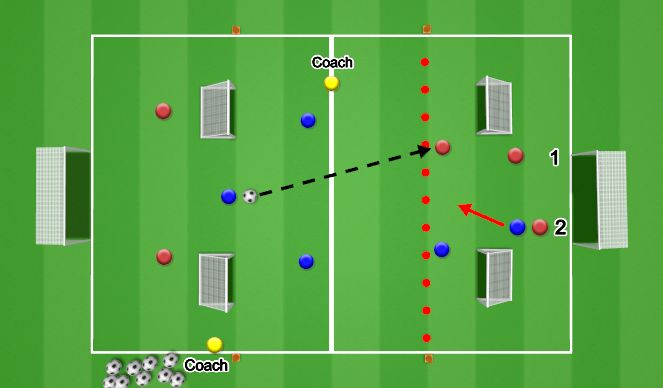
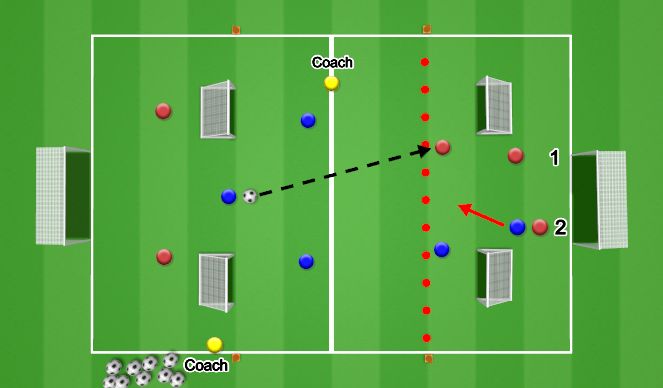
Title: Beat the Overload
Practice Spectrum: Overload/Underload/Match up.
Work 8 Rest 2 (X 4) On rotations.
STEP:
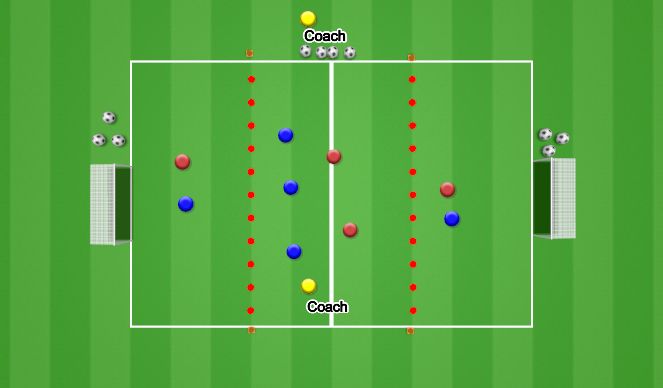
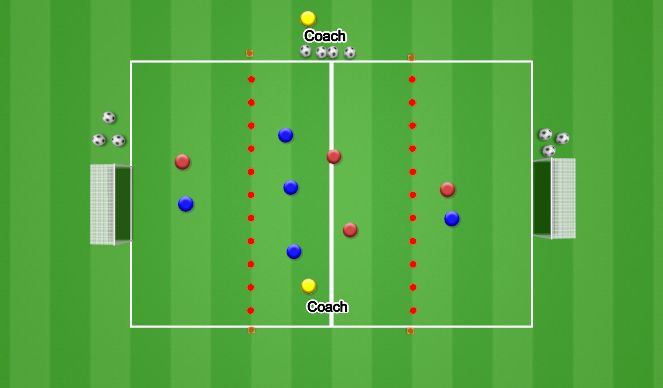
S: 30m x 20m
T: Deal with a temporary overload in a positive transition by protecting, penetrating.
E: Mini goals. B.B.C. Flats.
P: 3v2 and/or 2v1
Explanation of phase:
Overload team plays a driven pass in to the feet of the underload player (Replicating a driven pass forward that is then intercepted). The underload players are then looking to pass in to a break out goal (Replicating a forward pass to an attacking team member). Or score in the big goal. To add realism if the underload team protect and remain in possession for 15 seconds (be willing to adapt this to challange level required, and to achieve understanding of what it would look like in a game) then a player from line 2 joins the underload team.
(Repliacting a game like situation where an overload/ounderload situation is momentary (15 seconds longer than game but presents challange for longer to team in underload for more learning opputunities). Play continues until either team scores in break out goal, or big goal. Next sets of players step in play again. Players rotate between line one and two while playing in the underload team to offer variation in scenarios and decisions.
1 goal for break out goal (Pass forward). 3 Goals for scoring in big goal. The forward pass can not hold the same significance as scoring as it wouldn't in a game!
Constraint:
Underload/overload only lasts 15 seconds.
Questions:
What did we learn in phase 1 that we can apply to increase success in phase 2?
When we first recieve in an underload what must we be aware of? (Opposition/Team mate/ available space/ oppurtunity to penetrate quickly)
In an underload during a positve transition when are they least organised to prevent you playing forward and defeating the overload?
Challanges:
Can we protect the ball as a pair?
What turns and eliminating skills have you got to get you out of trouble?
Can we manage our risk and retain decisions for success out comes? (Explain what we mean by this)
Coaching Points:
- Risk and retain decisions
- Use of body when protecting the ball
- Recovering quickly in negative transition (Delay/Angle of press/Position of supporting players cover)
See the guidance at the top of this page to understand why you are not seeing interactive Football/Soccer images.
Learning Objectives
|
|
Technical Eliminating Skills |
|
|
Tactical Support play. Risk and retain Decisions |
|
|
Physical Use of body to protect and challange. Desire to recover and cover. |
|
|
Psychological Presence - Eye contact. Positive. Focused. Engaged. |
|
|
Social Verbal communication and leadership within a group to help each other find solutions as a team. Willing to contribute in question, answer, pattern discussions. Contributes ideas to finding solutions to problems. |
Phase 3 (25 mins)
Title: Cope with the underload.
Practice Spectrum: Overload/Underload
work 6 rest 1. (x3) Switch the underload after match 1. No constraints after match 2. Can players recognise when they are underoaded and deal with the situation in a game sitaution?
STEP:
S: 30m x 20m
T: Win, It's a game. Manange your underload. Exploit your overload.
E: B.B.C
P: 5v4, 6v5
Explanation of phase:
Play a match. Normal rules and intentions. Observe to seen if players apply session topics in challanging situations.
Constraint:
Underload team are restricted to their thirds.
Questions:
How do we recognise an underload?
How are we going to deal with it?
How will we prevent the other team from gaining an advantage in overload situations (delay/dictate/deny)
What were tonights topic?
Tell me one thing you've remebered from tonight you will use in a game?
What did you find challanging, and how did you solve it?
Challanges:
Manage the underload. Frustrate, and punish the team with the overload. Prove hardwork and good decisions win games.
Coaching Points:
- No coaching now observe application. Praise intention and attempted decisions that align with learning outcomes.
FINISH WITH RACES. ADD CHALLANGE TO THE RUNNING. PAIRS RELAYS!
'%3E%3Cpath id='path4169' d='M 11.4375,70.25 C 11.457031,38.394531 37.277344,13.242188 68.253906,13.050781 99.78125,12.855469 125.73047,38.351563 125.8125,70.078125 125.89844,101.62109 100.43359,127.14063 69.148438,127.42188 37.582031,127.70703 11.464844,102.23438 11.4375,70.25 m 6.425781,-0.08984 c 0.03516,28.421871 23.027344,50.69922 50.519532,50.82031 C 96.433594,121.10156 119.30469,98.367188 119.38281,70.359375 119.45313,42.878906 97.382813,19.714844 69.015625,19.496094 40.75,19.277344 17.964844,42.035156 17.863281,70.160156' style='clip-rule:nonzero;fill:%23333f48;fill-opacity:1;fill-rule:nonzero;stroke:none' /%3E%3Cpath style='fill:%23333f48;fill-opacity:1;fill-rule:nonzero;stroke:none' d='m 39.789063,108.62109 c 0.28125,0.14454 0.550781,0.32032 0.839843,0.4336 2.734375,1.05469 5.554688,1.78125 8.453125,2.23047 2.734375,0.42578 5.484375,0.64453 8.25,0.54297 3.988282,-0.15625 7.832032,-0.94922 11.445313,-2.69532 1.683594,-0.8164 3.246094,-1.82422 4.640625,-3.07422 3.265625,-2.92578 5.171875,-6.582027 5.796875,-10.906246 0.546875,-3.761719 0.04687,-7.425781 -1.09375,-11.019531 -1.4375,-4.523438 -3.730469,-8.582032 -6.703125,-12.265625 -1.03125,-1.277344 -2.082031,-2.535157 -3.113281,-3.808594 C 66.789063,66.1875 65.332031,64.269531 64.0625,62.21875 c -1.601562,-2.582031 -2.835937,-5.316406 -3.613281,-8.261719 -0.683594,-2.574218 -0.902344,-5.1875 -0.6875,-7.828125 0.214844,-2.617187 0.910156,-5.117187 2.152344,-7.441406 2.164062,-4.050781 5.503906,-6.710937 9.816406,-8.179687 1.890625,-0.640625 3.835937,-1.058594 5.832031,-1.195313 1.121094,-0.07813 2.242188,-0.152344 3.363281,-0.164062 4.28125,-0.02734 8.4375,0.734375 12.453125,2.175781 1.871094,0.671875 3.6875,1.496094 5.523438,2.257812 0.226562,0.09375 0.4375,0.230469 0.664062,0.351563 -0.164062,0.25 -0.371093,0.160156 -0.539062,0.164062 -2.824219,0.101563 -5.535156,0.703125 -8.132813,1.804688 -1.335937,0.570312 -2.570312,1.316406 -3.648437,2.296875 -2.527344,2.296875 -3.605469,5.15625 -3.34375,8.550781 0.140625,1.855469 0.722656,3.574219 1.550781,5.222656 0.648438,1.296875 1.414063,2.523438 2.292969,3.675782 0.953125,1.25 1.929687,2.484375 2.929687,3.699218 2.085938,2.523438 4.164063,5.054688 6.050782,7.738282 2.203125,3.136718 4.140627,6.417968 5.589847,9.980468 1.16406,2.867188 2.01562,5.820313 2.39843,8.894532 0.25,2.011718 0.30079,4.03125 0.11719,6.058593 -0.24219,2.640625 -0.79297,5.195313 -1.74609,7.667969 -1.29688,3.36328 -3.300784,6.22656 -5.972659,8.63281 -2.429687,2.19141 -5.171875,3.90625 -8.109375,5.3125 -2.695312,1.29297 -5.464843,2.40235 -8.34375,3.20313 -1.953125,0.54687 -3.945312,0.8789 -5.949218,1.15625 -3.035157,0.41797 -6.085938,0.48828 -9.132813,0.3125 -5.328125,-0.3125 -10.476562,-1.46094 -15.410156,-3.52344 -3.449219,-1.44141 -6.691406,-3.25781 -9.757813,-5.39453 -0.183593,-0.12891 -0.378906,-0.25 -0.53125,-0.41016 -0.07031,-0.0703 -0.05859,-0.22656 -0.08203,-0.34375 z m 0,0' id='path4175' /%3E%3Cpath style='fill:%23333f48;fill-opacity:1;fill-rule:nonzero;stroke:none' d='M 94.699219,29.390625 C 94.089844,29.21875 93.476563,29.054688 92.867188,28.875 90.183594,28.085938 87.46875,27.441406 84.703125,27.046875 c -3.976562,-0.566406 -7.945312,-0.59375 -11.863281,0.402344 -7.535156,1.914062 -12.386719,6.71875 -14.878906,13.996094 -0.894532,2.617187 -1.179688,5.328125 -0.953125,8.078125 0.203125,2.484375 0.867187,4.859375 1.816406,7.160156 0.933594,2.261719 2.117187,4.390625 3.4375,6.449219 1.4375,2.25 3.050781,4.371093 4.640625,6.511718 1.4375,1.933594 2.867187,3.871094 4.261719,5.835938 1.230468,1.730469 2.316406,3.546875 3.273437,5.445312 1.324219,2.625 2.265625,5.378907 2.703125,8.292969 0.433594,2.902344 0.292969,5.765625 -0.660156,8.5625 -0.9375,2.74609 -2.574219,5.00781 -4.777344,6.875 -2.417969,2.04688 -5.203125,3.39844 -8.246094,4.22266 -1.835937,0.5 -3.703125,0.75781 -5.609375,0.82031 -3.886718,0.13281 -7.679687,-0.47266 -11.421875,-1.46094 -2.261718,-0.59765 -4.488281,-1.33203 -6.695312,-2.11328 -0.207031,-0.0742 -0.40625,-0.16797 -0.597656,-0.25 -0.02344,-0.24609 0.148437,-0.19141 0.25,-0.20703 1.96875,-0.30469 3.921875,-0.67969 5.804687,-1.34766 1.367188,-0.48437 2.671875,-1.10156 3.855469,-1.94922 2.25,-1.61328 3.65625,-3.765621 4.0625,-6.515621 0.273437,-1.867188 0.09375,-3.710938 -0.429688,-5.527344 -0.472656,-1.648437 -1.171875,-3.199219 -2.109375,-4.628906 -0.792968,-1.207031 -1.636718,-2.382813 -2.523437,-3.519531 -0.921875,-1.195313 -1.921875,-2.328125 -2.890625,-3.484375 -2.753906,-3.273438 -5.351563,-6.660157 -7.523438,-10.355469 -2.042968,-3.480469 -3.667968,-7.136719 -4.597656,-11.078125 -0.640625,-2.699219 -0.980469,-5.4375 -0.832031,-8.214844 0.238281,-4.53125 1.476562,-8.78125 3.824219,-12.6875 1.082031,-1.800781 2.445312,-3.375 3.988281,-4.800781 2.742187,-2.527344 5.863281,-4.480469 9.257812,-5.992188 3.746094,-1.667968 7.652344,-2.769531 11.707032,-3.394531 3.152343,-0.488281 6.324218,-0.671875 9.507812,-0.519531 8.632813,0.410156 16.671875,2.792969 24,7.433594 0.08203,0.05078 0.152344,0.109375 0.230469,0.167968 -0.0039,0.04297 -0.0078,0.08984 -0.01563,0.136719' id='path4177' /%3E%3Cpath style='fill:%23333f48;fill-opacity:1;fill-rule:nonzero;stroke:none' d='m 31.699219,38.75 c -0.07813,0.238281 -0.152344,0.476563 -0.238281,0.710938 -1.460938,4.074218 -2.066407,8.28125 -1.808594,12.59375 0.4375,7.304687 2.808594,13.925781 7.277344,19.753906 3.714843,4.84375 7.441406,9.671875 11.167968,14.503906 1.113282,1.441406 1.953125,3.007813 2.414063,4.777344 0.332031,1.257812 0.425781,2.539062 0.273437,3.820312 -0.214843,1.832032 -1.070312,3.34375 -2.464843,4.546875 -0.984375,0.851559 -2.113282,1.449219 -3.316407,1.925779 -1.378906,0.54297 -2.8125,0.89063 -4.273437,1.1211 -2.226563,0.35547 -4.46875,0.46093 -6.722656,0.41015 -0.589844,-0.0156 -1.046875,-0.18359 -1.433594,-0.625 -0.636719,-0.72265 -1.335938,-1.39062 -1.9375,-2.14062 C 25.574219,93.800781 22.300781,86.621094 20.84375,78.636719 20.152344,74.835938 19.917969,71 20.15625,67.128906 20.796875,56.773438 24.390625,47.574219 30.859375,39.480469 c 0.21875,-0.273438 0.453125,-0.53125 0.679688,-0.796875 0.05469,0.02344 0.109375,0.04297 0.160156,0.06641' id='path4179' /%3E%3Cpath style='fill:%23333f48;fill-opacity:1;fill-rule:nonzero;stroke:none' d='m 105.41016,101.30078 c -0.13282,-0.3125 0.0234,-0.5039 0.0977,-0.69922 1.38672,-3.749997 1.98047,-7.628904 1.89844,-11.621091 -0.14453,-6.84375 -2.08594,-13.144531 -5.73437,-18.925781 C 99.890625,67.226563 97.917969,64.53125 95.835938,61.917969 94.4375,60.160156 92.988281,58.4375 91.582031,56.6875 90.632813,55.511719 89.6875,54.335938 88.792969,53.121094 c -0.835938,-1.144531 -1.488281,-2.398438 -1.953125,-3.742188 -0.523438,-1.515625 -0.695313,-3.070312 -0.511719,-4.652343 0.21875,-1.839844 1.082031,-3.339844 2.476563,-4.542969 1.039062,-0.890625 2.230468,-1.507813 3.503906,-1.980469 1.632812,-0.609375 3.320312,-0.960937 5.046875,-1.175781 1.917969,-0.238281 3.839841,-0.269531 5.769531,-0.230469 0.52734,0.01172 0.89453,0.203125 1.23828,0.585938 5.50391,6.113281 9.26172,13.144531 11.21875,21.132812 1.11719,4.554688 1.5625,9.179688 1.30469,13.855469 -0.58203,10.625 -4.23438,20.082031 -10.96094,28.339846 -0.15625,0.1914 -0.32812,0.375 -0.51562,0.58984' id='path4181' /%3E%3Cpath style='fill:%23333f48;fill-opacity:1;fill-rule:nonzero;stroke:none' d='m 39.796875,108.63281 c -0.05859,0.0117 -0.117187,0.0234 -0.175781,0.0352 0.05469,-0.0156 0.113281,-0.0312 0.167969,-0.0469 z m 0,0' id='path4183' /%3E%3C/g%3E%3C/svg%3E)
 Play animation
 Play step-by-step
 Repeat (toggle)
 Full Screen
 Pause
Pause Stop
Stop
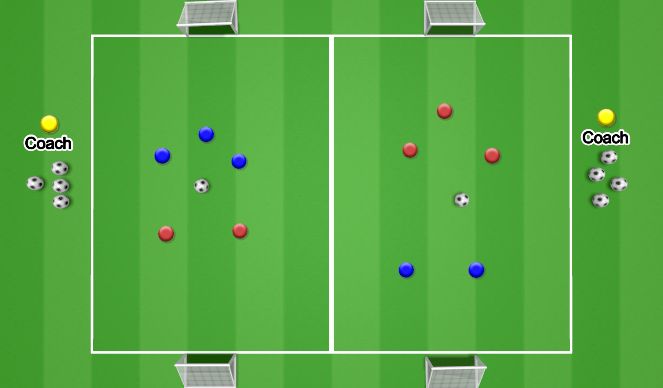
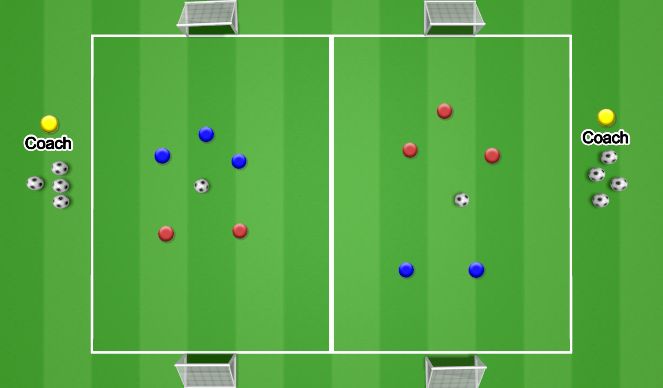
Phase 1 (25 mins)
Title: Overload SSGs
Play 4 games. Work 4, Rest 1. Switch underload teams after match one. Move player from overload team to underload team after match 2. Rotate underload teams again after match 3. Variety of oppoaition. Everyone plays at least two matches as the underloaded team.
Practice Spectrum: Overload/Underload.
STEP:
- S: 2 pitches 15mx10m
- T: Win - It's a match.
- E: Mini goals. B.B.C. Whiteboard on arrival.
- P: 3v2 (Ideally), 4v2, 4v3, 2v1
Explanation Of Phase:Match with overload. Play normal rules. 3 goals for scoring in the break out goal. 1 goal for dribbling over the opponents end line.
Playing size replicates distances in the central area of the pitch. The mini break out goals replicate a forward pass.
Make sure to explain what the break out goals and dribble lines represent, to allow the players to see the picture it replicates when playing on a match day.
Constraint:
Retreat line at 5m If underload team start with the ball.
Questions:
What did you find challanging about being in an underload?
What will you do differently in the next game to make it easier for yourselves?
In a game would we be underloaded continually if we can protect the ball?
Challanges:
Underload team. Can we delay with press and cover while being compact and look for triggers to intercept/or challange for the ball?
When we have the ball. Can we provide support and cover for our team mate in their 1v1 battle?
Can we protect the ball when we have it and use our support play and eliminating moves to create space exploit the other team?
Coaching Points: