
Football/Soccer Session (Academy Sessions): 2023 FootballNSW Coaching Conference: Supporting Player Ownership During Training - Gareth Long

Football New South Wales
Pete Nowakowski (FNSW)
Description
BIO -
Gareth Long is an experienced educationalist, coach, and coach educator. Having worked at the English FA as the PE & Coaching in Education Coordinator for the South West of England, Gareth now works at the Australian College of Physical Education at Sydney Olympic Park. When at the English FA Gareth helped design their Primary Teacher’s Award and has recently written the Sporting Schools Primary School Program for Football Australia.
Gareth currently holds his UEFA B licence qualification and has coached across a range of contexts including as a Youth Development Phase coach in an English Football League academy and as the Youth Development Phase Lead for an NPL club. Gareth has written the new Bachelor of Football (Development, Management & Performance) for the Australian College of Physical Education. More importantly Gareth coaches the U14s at Glebe Wanderers FC a community club within Eastern Suburbs Football Association.
SESSION OBJECTIVE:
- Encourage and support player ownership during training sessions whilst playing small-sided games
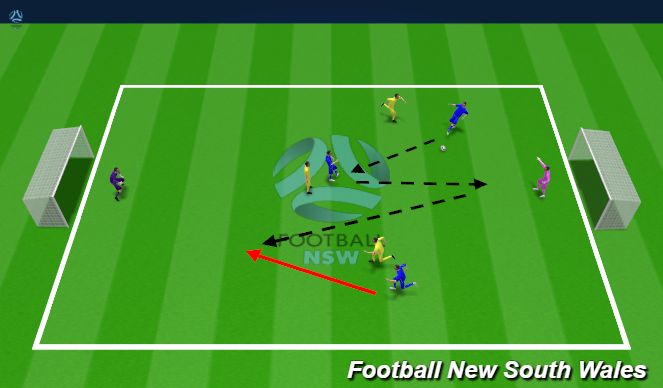
See the guidance at the top of this page to understand why you are not seeing interactive Football/Soccer images.
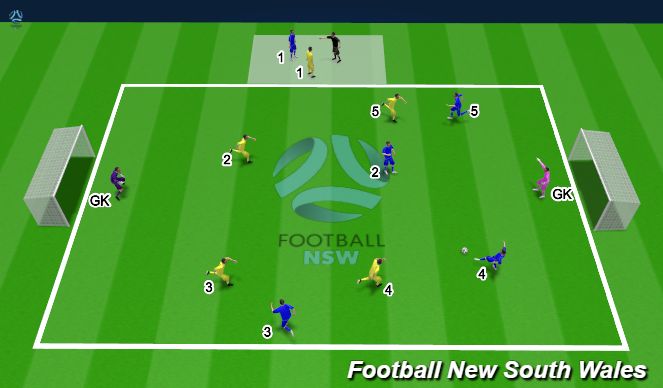
See the guidance at the top of this page to understand why you are not seeing interactive Football/Soccer images.
You Choose The Tactics
Coach Ownership: Decides on the options for players tochoose from (based on relevant game model and current coaching objectives)
Player Ownership: Players choose how their teams play
How it works
Players are numbered and at the start of the game, No.1s goand see the coach.
1. Formation choice: the coach has three options offormations that the players can choose from e.g.,
· 2-3-1
· 2-2-2
· 3-1-2
No.1s are tasked to organise their team – (Keep in mind thatplayers do not know what the other team has chosen)
After the teams have started to settle into the game, thecoach calls over Player No.2 from each team to discuss the choice of how toplay in the attacking third/half
Again, the coach has three options, e.g.,
· Look to get the ball wide and get crosses in
· Look to pass short and quickly
· Try to engage opposition players and take themon in 1v1s
After a set period,Player No.3s are called out to discuss: the choice of defending
Again, the coach has three options, e.g.:
· Everyone man marks when we lose the ball
· Some players are chosen to man-mark players fromthe opposition team
· The closest player is responsible for marking anopposition player
This can be repeated for No4 – How to play out fromour goalkeeper and No5 – how we play from set pieces
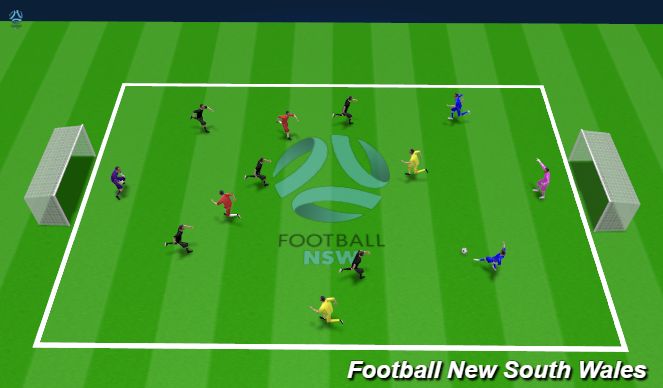
See the guidance at the top of this page to understand why you are not seeing interactive Football/Soccer images.
Remove The Bibs!
Coach Ownership: The coach overseesthe objectives/challenges
Players Ownership: Players overseethe self-analysis/feedback
SET UP
Two teams play a normal timed game.
TEAM A are the non-bibs, and they have 'free play' (shown by the black shirt player here)
Each player in TEAM B wears three bibs of different colours! (e.g., blue, yellow,and red). The players choose the order in which they wear the bibs, and eachplayer can have a different combination (e.g., blue on first, then red, thenyellow on top). So, the game is bibs (different colours) V non-bibs.
HOW IT WORKS
TEAM CHALLENGE 1 (Team A and B)
Both teams try to win the game as normal.
TEAM CHALLENGE 2 (for team B)
In the set time the team try to remove as many bibs as possible. THIS IS HOWTHEY DO THAT...
The players with the red bibs on top are allowed to remove this bib whenthey tackle an opponent and keep possession (another coloured bib will nowshow).
The players with the blue bibs on top are allowed to remove this bib whenthey dribble past an opponent, panna an opponent, or pull off an outrageouspiece of skill! (Another coloured bib will now show)
The players with the yellow bibs on top are allowed to remove this bib whenthey score a goal or provide an assist for a goal. (Another coloured bibwill now show)
Of course when a player reveals a new bib that player has a new challenge.
REFLECTION
Which team won the game?
How many bibs did team B remove?
Was a player able to remove all three of their bibs?
After a set time the teams swap over, and team A will wear the bibs.
OPTIONS, PROGRESSIONS & VARIATIONS
· Only give the players two bibs each
· Allow the players to decide what challenges the bibsrepresent
· Yellow bibs are individual personal challenges decidedby the coach
· For maximum chaos, have both teams wearing bibs!
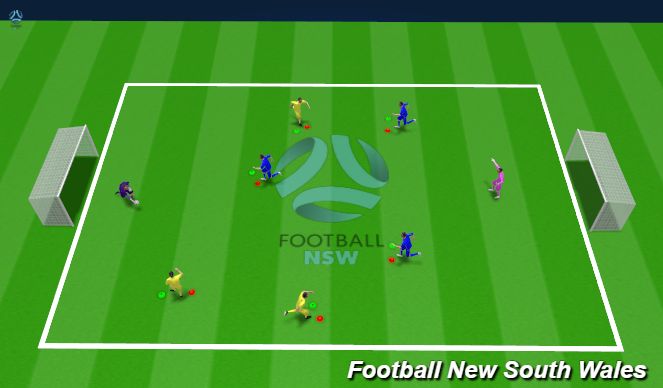
See the guidance at the top of this page to understand why you are not seeing interactive Football/Soccer images.
Cone Commitment Game
Coach Ownership: The coach overseesquestioning and observation
Players Ownership: Players overseetheir self-analysis/feedback
HOW IT WORKS
During the game, players try to get rid of their two cones.
Cone 1 - GREEN
This is their attacking cone, and players can get rid of it by receiving the ball from a teammate and 'doing something special with it' - e.g., successful pass, good dribble, shot on target.
To get rid of the cone, the player must complete the task THREE (3) times
Cone 2 - RED
This is their defending cone, and players can get rid of it by tackling an opponent and 'doing something special with it' - e.g., controlling the ball, retaining possession, starting an attack.
To get rid of the cone, the player must complete the task TWO (2) times

 Play animation
 Play step-by-step
 Repeat (toggle)
 Full Screen
 Pause
Pause Stop
Stop
You Choose The Game
Coach Ownership: Decides on the session focus (e.g. creatingand finishing goalscoring opportunities)
Player Ownership: Players choose the format and rules of thegame
How it works:
2 teams (e.g. Barcelona v Bayern Munich)
Game format – Barcelona get to choose the game format fromthe menu, e.g.:
1) First to 3
2) 5 min game
3) Must win by 2 goals
4) First to score
Bayern Munich get to choose the rules from the menu:
1) Goals must be a first-time shot
2) Must be a first-time assist
3) Must be scored without the GK getting a touch onthe ball
4) Must be scored after a forward pass
After the game, the format and rules are re-assigned (can’tpick the same as before)
Which team wins most of the 4 games?