
Football/Soccer Session (Academy Sessions): Defending insde the box

FAW Coach Ed
Tawanda Kaseke

Description
SESSION OBJECTIVES
• Develop players’ understanding of how to create
a back five to defend
• Create opportunities for players to protect central areas
and force play wide to defend crosses
PART 1: 5v5 FUNCTIONAL PRACTICE
• This practice introduces some of the concepts that will
underpin defending the box in a 3-5-2.
• The defending team is challenged to defend crosses,
with a heavy focus on technical detail.
PART 2: 8v8 POSITION-SPECIFIC
PRACTICE
• This is a position-specific attack v defence practice,
focusing on the specific roles and responsibilities of the
defensive unit.
• This practice gives the attacking team opportunities to
overload wide areas, which will test the understanding
of the defending team.
• It will pose questions of which players should fill the
four zones marked in the box, depending on who has
helped deal with the wide overload.
PART 3: 11v11 CONDITIONED GAME
• This 11v11 conditioned game reduces the time spent on
the ball for the defending team.
• It also encourages the attacking team to work balls into
the box to score.
• This practice has a high level of complexity; the
attackers are able to score in multiple ways, using the
whole pitch to move the defensive team and make it
more difficult for them to sit in a compact block.
See the guidance at the top of this page to understand why you are not seeing interactive Football/Soccer images.
See the guidance at the top of this page to understand why you are not seeing interactive Football/Soccer images.
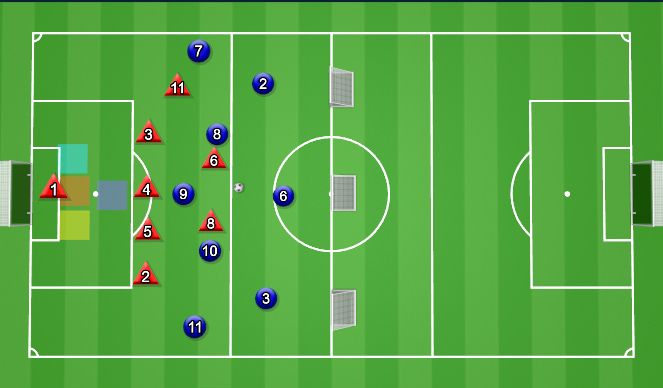
This position-specific pressing practice takes place in half a pitch.
Mini-goals are placed on the halfway line
Four zones are marked in the box: front post, middle of the goal, back post and cutback zone.
In-possession team BLUE has two full-backs, three midfielders and three attackers.
Out-of-possession team RED has two wing-backs, three centre-backs and two midfielders.
How to score
Ball starts with the in-possession team, who should attempt to score.
The defending team stays narrow and compact to protect the middle of the pitch.
If the defending team wins possession, they try to score in the mini-goals as quickly as possible.
DEVELOPING THE PRACTICE
Remove the visual aids of the zones in the box to challenge players’ positioning.
Coaching Points
PROTECTING THE MIDDLE
The defending side needs to be narrow and compact.
The defenders should also be coached not to be tootight, as this will allow the opposition to play around theblock easily and get crosses into the box.
WING-BACKS The wing-backs in this system will deal with whoeverprovides the width. This could be from the opposition’sfull-back or winger. If the wing-back is in a 2v1 situation, either a holdingmidfielder or outside centre-back can come out andsupport. This will limit overloads in wide areas, andthere should still be enough players centrally to defendthe boxBLOCKING THE LINE OF THE CROSS
When going out to the wide areas, the wing-backshould be encouraged to block the line of the cross. Doing this will force the attacker to either loft the cross– which will provide the goalkeeper with an opportunityto deal with an aerial ball – or the cross will be pulledback, so the defenders can face forward in the box,which will help with clearing the ball.
FILLING THE ZONES The defending team should be encouraged to fill thefour zones in the box. Who fills the zones will be dependent upon who hasbeen dragged out of position by the opposition’sattacking play.
example, the left-sided centre-back may be in thefront-post zone to defend a cross from the defensiveteam’s left-hand side. On another occasion, the leftsided centre-back may have to support the wing-back,which means the middle centre-back will have to moveinto the front-post zone.
MANAGING THE OPPOSITIONHIGH BALL TEMPO The in-possession team should be encouraged to havea high ball tempo to make it difficult for the defendingteam to organise their block. Play in as few touches as possible.
See the guidance at the top of this page to understand why you are not seeing interactive Football/Soccer images.
Activity
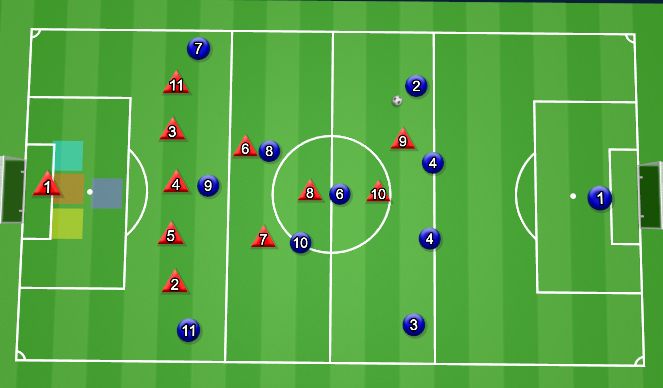
This 11v11 position-specific pressing practice takes place
on a full-sized pitch.
• The coached team sets up in a 3-5-2 formation.
The opposition starts in a 4-3-3 shape.
• The team set up in a 4-3-3 is awarded three points
if they are able to score within the opposition’s box.
This will encourage them to work chances in the box
to score.
• The team set up in a 3-5-2 have a maximum of 10
passes in which to score. This will encourage them
to attack quickly, which in turn will see them turn
possession over and increase the frequency with which
they must defend.
• Otherwise, standard football rules apply.
DEVELOPING THE PRACTICE
• Progress so that all restarts take place in the defensive
team’s final third, to increase their need to defend.
• Alter the formation of the 4-3-3 team to give the
coached team more challenges in defending.
COACHING DETAIL:
OUT OF POSSESSION
PROTECTING THE MIDDLE
• Protecting the middle of the pitch is vital to being
successful when defending the box.
• This will force the ball into wide areas, where the team
are able to organise themselves to defend crosses.
• To do this, the team must be narrow and compact,
and have short distances between and within units.
• It is also important not to become too tight with
distances, as teams will easily play around the block
and get into the box.
TURN THEM AROUND
• The mentality in the final third when defending is that
the defenders don’t need to win the ball.
• They can view themselves as having been successful
in their defending if they are able to make the player
in possession turn around or play backwards.
• This prevents progression towards the goal.
COMPOSURE
• When the defenders are defending in the box,
it is important that they remain composed.
• If they are on edge when defending, they are
likely to snatch at clearances.
• This will increase the chances of making a poor
connection with the ball, and failing to successfully
clear danger.
PREPARED TO COUNTER-ATTACK
• Being brave and leaving both strikers high when
defending in this system is important.
• This will give two possible out balls when attempting
to counter-attack or when clearing the ball.
• Leaving two players up will also increase the likelihood
that the opposition will leave at least three players back.
• This will reduce the numbers in the attack, that the
players will need to defend against.
COACHING DETAIL:
MANAGING THE OPPOSITION
HIGH BALL TEMPO
• The in-possession team should be encouraged to have
a high ball tempo, to make it difficult for the defending
team to organise their block.
• The faster the ball is moved around the pitch, the
quicker the defending team will have to shuffle and
slide to protect central areas

 Play animation
 Play step-by-step
 Repeat (toggle)
 Full Screen
 Pause
Pause Stop
Stop
Activity
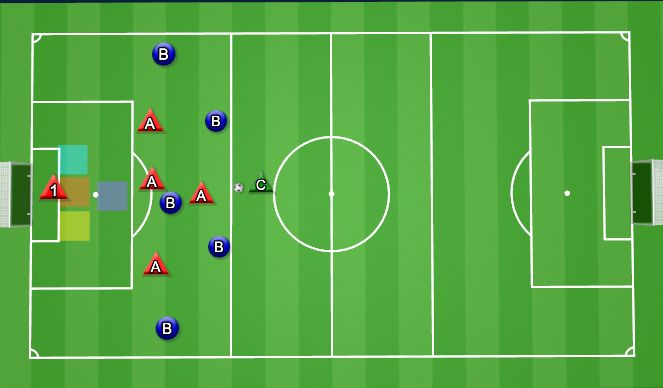
This is a functional 5v5 practice that takes place in the final third of a full-sized pitch.
The box has four zones marked- front post, middle of the goal, back post and cutback zone.
In-possession team – BLUE, consists of three attackers and two attacking midfielders.
Out of possesion Team RED consists of a goalkeeper, three defenders and a midfielder.
The coach (C) serves a ball into the practice, and the ball is worked wide for a crossing situation.
The crossing player is limited to two touches.
How to score
The BLUE are attempting to score in the goal.
The RED are attempting to clear the ball away from the box to the coach.
If the attackers score from a first touch = 2 points.
If they score from two touches = 1 point.
If the defenders are able to clear the ball to the coach = 1 point.
PROGRESION
Alter the depth of the crosses, and remove the zones as visual aids.
Coaching Points
CROWD THE ZONES
The defending team should be encouraged the fill the four zones in the box,WITH 1 PLAYER IN EACH ZONE
Defenders must show a high level of awareness to identify where the opposition areis running, and how to position themselves when
defending the box to prevent attackers getting space.
BODY SHAPE/POSITION
They should open their bodies when they are getting set to defend, to allow them to see more of the pitch.
Manoeuvring their body, so they are not facing their goal when defending, will help when trying to clear.
JUDGING THE FLIGHT OF THE BALL
Players should be encouraged to hold their position until they have judged the flight of the ball.
This will help prevent them running under the ball and getting caught out of position.
CLEARANCES
Clearances should be completed with the biggest surface area possible. An example of this would be
using the inside of the foot to volley clear.
This will limit the likelihood of the defender slicing a ball and risking an own goal.