


Football/Soccer Session (Moderate): UEFA C - DEFENDING PRINCIPLES FULL SESSION
Profile Summary

| Name: | Adam Zammit |
|---|---|
| City: | Manchester |
| Country: | United Kingdom |
| Membership: | Adult Member |
| Sport: | Football/Soccer |

Description
UEFA C - Defending -intercepting -covering/recovering
See the guidance at the top of this page to understand why you are not seeing interactive Football/Soccer images.
See the guidance at the top of this page to understand why you are not seeing interactive Football/Soccer images.
SCREENING FORWARD PASS & INTERCEPTING (15 mins)
Screening Forward Passes and Intercepting
Overview:
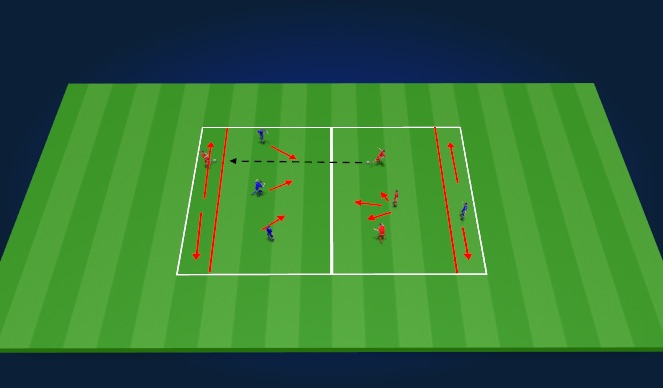
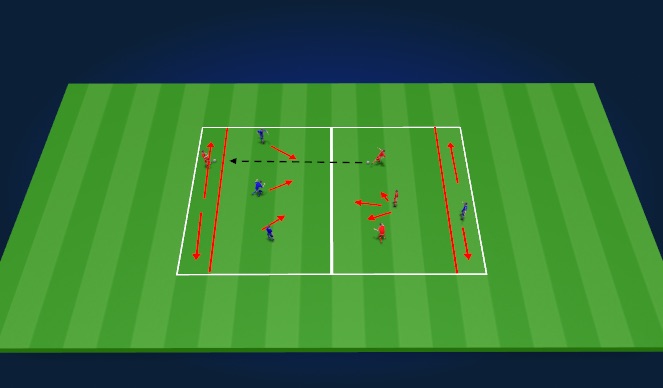
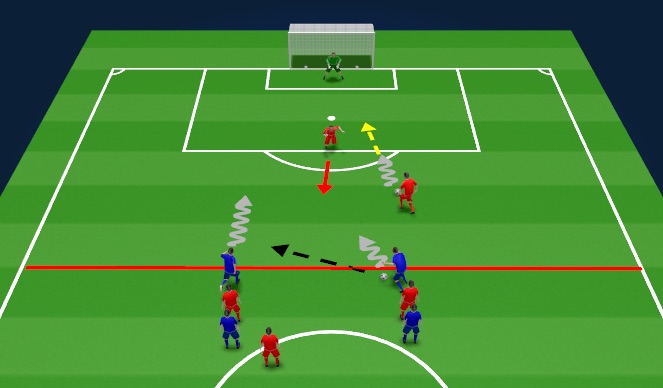
This practice takes place in an appropriately sized area according to the age and stage of the players. Position a line of cones as a half-way line to divide the area into 2 zones. A server is stationed at the side of the pitch with a supply of footballs. In both halves of the area, 3 players are positioned with a 4th player on the end lines. Each team’s 4th player is on the opposite side of the area furthest from them. To start the practice, the server passes in to either team who look to move the ball quickly among each other whilst looking for an opportunity to play a penetrating break line pass to their team-mate. The defending team have to work together to prevent the ball being passed through their unit. If the possession team successfully find their team-mate, they score a point and the server then plays a ball into the other team to go the opposite way. If the defending team intercept the ball, they become the possession team and try to find their team-mate with a split pass.
Coaching Points:
Defensive Organisation: The 3 players when working out of possession need to try and stay organised and adjust their positions according to the direction in which the possession team pass the ball. Their distances must be compact but not too narrow which would allow for passes to be played around the outside of their unit. Likewise, their defensive position should avoid being in a straight line which makes it easier for the passers to break their press.
Angles And Distances: The nearest player to the ball carrier at any one time must move towards the ball to close their space down preventing a forward pass. The supporting angles and distances of their team-mates play a crucial role. The next nearest defender must be slightly deeper than the presser and in a position to squeeze up should the ball be passed sideways.
The furthest defender acts as cover and can afford to be even deeper by marking space rather than an opponent. In the event of a short switch, this player then pushes up to apply more direct pressure to the receiving player.
Footwork And Body Shape: The defender’s footwork is vital to them moving effectively across the area. The practice encourages them to work on their lateral movement from side to side when constantly having to shuffle in line with the direction the ball is being passed by the possession team. The defender’s must, at all times, adopt an open body shape to see the ball and their nearest opponent.
Communication: Players should verbally instruct their team-mates when to press the ball to ensure effective engagement of the player receiving. They can also communicate non-verbally with their movement triggers and eye contact forming a positive connection between each other. This is particularly applicable when the supporting and covering defenders observe their team-mate pressing and then take up the required defensive positions.
Progressions:
- Increase the size of the area to raise the challenge for the defensive team by having more ground to cover.
- Add a 2nd target player on the outside to increase the passing options for the possession team.
Regressions:
- Decrease the size of the playing area so that passes are played over shorter distances and the defensive actions are less challenging.
- Add a constraint that all switch passes to the target players must be with 1 touch.
See the guidance at the top of this page to understand why you are not seeing interactive Football/Soccer images.
OVERLOADS TO GOAL (10 mins)
Overloads To Goal
Overview:
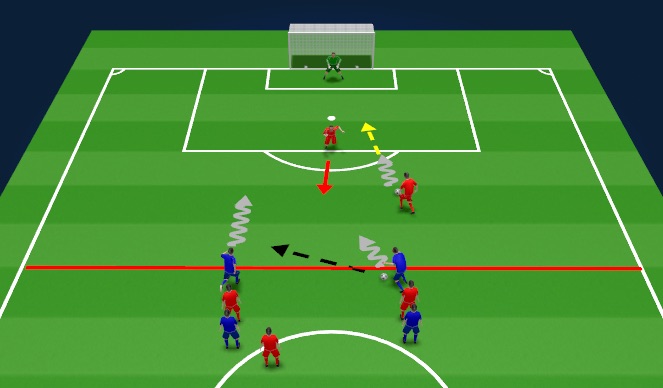
Setup a 20 x 20 area with one goal and a goalkeeper with the attackers/defenders on the opposite line. Duration 15 mins. The game begins with one attacker dribbling to go 1v1 with the Goalkeeper and then the attacks start. The order for turns is as follows: 1v0, 1v2, 3v2, 3v4, 4v4 (based on 8 players).
Coaching Points:
Deny: The defenders should look to deny the attacker with the ball space but also limit their options of being able to combine with their team mate too by positioning themselves where possible between both attackers. They should attempt to force the attackers back and look to win the ball if they turn away from the goal. If they cannot win the ball back high up, the defender should look to drop deeper and prevent the attackers from playing into the space behind to make it more challenging for them to getting into a goal scoring position.
Delay: Defenders can delay the attackers attack by pressing and denying the attacker space or by dropping quickly too. The defenders should be patient when defending 1v1 and wait for the right moment to try and intercept or win the ball back.
Deflect: In order to force the ball wide and try and make the attackers go out of play the defenders should look to get side on and be on the outside of the ball. As the attackers are attacking in pairs, they should also check their shoulders and attempt to position themselves between the attackers to block the passing line which will force the player on the ball not to have a passing option.
Defend:The defenders should aim to win the ball back and keep it for themselves, by using their front foot and body this will help them to come away with the ball once they’ve won it. If the attackers are in a goal scoring position the defenders may need to use emergency defending to stop them from scoring.
Progressions:
- Add two goals for the defenders to score in once they have won the ball and/or add a time limit for attackers to score within.
Regression:
- Make the area smaller which will make it easier for the defenders to defend the space.
See the guidance at the top of this page to understand why you are not seeing interactive Football/Soccer images.
BOX CLEVER - 7V7 SSG (20 mins)
Box Clever SSG 7v7 – Defending The MIdfield
Overview:
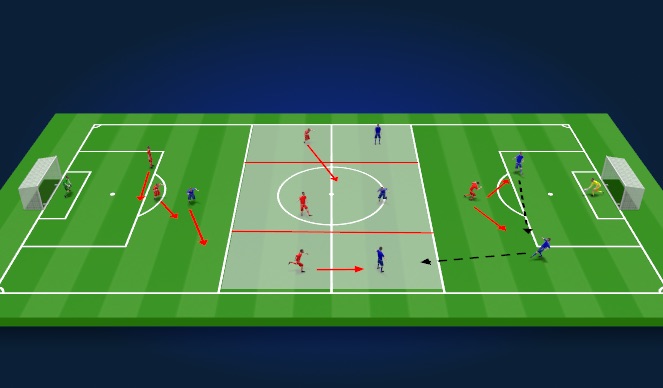
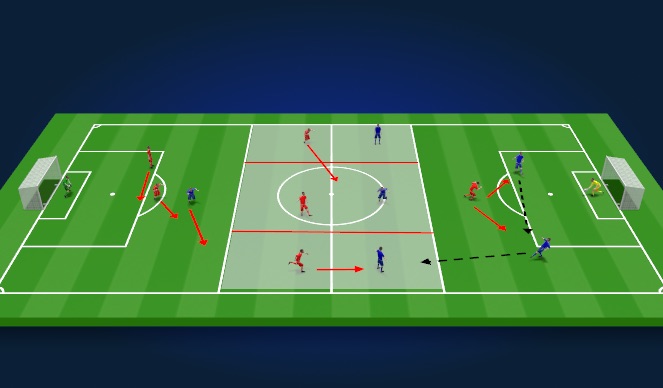
Setup a small sided pitch and have 7 v 7 game with the middle third area split into 3 boxes. The teams setup in a 1-2-3-1 formation. The midfield 3 unit need to try and cover 2 boxes when out of possession to get compact, stay connected and prevent the opposition from playing through midfield.
Coaching Points:
Compactness: The boxes act as a guide and reference point for the midfield unit to identify how to defend with compactness. They should try to leave the furthest box from the ball empty in order to cover 2 boxes when the ball is wide. When the ball is in the central box, they need to try and close the centre in order to force the ball wide where they can try to create an overload in their favour.
Individual Responsibility: Each of the midfielders should be responsible for a box and whenever the ball is in their box, it is their responsibility to press with the other 2 adjusting their positions accordingly.
Defending Unit: The 2 defenders also need to stay connected to the midfield and push up when effective pressure is applied to the opposition to reduce their space in which to play and to also leave the opposition strikers in offside positions.
Strikers Defensive Unit: The striker need to stay connected to the midfield unit when they are by-passed and the ball is in the opponent’s possession in the middle third. If the opposition decide to turn back and recycle possession to a defender or the GK, the strikers need to be in a position to press, block off the passing lane or intercept the pass.
Progressions:
- The team in possession score a point (counts as a goal) if they are able to switch play from outer box to outer box.
- If the midfield 3 don’t cover 2 boxes when the ball arrives in the midfield 3rd, they concede a goal.
Regressions:
- The pass into the midfield third needs to be 1st time.
- The midfielders in possession in the middle third have a set number of touches.
'%3E%3Cpath id='path4169' d='M 11.4375,70.25 C 11.457031,38.394531 37.277344,13.242188 68.253906,13.050781 99.78125,12.855469 125.73047,38.351563 125.8125,70.078125 125.89844,101.62109 100.43359,127.14063 69.148438,127.42188 37.582031,127.70703 11.464844,102.23438 11.4375,70.25 m 6.425781,-0.08984 c 0.03516,28.421871 23.027344,50.69922 50.519532,50.82031 C 96.433594,121.10156 119.30469,98.367188 119.38281,70.359375 119.45313,42.878906 97.382813,19.714844 69.015625,19.496094 40.75,19.277344 17.964844,42.035156 17.863281,70.160156' style='clip-rule:nonzero;fill:%23333f48;fill-opacity:1;fill-rule:nonzero;stroke:none' /%3E%3Cpath style='fill:%23333f48;fill-opacity:1;fill-rule:nonzero;stroke:none' d='m 39.789063,108.62109 c 0.28125,0.14454 0.550781,0.32032 0.839843,0.4336 2.734375,1.05469 5.554688,1.78125 8.453125,2.23047 2.734375,0.42578 5.484375,0.64453 8.25,0.54297 3.988282,-0.15625 7.832032,-0.94922 11.445313,-2.69532 1.683594,-0.8164 3.246094,-1.82422 4.640625,-3.07422 3.265625,-2.92578 5.171875,-6.582027 5.796875,-10.906246 0.546875,-3.761719 0.04687,-7.425781 -1.09375,-11.019531 -1.4375,-4.523438 -3.730469,-8.582032 -6.703125,-12.265625 -1.03125,-1.277344 -2.082031,-2.535157 -3.113281,-3.808594 C 66.789063,66.1875 65.332031,64.269531 64.0625,62.21875 c -1.601562,-2.582031 -2.835937,-5.316406 -3.613281,-8.261719 -0.683594,-2.574218 -0.902344,-5.1875 -0.6875,-7.828125 0.214844,-2.617187 0.910156,-5.117187 2.152344,-7.441406 2.164062,-4.050781 5.503906,-6.710937 9.816406,-8.179687 1.890625,-0.640625 3.835937,-1.058594 5.832031,-1.195313 1.121094,-0.07813 2.242188,-0.152344 3.363281,-0.164062 4.28125,-0.02734 8.4375,0.734375 12.453125,2.175781 1.871094,0.671875 3.6875,1.496094 5.523438,2.257812 0.226562,0.09375 0.4375,0.230469 0.664062,0.351563 -0.164062,0.25 -0.371093,0.160156 -0.539062,0.164062 -2.824219,0.101563 -5.535156,0.703125 -8.132813,1.804688 -1.335937,0.570312 -2.570312,1.316406 -3.648437,2.296875 -2.527344,2.296875 -3.605469,5.15625 -3.34375,8.550781 0.140625,1.855469 0.722656,3.574219 1.550781,5.222656 0.648438,1.296875 1.414063,2.523438 2.292969,3.675782 0.953125,1.25 1.929687,2.484375 2.929687,3.699218 2.085938,2.523438 4.164063,5.054688 6.050782,7.738282 2.203125,3.136718 4.140627,6.417968 5.589847,9.980468 1.16406,2.867188 2.01562,5.820313 2.39843,8.894532 0.25,2.011718 0.30079,4.03125 0.11719,6.058593 -0.24219,2.640625 -0.79297,5.195313 -1.74609,7.667969 -1.29688,3.36328 -3.300784,6.22656 -5.972659,8.63281 -2.429687,2.19141 -5.171875,3.90625 -8.109375,5.3125 -2.695312,1.29297 -5.464843,2.40235 -8.34375,3.20313 -1.953125,0.54687 -3.945312,0.8789 -5.949218,1.15625 -3.035157,0.41797 -6.085938,0.48828 -9.132813,0.3125 -5.328125,-0.3125 -10.476562,-1.46094 -15.410156,-3.52344 -3.449219,-1.44141 -6.691406,-3.25781 -9.757813,-5.39453 -0.183593,-0.12891 -0.378906,-0.25 -0.53125,-0.41016 -0.07031,-0.0703 -0.05859,-0.22656 -0.08203,-0.34375 z m 0,0' id='path4175' /%3E%3Cpath style='fill:%23333f48;fill-opacity:1;fill-rule:nonzero;stroke:none' d='M 94.699219,29.390625 C 94.089844,29.21875 93.476563,29.054688 92.867188,28.875 90.183594,28.085938 87.46875,27.441406 84.703125,27.046875 c -3.976562,-0.566406 -7.945312,-0.59375 -11.863281,0.402344 -7.535156,1.914062 -12.386719,6.71875 -14.878906,13.996094 -0.894532,2.617187 -1.179688,5.328125 -0.953125,8.078125 0.203125,2.484375 0.867187,4.859375 1.816406,7.160156 0.933594,2.261719 2.117187,4.390625 3.4375,6.449219 1.4375,2.25 3.050781,4.371093 4.640625,6.511718 1.4375,1.933594 2.867187,3.871094 4.261719,5.835938 1.230468,1.730469 2.316406,3.546875 3.273437,5.445312 1.324219,2.625 2.265625,5.378907 2.703125,8.292969 0.433594,2.902344 0.292969,5.765625 -0.660156,8.5625 -0.9375,2.74609 -2.574219,5.00781 -4.777344,6.875 -2.417969,2.04688 -5.203125,3.39844 -8.246094,4.22266 -1.835937,0.5 -3.703125,0.75781 -5.609375,0.82031 -3.886718,0.13281 -7.679687,-0.47266 -11.421875,-1.46094 -2.261718,-0.59765 -4.488281,-1.33203 -6.695312,-2.11328 -0.207031,-0.0742 -0.40625,-0.16797 -0.597656,-0.25 -0.02344,-0.24609 0.148437,-0.19141 0.25,-0.20703 1.96875,-0.30469 3.921875,-0.67969 5.804687,-1.34766 1.367188,-0.48437 2.671875,-1.10156 3.855469,-1.94922 2.25,-1.61328 3.65625,-3.765621 4.0625,-6.515621 0.273437,-1.867188 0.09375,-3.710938 -0.429688,-5.527344 -0.472656,-1.648437 -1.171875,-3.199219 -2.109375,-4.628906 -0.792968,-1.207031 -1.636718,-2.382813 -2.523437,-3.519531 -0.921875,-1.195313 -1.921875,-2.328125 -2.890625,-3.484375 -2.753906,-3.273438 -5.351563,-6.660157 -7.523438,-10.355469 -2.042968,-3.480469 -3.667968,-7.136719 -4.597656,-11.078125 -0.640625,-2.699219 -0.980469,-5.4375 -0.832031,-8.214844 0.238281,-4.53125 1.476562,-8.78125 3.824219,-12.6875 1.082031,-1.800781 2.445312,-3.375 3.988281,-4.800781 2.742187,-2.527344 5.863281,-4.480469 9.257812,-5.992188 3.746094,-1.667968 7.652344,-2.769531 11.707032,-3.394531 3.152343,-0.488281 6.324218,-0.671875 9.507812,-0.519531 8.632813,0.410156 16.671875,2.792969 24,7.433594 0.08203,0.05078 0.152344,0.109375 0.230469,0.167968 -0.0039,0.04297 -0.0078,0.08984 -0.01563,0.136719' id='path4177' /%3E%3Cpath style='fill:%23333f48;fill-opacity:1;fill-rule:nonzero;stroke:none' d='m 31.699219,38.75 c -0.07813,0.238281 -0.152344,0.476563 -0.238281,0.710938 -1.460938,4.074218 -2.066407,8.28125 -1.808594,12.59375 0.4375,7.304687 2.808594,13.925781 7.277344,19.753906 3.714843,4.84375 7.441406,9.671875 11.167968,14.503906 1.113282,1.441406 1.953125,3.007813 2.414063,4.777344 0.332031,1.257812 0.425781,2.539062 0.273437,3.820312 -0.214843,1.832032 -1.070312,3.34375 -2.464843,4.546875 -0.984375,0.851559 -2.113282,1.449219 -3.316407,1.925779 -1.378906,0.54297 -2.8125,0.89063 -4.273437,1.1211 -2.226563,0.35547 -4.46875,0.46093 -6.722656,0.41015 -0.589844,-0.0156 -1.046875,-0.18359 -1.433594,-0.625 -0.636719,-0.72265 -1.335938,-1.39062 -1.9375,-2.14062 C 25.574219,93.800781 22.300781,86.621094 20.84375,78.636719 20.152344,74.835938 19.917969,71 20.15625,67.128906 20.796875,56.773438 24.390625,47.574219 30.859375,39.480469 c 0.21875,-0.273438 0.453125,-0.53125 0.679688,-0.796875 0.05469,0.02344 0.109375,0.04297 0.160156,0.06641' id='path4179' /%3E%3Cpath style='fill:%23333f48;fill-opacity:1;fill-rule:nonzero;stroke:none' d='m 105.41016,101.30078 c -0.13282,-0.3125 0.0234,-0.5039 0.0977,-0.69922 1.38672,-3.749997 1.98047,-7.628904 1.89844,-11.621091 -0.14453,-6.84375 -2.08594,-13.144531 -5.73437,-18.925781 C 99.890625,67.226563 97.917969,64.53125 95.835938,61.917969 94.4375,60.160156 92.988281,58.4375 91.582031,56.6875 90.632813,55.511719 89.6875,54.335938 88.792969,53.121094 c -0.835938,-1.144531 -1.488281,-2.398438 -1.953125,-3.742188 -0.523438,-1.515625 -0.695313,-3.070312 -0.511719,-4.652343 0.21875,-1.839844 1.082031,-3.339844 2.476563,-4.542969 1.039062,-0.890625 2.230468,-1.507813 3.503906,-1.980469 1.632812,-0.609375 3.320312,-0.960937 5.046875,-1.175781 1.917969,-0.238281 3.839841,-0.269531 5.769531,-0.230469 0.52734,0.01172 0.89453,0.203125 1.23828,0.585938 5.50391,6.113281 9.26172,13.144531 11.21875,21.132812 1.11719,4.554688 1.5625,9.179688 1.30469,13.855469 -0.58203,10.625 -4.23438,20.082031 -10.96094,28.339846 -0.15625,0.1914 -0.32812,0.375 -0.51562,0.58984' id='path4181' /%3E%3Cpath style='fill:%23333f48;fill-opacity:1;fill-rule:nonzero;stroke:none' d='m 39.796875,108.63281 c -0.05859,0.0117 -0.117187,0.0234 -0.175781,0.0352 0.05469,-0.0156 0.113281,-0.0312 0.167969,-0.0469 z m 0,0' id='path4183' /%3E%3C/g%3E%3C/svg%3E)
 Play animation
 Play step-by-step
 Repeat (toggle)
 Full Screen
 Pause
Pause Stop
Stop
THE STEALERS (15 mins)
The Stealers
Overview:
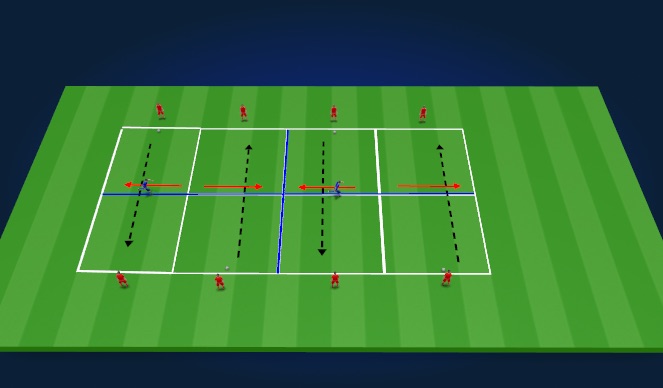
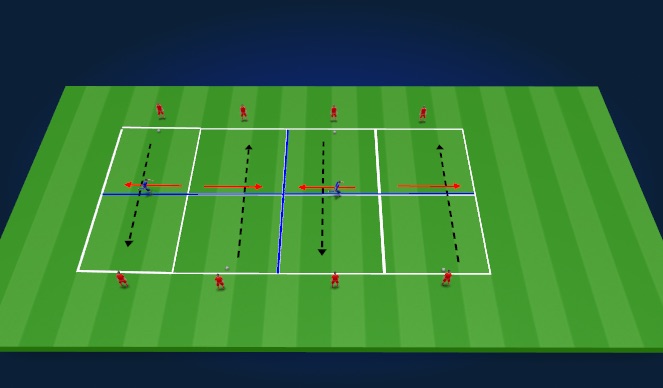
For this practice, set up in an area of around 20 x 20 yards dependent on the age, stage and number of players in the group. If you think players can’t strike across the area, then make it smaller. Duration 10-15 mins.
Mark out a horizontal line across the middle of the area along with 3 additional lines to separate the area into quarters. 8 players line up in pairs with a ball between them and 2 “stealers” are positioned along the horizontal line. To start, the outside players begin passing their ball (1 point per successful pass). The stealer’s objective is to intercept a ball as it is played between the 2 passers. They must always move along the line and cannot move off it without the ball. If they do intercept a pass the defender simply passes the ball back to the outside player and continues to try and intercept the passes.
Progression:
If they do intercept a pass, they must try and dribble past the player who gave the ball away past the end line. The passer now becomes a defender and attempts to tackle the stealer to win their ball back. If the stealer reaches the end line, they become a passer, and if the passer wins their ball back, they continue as they are. Play for a set time, add up all the points (which pair and which stealer scores the most points?) and then swap the players over.
Coaching Points:
Scanning And Awareness: As the balls are being passed between each pair, the stealers must try and scan as much as possible to identify which pair’s ball then can try and intercept, and from which side of the area they can do so.
Interception Timing: The stealer tries to time their movement effectively to intercept a pass. This may be through small, quick steps or a larger stride depending on the weight and angle of the pass.
Tackling Technique: After losing possession, the passer needs to react quickly to this transition of becoming a defender. They must close the stealer down as fast as possible to reduce their time and space and read any pressing trigger such as a heavy touch, ball stuck between their feet or eyes down looking at the ball for too long. When tackling, can the passer step into the ball to block the stealer’s path or use their front foot as a ‘poker’ to push the ball away before regaining it for themselves?
Progressions:
Regressions: