


Football/Soccer Session (Difficult): Midfielders Joining The Attack (Start Time: 2020-08-19 19:30:00)


Premier Users' Club
Joseph McCann
Profile Summary

| Name: | Joseph McCann |
|---|---|
| City: | Liverpool |
| Country: | United Kingdom |
| Membership: | Adult Member |
| Sport: | Football/Soccer |

Description
4-Corner LTPD Model:
Technical/Tactical: Main Focus - Midfield Rotation (Height/Width/Depth) & Supporting Forwards.
Also: Passing & Receiving, Crossing, Finishing, Ball Control.
Physical: Main Focus - Anaerobic Endurance.
Also: Aerobic Endurance, Speed.
Psychological: Main Focus - Awareness.
Also: Decision Making, Imagery.
Social: Main Focus - Teamwork.
Also: Communication (Verbal & Nonverbal).
See the guidance at the top of this page to understand why you are not seeing interactive Football/Soccer images.
See the guidance at the top of this page to understand why you are not seeing interactive Football/Soccer images.
Skills Practice (30 mins)
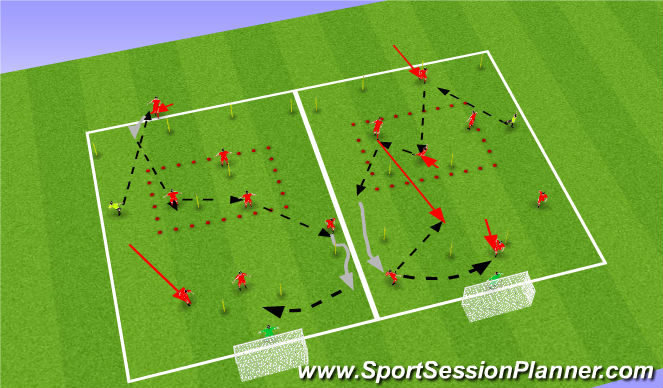
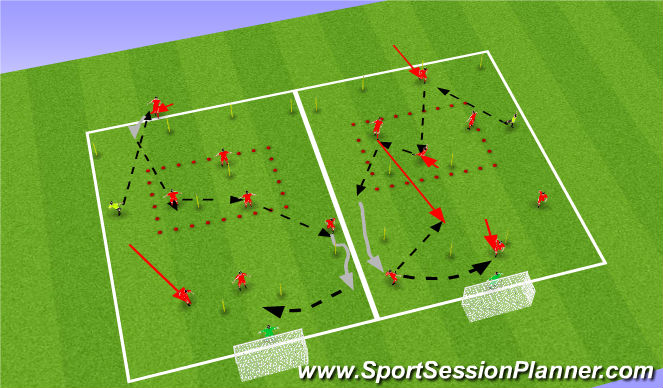
Set up as a midfield 3 and front 3 with a central defender also, against an opposition 1-4-4-2 (outfield players marked out with poles/mannequins). The pattern of play begins with a transition, where the coach acting as opposing team left back who has advanced into the middle third, and is attempting to play the ball into an opposing team striker, with their wide players also high up the pitch. Our central defender reads this and steps in to intercept the pass, regaining possession for our team. He then plays the ball into our midfield three who then play a combination of passes around the opposition midfield two, before feeding the ball into either winger. He then either exploits the space vacated by the opposing left back, or, if on the opposite wing, will produce skill to beat the other full back and then deliver the ball into a dangerous area for our other forwards to score past the goalkeeper. Players will then recover and reset, rotating who receives the ball from the central defender and who plays the ball into either winger.
Organisation:
Area:
At least one half of pitch for each group
Time:
30 minutes
Players:
16 players (14 outfield, 2 goalkeepers) + 2 coaches to feed ball in at beginning of transition.
Equipment:
2 goals, 16 flat discs,18 poles/mannequins, 12 footballs, stopwatch, whistle
Physical Loading:
Duration:
Each full attack takes 20 seconds including reset, and so each set takes 1 minute.
Repetitions:
3 reps each set - one for each midfielder to receive the ball off the defender and one time for each to play the pass into the forwards.
Sets:
Each attacker performs a total of around 20 sets.
Work to Rest Ratio/s:
1:6 for midfielders - roughly 10 seconds working anaerboically during rep. Rest periods come while rotating midfield runner, resetting and during interventions.
Key Coaching Points:
Sharpness of movement and rotation
Create height, width and depth in midfield 3
Awareness and body position receiving
Quality of pass into forwards
Speed and desire to join in the attack
Targets/Goals:
Midfield runner - Can we get inside the box by the time the ball is arriving in 15 times out of around 20 (3/4).
Wingers - Can we deliver the ball in 'corridoor of uncertainty' between poles (defenders) and goalkeeper 5 times each
Forward - can we get 10 first time finishes.
Conditions:
Midfielders must stay in box during rotations.
Progressions:
1. Midfield three now rotate creatively to provide height, width and depth, to be hard to mark and make the most of the overload in the central area.
2. Midfielder who plays the pass into the final third now joins in the attack, working anaerobically to get into the box to increase our chances of scoring a goal.
3. Aware that our first runner may cause an opposing midfielder to track back, practice an extra midfielder going to make a late 'lampard' run to the edge of the penalty area to give our winger the option of a cut-back, players using communication to decide who of the remaining midfielders goes and who stays.
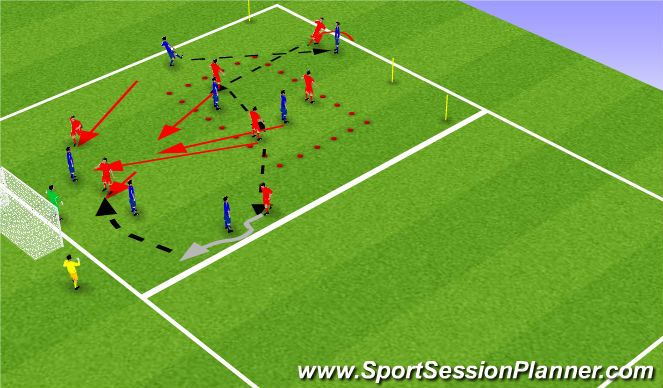
See the guidance at the top of this page to understand why you are not seeing interactive Football/Soccer images.
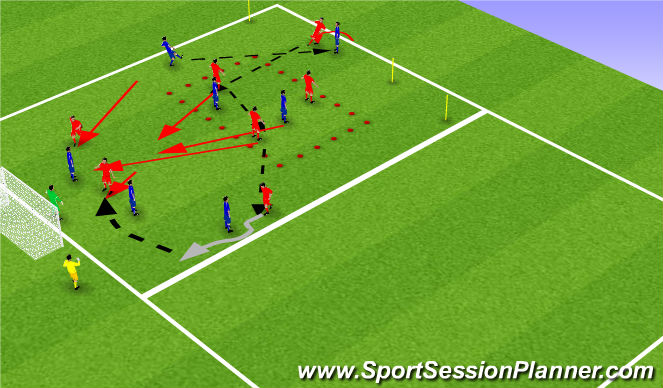
Drill (15 mins)
A progression of the skills practice, bringing both groups together to have an opposition defending against us to create more realism within the practice. Reds will attack first, after the central defender steps in front of the opposing striker. The opposing strikers job is to make it diffiult for the defender to intercept the ball and then go live on the defenders first touch, to hurry the defender to to make the pass into the middle third, or risk being dispossessed in a dangerous area. It follows the same set up and pattern of play as in the skills practice. This time the midfield three are playing live against a midfield 2, forcing them to add intensity and creativity to their movement and rotation, and create that height, width and depth to get the better of the midfield two. Opposing right back is not allowed to tackle the wingers, in order to keep the flow of the session and allow for success, but jockey the attacker attampting to beat them, and the left back is to chase back to again put the right winger under pressure and add realism to the practice. Opposing central defenders and goalkeeper are to defend as normal. If opposing team win the ball back and have comfortable possession, the ball is dead and the drill will reset. Midfielders must use the awareness, team work and communication developed in the skills practice for this drill, to know if, when, who and how to make the forward runs to support the attack. The 2 goalkeepers alternate turns in goal for each attack.
Organisation:
Area:
At least one half of pitch for each group
Time:
22 minutes
Players:
16 players (14 outfield, 2 goalkeepers)
Equipment:
1 goal, 8 flat discs,3 poles/mannequins, 12 footballs, stopwatch, whistle
Physical Loading:
Duration:
Each full attack takes 20 seconds including reset, and so each set takes 1 minute.
Repetitions:
3 reps each set - one for each midfielder to receive the ball off the defender and one time for each to play the pass into the forwards.
Sets:
Each attacker performs a total of around 20 sets.
Work to Rest Ratio/s:
1:6 for midfielders - roughly 10 seconds working anaerboically during rep. Rest periods come while rotating midfield runner, resetting and during interventions.
Key Coaching Points:
Sharpness of movement and rotation
Create height, width and depth in midfield 3
Awareness to understand when to make runs from midfield.
Quality of pass into forwards
Speed and desire to join in the attack
Targets/Goals:
1.Beat the opposition team score during compeition.
2. Each team score at least 1 two-point goal.
Conditions:
Midfielders must stay in box during rotations.
Regressions:
1. Midfield 2 don't tackle, just apply pressure to player on the ball.
Progressions:
1. Midfield can now play into our number 9 instead of wingers and they can then create chances how they choose, in order to empower the players to find their own solutions.
2. Add competition vs defending team - opposing full backs now allowed to defend properly and opposing striker also goes live to win ball back after defenders first touch. 1 point for goal, 2 points if goal scored by midfielder who has made a forward run to join attack. Swap teams over after 5 minutes.
Conditions - Midfielders must not leave us underloaded (e.g. 1v2) in the middle zone when making runs to join the attack, or points are void for that attack.
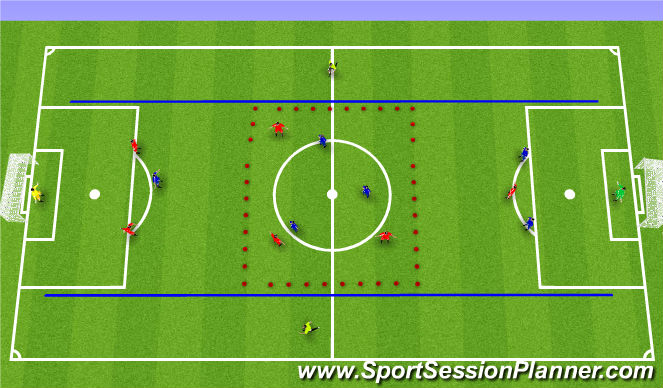
See the guidance at the top of this page to understand why you are not seeing interactive Football/Soccer images.
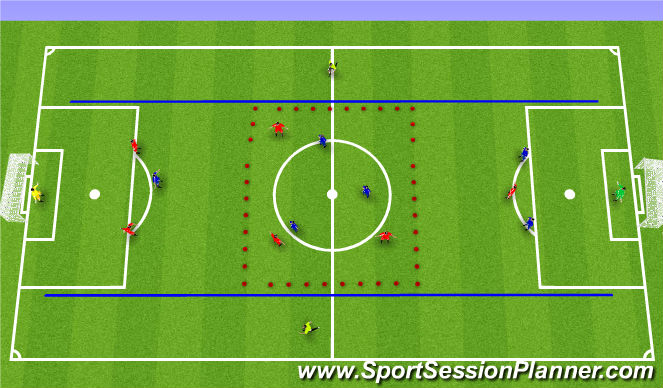
Small Sided Game (20 mins)
Keeping the central area marked out and assigning a goalkeeper to each team, play a match with the wide positions marked out for wingers (playing for both teams) to be unnopposed when in the wide areas delivering crosses. This allows for an overload to the attacking team when in the final third in order to create lots of success and opportunities for wingers to cross the ball in for midfielders making runs into the box; as well as leaving 2v1 for defenders when in possession in order to make it easier to play through the thirds, thus bringing out the session topic. This is again a progression from the drill as midfielders are now against another midfield 3, to provide further challenge and meaning their movement and rotation has to be sharper again to achieve success.
Conditions:
1.Only the wingers can enter the wide areas and cannot be tackled when in this zone.
2. Wingers are allowed to come inside the pitch but then defenders are allowed to tackle them
3. Goal is worth 2 if scored from a cross from wide area with attacking team's midfielder inside the box as it arrives.
4. Goal is worth 3 if scored by a midfield runner after the ball was played from midfield into forwards.
Organisation:
Area:
Full pitch
Time:
23 minutes
Players:
16 players (14 outfield, 2 goalkeepers)
Equipment:
2 goals, 8 flat discs, 12 footballs, stopwatch, whistle
Physical Loading:
Work to Rest Ratio:
4x3mins of play with 2 mins rest in between each, for any interventions and coaching points, and to allow for rest periods and drinks breaks for players.
Key Coaching Points:
Team work and communication
Sharpness of movement and rotation
Create height, width and depth in midfield 3
Awareness to understand when to make runs from midfield.
Quality of pass into forwards
Speed and desire to join in the attack
Targets/Goals:
1.Win the game
2. Can each team get both a two-point goal and a three-point goal
Regressions:
1. Make a midfielder of each team a floater playing for both teams, so the attacking team always has an overload in the midfield area to create more success.
See the guidance at the top of this page to understand why you are not seeing interactive Football/Soccer images.
Timeline
Warm up: (15 mins)
00:00-05:00 - Inrease heart rate and blood flow followed by dynamic stretching.
05:00-09:00 - Technical warm up - demonstrate movement pattern and let them play.
10:00-11:00 - Demonstrate progression with one-two and different movements off the poles/mannequins.
10:00-15:00 - let them play with progression.
Skills Practice: (30 mins)
15:00-18:00 - Water break and set up skills practice, followed by introduction on white board and then walk through the fixed initial pattern of play
18:00-23:00 - Let them play and discover the feel for the drill.
23:00-25:00 - Small group intervention about height width and depth of midfield, rotation and not being in fixed positions - how important that is when playing a midfield 3 and how that is what brings the advantage against a midfield 2, then demonstrate an example.
25:00-28:00 - Work on one example of the rotation for a couple of rounds.
28:00-29:00 - Whole group intervention - explain how this is what the final third looks like on a match day at the moment, particularly Runcorn Linnets game. Ask how we might imporve our chances of scoring a goal of these attacks (answer - more bodies forward into goalscoring positions).
29:00-30:00 - Small group intervention -Demonstrate midfielder playing the first pass into the winger has to go join in and get himself in the box - we are okay getting left 2v2 in midfield if it breaks down as we have a back 4 behind us.
30:00-37:00 - Play with 1 midfielder joining the attack.
37:00-39:00 - Q&A - if an opposing midfielder tracks first runner, what does that leave? (answer - 2v1 overload). What does that then allow us to do? (answer - commit an extra player forward into a goalscoring position). How do we decide who? (answer - communication).
39:00-45:00 - Practice with the second midfield runner who goes late to time his run to arrive on the edge of the box for a cutback from winger - 'lampard run'. - Give the winger the freedom to decide if to cross or cut back.
Drill: (22 mins)
45:00-47:00 - Water break Set up into drill
47:00-50:00 - Now opposing players have been introduced. Opposing full backs let wingers deliver ball into dangerous area, but provide an opposition for them to beat. Opposing midfield two, central defenders and goalkeeper, play live to defend and win the ball back. Midfield three using their awarness and communication as discussed in Skills Practice for if/when the second midfield runner can join attack. Introduce regression if needed.
50:00-52:00 - Progression: Midfield can now play into 9 as well as wingers, and attacking team become creative with how they finish, in order to empower the players in finding their own solutions.
52:00-57:00 - Competition vs defending team - opposing full backs now allowed to defend properly and opposing striker also goes live to win ball back after defenders first touch. 1 point for goal, 2 points if goal scored by midfielder who has made a forward run to join attack.
57:00-1:02:00 - Swap teams and repeat non-competitive part of the drill.
1:02:00-1:07:00 - Competition - see if 2nd attacking team can beat the 1st.
Small Sided Game: (23 mins)
1:07:00-1:10:00 - Add in wide player unopposed lanes while players have a water break. Introduce the rules and conditions for the game and walk through.
1:10:00-1:28:00 - Play. Add in points system from drill if needed to increase attention on main focus of the session.
1:28:00-1:30:00 - Debrief - run back through session aims and if we hit them all.
See the guidance at the top of this page to understand why you are not seeing interactive Football/Soccer images.
Session Review
Positives:
-Tested them physically.
-Players agreed they developed tactical knowledge and understanding of a 4-3-3 formation.
-Kept to the timings in the session plan.
-Interventions were given that improved the outcomes of the session from beginning to the end.
-All 4 parts of the session progressed with a session theme.
-Using the 2 groups allowed for 80% ball rolling time throughout session.
-Feedback from the players that they enjoyed the session.
Areas for improvement:
-Too much time spent switching between groups giving coaching points and progressions, and not enough time to actually watch one particular group to provide more detailed and relevant interventions, despite having other coaches watching over the groups.
-Session was unopposeed for too long. Therefore, not challenging enough, particularly for the forwards who said during the debrief that they struggled to make the play in the final third realistic to the match, in terms of tempo and quality, despite the goals and targets set for them.
'%3E%3Cpath id='path4169' d='M 11.4375,70.25 C 11.457031,38.394531 37.277344,13.242188 68.253906,13.050781 99.78125,12.855469 125.73047,38.351563 125.8125,70.078125 125.89844,101.62109 100.43359,127.14063 69.148438,127.42188 37.582031,127.70703 11.464844,102.23438 11.4375,70.25 m 6.425781,-0.08984 c 0.03516,28.421871 23.027344,50.69922 50.519532,50.82031 C 96.433594,121.10156 119.30469,98.367188 119.38281,70.359375 119.45313,42.878906 97.382813,19.714844 69.015625,19.496094 40.75,19.277344 17.964844,42.035156 17.863281,70.160156' style='clip-rule:nonzero;fill:%23333f48;fill-opacity:1;fill-rule:nonzero;stroke:none' /%3E%3Cpath style='fill:%23333f48;fill-opacity:1;fill-rule:nonzero;stroke:none' d='m 39.789063,108.62109 c 0.28125,0.14454 0.550781,0.32032 0.839843,0.4336 2.734375,1.05469 5.554688,1.78125 8.453125,2.23047 2.734375,0.42578 5.484375,0.64453 8.25,0.54297 3.988282,-0.15625 7.832032,-0.94922 11.445313,-2.69532 1.683594,-0.8164 3.246094,-1.82422 4.640625,-3.07422 3.265625,-2.92578 5.171875,-6.582027 5.796875,-10.906246 0.546875,-3.761719 0.04687,-7.425781 -1.09375,-11.019531 -1.4375,-4.523438 -3.730469,-8.582032 -6.703125,-12.265625 -1.03125,-1.277344 -2.082031,-2.535157 -3.113281,-3.808594 C 66.789063,66.1875 65.332031,64.269531 64.0625,62.21875 c -1.601562,-2.582031 -2.835937,-5.316406 -3.613281,-8.261719 -0.683594,-2.574218 -0.902344,-5.1875 -0.6875,-7.828125 0.214844,-2.617187 0.910156,-5.117187 2.152344,-7.441406 2.164062,-4.050781 5.503906,-6.710937 9.816406,-8.179687 1.890625,-0.640625 3.835937,-1.058594 5.832031,-1.195313 1.121094,-0.07813 2.242188,-0.152344 3.363281,-0.164062 4.28125,-0.02734 8.4375,0.734375 12.453125,2.175781 1.871094,0.671875 3.6875,1.496094 5.523438,2.257812 0.226562,0.09375 0.4375,0.230469 0.664062,0.351563 -0.164062,0.25 -0.371093,0.160156 -0.539062,0.164062 -2.824219,0.101563 -5.535156,0.703125 -8.132813,1.804688 -1.335937,0.570312 -2.570312,1.316406 -3.648437,2.296875 -2.527344,2.296875 -3.605469,5.15625 -3.34375,8.550781 0.140625,1.855469 0.722656,3.574219 1.550781,5.222656 0.648438,1.296875 1.414063,2.523438 2.292969,3.675782 0.953125,1.25 1.929687,2.484375 2.929687,3.699218 2.085938,2.523438 4.164063,5.054688 6.050782,7.738282 2.203125,3.136718 4.140627,6.417968 5.589847,9.980468 1.16406,2.867188 2.01562,5.820313 2.39843,8.894532 0.25,2.011718 0.30079,4.03125 0.11719,6.058593 -0.24219,2.640625 -0.79297,5.195313 -1.74609,7.667969 -1.29688,3.36328 -3.300784,6.22656 -5.972659,8.63281 -2.429687,2.19141 -5.171875,3.90625 -8.109375,5.3125 -2.695312,1.29297 -5.464843,2.40235 -8.34375,3.20313 -1.953125,0.54687 -3.945312,0.8789 -5.949218,1.15625 -3.035157,0.41797 -6.085938,0.48828 -9.132813,0.3125 -5.328125,-0.3125 -10.476562,-1.46094 -15.410156,-3.52344 -3.449219,-1.44141 -6.691406,-3.25781 -9.757813,-5.39453 -0.183593,-0.12891 -0.378906,-0.25 -0.53125,-0.41016 -0.07031,-0.0703 -0.05859,-0.22656 -0.08203,-0.34375 z m 0,0' id='path4175' /%3E%3Cpath style='fill:%23333f48;fill-opacity:1;fill-rule:nonzero;stroke:none' d='M 94.699219,29.390625 C 94.089844,29.21875 93.476563,29.054688 92.867188,28.875 90.183594,28.085938 87.46875,27.441406 84.703125,27.046875 c -3.976562,-0.566406 -7.945312,-0.59375 -11.863281,0.402344 -7.535156,1.914062 -12.386719,6.71875 -14.878906,13.996094 -0.894532,2.617187 -1.179688,5.328125 -0.953125,8.078125 0.203125,2.484375 0.867187,4.859375 1.816406,7.160156 0.933594,2.261719 2.117187,4.390625 3.4375,6.449219 1.4375,2.25 3.050781,4.371093 4.640625,6.511718 1.4375,1.933594 2.867187,3.871094 4.261719,5.835938 1.230468,1.730469 2.316406,3.546875 3.273437,5.445312 1.324219,2.625 2.265625,5.378907 2.703125,8.292969 0.433594,2.902344 0.292969,5.765625 -0.660156,8.5625 -0.9375,2.74609 -2.574219,5.00781 -4.777344,6.875 -2.417969,2.04688 -5.203125,3.39844 -8.246094,4.22266 -1.835937,0.5 -3.703125,0.75781 -5.609375,0.82031 -3.886718,0.13281 -7.679687,-0.47266 -11.421875,-1.46094 -2.261718,-0.59765 -4.488281,-1.33203 -6.695312,-2.11328 -0.207031,-0.0742 -0.40625,-0.16797 -0.597656,-0.25 -0.02344,-0.24609 0.148437,-0.19141 0.25,-0.20703 1.96875,-0.30469 3.921875,-0.67969 5.804687,-1.34766 1.367188,-0.48437 2.671875,-1.10156 3.855469,-1.94922 2.25,-1.61328 3.65625,-3.765621 4.0625,-6.515621 0.273437,-1.867188 0.09375,-3.710938 -0.429688,-5.527344 -0.472656,-1.648437 -1.171875,-3.199219 -2.109375,-4.628906 -0.792968,-1.207031 -1.636718,-2.382813 -2.523437,-3.519531 -0.921875,-1.195313 -1.921875,-2.328125 -2.890625,-3.484375 -2.753906,-3.273438 -5.351563,-6.660157 -7.523438,-10.355469 -2.042968,-3.480469 -3.667968,-7.136719 -4.597656,-11.078125 -0.640625,-2.699219 -0.980469,-5.4375 -0.832031,-8.214844 0.238281,-4.53125 1.476562,-8.78125 3.824219,-12.6875 1.082031,-1.800781 2.445312,-3.375 3.988281,-4.800781 2.742187,-2.527344 5.863281,-4.480469 9.257812,-5.992188 3.746094,-1.667968 7.652344,-2.769531 11.707032,-3.394531 3.152343,-0.488281 6.324218,-0.671875 9.507812,-0.519531 8.632813,0.410156 16.671875,2.792969 24,7.433594 0.08203,0.05078 0.152344,0.109375 0.230469,0.167968 -0.0039,0.04297 -0.0078,0.08984 -0.01563,0.136719' id='path4177' /%3E%3Cpath style='fill:%23333f48;fill-opacity:1;fill-rule:nonzero;stroke:none' d='m 31.699219,38.75 c -0.07813,0.238281 -0.152344,0.476563 -0.238281,0.710938 -1.460938,4.074218 -2.066407,8.28125 -1.808594,12.59375 0.4375,7.304687 2.808594,13.925781 7.277344,19.753906 3.714843,4.84375 7.441406,9.671875 11.167968,14.503906 1.113282,1.441406 1.953125,3.007813 2.414063,4.777344 0.332031,1.257812 0.425781,2.539062 0.273437,3.820312 -0.214843,1.832032 -1.070312,3.34375 -2.464843,4.546875 -0.984375,0.851559 -2.113282,1.449219 -3.316407,1.925779 -1.378906,0.54297 -2.8125,0.89063 -4.273437,1.1211 -2.226563,0.35547 -4.46875,0.46093 -6.722656,0.41015 -0.589844,-0.0156 -1.046875,-0.18359 -1.433594,-0.625 -0.636719,-0.72265 -1.335938,-1.39062 -1.9375,-2.14062 C 25.574219,93.800781 22.300781,86.621094 20.84375,78.636719 20.152344,74.835938 19.917969,71 20.15625,67.128906 20.796875,56.773438 24.390625,47.574219 30.859375,39.480469 c 0.21875,-0.273438 0.453125,-0.53125 0.679688,-0.796875 0.05469,0.02344 0.109375,0.04297 0.160156,0.06641' id='path4179' /%3E%3Cpath style='fill:%23333f48;fill-opacity:1;fill-rule:nonzero;stroke:none' d='m 105.41016,101.30078 c -0.13282,-0.3125 0.0234,-0.5039 0.0977,-0.69922 1.38672,-3.749997 1.98047,-7.628904 1.89844,-11.621091 -0.14453,-6.84375 -2.08594,-13.144531 -5.73437,-18.925781 C 99.890625,67.226563 97.917969,64.53125 95.835938,61.917969 94.4375,60.160156 92.988281,58.4375 91.582031,56.6875 90.632813,55.511719 89.6875,54.335938 88.792969,53.121094 c -0.835938,-1.144531 -1.488281,-2.398438 -1.953125,-3.742188 -0.523438,-1.515625 -0.695313,-3.070312 -0.511719,-4.652343 0.21875,-1.839844 1.082031,-3.339844 2.476563,-4.542969 1.039062,-0.890625 2.230468,-1.507813 3.503906,-1.980469 1.632812,-0.609375 3.320312,-0.960937 5.046875,-1.175781 1.917969,-0.238281 3.839841,-0.269531 5.769531,-0.230469 0.52734,0.01172 0.89453,0.203125 1.23828,0.585938 5.50391,6.113281 9.26172,13.144531 11.21875,21.132812 1.11719,4.554688 1.5625,9.179688 1.30469,13.855469 -0.58203,10.625 -4.23438,20.082031 -10.96094,28.339846 -0.15625,0.1914 -0.32812,0.375 -0.51562,0.58984' id='path4181' /%3E%3Cpath style='fill:%23333f48;fill-opacity:1;fill-rule:nonzero;stroke:none' d='m 39.796875,108.63281 c -0.05859,0.0117 -0.117187,0.0234 -0.175781,0.0352 0.05469,-0.0156 0.113281,-0.0312 0.167969,-0.0469 z m 0,0' id='path4183' /%3E%3C/g%3E%3C/svg%3E)
 Play animation
 Play step-by-step
 Repeat (toggle)
 Full Screen
 Pause
Pause Stop
Stop
Warm Up (15 mins)
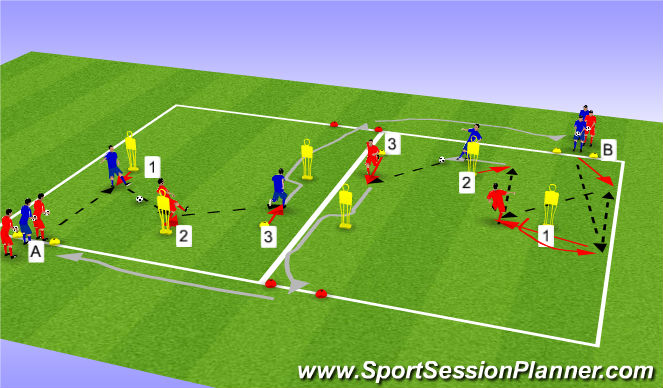
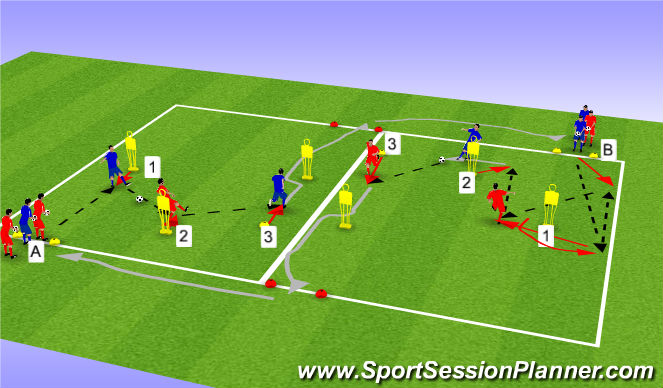
Split players into two groups (A&B), put players at points 1,2 and 3 with the rest of the players queued at the beginning of their respective stations with a ball. The ball will be played from the first player into the player on point 1, who will make a run off the marker (mannequin) to receive the ball on their front foot, to keep distance between the ball and defender. Then on their second touch they will play the ball into feet at point 2 who will control the ball the same before playing an inviting pass for the player on point 3 to run onto, before dribbling past the mannequin with skill and purpose, and then through the end zone. After each player makes their pass they will sprint to the next point ready to receive the next pass. The player who dribbles through the end zone will then join the back of group B to continue to practice in a cycle.
Progression:
Add different movements to lose marker and angles of passing and receiving to make to pattern of play more complex and realistic to the game (one-two/reverse pass/peal away from defender etc).