
Football/Soccer Session (Moderate): Improving Transitional Play

Football Life
Louis Baron

Description
Session Objective: This session is geared to help players react and transition quickly when defending and when attacking. This is to both exploit and deal with counter-attacking situations.
Level: U13+
Principles of Play:
Attacking:
- Penetration
- Mobility
- Space
- Pressure
- Delay
- Cover
- Balance
Part 1: Warm up: (Engage 10-15mins)
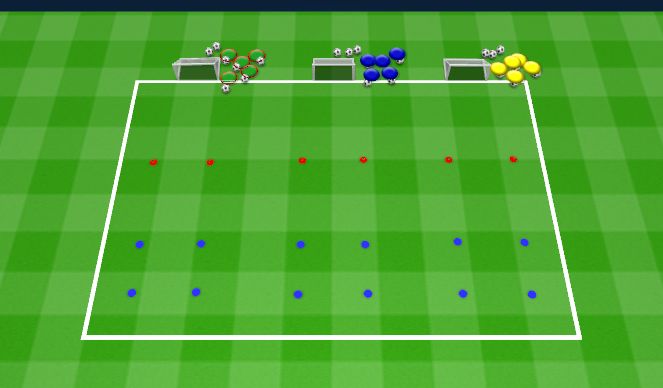
- This is a classic relay race that helps players work on their technical skills of dribbling at speed, passing with accuracy, taking a clean first touch.
- This warm-up drill also works on players agility and explosive speed.
Part 2: Practice: (Educate 20-25mins)
- This is a possession-based practice that is designed to help players dominant possession by applying key attacking principles of play: penetration, mobility and space/shape (width/depth).
- This practice is also designed to help players react quickly and efficiently when in transition i.e., immediately after either losing possession or regaining possession.
Part 3: Game: (Explore 25-30mins)
- Using the same concepts and coaching details as the practice, this small-sided game (SSG) gives players many opportunities to explore in a game scenario the importance of transiting with speed and purpose.
See the guidance at the top of this page to understand why you are not seeing interactive Football/Soccer images.

See the guidance at the top of this page to understand why you are not seeing interactive Football/Soccer images.
20 mins
Overview/Set Up:
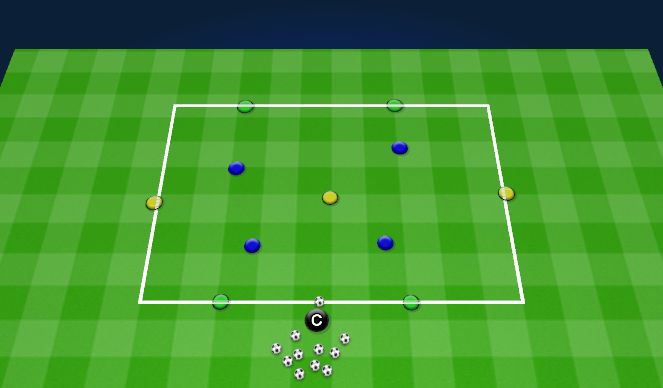
- Set-up a 20 x 20 playing area (approx.).
- Arrange three teams of 4 players per team (or if you've got an odd number, two teams of 4 players and one team of 3 players - like in the video).
- Have one team of 4 players as the defending team (Blue team in video). This team remains inside the box. Have another team split onto two sides of the box, top and bottom (Green team in video). Have the final/neutral team split, one on either side of the box, left and right, and one/two in the middle of the box (Yellow team in video).
- Coach takes up a central position at the base of the box. The coach makes sure to have plenty of spare balls with him. This is to keep the practice flowing without too many interruptions. If a ball goes a long way out of play, make sure players do to retrieve the ball as this wastes precious training time.
Game Rules/Points:
- In this practice, the outside players (Green team) are working together with the neutral players (Yellow team) to keep the ball away from the defending team (Blue team). They are to attempt as many passes as possible. Give your players a target that is suitable to their age/skill level e.g., U13 = 8 passes U14 = 10 passes U15 = 12 passes etc.
- The defending team has to win possession of the ball. Once they have won possession of the ball they must transition from defending to attacking by quickly passing the ball to a neutral player. They then become the new team on the outside of the box. They now aim to complete more passes than the other team (see video).
- The team who lost possession now becomes the defending team in the middle of the box.
- If attacking teams manage to complete the set number of passes, they receive 1 Point.
- Play for 3 minute rounds.
Work to Rest Ratio:
- 3 minutes of work with 1 minute rest.
- Play for a total of 20-25mins.
Coaching Points:
- Quality of Pass: players need to deliver accurate, well-weighted passes (i.e., not too soft, not too hard) to their teammates. Passes also need to be directed to their teammates correct side/foot e.g., if a teammate wants to move to their right-hand-side, then the pass needs to be directed to their right foot. If the pass is misdirected to their teammates left foot, this will of course hinder their movement, making it harder for them.
- Pressing: the defending team is to press with intelligence and as a unit. See YouTube video on Pressing.
- Reaction Speed: when the defending team gains possession of the ball, can they quickly pass to a neutral player. Can they also get into a good shape quickly by moving to the sides (top and bottom) of the box. This is the principle of space - getting into a good shape quickly.
- Awareness: all players - attackers and defenders - need to constantly scan when playing. This will help them be more aware of their surroundings e.g., space to exploit, teammates in space, defenders to avoid, attackers to press etc.
- Mobility: attacking players (those in possession of the ball) must maintain good mobility i.e., not be flat-footed, but always be on the move looking for space to move into.
Progressions:
- If the skill level of your team is high, introduce a 2nd ball into the practice i.e., play with 2 balls. This will force all players to be more focused and alert, speeding up their reaction speed.
Regression:
- Increase the size of the box if teams are struggling to keep possession.
See the guidance at the top of this page to understand why you are not seeing interactive Football/Soccer images.
25 mins
Overview/Set Up
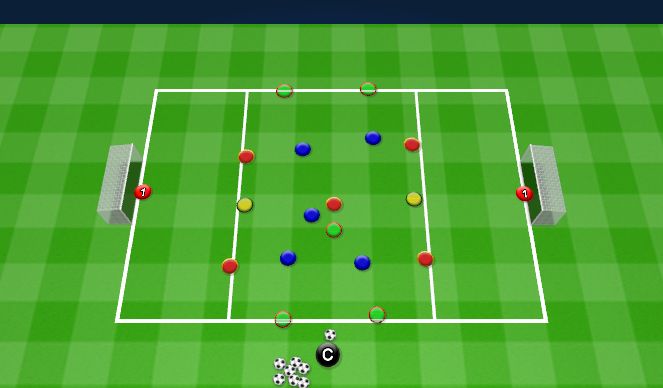
- Set-up a larger playing area approx. 60 x 40 yards (the size will depend on the number of players you have. Bigger space for more players etc).
- Split the area into thirds with the central third being larger (see diagram).
- Place goalkeepers in each goal (or defenders if you don't have goalkeepers).
- Divide your team into three even teams (3-5 per team) with two spare players (Yellows) who will play as centre forwards. It's okay if you don't have three even teams.
- Coach (C) takes up a central position, with spare balls next to him.
Game Rules/Points:
- One team starts in the middle zone as the defending team (Blues in video).
- Another team are placed on the sides (2 on top & 2 on bottom) of the middle zone with one team player in the middle (Greens in video).
- The third team have two "defenders" on each vertical line of the middle zone and one player in the middle (Reds in video). The two players on each vertical line immediately become "defenders" during the transition from attack to defence (see video).
- Place the centre forwards (Yellows in video) on each vertical line of the middle zone. These centre forwards are inactive until the defensive team wins possession of the ball i.e., they spring into life immediately after the defending teams gains possession of the ball.
- The aim/objective of this small-sided game (SSG) is for the outside players and two neutral players to maintain possession for as long as possible, keeping the ball away from the defending team. If the defending team gains possession of the ball, they must transition ("break out"!) at speed and attack to score in one of the goals. This is when the centre forwards (Yellows) become active against the two defenders to create goal scoring opportunities to finish (again, see video).
- How many goals can the defending team score? Make it a competition between the three teams.
- You can also rotate the centre forwards if you wish.
Work to Rest Ratio:
- Play 5-7 minute rounds with 1 minute rest periods. Change the defending team after each round. Play 3 rounds. This gives each team a chance to defend and then attack on goal.
Coaching Points: Same details as before with these additional coaching points:
- Transition to Attack: immediately after gaining possession, can the defending team quickly transition into attack mode, penetrating their opponents goal at speed. This might be a quick dribble towards goal OR a quick through ball OR combination play. The main point being quick reaction speed from defence mode to attack mode.
- Finishing: can the defending team not only create goal-scoring opportunities, but also have an "end product" by actually scoring.
Progressions:
- You can make the centre forward active throughout the drill, being able to apply pressure.
- If the defending team manage to score, the coach immediately serves another ball into them so that they can mount an attack in the opposite goal.
Regression:
- Play without goalkeepers, making it easier to score.
YouTube Video

 Play animation
 Play step-by-step
 Repeat (toggle)
 Full Screen
 Pause
Pause Stop
Stop
15 mins
Overview/Set Up:
Game Rules/Points:
Work to Rest Ratio:
Coaching Points:
Progressions:
Regression: