


Football/Soccer Session (Moderate): 5th Technique: Improve oriented control in technical-tactical situations. (Start Time: 2025-09-29 20:20:00)
Profile Summary

| Name: | CDE GOPAD Education and Sports |
|---|---|
| City: | Majadahonda |
| Country: | España |
| Membership: | Adult Member |
| Sport: | Football/Soccer |

Description
Improve oriented control in technical and tactical situations.Sub-objectives: decision-making, body orientation, first touch, and spatial awareness.
See the guidance at the top of this page to understand why you are not seeing interactive Football/Soccer images.
See the guidance at the top of this page to understand why you are not seeing interactive Football/Soccer images.
 Save Image:
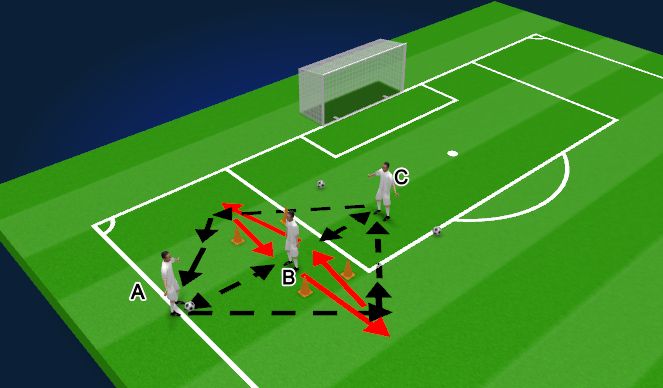
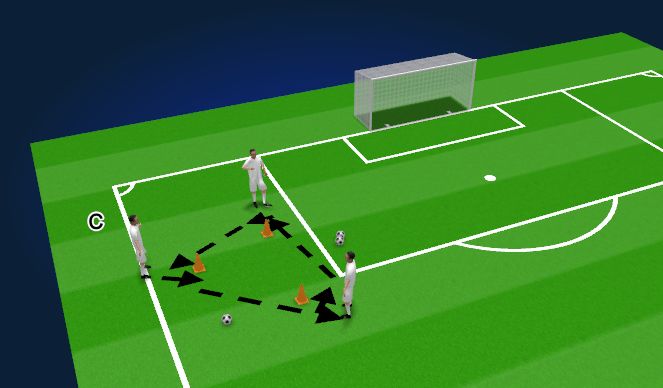
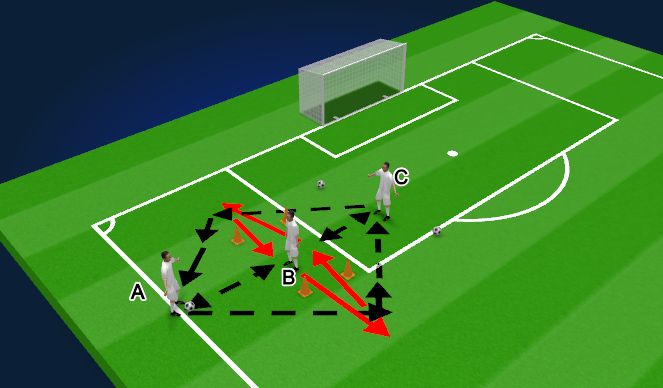
Players in motion: oriented control and dynamic passing. (5 mins)
Players in motion: oriented control and dynamic passing.
Activity Description:Lsmall cones, balls, small goals.
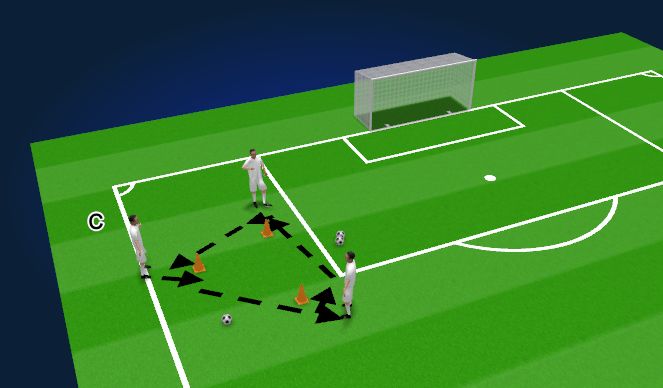
trios separated by 10-15 meters.
Player A passes to Player B.
B returns the ball to A and moves outside the square to receive the ball again.
A passes to B in his new position.
B, with proper body shape, takes an oriented control and passes to Player C.
C passes into the middle of the square where B is now returning.
B lays the ball off to C and moves to the opposite side of the square.
C now passes to B again.
B, with proper body shape, takes an oriented control and passes to Player A.
A passes into the middle of the square where B is returning again.
B lays it off to A and the sequence continues...
Rotate the diractatatio fter every 3 repetitions.
Coaching Objectives:Orientation control and quality pass after control.
Body orientation before receiving the ball
First touch quality and direction
Spatial awareness and perception
Key Coaching Points:
Open body position before receiving the pass
Scan the field before the first touch
Use inside of the foot
Emphasize control into space, not just towards the cone
Progressions:
Speed the ball, give time to do a lap
Increase the distance between players.
Control with non-dominant leg.
Low or aerial pass.
Limit the number of touches.
Game. Count the time you make a lap in 1 minute
See the guidance at the top of this page to understand why you are not seeing interactive Football/Soccer images.
Oriented control technical circuit (10 mins)
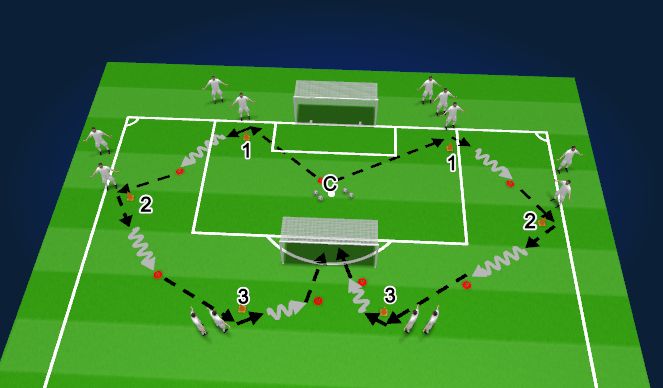
Passing wheel: Oriented control technical circuit
Activity Description:Large and small cones, balls, small goals.
The circuit is set up to simulate a ball progression from the back (build-up phase). The coach initiates the play from the edge of the 6-yard box (small area), alternating sides. The setup is symmetrical on both sides of the field.
Players form lines behind the large cones, which mark the points where oriented control must be performed.
Coach passes the ball to Player 1.
Player 1 performs an oriented control around a cone or mannequin (simulating an opponent), drives the ball forward to a small cone, and passes to Player 2.
Player 2 repeats the action: oriented control, dribble to small cone, pass to Player 3.
Player 3 performs the same sequence, finishing with a shot on goal.
After shooting, the player collects the ball and passes it to the coach on the opposite side, then joins the line on that side to practice the opposite orientation.
The drill flows continuously from one side to the other.
Coaching Objectives:
Body orientation before receiving the ball
First touch quality and direction
Spatial awareness and perception
Key Coaching Points:
Open body position before receiving the pass
Scan the field before the first touch
Use inside or outside of the foot depending on the situation
Emphasize control into space, not just towards the cone
Progressions:
Limit the number of touches or impose a time constraint for each action.
Add a 1v1 challenge before the pass to the next player:
Start with passive pressure
Increase to active pressure if the players' level allows
See the guidance at the top of this page to understand why you are not seeing interactive Football/Soccer images.
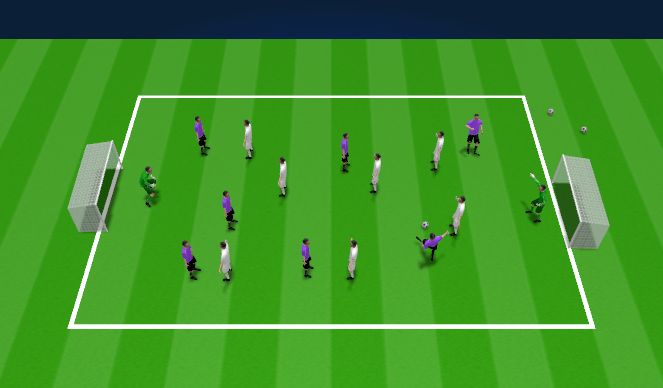
Oriented control:Small game without goalkeepers (4:4 or 5:5) (10 mins)
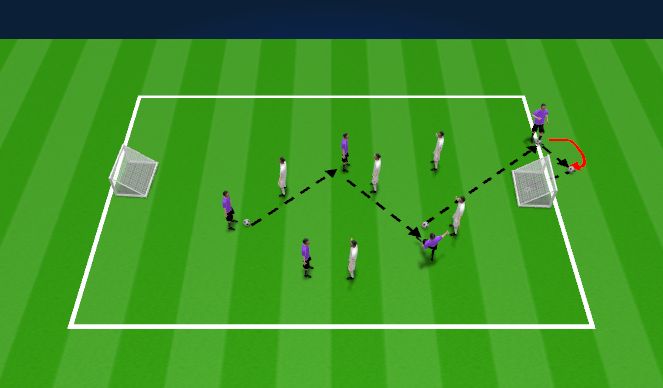
Oriented control:Small game without goalkeepers (4:4 or 5:5)
Activity Description:Small goals, pennis, balls and cons.Format: 4:4 in a 30x20 m space
Objective: To score in mini-goals or target areas.Each time a player receives the ball, they must make a directional control into open space or the offensive zone.A goal is only valid if the previous play includes a successful directional control.
Rules:The game follows FIFA rules, with the following exceptions:
Oriented Control Required Before Scoring
Players must perform an oriented control towards the outside (away from goal or towards the touchline) before attempting to score.
Goals are only valid if this oriented control is clearly executed.
Small Goals Facing Outward
The small goals must be positioned to face the outside of the field (i.e., toward the sidelines or away from the central area).
This positioning encourages attacking through wide areas and reinforces the habit of orienting control away from pressure.
Coaching Objectives:
Body orientation before receiving the ball
First touch quality and direction
Spatial awareness and perception
Good decision making
Progressions:
Limit the number of touches or impose a time constraint for each action.
Reduce the space
See the guidance at the top of this page to understand why you are not seeing interactive Football/Soccer images.
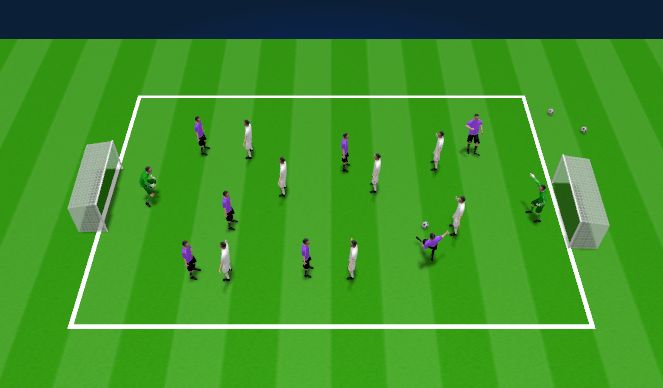
Modified scrimmage: Oriented Control (5 mins)
Modified scrimmage
Activity Description:Goals, pennis, balls and cons.7:7 with special rules.
Modified rules:Double goal if generated after a controlled ball that crosses an opponent's line.Loss of possession if a controlled ball is not used (whistle is blown and possession changes).The use of controlled ball as a tactical advantage is rewarded.
Modified Rules:The game follows FIFA rules, with the following exceptions:
Double goal if generated after a controlled ball that crosses an opponent's line.
Loss of possession if a controlled ball is not used (whistle is blown and possession changes).The use of controlled ball as a tactical advantage is rewarded.
Coaching Objectives:
Body orientation before receiving the ball
First touch quality and direction
Good decision making
Progressions:
Limit the number of touches or impose a time constraint for each action.
Reduce the space
'%3E%3Cpath id='path4169' d='M 11.4375,70.25 C 11.457031,38.394531 37.277344,13.242188 68.253906,13.050781 99.78125,12.855469 125.73047,38.351563 125.8125,70.078125 125.89844,101.62109 100.43359,127.14063 69.148438,127.42188 37.582031,127.70703 11.464844,102.23438 11.4375,70.25 m 6.425781,-0.08984 c 0.03516,28.421871 23.027344,50.69922 50.519532,50.82031 C 96.433594,121.10156 119.30469,98.367188 119.38281,70.359375 119.45313,42.878906 97.382813,19.714844 69.015625,19.496094 40.75,19.277344 17.964844,42.035156 17.863281,70.160156' style='clip-rule:nonzero;fill:%23333f48;fill-opacity:1;fill-rule:nonzero;stroke:none' /%3E%3Cpath style='fill:%23333f48;fill-opacity:1;fill-rule:nonzero;stroke:none' d='m 39.789063,108.62109 c 0.28125,0.14454 0.550781,0.32032 0.839843,0.4336 2.734375,1.05469 5.554688,1.78125 8.453125,2.23047 2.734375,0.42578 5.484375,0.64453 8.25,0.54297 3.988282,-0.15625 7.832032,-0.94922 11.445313,-2.69532 1.683594,-0.8164 3.246094,-1.82422 4.640625,-3.07422 3.265625,-2.92578 5.171875,-6.582027 5.796875,-10.906246 0.546875,-3.761719 0.04687,-7.425781 -1.09375,-11.019531 -1.4375,-4.523438 -3.730469,-8.582032 -6.703125,-12.265625 -1.03125,-1.277344 -2.082031,-2.535157 -3.113281,-3.808594 C 66.789063,66.1875 65.332031,64.269531 64.0625,62.21875 c -1.601562,-2.582031 -2.835937,-5.316406 -3.613281,-8.261719 -0.683594,-2.574218 -0.902344,-5.1875 -0.6875,-7.828125 0.214844,-2.617187 0.910156,-5.117187 2.152344,-7.441406 2.164062,-4.050781 5.503906,-6.710937 9.816406,-8.179687 1.890625,-0.640625 3.835937,-1.058594 5.832031,-1.195313 1.121094,-0.07813 2.242188,-0.152344 3.363281,-0.164062 4.28125,-0.02734 8.4375,0.734375 12.453125,2.175781 1.871094,0.671875 3.6875,1.496094 5.523438,2.257812 0.226562,0.09375 0.4375,0.230469 0.664062,0.351563 -0.164062,0.25 -0.371093,0.160156 -0.539062,0.164062 -2.824219,0.101563 -5.535156,0.703125 -8.132813,1.804688 -1.335937,0.570312 -2.570312,1.316406 -3.648437,2.296875 -2.527344,2.296875 -3.605469,5.15625 -3.34375,8.550781 0.140625,1.855469 0.722656,3.574219 1.550781,5.222656 0.648438,1.296875 1.414063,2.523438 2.292969,3.675782 0.953125,1.25 1.929687,2.484375 2.929687,3.699218 2.085938,2.523438 4.164063,5.054688 6.050782,7.738282 2.203125,3.136718 4.140627,6.417968 5.589847,9.980468 1.16406,2.867188 2.01562,5.820313 2.39843,8.894532 0.25,2.011718 0.30079,4.03125 0.11719,6.058593 -0.24219,2.640625 -0.79297,5.195313 -1.74609,7.667969 -1.29688,3.36328 -3.300784,6.22656 -5.972659,8.63281 -2.429687,2.19141 -5.171875,3.90625 -8.109375,5.3125 -2.695312,1.29297 -5.464843,2.40235 -8.34375,3.20313 -1.953125,0.54687 -3.945312,0.8789 -5.949218,1.15625 -3.035157,0.41797 -6.085938,0.48828 -9.132813,0.3125 -5.328125,-0.3125 -10.476562,-1.46094 -15.410156,-3.52344 -3.449219,-1.44141 -6.691406,-3.25781 -9.757813,-5.39453 -0.183593,-0.12891 -0.378906,-0.25 -0.53125,-0.41016 -0.07031,-0.0703 -0.05859,-0.22656 -0.08203,-0.34375 z m 0,0' id='path4175' /%3E%3Cpath style='fill:%23333f48;fill-opacity:1;fill-rule:nonzero;stroke:none' d='M 94.699219,29.390625 C 94.089844,29.21875 93.476563,29.054688 92.867188,28.875 90.183594,28.085938 87.46875,27.441406 84.703125,27.046875 c -3.976562,-0.566406 -7.945312,-0.59375 -11.863281,0.402344 -7.535156,1.914062 -12.386719,6.71875 -14.878906,13.996094 -0.894532,2.617187 -1.179688,5.328125 -0.953125,8.078125 0.203125,2.484375 0.867187,4.859375 1.816406,7.160156 0.933594,2.261719 2.117187,4.390625 3.4375,6.449219 1.4375,2.25 3.050781,4.371093 4.640625,6.511718 1.4375,1.933594 2.867187,3.871094 4.261719,5.835938 1.230468,1.730469 2.316406,3.546875 3.273437,5.445312 1.324219,2.625 2.265625,5.378907 2.703125,8.292969 0.433594,2.902344 0.292969,5.765625 -0.660156,8.5625 -0.9375,2.74609 -2.574219,5.00781 -4.777344,6.875 -2.417969,2.04688 -5.203125,3.39844 -8.246094,4.22266 -1.835937,0.5 -3.703125,0.75781 -5.609375,0.82031 -3.886718,0.13281 -7.679687,-0.47266 -11.421875,-1.46094 -2.261718,-0.59765 -4.488281,-1.33203 -6.695312,-2.11328 -0.207031,-0.0742 -0.40625,-0.16797 -0.597656,-0.25 -0.02344,-0.24609 0.148437,-0.19141 0.25,-0.20703 1.96875,-0.30469 3.921875,-0.67969 5.804687,-1.34766 1.367188,-0.48437 2.671875,-1.10156 3.855469,-1.94922 2.25,-1.61328 3.65625,-3.765621 4.0625,-6.515621 0.273437,-1.867188 0.09375,-3.710938 -0.429688,-5.527344 -0.472656,-1.648437 -1.171875,-3.199219 -2.109375,-4.628906 -0.792968,-1.207031 -1.636718,-2.382813 -2.523437,-3.519531 -0.921875,-1.195313 -1.921875,-2.328125 -2.890625,-3.484375 -2.753906,-3.273438 -5.351563,-6.660157 -7.523438,-10.355469 -2.042968,-3.480469 -3.667968,-7.136719 -4.597656,-11.078125 -0.640625,-2.699219 -0.980469,-5.4375 -0.832031,-8.214844 0.238281,-4.53125 1.476562,-8.78125 3.824219,-12.6875 1.082031,-1.800781 2.445312,-3.375 3.988281,-4.800781 2.742187,-2.527344 5.863281,-4.480469 9.257812,-5.992188 3.746094,-1.667968 7.652344,-2.769531 11.707032,-3.394531 3.152343,-0.488281 6.324218,-0.671875 9.507812,-0.519531 8.632813,0.410156 16.671875,2.792969 24,7.433594 0.08203,0.05078 0.152344,0.109375 0.230469,0.167968 -0.0039,0.04297 -0.0078,0.08984 -0.01563,0.136719' id='path4177' /%3E%3Cpath style='fill:%23333f48;fill-opacity:1;fill-rule:nonzero;stroke:none' d='m 31.699219,38.75 c -0.07813,0.238281 -0.152344,0.476563 -0.238281,0.710938 -1.460938,4.074218 -2.066407,8.28125 -1.808594,12.59375 0.4375,7.304687 2.808594,13.925781 7.277344,19.753906 3.714843,4.84375 7.441406,9.671875 11.167968,14.503906 1.113282,1.441406 1.953125,3.007813 2.414063,4.777344 0.332031,1.257812 0.425781,2.539062 0.273437,3.820312 -0.214843,1.832032 -1.070312,3.34375 -2.464843,4.546875 -0.984375,0.851559 -2.113282,1.449219 -3.316407,1.925779 -1.378906,0.54297 -2.8125,0.89063 -4.273437,1.1211 -2.226563,0.35547 -4.46875,0.46093 -6.722656,0.41015 -0.589844,-0.0156 -1.046875,-0.18359 -1.433594,-0.625 -0.636719,-0.72265 -1.335938,-1.39062 -1.9375,-2.14062 C 25.574219,93.800781 22.300781,86.621094 20.84375,78.636719 20.152344,74.835938 19.917969,71 20.15625,67.128906 20.796875,56.773438 24.390625,47.574219 30.859375,39.480469 c 0.21875,-0.273438 0.453125,-0.53125 0.679688,-0.796875 0.05469,0.02344 0.109375,0.04297 0.160156,0.06641' id='path4179' /%3E%3Cpath style='fill:%23333f48;fill-opacity:1;fill-rule:nonzero;stroke:none' d='m 105.41016,101.30078 c -0.13282,-0.3125 0.0234,-0.5039 0.0977,-0.69922 1.38672,-3.749997 1.98047,-7.628904 1.89844,-11.621091 -0.14453,-6.84375 -2.08594,-13.144531 -5.73437,-18.925781 C 99.890625,67.226563 97.917969,64.53125 95.835938,61.917969 94.4375,60.160156 92.988281,58.4375 91.582031,56.6875 90.632813,55.511719 89.6875,54.335938 88.792969,53.121094 c -0.835938,-1.144531 -1.488281,-2.398438 -1.953125,-3.742188 -0.523438,-1.515625 -0.695313,-3.070312 -0.511719,-4.652343 0.21875,-1.839844 1.082031,-3.339844 2.476563,-4.542969 1.039062,-0.890625 2.230468,-1.507813 3.503906,-1.980469 1.632812,-0.609375 3.320312,-0.960937 5.046875,-1.175781 1.917969,-0.238281 3.839841,-0.269531 5.769531,-0.230469 0.52734,0.01172 0.89453,0.203125 1.23828,0.585938 5.50391,6.113281 9.26172,13.144531 11.21875,21.132812 1.11719,4.554688 1.5625,9.179688 1.30469,13.855469 -0.58203,10.625 -4.23438,20.082031 -10.96094,28.339846 -0.15625,0.1914 -0.32812,0.375 -0.51562,0.58984' id='path4181' /%3E%3Cpath style='fill:%23333f48;fill-opacity:1;fill-rule:nonzero;stroke:none' d='m 39.796875,108.63281 c -0.05859,0.0117 -0.117187,0.0234 -0.175781,0.0352 0.05469,-0.0156 0.113281,-0.0312 0.167969,-0.0469 z m 0,0' id='path4183' /%3E%3C/g%3E%3C/svg%3E)
 Play animation
 Play step-by-step
 Repeat (toggle)
 Full Screen
 Pause
Pause Stop
Stop
Oriented control and moving pass (5 mins)
Oriented control and moving pass
Activity Description:small cones, balls.
Pairs or trios separated by 10-15 meters.
Player passes to B → B performs a free-side control and passes to C (or returns to A if a pair).
Rotate the diractatatio fter every 3 repetitions.
Variations: Increase distance, non-dominant leg control, aerial pass, light pressure from a passive defender. Orientation control and quality pass after control.
Coaching Objectives:Orientation control and quality pass after control.
Body orientation before receiving the ball
First touch quality and direction
Spatial awareness and perception
Key Coaching Points:
Open body position before receiving the pass
Scan the field before the first touch
Use inside of the foot
Emphasize control into space, not just towards the cone
Progressions:
Speed the ball, give time to do a lap
Increase the distance between players.
Control with non-dominant leg.
Low or aerial pass.
Add passive pressure from a defender to B before receiving.
Limit the number of touches.
Game. Count the time you make a lap in 1 minute