


Football/Soccer Session (Beginner): Term 1 / Week 7 - First Touch


FAW Coach Ed
Adam Davidson
Profile Summary

| Name: | Adam Davidson |
|---|---|
| City: | Sydney |
| Country: | Australia |
| Membership: | Adult Member |
| Sport: | Football/Soccer |

Description
Technical | First Touch
Tactical | Individual skill to create scoring chances
Psychological | Example
Session Objective | in this session, our focus shifts towards using first touch skills and complementary movement to support one another in possession. Players will learn the importance and application of (i) body position, (ii) pitch position and (iii) width, depth & length and (iv) shape; all of which have a huge impact on available space and first touch possibilities.
Coaches, aim to keep coaching points short & simple. Go in, deliver your point, affect the players on the ball, around the ball and away from the ball, then get out. As often as possible look to coach on the run and let them play, however, if play needs to be stopped during tactical component and skill game, then address problems as follows: -
spot problem | stop play | correct using demonstration, guided discover and q&a | play is live off my touch "and we play".
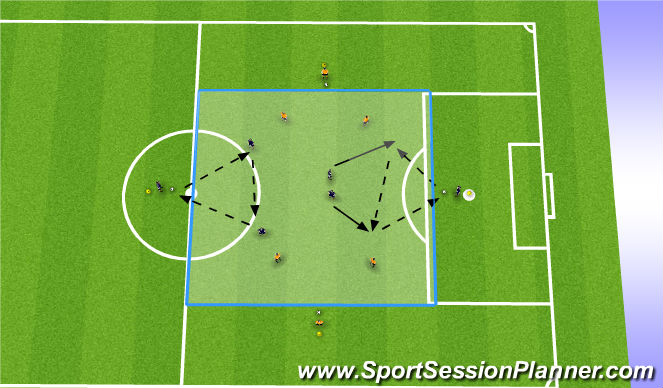
See the guidance at the top of this page to understand why you are not seeing interactive Football/Soccer images.
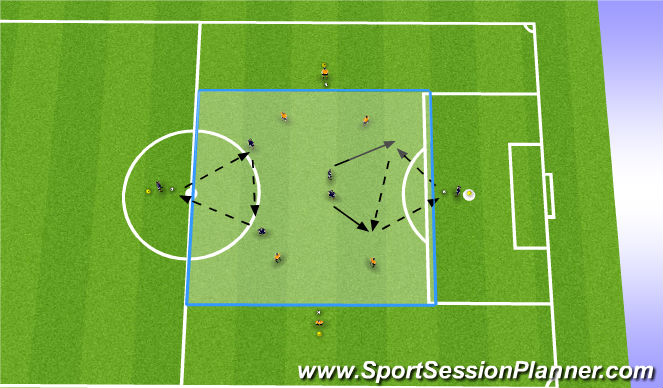
See the guidance at the top of this page to understand why you are not seeing interactive Football/Soccer images.
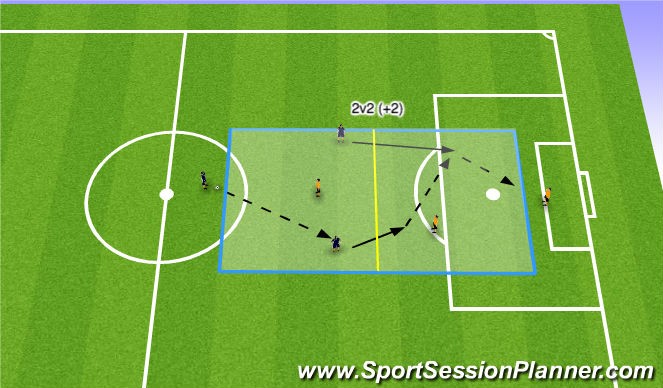
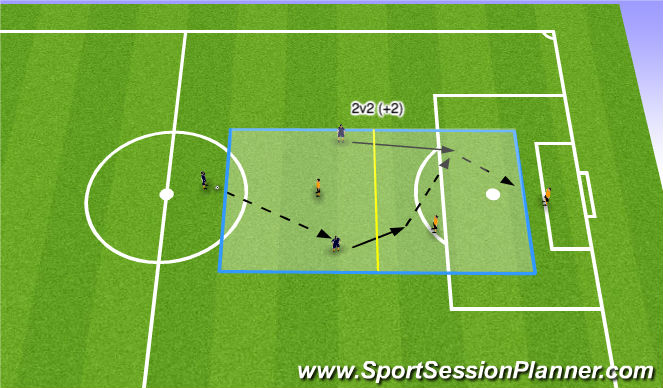
Skill training: 2v2(+2) (15 mins)
Frame
Opposed first touch training that focuses on creating space to play forward under pressure, with a numerical advantage.
Explanation
Teams play 2v2 in the area with a target player either side. One team is designated defenders, the other is designated attackers. 1 defender can only defend in a designated half. Attackers are free to play in any half (2v1's). Attackers are tasked with transferring the ball from one target player to another - they are awarded 1 goal each time they successfully achieve this. Defenders score goals by stealing / intercepting the ball and playing to either target player. Rotate teams after 1.5 minutes.
Coaching points
> body position & pitch position = important for playing forward.
> to create space when we get on the ball, we need a little bit of what? width and depth - I want to see if you can really work the opposites to create space.
> use the half-way line as a guide for where you should be to support your team mate.
> as often as possible, try not to set up on the same lines as your team mate.
> check shoulders for awareness of defenders, team mate and space.
> how many movements to lose your marker? yeah, rarely one - usually two or three to create space & a angle to receive and play forward.
See the guidance at the top of this page to understand why you are not seeing interactive Football/Soccer images.
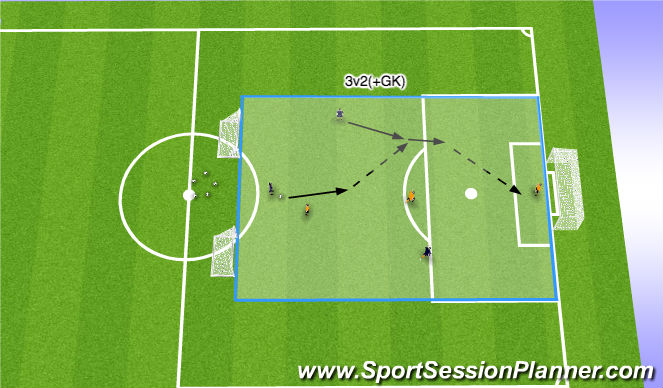
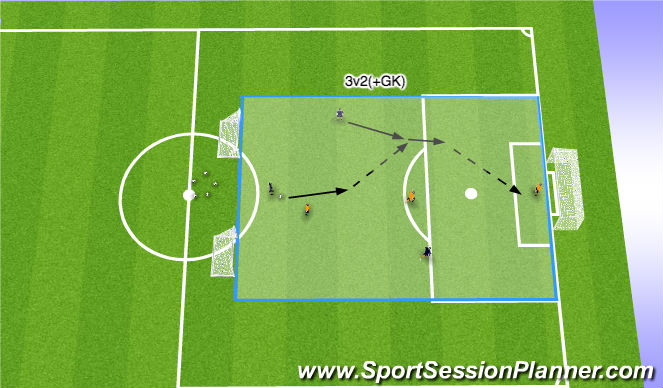
ST progression: 3v2(+GK) (15 mins)
Frame
Particular attention is paid to the idea of shifting the ball forward as a unit and, as often as possible making clever first touch decisions to creat goal-scoring opportunities.
Explanation
3v2 | 10x20 playing area with an 10x8 shooting zone at one end. A supply of 3 balls is placed at one end of the playing area. 3 attackers vs 2 defenders. Offside rule = ON. Attacking team have 3 attempts to score 3 goals. Attackers must score off their first or second touch, but can shoot from anywhere in the playing area. Defenders can earn points by regaining possession and scoring in the small goals. A ball is dead when a goal is scored; dribble-ins / kick-ins if the ball leaves the playing area. When a ball is dead, play is restarted by the attacking team getting a new ball and starting a new attack. Rotate roles of players after all 3 balls are dead.
Coaching points
> we're looking for the attacking team to provide good what? width and depth, good receiving angles, good first touch and various types of passes that suit the situation you're in.
> Let's say the orange steal the ball, and the blues win the ball back off them; let's walk through that. Ok, and already you're about to spread out - good. So, if the ball goes out to a team mate on the edge of the area, what are we looking for? Yeah, another little movement and rotation, just to clear space.
> So great, you've spread out wide, but as that ball travels you might just have to clear space to keep the passing options fresh.
> Because the oranges might come out and press, the more we can move as the ball travels, the harder it will be for them to defend and get the ball back.
> Speed up, slow down and show for the ball. If you don't get it spin out, move again, offer a different angle. Just moving isn't the same as showing for the ball and asking to receive.
> Be patient in possession; pivot player controls the attack - give it, get it back, start again, change your angle, rotate if it's on.
> Check shoulders for awareness of defenders, team mate and space.
See the guidance at the top of this page to understand why you are not seeing interactive Football/Soccer images.
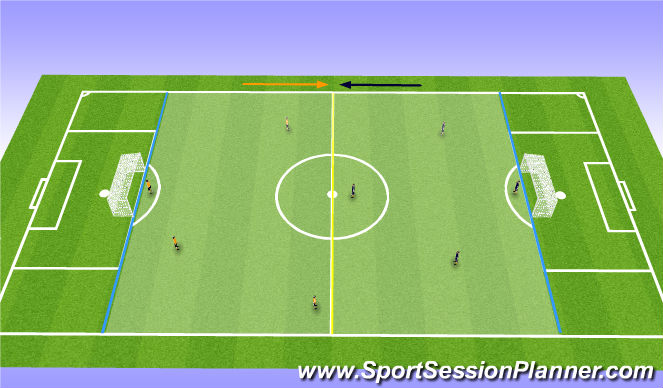
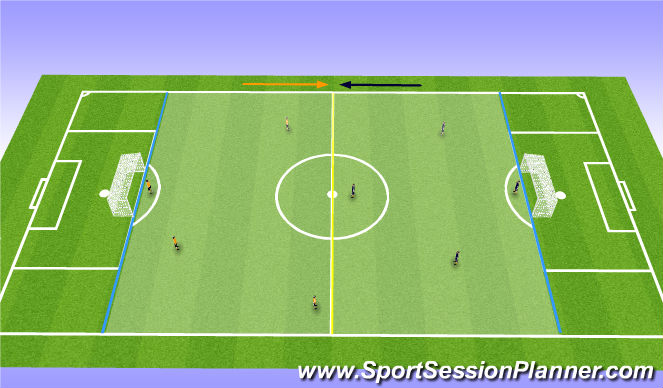
Tactical component: 6v6 conditioned game (20 mins)
Frame
A small-sided conditioned game to emphasise the importance of body shape/ positioning to play forward. Players receive feedback directly from the game itself and learn to become more aware of their surroundings and to react accordingly to solve a football problem.
Explanation
2 large goals. Short but wide pitch - . 4v4 / 5v5 / 6v6. Goals can only be scored off your 1st or 2nd touch. Headers & half-volleys count as 2 goals. Fly GK's = anyone can be GK at any time, all they have to do is call out KEEPER! before using their hands.
Progression
1. If a team can complete 8 passes without losing possession, we'll give them a goal for that. NB - coach can make it a condition that passes must split opposition players. *The intention here is to give the opposition an incentive to press the ball, and leave space behind for the team in possession to exploit*
Coaching Points
> if it's tight, in a small area and you can't squeeze through - you can come back out, pass and keep the ball - wait for the right opportunity to play forward and score.
> body shape will dictate action - receive and play FWD / set back / play around the corner.
> receive back foot to play forward, receive front foot to protect the ball, set back and combine to play FWD.
> if I've lost my man and bought a yard or two of space, can I get it on my back foot? yeah, good players will take that forward and take the defender out of the game.
> what happens if he's very tight to me? yeah, I could move off him and set it for a team mate OR I sink in and play it around the corner like that.
> now, if I'm standing square I can't see what? what's behind me, and all of sudden all of those options I had before disappear.
'%3E%3Cpath id='path4169' d='M 11.4375,70.25 C 11.457031,38.394531 37.277344,13.242188 68.253906,13.050781 99.78125,12.855469 125.73047,38.351563 125.8125,70.078125 125.89844,101.62109 100.43359,127.14063 69.148438,127.42188 37.582031,127.70703 11.464844,102.23438 11.4375,70.25 m 6.425781,-0.08984 c 0.03516,28.421871 23.027344,50.69922 50.519532,50.82031 C 96.433594,121.10156 119.30469,98.367188 119.38281,70.359375 119.45313,42.878906 97.382813,19.714844 69.015625,19.496094 40.75,19.277344 17.964844,42.035156 17.863281,70.160156' style='clip-rule:nonzero;fill:%23333f48;fill-opacity:1;fill-rule:nonzero;stroke:none' /%3E%3Cpath style='fill:%23333f48;fill-opacity:1;fill-rule:nonzero;stroke:none' d='m 39.789063,108.62109 c 0.28125,0.14454 0.550781,0.32032 0.839843,0.4336 2.734375,1.05469 5.554688,1.78125 8.453125,2.23047 2.734375,0.42578 5.484375,0.64453 8.25,0.54297 3.988282,-0.15625 7.832032,-0.94922 11.445313,-2.69532 1.683594,-0.8164 3.246094,-1.82422 4.640625,-3.07422 3.265625,-2.92578 5.171875,-6.582027 5.796875,-10.906246 0.546875,-3.761719 0.04687,-7.425781 -1.09375,-11.019531 -1.4375,-4.523438 -3.730469,-8.582032 -6.703125,-12.265625 -1.03125,-1.277344 -2.082031,-2.535157 -3.113281,-3.808594 C 66.789063,66.1875 65.332031,64.269531 64.0625,62.21875 c -1.601562,-2.582031 -2.835937,-5.316406 -3.613281,-8.261719 -0.683594,-2.574218 -0.902344,-5.1875 -0.6875,-7.828125 0.214844,-2.617187 0.910156,-5.117187 2.152344,-7.441406 2.164062,-4.050781 5.503906,-6.710937 9.816406,-8.179687 1.890625,-0.640625 3.835937,-1.058594 5.832031,-1.195313 1.121094,-0.07813 2.242188,-0.152344 3.363281,-0.164062 4.28125,-0.02734 8.4375,0.734375 12.453125,2.175781 1.871094,0.671875 3.6875,1.496094 5.523438,2.257812 0.226562,0.09375 0.4375,0.230469 0.664062,0.351563 -0.164062,0.25 -0.371093,0.160156 -0.539062,0.164062 -2.824219,0.101563 -5.535156,0.703125 -8.132813,1.804688 -1.335937,0.570312 -2.570312,1.316406 -3.648437,2.296875 -2.527344,2.296875 -3.605469,5.15625 -3.34375,8.550781 0.140625,1.855469 0.722656,3.574219 1.550781,5.222656 0.648438,1.296875 1.414063,2.523438 2.292969,3.675782 0.953125,1.25 1.929687,2.484375 2.929687,3.699218 2.085938,2.523438 4.164063,5.054688 6.050782,7.738282 2.203125,3.136718 4.140627,6.417968 5.589847,9.980468 1.16406,2.867188 2.01562,5.820313 2.39843,8.894532 0.25,2.011718 0.30079,4.03125 0.11719,6.058593 -0.24219,2.640625 -0.79297,5.195313 -1.74609,7.667969 -1.29688,3.36328 -3.300784,6.22656 -5.972659,8.63281 -2.429687,2.19141 -5.171875,3.90625 -8.109375,5.3125 -2.695312,1.29297 -5.464843,2.40235 -8.34375,3.20313 -1.953125,0.54687 -3.945312,0.8789 -5.949218,1.15625 -3.035157,0.41797 -6.085938,0.48828 -9.132813,0.3125 -5.328125,-0.3125 -10.476562,-1.46094 -15.410156,-3.52344 -3.449219,-1.44141 -6.691406,-3.25781 -9.757813,-5.39453 -0.183593,-0.12891 -0.378906,-0.25 -0.53125,-0.41016 -0.07031,-0.0703 -0.05859,-0.22656 -0.08203,-0.34375 z m 0,0' id='path4175' /%3E%3Cpath style='fill:%23333f48;fill-opacity:1;fill-rule:nonzero;stroke:none' d='M 94.699219,29.390625 C 94.089844,29.21875 93.476563,29.054688 92.867188,28.875 90.183594,28.085938 87.46875,27.441406 84.703125,27.046875 c -3.976562,-0.566406 -7.945312,-0.59375 -11.863281,0.402344 -7.535156,1.914062 -12.386719,6.71875 -14.878906,13.996094 -0.894532,2.617187 -1.179688,5.328125 -0.953125,8.078125 0.203125,2.484375 0.867187,4.859375 1.816406,7.160156 0.933594,2.261719 2.117187,4.390625 3.4375,6.449219 1.4375,2.25 3.050781,4.371093 4.640625,6.511718 1.4375,1.933594 2.867187,3.871094 4.261719,5.835938 1.230468,1.730469 2.316406,3.546875 3.273437,5.445312 1.324219,2.625 2.265625,5.378907 2.703125,8.292969 0.433594,2.902344 0.292969,5.765625 -0.660156,8.5625 -0.9375,2.74609 -2.574219,5.00781 -4.777344,6.875 -2.417969,2.04688 -5.203125,3.39844 -8.246094,4.22266 -1.835937,0.5 -3.703125,0.75781 -5.609375,0.82031 -3.886718,0.13281 -7.679687,-0.47266 -11.421875,-1.46094 -2.261718,-0.59765 -4.488281,-1.33203 -6.695312,-2.11328 -0.207031,-0.0742 -0.40625,-0.16797 -0.597656,-0.25 -0.02344,-0.24609 0.148437,-0.19141 0.25,-0.20703 1.96875,-0.30469 3.921875,-0.67969 5.804687,-1.34766 1.367188,-0.48437 2.671875,-1.10156 3.855469,-1.94922 2.25,-1.61328 3.65625,-3.765621 4.0625,-6.515621 0.273437,-1.867188 0.09375,-3.710938 -0.429688,-5.527344 -0.472656,-1.648437 -1.171875,-3.199219 -2.109375,-4.628906 -0.792968,-1.207031 -1.636718,-2.382813 -2.523437,-3.519531 -0.921875,-1.195313 -1.921875,-2.328125 -2.890625,-3.484375 -2.753906,-3.273438 -5.351563,-6.660157 -7.523438,-10.355469 -2.042968,-3.480469 -3.667968,-7.136719 -4.597656,-11.078125 -0.640625,-2.699219 -0.980469,-5.4375 -0.832031,-8.214844 0.238281,-4.53125 1.476562,-8.78125 3.824219,-12.6875 1.082031,-1.800781 2.445312,-3.375 3.988281,-4.800781 2.742187,-2.527344 5.863281,-4.480469 9.257812,-5.992188 3.746094,-1.667968 7.652344,-2.769531 11.707032,-3.394531 3.152343,-0.488281 6.324218,-0.671875 9.507812,-0.519531 8.632813,0.410156 16.671875,2.792969 24,7.433594 0.08203,0.05078 0.152344,0.109375 0.230469,0.167968 -0.0039,0.04297 -0.0078,0.08984 -0.01563,0.136719' id='path4177' /%3E%3Cpath style='fill:%23333f48;fill-opacity:1;fill-rule:nonzero;stroke:none' d='m 31.699219,38.75 c -0.07813,0.238281 -0.152344,0.476563 -0.238281,0.710938 -1.460938,4.074218 -2.066407,8.28125 -1.808594,12.59375 0.4375,7.304687 2.808594,13.925781 7.277344,19.753906 3.714843,4.84375 7.441406,9.671875 11.167968,14.503906 1.113282,1.441406 1.953125,3.007813 2.414063,4.777344 0.332031,1.257812 0.425781,2.539062 0.273437,3.820312 -0.214843,1.832032 -1.070312,3.34375 -2.464843,4.546875 -0.984375,0.851559 -2.113282,1.449219 -3.316407,1.925779 -1.378906,0.54297 -2.8125,0.89063 -4.273437,1.1211 -2.226563,0.35547 -4.46875,0.46093 -6.722656,0.41015 -0.589844,-0.0156 -1.046875,-0.18359 -1.433594,-0.625 -0.636719,-0.72265 -1.335938,-1.39062 -1.9375,-2.14062 C 25.574219,93.800781 22.300781,86.621094 20.84375,78.636719 20.152344,74.835938 19.917969,71 20.15625,67.128906 20.796875,56.773438 24.390625,47.574219 30.859375,39.480469 c 0.21875,-0.273438 0.453125,-0.53125 0.679688,-0.796875 0.05469,0.02344 0.109375,0.04297 0.160156,0.06641' id='path4179' /%3E%3Cpath style='fill:%23333f48;fill-opacity:1;fill-rule:nonzero;stroke:none' d='m 105.41016,101.30078 c -0.13282,-0.3125 0.0234,-0.5039 0.0977,-0.69922 1.38672,-3.749997 1.98047,-7.628904 1.89844,-11.621091 -0.14453,-6.84375 -2.08594,-13.144531 -5.73437,-18.925781 C 99.890625,67.226563 97.917969,64.53125 95.835938,61.917969 94.4375,60.160156 92.988281,58.4375 91.582031,56.6875 90.632813,55.511719 89.6875,54.335938 88.792969,53.121094 c -0.835938,-1.144531 -1.488281,-2.398438 -1.953125,-3.742188 -0.523438,-1.515625 -0.695313,-3.070312 -0.511719,-4.652343 0.21875,-1.839844 1.082031,-3.339844 2.476563,-4.542969 1.039062,-0.890625 2.230468,-1.507813 3.503906,-1.980469 1.632812,-0.609375 3.320312,-0.960937 5.046875,-1.175781 1.917969,-0.238281 3.839841,-0.269531 5.769531,-0.230469 0.52734,0.01172 0.89453,0.203125 1.23828,0.585938 5.50391,6.113281 9.26172,13.144531 11.21875,21.132812 1.11719,4.554688 1.5625,9.179688 1.30469,13.855469 -0.58203,10.625 -4.23438,20.082031 -10.96094,28.339846 -0.15625,0.1914 -0.32812,0.375 -0.51562,0.58984' id='path4181' /%3E%3Cpath style='fill:%23333f48;fill-opacity:1;fill-rule:nonzero;stroke:none' d='m 39.796875,108.63281 c -0.05859,0.0117 -0.117187,0.0234 -0.175781,0.0352 0.05469,-0.0156 0.113281,-0.0312 0.167969,-0.0469 z m 0,0' id='path4183' /%3E%3C/g%3E%3C/svg%3E)
 Play animation
 Play step-by-step
 Repeat (toggle)
 Full Screen
 Pause
Pause Stop
Stop
Skill introduction
Frame
Technical first touch introduction with plenty of decision-making; implicit learning of complimentary movement patterns to support play as a two / three.
Explanation
Players in groups of 3, with 2 players working in the square & 1 player serving on the outside. Server plays a pass to a player inside the square, who then combines with a teammate. Team mate plays the ball back to the server & the pair find a new server. Pairs start off by receiving from a server who is the same colour. The server on the outside (server) starts with the football. Pairs are challenged to come together and then split to create angles and space to receive.
Progression
1. Challenge the pair to create width and depth - 1 goes short, the other long. Server hits the furthest player, pair combines to play it back.
2. Challenge the pair to make a combination that plays through another pair in the square.
3. Challenge the pair to receive from one server, combine and play it to a different server.
Coaching points
> as often as possible, play with fewer touches; show me that you know where you're sending it/taking it before you receive it.
> to create space when we get on the ball, we need a little bit of what? width and depth - I want to see if you can really work the opposites to create space.
> Paddy came up with a good point there, do we have to play our far man every single time? No, why might we not play the furthest man? Yeah, if it's crowded and the pass is blocked, we might just go with the man who's clear.
> why might we want to play the furthest player first? Yeah, it's a good habit to play the deepest player when and where we can because if he's in a game, he'll be the furthest player forward.
> vary the type of pass, movement and combinations. Be adaptable and clever.
> confusing sometimes in there with all those people and colours, yeah? Definitely but that's a problem we need to solve.