
Football/Soccer Session (Moderate): Attacking Principles in Wide Areas

Description
This session is designed to develop a team’s ability to build attacks through wide areas using structured passing patterns, coordinated movements, and quick combination play. The practices progress from a possession-based warm-up into unopposed technical patterns, before advancing into more realistic wide-attacking scenarios that replicate match situations.
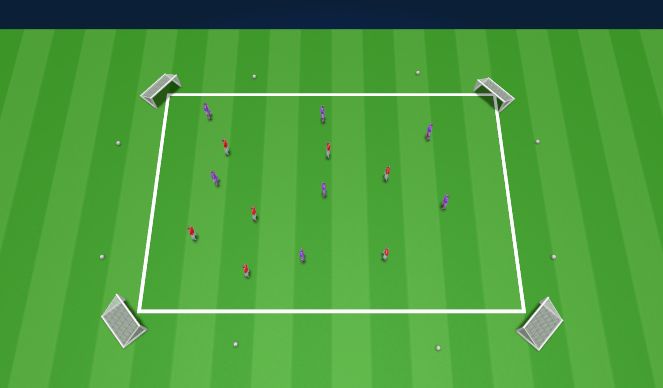
The session begins with a 6v6 + 2 throw-in possession game, which encourages players to retain the ball under pressure while using wide support options. The two neutral throwers act as constant outlets, helping the team in possession to switch play quickly and recognise opportunities to exploit space on the flanks. This activity promotes scanning, body shape when receiving, quick decision-making, and intelligent support angles — all key habits needed for effective wide play.
The session then transitions into structured passing sequences that rehearse movements and combinations used to progress the ball into wide attacking areas. Players practice circulating possession across the pitch before executing penetrative passes into the flanks, focusing on timing, weight of pass, and coordinated supporting runs.
As the session develops, a progression introduces the option to play directly from the centre back into a high, inverted winger. This creates opportunities for third-player combinations with the advancing wing back, encouraging players to recognise moments to play forward quickly and exploit gaps in the opposition’s defensive structure.
Throughout the session, emphasis is placed on:
• Playing forward with purpose
• Creating and using width effectively
• Timing of movements to support the ball
• Quick combination play to break lines
• Quality of final passes into dangerous areas
By the end of the session, players should better understand how to manipulate defensive shapes, create overloads in wide areas, and execute coordinated movements that lead to crossing or penetrative attacking opportunities.
See the guidance at the top of this page to understand why you are not seeing interactive Football/Soccer images.
See the guidance at the top of this page to understand why you are not seeing interactive Football/Soccer images.
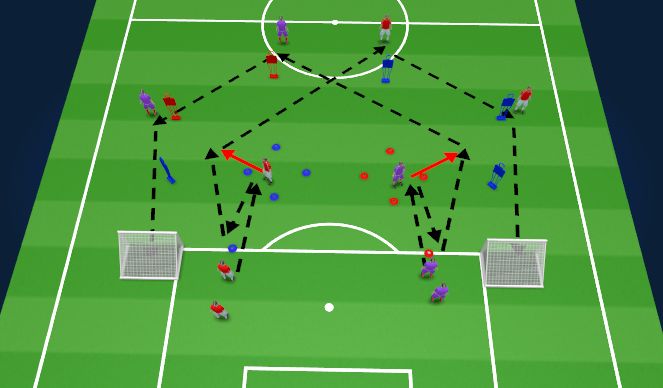
Attacking Wide Areas – Passing & Combination Sequence
Objective:
To develop the team’s ability to circulate possession across the pitch and attack wide areas using quick combinations through central spaces. The practice focuses on timing of movement, quality of passing, and playing forward at speed to create crossing or attacking opportunities in wide channels.
Organisation
-
Players: 10+ players (can run simultaneously on both sides)
-
Area: Half pitch or approximately 40x35 yards
-
Equipment:
-
Cones to mark positions
-
Mannequins or cones to represent defenders
-
1 mini goal placed wide in the final area
-
Footballs at the starting position
-
Set-Up:
Create a structured passing pattern involving:
-
Starting Player
-
Central Player (inside a diamond)
-
Opposite Centre Back
-
Full Back
-
Wide channel mini goal
Mannequins or cones can be used to simulate defenders and create realistic passing lanes and trigger movements.
Practice Sequence
-
The starting player passes into the central player positioned in the diamond.
-
The central player sets a bounce pass back to the starting player.
-
After playing the bounce pass, the central player moves out of the diamond to receive again.
-
The starting player now plays a second pass into the central player’s back foot.
-
The central player then switches play with a firm pass to the opposite centre back.
-
The centre back takes a positive touch and plays a pass out wide to the full back.
-
The full back plays a forward pass down the line into the mini goal, representing a penetrative wide attack or cross into space.
-
The player retrieves the ball and returns it to the start.
Rotation:
Players move to the station they last passed to:
-
Start → Central
-
Central → Centre Back
-
Centre Back → Full Back
-
Full Back → Retrieve ball and return to start
Run the pattern continuously at game speed.
Coaching Points
1. Quality of First Touch
-
Receive on the back foot to play forward quickly.
-
First touch should set up the next action.
2. Passing Detail
-
Firm, accurate passes played with the correct weight.
-
Pass into the receiver’s path and away from pressure.
3. Timing of Movement
-
Central player must move out of the diamond at the correct moment to create the next passing angle.
-
Avoid arriving too early or too late.
4. Body Position
-
Players should receive side-on to see both sides of the pitch.
-
Encourage players to scan before receiving.
5. Speed of Play
-
Sequence should be completed at match tempo.
-
Limit unnecessary touches where possible.
6. Communication
-
Early verbal and visual cues.
See the guidance at the top of this page to understand why you are not seeing interactive Football/Soccer images.
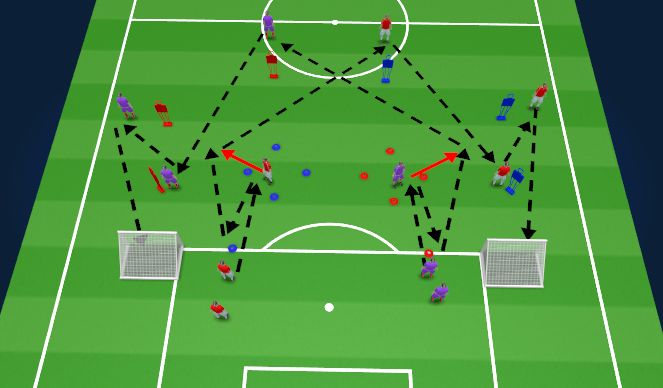
Attacking Wide Areas Passing Sequence – Progression 1
Objective
To bring in the option for the center back to play forward into the winger positioned high and inverted. The winger receives inside and combines with the wing back, who then plays a penetrative pass into the mini goal.
Passing Sequence
- The starting player plays a pass into the diamond and receives a bounce pass back. Player then plays a pass back to the central player who has moved int space to receive on their back foot.
- The center back plays a firm forward pass into the winger who has moved inside to receive.
- The winger sets the ball into the path of the advancing wing back.
- The wing back plays a forward penetrative pass into the mini goal.
Coaching Points
Centre Back – Quality & Decision
Recognize the moment to play forward early
Pass must break lines, not drift sideways
Firm, accurate pass into the winger’s back foot
Head up before passing to assess space and pressure
Winger – Movement & Body Shape
Start wide, then invert at the right moment to lose defender
Check shoulder before receiving to scan central pressure
Receive side-on to play forward quickly
First touch should move ball away from pressure
Set pass must be cushioned and into wing back’s path
Timing of Movement
- Winger moves inside as CB prepares to pass
- Wing back advances as ball travels into winger
- Avoid arriving too early and blocking passing lanes
- Movements should be coordinated and game-realistic
Wing Back – Positive First Action
Receive on the move
First touch forward to attack space
Keep hips open to play down the line quickly
Avoid slowing momentum with extra touches
Communication
Early call from winger to show availability
Wing back gives clear passing cue (“set”, “leave”)
Centre back directs tempo
Tactical Understanding
Recognize inverted winger creates central overload
Wing back provides natural width
Movement replicates breaking compact defensive blocks
Encourage players to visualize match scenarios
See the guidance at the top of this page to understand why you are not seeing interactive Football/Soccer images.
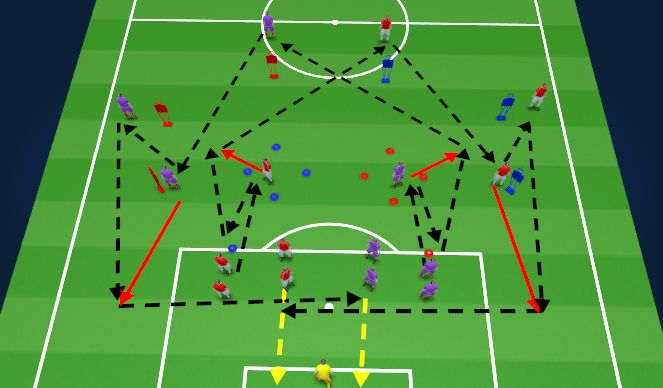
Attacking Wide Areas Passing Sequence – Progression 2
Objective
To bring in the option for the center back to play forward into the winger positioned high and inverted. The winger receives inside and combines with the wing back, who then plays a penetrative pass into the pocket of space wide. The winger spins out to get in behind into the space to deliver for a finish inside the box.
Passing Sequence
- The starting player plays a pass into the diamond and receives a bounce pass back. Player then plays a pass back to the central player who has moved int space to receive on their back foot.
- The center back plays a firm forward pass into the winger who has moved inside to receive.
- The winger sets the ball into the path of the advancing wing back.
- The wing back plays a forward penetrative pass into the space in the wide area.
- Winger after playing the bounce pass, spins and runs into the space to receive the pass, to the cross into the box for a shot on goal.
Coaching Points
Centre Back – Quality & Decision
Recognize the moment to play forward early
Pass must break lines, not drift sideways
Firm, accurate pass into the winger’s back foot
Head up before passing to assess space and pressure
Winger – Movement & Body Shape
Start wide, then invert at the right moment to lose defender
Check shoulder before receiving to scan central pressure
Receive side-on to play forward quickly
First touch should move ball away from pressure
Set pass must be cushioned and into wing back’s path
Timing of Movement
- Winger moves inside as CB prepares to pass
- Wing back advances as ball travels into winger
- Avoid arriving too early and blocking passing lanes
- Movements should be coordinated and game-realistic
Wing Back – Positive First Action
Receive on the move
First touch forward to attack space
Keep hips open to play down the line quickly
Avoid slowing momentum with extra touches
Communication
Early call from winger to show availability
Wing back gives clear passing cue (“set”, “leave”)
Centre back directs tempo
Tactical Understanding
Recognize inverted winger creates central overload
Wing back provides natural width
Movement replicates breaking compact defensive blocks
Encourage players to visualize match scenarios

 Play animation
 Play step-by-step
 Repeat (toggle)
 Full Screen
 Pause
Pause Stop
Stop
6v6 + 2 Neutral Players – Throw-In Possession Game
Objective:
To develop players’ ability to maintain possession under pressure, react quickly in transition, and finish in tight spaces. The practice encourages awareness, movement off the ball, and effective pressing.
Organisation
Players: 14 total (6v6 plus 2 neutral players)
Area: Approx. 30x30 yards (adjust depending on age/level)
Equipment:
4 small goals (one on each corner of the area)
Footballs around the pitch
Bibs for teams and neutrals
Set-Up:
Two teams of 6 players compete inside the grid.
2 neutral players play for the team in possession to create an overload (8v6 when attacking).
Place four small goals around the outside of the area, one on each corner.
Play always restarts with a throw-in from a player whenever the ball goes out of play in a throw in game scenario.
Practice Rules
Phase 1 – Controlled Possession (6 Minutes Total)
One team starts as the possession team for 3 minutes.
The possession team must complete 10 consecutive passes = 1 point.
The defending team aims to win possession.
Once the defending team wins the ball, they must complete 3 passes before they are allowed to score in any of the 4 small goals.
After 3 minutes, switch the designated possession team (option to rotate neutral players).
The team with the most points at the end of 6 minutes wins.
Optional: Add light forfeits or competitive consequences for the losing team.
Progression – Transitional Game (5 Minutes)
Allow free transition between teams.
When a team wins possession, they must complete 5 passes before they can score in any of the four goals.
The opposition must react immediately and organise defensively.
Encourage quick attacking play once the pass target is achieved.
This progression increases decision-making speed and transition intensity.
Coaching Points
1. Awareness
Constant scanning before receiving.
Recognising pressure, space, and passing options.
2. First Touch
Positive first touch away from pressure.
Prepare the ball to play forward where possible.
3. Movement Off the Ball
Create passing angles and supporting positions.
Rotate positions to disrupt defenders.
4. Speed of Press
Immediate pressure on the ball when possession is lost.
Nearest player presses; teammates provide cover and balance.
5. Transition Reactions
Quick mental switch from attack to defence and defence to attack.
First few seconds after winning/losing the ball are crucial.
6. Communication
Clear, early information to teammates.
Encourage leadership and organisation in pressing and build-up.
7. Finishing Under Pressure
Quick decision making in front of the small goals.
Accuracy and composure when space is limited.
Key Outcomes
Improved possession retention
Faster defensive pressing and transitions
Better supporting angles and off-ball movement
Composure and accuracy in pressured finishing situations