
Football/Soccer Session (Beginner): Improve builid up in the attacking half - 4v4

Nationals Soccer
James Decosemo

See the guidance at the top of this page to understand why you are not seeing interactive Football/Soccer images.
See the guidance at the top of this page to understand why you are not seeing interactive Football/Soccer images.
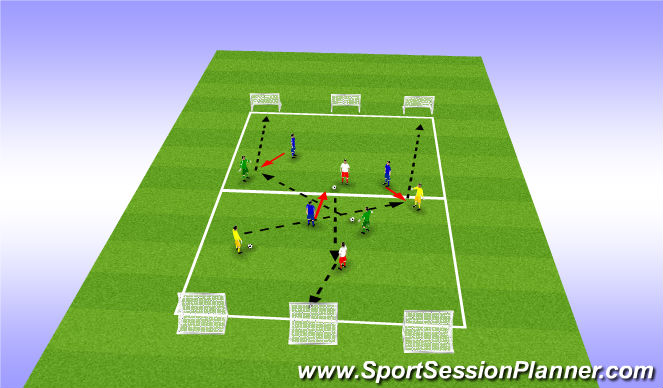
OBJECTIVE: To pass or dribble past an opponent in order to create scoring chances
PLAYER ACTIONS: Shoot, Pass or dribble forward
ORGANIZATION: In a 25Wx35L grid with 3 goals on each end line, the coach will select 2-3 players to defend. All other players have a partner & a soccer ball to share. The teams with a ball can dribble or pass past the defenders & score in any of the 3 goals on an end line. Once they have scored, they can get any soccer ball from the goal or behind the goal & try to score in any of the 3 goals on the opposite end line. Challenge the players to score as many goals as they can in 2 minutes. RULES: if a defender steals their soccer ball & can play it off the field, the players who lost their ball lose all their points & must begin scoring over. Players can shoot, pass or dribble into a goal. Rotate defenders after each round.
KEY WORDS: look up, move with your teammate
GUIDED QUESTIONS: How do you know where the goal & opponents are? How can the 2 players with a ball beat any 1 defender? Why is it important to turn your body toward your teammate when you are ready to pass the ball?
ANSWERS: Look up to see if you have an opening or if it’s closed. Try to dribble the ball toward a defender to see if he/she follows you then pass to your teammate. Facing my teammate will help me make a more accurate pass.
Note: After 2-3 successful rounds, coaches can have the players switch roles if they steal a ball from the attackers & the game continues.
See the guidance at the top of this page to understand why you are not seeing interactive Football/Soccer images.
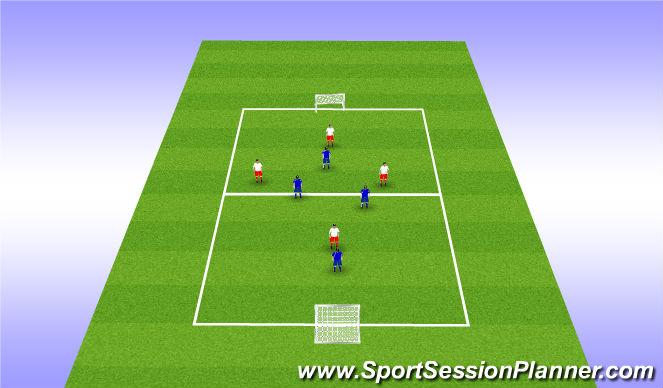
OBJECTIVE: To pass or dribble past an opponent then score goals. PLAYER ACTIONS: Shoot, Pass or dribble forward
ORGANIZATION: In a 25Wx35L field & a small goal on each end line, play a 4v4 game with no goal keepers. Play for 22 minutes – 2 x 9-minute halves with a 2-minute half-time. Local rules apply. If the ball leaves the field, the coach can play another ball onto the field and the play continues.
KEY WORDS: look up, move with your teammate
GUIDED QUESTIONS: How do you know where the goal & opponents are? How can the 2 players with a ball beat any 1 defender? Why is it important to turn your body toward your teammate when you are ready to pass the ball?
ANSWERS: Look up to see if you have an opening or if it’s closed. Try to dribble the ball toward a defender to see if he/she follows you then pass to your teammate. Facing my teammate will help me make a more accurate pass.
NOTES: Depending on your local rules, coaches may introduce throw-ins, corner kicks & goal kicks if rules enforce. Remember to create a build out line for goal kicks and focus on the techniques needed to complete the task instead of the moment of the players on the field. The game must be played so try not to dwell on the restarts.

 Play animation
 Play step-by-step
 Repeat (toggle)
 Full Screen
 Pause
Pause Stop
Stop
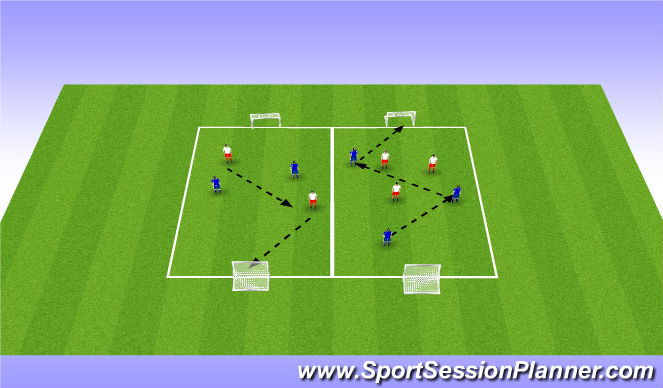
OBJECTIVE: To pass or dribble past an opponent in order to create scoring chances PLAYER ACTIONS: Shoot, Pass or dribble forward
ORGANIZATION: Divide your (25W x 35L) game field into two 15W x 25L fields with a small goal on each end line. When practice is ready to start & as soon as 2 players arrive, start playing a game. The game can start as 1v1. As players arrive, the game becomes 2v1 then 2v2 up to 3v3.
KEY WORDS: look up, find your teammate
GUIDED QUESTIONS: How do you know where the goal & opponents are? What can you do if
goal is too far away?
ANSWERS: Look up to see if you have an opening or if it’s closed. Find a teammate who is closer to the goal to see if they can score.
NOTES: Encourage players to dribble to goal. At the first break, ask questions which generate thoughts about when to dribble. Second break, elicit answers from the same questions to determine the level of understanding from the players.