
Football/Soccer Session (Academy Sessions): U12/U14 Situation games

Premier Users' Club
Samuel Holmshaw

Description
Topic: Defend the overload
Coaching points: Recognise opposition movement, Press quickly, Protect the middle, Leave the furthest player
IP principles: When and how to exploit a numerical advantage, Find the spare player, Player movement to create the overload, Interchange positions, Commit the opponent, Ball speed
Session objectives: Players will demonstrate how to defend the overload by recognising opposition movement, pressing the ball quickly, protecting the middle and leaving the furthest player
See the guidance at the top of this page to understand why you are not seeing interactive Football/Soccer images.
See the guidance at the top of this page to understand why you are not seeing interactive Football/Soccer images.
Practice 1 - In possession points
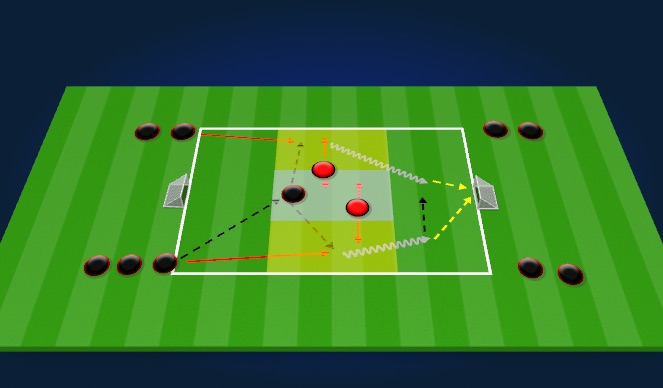
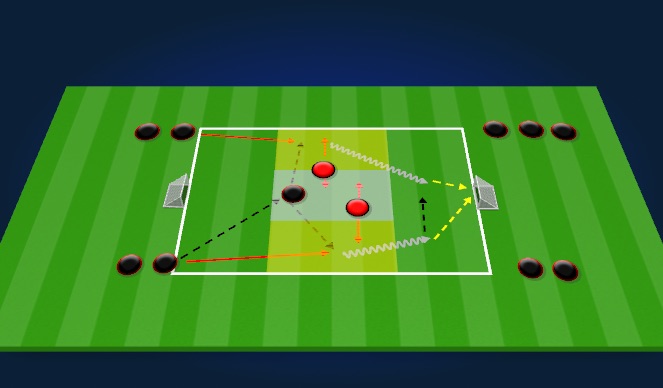
Set up: Create a 30 x 15 playing area, create a middle zone that is 10m in width, creating 3 further zones within it that are 5m in length each. Add two mini goal's at each end of the playing area, positioned in the middle. Add four cones in each corner of the area.
The group needs to be split into attackers (blue) and defenders (red). 2 attackers position themselves on each cone, with two defenders and one attacker positioning themselves within the middle area.
Timings: 5 x 2 minute blocks, with a 60 second rest in-between.
To Start: One of the attackers starts with the ball, they play a pass into the attacking player into the middle area to begin the 3 vs 2, this player can either pass back immediately to the winger, or look to turn out and beat the defenders, either way, their objective is to score in the mini net. If the defenders win the ball, they immediately look to score in the mini net that the attackers started from.
After attackers or defenders score, the attackers from the opposite side restart play.
Rotate the defenders and attacker (inside the middle) each block.
Conditions: The attackers (including the one starting in the middle, can move freely through the middle area. Both defenders can move freely in their central channel, but only one is allowed to move left, and one allowed to move right.
Target: The target for the attacking team is to progress the ball through the middle third through passing combinations or beating the defender 1 vs 1 to score a goal.
Challenges: Can the attackers score through drawing the defenders in one side and playing to the isolated player, or beating the defender 1 vs 1.
Progressions: Limit the attacking team's touches to 2 or 3 touch, to encourage quicker play.
Add a time limit for the attacking team to progress past the middle third.
Regressions: Remove the limit on touches on the ball
Increase the amount of time required to progress past the middle area.
Coaching points:
Technical detail: Ball speed in passing, attacking players receiving on the half turn (middle) or side on to progress the play quickly. Consider the weight of the pass on the ball.
Tactical detail:
Find the spare player - play the ball away from the pressure to progress the ball forwards.
Player movement to create the overload - quick and purposeful movement off the ball to create a passing lane.
Interchange positions - Both wide players can swap positions rather than progressing forwards in straight lines, harder for defenders to mark.
Commit the opponent - Player on the ball looks to draw the opponents in, second players movement or run can draw in the support defender, creating an isolated winger on the far side. Either go 1 vs 1 or play to the isolated player.
See the guidance at the top of this page to understand why you are not seeing interactive Football/Soccer images.
Practice 2 - Out of possession points
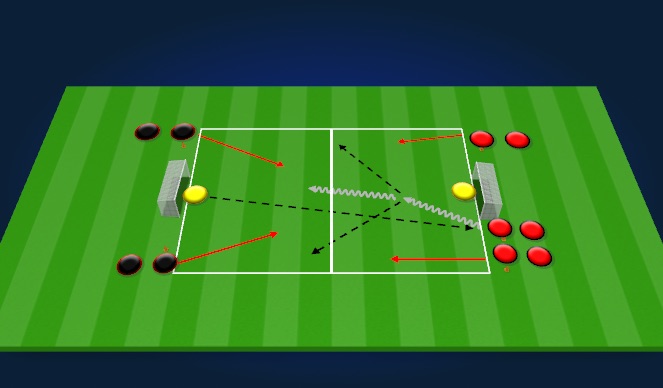
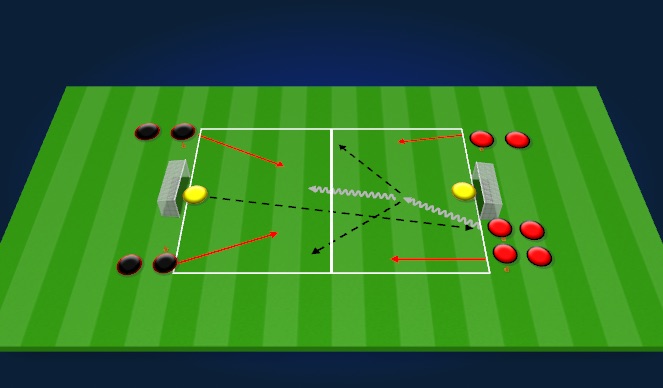
Set up: Using the same area as the previous activity, remove th middle zone, adding a line using spot markers down the middle of the area (15m approx). Add two 7-a-side goals at each side of the area.
Split the group up into an attacking team of 6 and a defensive team of 4, as well as two goalkeepers that occupy each goal. Attacking team players and defensive team players positioned as shown on the diagram.
12 balls to be positioned in the defensive gk's goal, to be used for each restart.
Timings: 5 x 2 minute blocks, with a 60 second rest in-between.
To Start: The defensive team's goalkeeper starts the play by passing the ball to any of the attacking players (for demonstration play to central player first. Upon receiving the ball the play starts. The attackers attempt to progress the ball forwards to score a goal past the goalkeeper. If the defenders win the ball, they attempt to score past the attackers goalkeeper.
Conditions: The attackers have a 15 second time limit to get a shot on goal.
Target: The target for the defending team is to first stop the attacking team progressing forwards and scoring by any means. If the defenders win the ball, they switch to an attack and attempt to score a goal. Each goal equals a point for attackers/defenders.
Challenges: If the defenders can't win the ball, how many times can they force the attackers to run out of time.
Progressions: If defending the overload is too comfortable, the attackers goalkeeper can come into play acting as a sweeper GK to make the practice a 4 vs 2.
Increase the time limit for attackers to score a goal to 30 seconds.
Two attackers can move before the receiver wins the ball, giving the attackers a head start.
Regressions: The defending team will now score a goal each time the attackers run out of time to score a goal.
Coaching points:
Technical detail: Using triggers for decision making in pressing. Body shape and positioning in defending 1 vs 1, supporting teammates by covering effectively, awareness of movements/ attacking rotations.
Tactical detail:
- Recognise opposition movement - are the attackers progressing in straight lines or rotating positions?
- Press quickly - Get out to the ball quickly
- Protect the middle - consider a defensive line, if the ball left or right closest player follows but the second defender must cover the central area.
- Leave the futhest player - Assuming the play likely moves left or right, leave the furthest winger.
See the guidance at the top of this page to understand why you are not seeing interactive Football/Soccer images.
Practice 2 - In possession points
Set up: Using the same area as the previous activity, remove th middle zone, adding a line using spot markers down the middle of the area (15m approx). Add two 7-a-side goals at each side of the area.
Split the group up into an attacking team of 6 and a defensive team of 4, as well as two goalkeepers that occupy each goal. Attacking team players and defensive team players positioned as shown on the diagram.
12 balls to be positioned in the defensive gk's goal, to be used for each restart.
Timings: 5 x 2 minute blocks, with a 60 second rest in-between.
To Start: The defensive team's goalkeeper starts the play by passing the ball to any of the attacking players (for demonstration play to central player first. Upon receiving the ball the play starts. The attackers attempt to progress the ball forwards to score a goal past the goalkeeper. If the defenders win the ball, they attempt to score past the attackers goalkeeper.
Conditions: The attackers have a 15 second time limit to get a shot on goal.
Target: The target for the attacking team is to beat the defenders and progress the ball to goal to score.
Challenges: Can the attacking team use passing combinations to manipulate defenders positioning and play to each teammate before scoring a goal.
Progressions: Add a touch limit for attackers, increasing difficulty to attack the goal.
Reduce the time limit further to 10 seconds to attack the goal.
The defenders can move as soon as the ball is played, they don't have to wait for attackers to receive.
Regressions: Remove the touch rule
Increase the time limit for attackers to get a shot on goal.
Coaching points:
When and how to exploit a numerical advantage - When (defenders drawn in to ball and nearest teammate) How (play a quick pass to the isolated teammate to attack the goal and bypass the defensive press).
Find the spare player - Always look to play the ball away from pressure for easier progression towards goal.
Player movement to create the overload - quick and purposeful movement off the ball, use width and depth to create options.
Interchange positions - Consider switching positions ahead of time to help create overlapping or underlapping runs. Avoid progressing in straight lines.
Commit the opponent - Player on the ball looks to draw the opponents in, second players movement or run can draw in the support defender, creating an isolated winger on the far side. Either go 1 vs 1 or play to the isolated player.
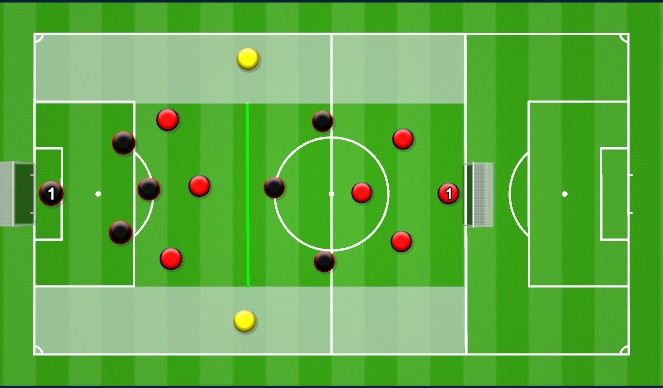
See the guidance at the top of this page to understand why you are not seeing interactive Football/Soccer images.
Conditioned game
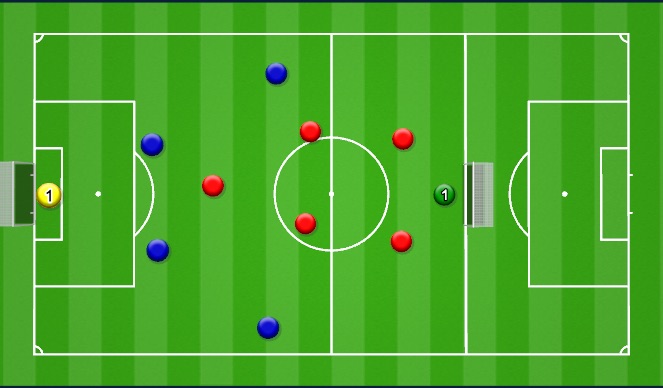
Set up: Using two thirds of the pitch, bring the 8-a-side goal forwards. Add a halfway marker using cones in the middle of the pitch, then mark out two wide area's as shown on the diagram.
Split the group up into 3 teams of 4. One team will initially act as both goalkeepers and the two neutral players. Teams to rotate every two blocks.
6 balls to be positioned in the defensive gk's goal, to be used for each restart.
Timings: 6 x 2 minute blocks, with a 60 second rest in-between.
To Start: The objective is to progress the ball from the GK to Defenders through the zones into the attacking zone to score. Each team is allowed to use both neutral players when in possession of the ball. Upon receiving, one neutral player may move into the attacking zone to create a 3 vs 2 situation.
Conditions: Neutral players are only allowed in wide zones. Only one neutral player can enter the attacking central area, they cannot enter defensive area. The ball can only be played on the floor in this game.
Target: The target is to score a goal via utilising the overload.
Progressions:
Defending the overload: Consider adapting the practice to 4 vs 2, to increase the challenge for the defenders, meaning that both neutral players can enter the attacking zone at any one time.
Attacking the overload: Limit the attacking team's touches to 2 or 3 touch, to encourage quicker play.
Add a time limit for the attacking team to progress past the middle third.
Regressions:
Defending the overload: Time restriction for the attacking team, they only have 10 seconds to progress through the middle area and score.
Attacking the overload: Remove the limit on touches on the ball
Increase the amount of time required to progress past the middle area.
Coaching points:Defending the overload:
- Recognise opposition movement - are the attackers progressing in straight lines or rotating positions?
- Press quickly - Get out to the ball quickly
- Protect the middle - consider a defensive line, if the ball left or right closest player follows but the second defender must cover the central area.
- Leave the futhest player - Assuming the play likely moves left or right, leave the furthest winger.
Attacking the overload:When and how to exploit a numerical advantage - When (defenders drawn in to ball and nearest teammate) How (play a quick pass to the isolated teammate to attack the goal and bypass the defensive press).
Find the spare player - Always look to play the ball away from pressure for easier progression towards goal.
Player movement to create the overload - quick and purposeful movement off the ball, use width and depth to create options.
Interchange positions - Consider switching positions ahead of time to help create overlapping or underlapping runs. Avoid progressing in straight lines.
Commit the opponent - Player on the ball looks to draw the opponents in, second players movement or run can draw in the support defender, creating an isolated winger on the far side. Either go 1 vs 1 or play to the isolated player.
See the guidance at the top of this page to understand why you are not seeing interactive Football/Soccer images.
Unconditioned game
6 vs 6 conditioned game

 Play animation
 Play step-by-step
 Repeat (toggle)
 Full Screen
 Pause
Pause Stop
Stop
Practice 1 - Out of possession points
Primary focus: A general session to help engage players understanding of how to defend in an overload situation.
Set up: Create a 30 x 15 playing area, create a middle zone that is 10m in width, creating 3 further zones within it that are 5m in length each. Add two mini goal's at each end of the playing area, positioned in the middle. Add four cones in each corner of the area.
The group needs to be split into attackers (blue) and defenders (red). 2 attackers position themselves on each cone, with two defenders and one attacker positioning themselves within the middle area.
Timings: 5 x 2 minute blocks, with a 60 second rest in-between.
To Start: One of the attackers starts with the ball, they play a pass into the attacking player into the middle area to begin the 3 vs 2, this player can either pass back immediately to the winger, or look to turn out and beat the defenders, either way, their objective is to score in the mini net. If the defenders win the ball, they immediately look to score in the mini net that the attackers started from.
After attackers or defenders score, the attackers from the opposite side restart play.
Rotate the defenders and attacker (inside the middle) each block.
Conditions: The attackers (including the one starting in the middle, can move freely through the middle area. Both defenders can move freely in their central channel, but only one is allowed to move left, and one allowed to move right.
The defending team are only allowed 2 players to move into the opponents end zone. The other two defenders must stay in the central zone.
Target: The target for the defensive team is to stop the ball progressing past the middle channel by any means, and scoring in the mini net.
Challenges: Being compact and protecting the central area of the pitch, don't let the lone attacker break through this area.
Progressions: Limit the attacking team's touches, this should encourage quicker play which should be harder to defend against.
Consider adapting the practice to 4 vs 2, to increase the challenge for the defenders.
Regressions: Consider adapting the practice to a 4 vs 3, this extra defender in the central channel should give the defenders more success in stopping the play progressing through the channel.
Time restriction for the attacking team, they only have 10 seconds to progress through the middle area and score.
Coaching points:
Technical detail: Using triggers for decision making in pressing. Body shape and positioning in defending 1 vs 1, supporting teammates by covering effectively, awareness of movements/ attacking rotations.
Tactical detail:
- Recognise opposition movement - initial movement of central attacker, awareness of any attacking rotations from wide players.
- Press quickly - press the central attacker quickly to put pressure on the ball.
- Protect the middle - compact structure to prevent attacker turning out though the middle.
- Press quickly - second defender to put quick pressure on the winger if ball is received.
- Leave the futhest player - Pressure towards the ball, no need to mark the opposite winger intially until play transferred.