


Football/Soccer Session (Moderate): Defending as a team


Premier Users' Club
Hannah Claughton
Profile Summary

| Name: | Hannah Claughton |
|---|---|
| City: | Norwich |
| Country: | United Kingdom |
| Membership: | Adult Member |
| Sport: | Football/Soccer |

Description
Age group: mini soccer age (under 7-under 10)
12 Participants
Traditional session - Blocked, variable and random
Session objective is defending as a team getting the technique right, and putting it into practice in a game situation.
Place players in teams from the start to save time throughout the session
Session timeline:
30 minutes:
1 -Session introduction
1v1 press - 8 mins
3 mins- playing time
1 min - Group intervention and feedback
3 mins - Playing time with coaching process
1 min - Group intervention and feedback on the game
3v3 press- 8 mins
1 min - Session introduction
2 mins - Playing time
2 mins - Group intervention and feedback, player led team meetings
2 mins - Playing time with coaching process
1 min - Group intervention and feedback on the game
SSG - 14 mins
1 min - Session introduction
3 mins - Playing time
1 min - Group interventions and feedback
4 mins - playing time with coaching process
1 min - Player team meetings
3 mins - Playing Time with coaching process
1 min - feedback and closing of session
Health and safety considerations:
All equipment, bottles, jackets etc. Will be at least 2 metres away from the active pitch in a coned area.
Ball nests placed effectively around, but far enough away from the active play area.
An inspection of the pitch will be conducted before the players arrive, making sure it is safe. Also a check of all equipment ensuring the goals are safe, no sharp edges or anything and the footballs are pumped up.
All medical information of participants will be collected before the session, and then a check will be done before they arrive checking the have the equipment they need such as inhalers and epipens.
Also a full check of their personal equipment such as shin pads and checking boots, no jewellery or watches and hair tied back if needed.
Equipment needed:
12 footballs
Cones
12 bibs, 6 of each colour
2 goals
Coaching toolbox interventions:
The coaching toolbox methods that I will use within my coaching are freeze, fly by and drive by. I will use the freeze method to allow the participants to have a little break, they can have a drink whilst listening. During this time i will go through the appropriate technique for defending and pressing quickly, using a demonstration if needed. During this time I can also add conditions and challenges if needed. It is also the appropriate time for the players to to ask any questions if the have them. An example of the time I could use is when I see the wrong technique or a mistake, allowing me to stop play and ask questions of why they think i stopped it then correct them. I will use fly by, when play is continuing to encourage and give positive feedback, without stopping the game. Then use drive by on individual players encouraging them to challenge themselves and getting them to think a bit more about their technique or the method they are using.
Conditions:
Conditions may be if a player is finding it to easy, limit their touches or add a goalkeeper into the variable part of the session making it harder to score
Challenges:
I could challenge them by getting them to use both feet, focus on weaker foot. Or being more vocal.
See the guidance at the top of this page to understand why you are not seeing interactive Football/Soccer images.
Learning Objectives

|
Technical Control, passing the initial ball with accuracy, exploding out to close the space, body shape when defending. Which way to show them (onto their weaker side). |

|
Tactical Decision making for the defender such as, when to commit to the tackle and when to just jokey the ball. Also which side to show them towards. |

|
Physical Balance when defending and jockeying. Also agility to change direction quickly when the attacker reacts. |

|
Psychological Motor learning is crucial for 3-9 years olds. Making the right decisions as a player. |

|
Social Competition against your partner. |
See the guidance at the top of this page to understand why you are not seeing interactive Football/Soccer images.
Learning Objectives
|
|
Technical Defending, body position of side on. Getting the technique right. Control to slow down when pressing the ball so the attacker can’t just skip around you. |
|
|
Tactical Working as a team, deciding that closest player to the ball presses and the others cover and cut off the options. Pressing them quickly to put them under pressure forcing a mistake. Deciding when to react to make a tackle. Looking for the key points to make that tackle are a poor pass, poor touch and weak foot. |
|
|
Physical Agility to change direction when the attacker makes the decision of what they will do. Balance when tackling to not give away a foul and win possession. |
|
|
Psychological Motor learning is crucial. Short and explosive activities to keep them focused and used to initiate the aerobic system. The integration from individuals to working as a team. |
|
|
Social Working as a team when to press and who’s going to cover. This needs communication so not everyone goes to them ball at once. |
3v3 press (10 mins)
3v3 press
Equipment and space:
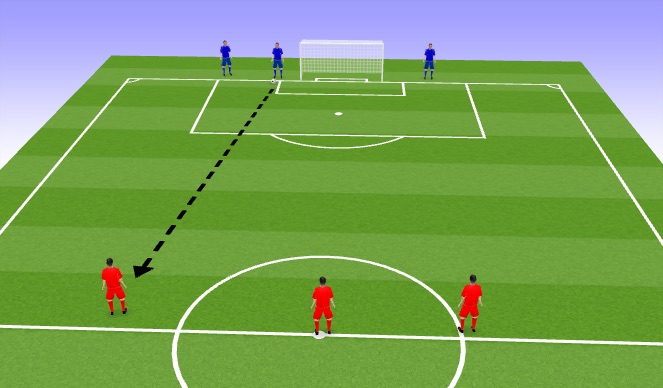
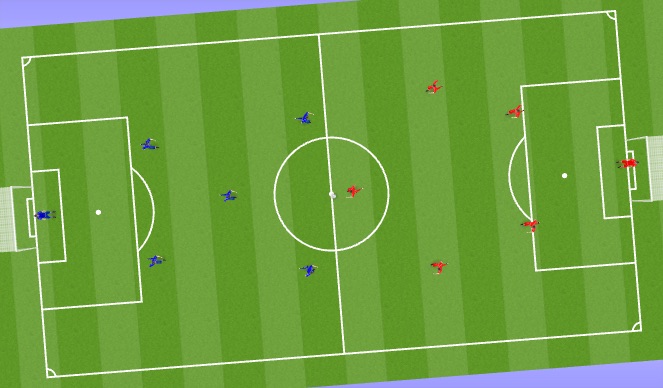
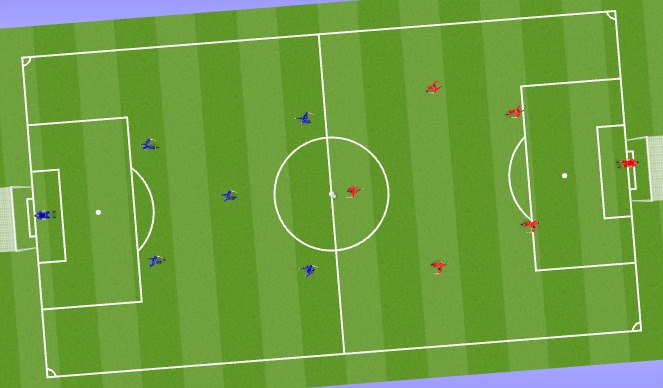
Using half of a mini soccer pitch. With 2 games going on at a rime. So 6 on each half. To make it realistic use a mini soccer goal, this will make it realistic for the attackers to shoot in. If it is too easy for the attackers to shoot in as there is no goalkeeper, it could be changed to a pugg goal.
Bibs - one colour for the defending team and one for attacking. So in total 6 reds and 6 blues.
Footballs - 12 footballs, having a ball nest by each of the goals with 6 in. This will allow the play to continue quickly if it goes out.
The defenders start on the goal line with the ball and the attackers start on the halfway line
The play starts by defenders passing the ball to the red team.
It’s the same process as the technical practice but now just pressing as a team. And the attackers are now able to shoot in a goal, meaning there is more emphasis on closing them down quickly before they can shoot.
The attackers need to make at least 3 passes to allow the defenders the opportunity to get out to them and press.
Defending as a team requires communication and teamwork. This is for the closest player to the ball to press and the others to cover and cut off their options.
Progressions:
There is an opportunity to add to small goals on the halfway line for the defenders to attack when they win possession. Putting them towards the edge of the pitch will stimulate the idea of making the pass down the wing to make an attack.
There is also an opportunity to add a goalkeeper in which will make it harder for the attackers.
See the guidance at the top of this page to understand why you are not seeing interactive Football/Soccer images.
Learning Objectives
|
|
Technical Defending, which is the aim of our session. Focusing on pressing the ball quickly and working as a team. Getting the technique right and then putting it into practice. Control when defending to not give away a foul and slow down once they get to the |
|
|
Tactical Lots of decisions to make, whether this is deciding who’s going to press, and when they are going to make that tackle or just jockey the ball. |
|
|
Physical A small sided game requires all of the abc’s (agility, balance, coordination, speed) Defending and pressing quickly and when to react to a change. |
|
|
Psychological Motor learning is critical. Short and explosive activities to keep them focused, and used to initiate aerobic system. The intergration from individuals to teams and working towards a goal. Concentration for the short period they are playing is key. And this is the coaches job to provide positive encouragement. |
|
|
Social Teamwork is important, to be able to defend and win the ball back as effectively and quickly as possible. Communication is also important to let them know where they are. The most important thing is to ensure they are having. Fun, which is what it is about at this age. |
SSG (10 mins)
Small sided game
Equipment and space:
Using a full mini soccer pitch, to keep it as realistic as possible.
Using ball nests, (1 by each goal) Have an equal amount of balls in each, allowing play to continue quickly.
Bibs - 6 red and 6 blue.
To finish the session, end with a 6v6 game. Allowing them to put in practice and show what they have learnt.
It also gives me the opportunity to observe them all in a realistic game scenario, and provide coaching points where needed.
'%3E%3Cpath id='path4169' d='M 11.4375,70.25 C 11.457031,38.394531 37.277344,13.242188 68.253906,13.050781 99.78125,12.855469 125.73047,38.351563 125.8125,70.078125 125.89844,101.62109 100.43359,127.14063 69.148438,127.42188 37.582031,127.70703 11.464844,102.23438 11.4375,70.25 m 6.425781,-0.08984 c 0.03516,28.421871 23.027344,50.69922 50.519532,50.82031 C 96.433594,121.10156 119.30469,98.367188 119.38281,70.359375 119.45313,42.878906 97.382813,19.714844 69.015625,19.496094 40.75,19.277344 17.964844,42.035156 17.863281,70.160156' style='clip-rule:nonzero;fill:%23333f48;fill-opacity:1;fill-rule:nonzero;stroke:none' /%3E%3Cpath style='fill:%23333f48;fill-opacity:1;fill-rule:nonzero;stroke:none' d='m 39.789063,108.62109 c 0.28125,0.14454 0.550781,0.32032 0.839843,0.4336 2.734375,1.05469 5.554688,1.78125 8.453125,2.23047 2.734375,0.42578 5.484375,0.64453 8.25,0.54297 3.988282,-0.15625 7.832032,-0.94922 11.445313,-2.69532 1.683594,-0.8164 3.246094,-1.82422 4.640625,-3.07422 3.265625,-2.92578 5.171875,-6.582027 5.796875,-10.906246 0.546875,-3.761719 0.04687,-7.425781 -1.09375,-11.019531 -1.4375,-4.523438 -3.730469,-8.582032 -6.703125,-12.265625 -1.03125,-1.277344 -2.082031,-2.535157 -3.113281,-3.808594 C 66.789063,66.1875 65.332031,64.269531 64.0625,62.21875 c -1.601562,-2.582031 -2.835937,-5.316406 -3.613281,-8.261719 -0.683594,-2.574218 -0.902344,-5.1875 -0.6875,-7.828125 0.214844,-2.617187 0.910156,-5.117187 2.152344,-7.441406 2.164062,-4.050781 5.503906,-6.710937 9.816406,-8.179687 1.890625,-0.640625 3.835937,-1.058594 5.832031,-1.195313 1.121094,-0.07813 2.242188,-0.152344 3.363281,-0.164062 4.28125,-0.02734 8.4375,0.734375 12.453125,2.175781 1.871094,0.671875 3.6875,1.496094 5.523438,2.257812 0.226562,0.09375 0.4375,0.230469 0.664062,0.351563 -0.164062,0.25 -0.371093,0.160156 -0.539062,0.164062 -2.824219,0.101563 -5.535156,0.703125 -8.132813,1.804688 -1.335937,0.570312 -2.570312,1.316406 -3.648437,2.296875 -2.527344,2.296875 -3.605469,5.15625 -3.34375,8.550781 0.140625,1.855469 0.722656,3.574219 1.550781,5.222656 0.648438,1.296875 1.414063,2.523438 2.292969,3.675782 0.953125,1.25 1.929687,2.484375 2.929687,3.699218 2.085938,2.523438 4.164063,5.054688 6.050782,7.738282 2.203125,3.136718 4.140627,6.417968 5.589847,9.980468 1.16406,2.867188 2.01562,5.820313 2.39843,8.894532 0.25,2.011718 0.30079,4.03125 0.11719,6.058593 -0.24219,2.640625 -0.79297,5.195313 -1.74609,7.667969 -1.29688,3.36328 -3.300784,6.22656 -5.972659,8.63281 -2.429687,2.19141 -5.171875,3.90625 -8.109375,5.3125 -2.695312,1.29297 -5.464843,2.40235 -8.34375,3.20313 -1.953125,0.54687 -3.945312,0.8789 -5.949218,1.15625 -3.035157,0.41797 -6.085938,0.48828 -9.132813,0.3125 -5.328125,-0.3125 -10.476562,-1.46094 -15.410156,-3.52344 -3.449219,-1.44141 -6.691406,-3.25781 -9.757813,-5.39453 -0.183593,-0.12891 -0.378906,-0.25 -0.53125,-0.41016 -0.07031,-0.0703 -0.05859,-0.22656 -0.08203,-0.34375 z m 0,0' id='path4175' /%3E%3Cpath style='fill:%23333f48;fill-opacity:1;fill-rule:nonzero;stroke:none' d='M 94.699219,29.390625 C 94.089844,29.21875 93.476563,29.054688 92.867188,28.875 90.183594,28.085938 87.46875,27.441406 84.703125,27.046875 c -3.976562,-0.566406 -7.945312,-0.59375 -11.863281,0.402344 -7.535156,1.914062 -12.386719,6.71875 -14.878906,13.996094 -0.894532,2.617187 -1.179688,5.328125 -0.953125,8.078125 0.203125,2.484375 0.867187,4.859375 1.816406,7.160156 0.933594,2.261719 2.117187,4.390625 3.4375,6.449219 1.4375,2.25 3.050781,4.371093 4.640625,6.511718 1.4375,1.933594 2.867187,3.871094 4.261719,5.835938 1.230468,1.730469 2.316406,3.546875 3.273437,5.445312 1.324219,2.625 2.265625,5.378907 2.703125,8.292969 0.433594,2.902344 0.292969,5.765625 -0.660156,8.5625 -0.9375,2.74609 -2.574219,5.00781 -4.777344,6.875 -2.417969,2.04688 -5.203125,3.39844 -8.246094,4.22266 -1.835937,0.5 -3.703125,0.75781 -5.609375,0.82031 -3.886718,0.13281 -7.679687,-0.47266 -11.421875,-1.46094 -2.261718,-0.59765 -4.488281,-1.33203 -6.695312,-2.11328 -0.207031,-0.0742 -0.40625,-0.16797 -0.597656,-0.25 -0.02344,-0.24609 0.148437,-0.19141 0.25,-0.20703 1.96875,-0.30469 3.921875,-0.67969 5.804687,-1.34766 1.367188,-0.48437 2.671875,-1.10156 3.855469,-1.94922 2.25,-1.61328 3.65625,-3.765621 4.0625,-6.515621 0.273437,-1.867188 0.09375,-3.710938 -0.429688,-5.527344 -0.472656,-1.648437 -1.171875,-3.199219 -2.109375,-4.628906 -0.792968,-1.207031 -1.636718,-2.382813 -2.523437,-3.519531 -0.921875,-1.195313 -1.921875,-2.328125 -2.890625,-3.484375 -2.753906,-3.273438 -5.351563,-6.660157 -7.523438,-10.355469 -2.042968,-3.480469 -3.667968,-7.136719 -4.597656,-11.078125 -0.640625,-2.699219 -0.980469,-5.4375 -0.832031,-8.214844 0.238281,-4.53125 1.476562,-8.78125 3.824219,-12.6875 1.082031,-1.800781 2.445312,-3.375 3.988281,-4.800781 2.742187,-2.527344 5.863281,-4.480469 9.257812,-5.992188 3.746094,-1.667968 7.652344,-2.769531 11.707032,-3.394531 3.152343,-0.488281 6.324218,-0.671875 9.507812,-0.519531 8.632813,0.410156 16.671875,2.792969 24,7.433594 0.08203,0.05078 0.152344,0.109375 0.230469,0.167968 -0.0039,0.04297 -0.0078,0.08984 -0.01563,0.136719' id='path4177' /%3E%3Cpath style='fill:%23333f48;fill-opacity:1;fill-rule:nonzero;stroke:none' d='m 31.699219,38.75 c -0.07813,0.238281 -0.152344,0.476563 -0.238281,0.710938 -1.460938,4.074218 -2.066407,8.28125 -1.808594,12.59375 0.4375,7.304687 2.808594,13.925781 7.277344,19.753906 3.714843,4.84375 7.441406,9.671875 11.167968,14.503906 1.113282,1.441406 1.953125,3.007813 2.414063,4.777344 0.332031,1.257812 0.425781,2.539062 0.273437,3.820312 -0.214843,1.832032 -1.070312,3.34375 -2.464843,4.546875 -0.984375,0.851559 -2.113282,1.449219 -3.316407,1.925779 -1.378906,0.54297 -2.8125,0.89063 -4.273437,1.1211 -2.226563,0.35547 -4.46875,0.46093 -6.722656,0.41015 -0.589844,-0.0156 -1.046875,-0.18359 -1.433594,-0.625 -0.636719,-0.72265 -1.335938,-1.39062 -1.9375,-2.14062 C 25.574219,93.800781 22.300781,86.621094 20.84375,78.636719 20.152344,74.835938 19.917969,71 20.15625,67.128906 20.796875,56.773438 24.390625,47.574219 30.859375,39.480469 c 0.21875,-0.273438 0.453125,-0.53125 0.679688,-0.796875 0.05469,0.02344 0.109375,0.04297 0.160156,0.06641' id='path4179' /%3E%3Cpath style='fill:%23333f48;fill-opacity:1;fill-rule:nonzero;stroke:none' d='m 105.41016,101.30078 c -0.13282,-0.3125 0.0234,-0.5039 0.0977,-0.69922 1.38672,-3.749997 1.98047,-7.628904 1.89844,-11.621091 -0.14453,-6.84375 -2.08594,-13.144531 -5.73437,-18.925781 C 99.890625,67.226563 97.917969,64.53125 95.835938,61.917969 94.4375,60.160156 92.988281,58.4375 91.582031,56.6875 90.632813,55.511719 89.6875,54.335938 88.792969,53.121094 c -0.835938,-1.144531 -1.488281,-2.398438 -1.953125,-3.742188 -0.523438,-1.515625 -0.695313,-3.070312 -0.511719,-4.652343 0.21875,-1.839844 1.082031,-3.339844 2.476563,-4.542969 1.039062,-0.890625 2.230468,-1.507813 3.503906,-1.980469 1.632812,-0.609375 3.320312,-0.960937 5.046875,-1.175781 1.917969,-0.238281 3.839841,-0.269531 5.769531,-0.230469 0.52734,0.01172 0.89453,0.203125 1.23828,0.585938 5.50391,6.113281 9.26172,13.144531 11.21875,21.132812 1.11719,4.554688 1.5625,9.179688 1.30469,13.855469 -0.58203,10.625 -4.23438,20.082031 -10.96094,28.339846 -0.15625,0.1914 -0.32812,0.375 -0.51562,0.58984' id='path4181' /%3E%3Cpath style='fill:%23333f48;fill-opacity:1;fill-rule:nonzero;stroke:none' d='m 39.796875,108.63281 c -0.05859,0.0117 -0.117187,0.0234 -0.175781,0.0352 0.05469,-0.0156 0.113281,-0.0312 0.167969,-0.0469 z m 0,0' id='path4183' /%3E%3C/g%3E%3C/svg%3E)
 Play animation
 Play step-by-step
 Repeat (toggle)
 Full Screen
 Pause
Pause Stop
Stop
1v1 press (10 mins)
1v1 press
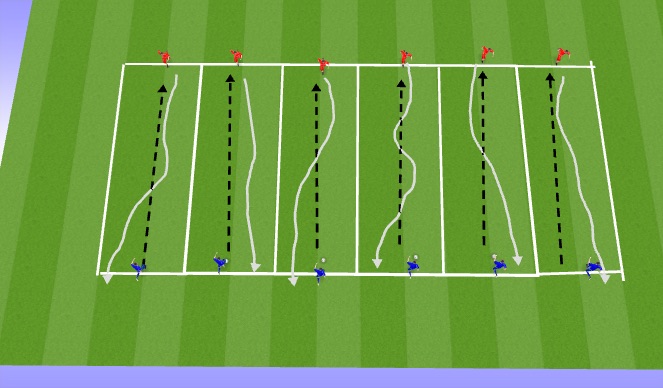
This session is focused on the defenders, the aim is for the defenders to practice their technique in a 1v1 scenarios and win the ball back.
Equipment:
12 footballs, have 2 per channel. 1 in active play at a time and the other to the side, this will allow them to get another one and continue play quickly if it goes out of play.
Cones to mark out each channel clearly.
The area used will be a mini soccer pitch with it split up to create the channels.
Bibs- Every player to wear a bib. This stops arguments and then also stops arguments of who has to wear bibs. 6 reds and 6 blues.
Whiteboard to record the scores.
To start the game the defender (blue) passes to the red player which is the attacker. This signals the start of play. The red player will then try to attack the blues end, by getting past them and dribbling the ball over their line. The defender is going to try and stop them by intercepting the ball. If they win possession they can then go and attack the other end. If the ball goes out of play, they game is over and will need to start again.
Coaching points:
Once the initial pass is played, the defender needs to react quickly and explode, to close them down, closing down the space and not allowing the defender time to react and make their plan.
When the defender reaches the attacker they need to be side on. Pushing them towards their weaker side. This closes the space down even more and doesn’t allow the attacker to change direction quicker. Also pushing them onto their weaker side will mean a higher chance of them making a mistake. If the defender was standing straight on then it would give the attacker the option to go either way and will take longer for the defender to react, giving the attacker the opportunity to break away quickly.
Progression:
To make it more competitive I will add a points system. The attacker will get a point for dribbling it over the defenders line and the defender can get a point by winning possession or dribbling it over the attackers line.
Start using whiteboards. Have one by each channel where they can have the responsibility of recording scores and keeping track by themselves.