
Football/Soccer Session (Academy Sessions): UEFA A LICENCE - Match Preparation: Defending from the front in a 4-2-3-1

FAW Coach Ed
Martyn Bowles

See the guidance at the top of this page to understand why you are not seeing interactive Football/Soccer images.
See the guidance at the top of this page to understand why you are not seeing interactive Football/Soccer images.
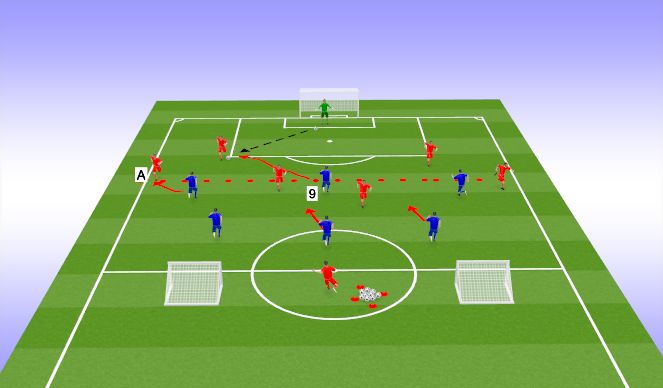
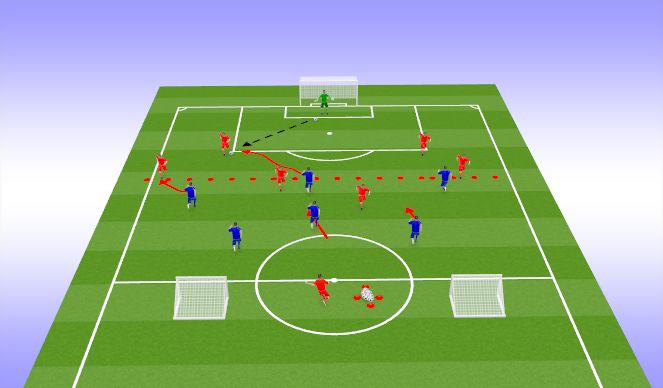
Trigers : Goalkeeper is playing ball out to center half (read body language of goalkeeper), ball is being played to wing-back, ball is being played to holding midfielder. Another important pressing trigger is a bad touch by opposition or not the ebst pass.
Challenges : Can team win ball within 7 seconds? Can team block the switch of play through goalkeeper/diagnal ball? Can team not get split, while inflicting organized pressure?
What If : The switch of play happens through the goalkeeper/center half? Ball reaches holding midfielder of the opposition? Space in the wide areas get exposed? (2v1 situation on the wing).
Management of opposition (Red team): Keeping the wide shape (while playing ball out of the back, center halfs and wingers go wide). Holding midfielders providing options or threats in behind (Playing realistically and not staying in a line, while in possesion). Trying to expose the spaces that defending team is not protecting. Playing passing based football, however if 2v1/2v2 situation occurs (especially on the wing), taking on opponent can be done. The server is not alowed to cross halway line, however, it is required that player is activelly moving and creating angles for his teammate
Methodology used in Drill : Most of the drill will be based on Zonal Proximal Development and Scaffolding Theories. According to Vygotsky (1978, p. 86) Zonal Proximal Development can be described as "the distance between the actual developmental level as determined by independent problem solving and the level of potential development as determined through problem-solving under adult guidance, or in collaboration with more capable peers". In other words, the players will be provided with the opportunity to practise and develop certain defensive strategies, while under the supervision of the head coach, who has the knowledge, which is required, to successfully execute the task. This whole process wil be performed through social interactions between the coach and players. What is more, Wood (1976, p. 90) states that Scaffolding is an important part of ZPD, which is based "...on controlling those elements of the task that are initially beyond the learner's capability, thus permitting him to concentrate upon and complete only those elements that are within his range of competence". In other words, it is explaining task, while building-up the difficulty or ammount of actions to do. In the session, the coach will be explaining who, where, when, why and how each player should react to opposition.
See the guidance at the top of this page to understand why you are not seeing interactive Football/Soccer images.
5 mins
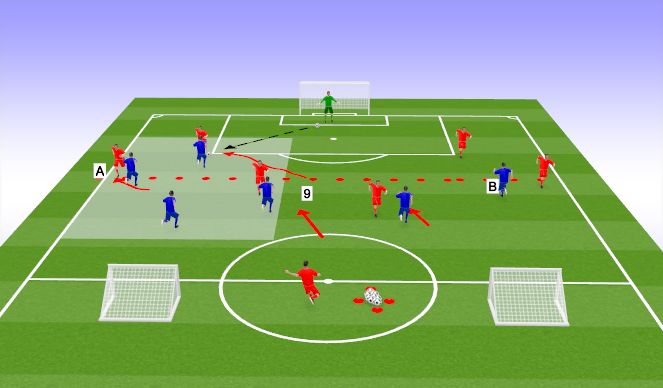
Scenario 1 : Ball is played to one of the Center Denfenders
Drill starts with server passing the ball to the goalkeeper. Once that happens, the Red team, gets into wide shape and blue team gets narrow and compact. When the ball reaches goalkeeper Defending players moves as described below :
Striker- Makes an angled run, towards the center half, that is receiving ball. While making angled run (showing outside), striker makes sure that any of the center defenders are not able to get the ball and the only option to play the ball to is opposite center half or goalkeeper.
Wingers : The winger, on whose side center half receives the ball, makes angled run (showing outside) and tightly marks the wing back, while leaving no options for him to pass the ball to one of the midfield unit players. This action happens at the same time, when striker is making run. Winger on the opposite side, is staying in the line, a few meters away from the wing-back of the opposition, in case the switch happens (This way player can delay the wing back, if needed, and protect the space in behind).
Midfileders : The midfielder, on whose side, center half receives the ball, protects the space in behind of winger (In case, if wing back defeats winger. This way, it is always at least 2v2 situation on this wing. What is more, player can intercept direct pass to one of the opposition midfielders). Center midfielder then moves and marks the closest opposition`s holding midfielder to the ball. (This way, it`s 4v2 situation on the wing). The midfielder, who plays on opposite wing, marks another defensive midfielder of opposition. If the switch happens, and it`s 2v1 situation on the opposite wing, player has to step in asap and make it into 2v1.
See the guidance at the top of this page to understand why you are not seeing interactive Football/Soccer images.
5 mins
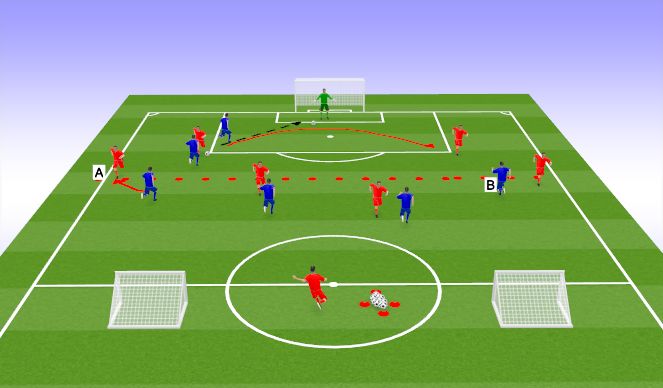
Scenario 2 : If the switch is happening through a goalkeeper.
If striker and winger does not manage to win the ball fast in the wide area and pass to the goalkeeper happens :
Striker- Makes an angled run, towards the goalkeeper (This way he prevents goalkeeper from playing direct pass to one of the three midfielders up front). If goalkeeper manages to pass the ball to the opposite center half, striker runs to press the mentioned player (Prevent 2v3 situation on the wing and block the direct pass to one of the midfielders up front)
Wingers : The Winger, who plays on the wing, where the action occured, then moves and presses the center half (that passd the ball to the goalkeeper). WInger on the opposite site is stil, protecting the space in behind/marking wing back.
Midfileders : The spare midfielder on the wing, where action occured, moves to mark the wing back. Other two midfielders do not deal with many changes, however are ready to step in to avoid (1v2 or 2v3 situation on the switch).
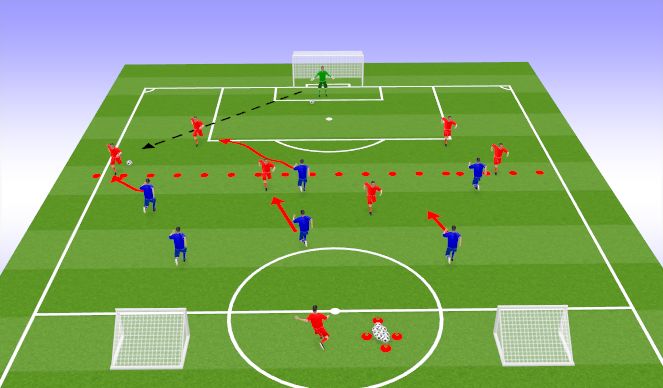
See the guidance at the top of this page to understand why you are not seeing interactive Football/Soccer images.
5 mins
Scenario 3 : Ball is played to one of the Wing Backs
Striker- Makes an angled run, towards the center half, that is receiving ball. While making angled run (showing outside), striker makes sure that any of the center defenders are not able to get the ball and the only option to play the ball to is opposite center half or goalkeeper.
Wingers : The winger, on whose side center half receives the ball, makes angled run (showing outside) and tightly marks the wing back, while leaving no options for him to pass the ball to one of the midfield unit players. Thisn action happens at the same time, when striker is making run. Winger on the opposite side, is staying in the line, a few meters away from the wing-back of the opposition, in case the switch happens (This way player can delay the wing back, if needed, and protect the space in behind).
Midfileders : The midfielder, on whose side, center half receives the ball, protects the space in behind of winger (In case, if wing back defeats winger. This way, it is always at least 2v2 situation on this wing. What is more, player can intercept direct pass to one of the opposition midfielders). Center midfielder then moves and marks the closest opposition`s holding midfielder to the ball. (This way, it`s 4v2 situation on the wing). The midfielder, who plays on opposite wing, marks another defensive midfielder of opposition. If the switch happens, and it`s 2v1 situation on the opposite wing, player has to step in asap and make it into 2v1.
Bibliography :
Clive W. Reeves, A. R. (2009). Stressors and Coping Strategies among Early and Middle Adolescent Premier League Academy Soccer Players: Differences According to Age. Journal of Applied Sport Psychology, 31-48.
FIFA. (2018, July 24). Retrieved from https://www.fifa.com/worldcup/matches/match/300331502/#match-summary
Javier Fernandez-Navarro, L. F. (2016). Attacking and defensive styles of play in soccer:. Journal of Sports Sciences, 2195-2204.
Thomas Haugen, E. T. (2013). The Role and Development of Sprinting Speed in Soccer. International journal of sports physiology and performance.
University of New Zealand. (2019, March 15). Retrieved from https://www.massey.ac.nz/massey/fms/AVC%20Academic/Teaching%20and%20Learning%20Cenrtres/Scenario-based-learning.pdf
Vygotsky, L. S. (1978). Mind in society: The development of higher psychological processes. Cambridge, MA: Harvard University Press.
Wood, D., Bruner, J., & Ross, G. (1976). The role of tutoring in problem solving. Journal of Child Psychology and Child Psychiatry, 17, 89−100.
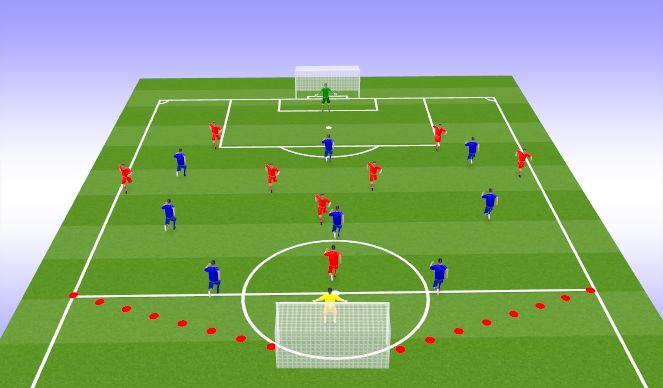
See the guidance at the top of this page to understand why you are not seeing interactive Football/Soccer images.
15 mins
Blue Team (4-3-3), in SSG (1-2-3-3). Red team (4-2-3-1), in SSG (1-4-2-1-1)
Equipment Used in Dril : 2 default sizes goals, flat cones, tactical board, 18 bibs (8 for Red Team , 8 for the Blue team, 2 goalkeeper specific), 12 balls.
Organization : 18 players (8 red team outfield players, 8 blue team outfield players, 2 goalkeepers), area size - half of the pitch (Relevance of the Pitch Geography/Topic and nature of Drill), 3 mini goals on the halfway line (imitation of 3 Center Midfielders), Recovery/restriction line (approximatelly 20 yards away from the goal).
Session Aims : Aim of the SSG is to provide alternative high pressure practising opportunities for the players. What is more, the high pressing should be purposefull and effective (winning the ball after infilcting pressure/scoring goals after positive transitions).In order to make players engage with the idea of high pressing and defensive duties after already being physically challenged by drill, scenario based learning should be involved within the session. According to University of New Zealand (2019) "Scenario-based learning (SBL) uses interactive scenarios to support active learning strategies such as problem-based or case-based learning. It normally involves students working their way through a storyline, usually based around an ill-structured or complex problem, which they are required to solve. In the process students must apply their subject knowledge, and critical thinking and problem solving skills in a safe, real-world context." In this particular case, certain scenario of "FIFA World Cup 2018" Group E game between Germany and Mexico will be used. The pressing team will be drawing the game "0-0" and will be required to press high/score and not concede, while doing it. The challenge to score only 1 goal after the pressure is in the session, because of the big physical load that players have been enduring, since the start of the drill (non professional players/not the first training session).
Key points : Communication and co-ordination of actions within individuals and units (organized pressing, which will be explained throughout the session), striker/2 wingers would play wide while on the 1st phase of pressure, midfield unit stays relativelly narrow (width of 18 yard box), in order to support the wide offensive unit and prevent getting split/played around, on the switch of play/unprevented pass to wide areas or zones in behind (2nd phase of pressing) remaining organized, keeping the narrow shape protecting the spaces in behind/potential options for opposition to deliver ball to dangerous areas, showing opposition outside (however, if 2v1 situation in the wide area occurs, showing opposition inside/delaying, in order to have defensive shape re-organized)
Challenges : Can team win ball within 7 seconds? Can team block the switch of play through goalkeeper/diagnal ball? Can team not get split, while inflicting organized pressure?
What If : The switch of play happens through the goalkeeper/center half? Ball reaches holding midfielder of the opposition? Space in the wide areas get exposed? (2v1 situation on the wing).
Management of opposition : Keeping the wide shape (while playing ball out of the back, center halfs and wingers go wide). Holding midfielders providing options or threats in behind (Playing realistically and not staying in a line, while in possesion). Trying to expose the spaces that defending team is not protecting. Playing passing based football, however if 2v1/2v2 situation occurs (especially on the wing), taking on opponent can be done.
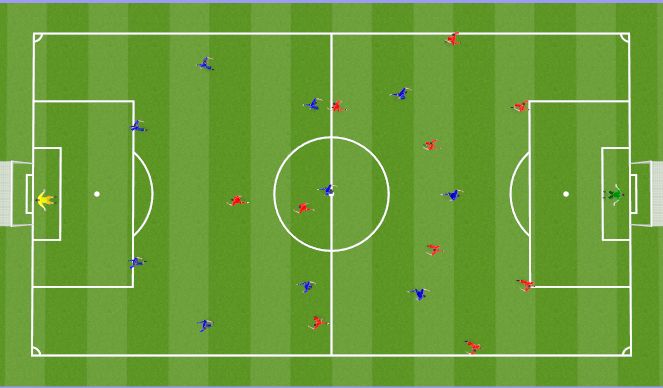
See the guidance at the top of this page to understand why you are not seeing interactive Football/Soccer images.
20 mins
Blue Team (1-4-3-3), Red team (1-4-2-3-1)
The session is based on defending from the front, in the Final Third of the pitch, while having striker and two wide players. The Pitch Geography will be focused on Red Team`s Defensive Third (Blue Team`s Attacking Third). According to Navarro, Fradua, Zubilaga, Ford and McRobert (2016) "Successful teams from European Leagues and World Cups tend to have higher attacking third regains (Bell-Walker et al., 2006; Garganta et al., 1997). Moreover, Tenga et al. (2010a) reported that the probability of producing a score-box possession decreases when a balanced defence is present (i.e., defenders provide defensive backup and cover). The utilisation of high- or low-pressure styles could be notably influenced by the opposing team’s style of play (Cotta, Mora, Merelo-Molina, & Merelo, 2013). For instance, using a high-pressure style of play against a team that utilises a possession style of play could be very effective for regaining the ball due to time and space denied to attacking players, while increasing the chances of scoring opportunities". Throughout the session Red Team will be encouraged to play possesion based style, while Blue Team will be defensive and apply direct approach, in terms of quick counter-attacks. What is more, the session will be based on developing tactical (inflicting certain defensive/pressing technique), technical (performing various defensive/offensive actions), physical (sprinting while pressing/counter-attacking or exploiting spaces), psychological (dealing with high-intensity and pressured situations) and social (pressing, while different units wotk together) elements of the game. Finally, the session will consist out of ~12 minutes drill and 15 minutes Small Sided Game. More Information about Drill and SSG is provided in the specific graphs.

 Play animation
 Play step-by-step
 Repeat (toggle)
 Full Screen
 Pause
Pause Stop
Stop
15 mins
Blue Team (4-3-3), in Drill (3-3). Red team (4-2-3-1), in Drill (4-2)
Equipment Used in Dril : 1 default size goal, 3 mini goals, flat cones, tactical board, 13 bibs (6 for team that plays out, 6 for the defending team, 1 goalkeeper specific), 12 balls.
Organization : 13 players (6 red team outfield players, 6 blue team outfield players, 1 goalkeeper), area size - half of the pitch (Relevance of the Pitch Geography/Topic and nature of Drill), 3 mini goals on the halfway line (imitation of 3 Center Midfielders), Recovery/restriction line (approximatelly 20 yards away from the goal).
Aims of the session : According to Santos, P., Silva, P.M., & Lago-Peñas (2017), ball recovery in the final third and the speed of reaction, while developing positive transition, can be one of the variables that indicates successful teams. What is more, FIFA (2018) states that in "FIFA World Cup 2018" Group E game between Germany and Mexico (0-1 victory by mexico), "Germany enjoyed more possession, particularly in the second half, however Mexico’s pressing game made sure the holders were never at ease. Proof of that is the fact that El Tri recovered possession 38 times to the Germans’ 31". In regards to statistic, provided by various academic and professional literature, pressing in the opposition`s defensive areas can be extremelly efficient and effective, in terms of achieving good results. However, the pressing techniques must be well planned and drilled. As a result, the main aim of this drill is practising pressing technique with 3 players up the front (1 striker/2 wingers) and 3 supporting midfielders. What is more, according to Haugen (2013), "Time motion analysis show that short sprints occur frequently during soccer games. Straight sprinting is the most frequent action prior to goals, both for the scoring and assisting player. Straight line sprinting velocity (both acceleration and maximal sprinting speed), certain agility skills and repeated sprint ability are shown to distinguish groups from different performance levels. Professional players have become faster over time, indicating that sprinting skills are becoming more and more important in modern soccer." As a result, this drill can be excellent tool for developing straight/linear sprinting, since pressing and build-up play (while moving into the spaces) involves high repetetive and explosive short distanced sprints. Finally, according to Clive W. Reeves , Adam R. Nicholls & Jim McKenna (2009) psychological pressure in football can highly affect young players performance negatively. This drill can be an effective tool, in order to make players deal with the the pressure (of making mistake while pressing or playing out of the back, which can be lethal). Exposure to this controlled (since drill is relativelly easy to control) pressure can develop mentally well prepared players. This means that one of the main session aims is stimulating psychological part of the football as well. Finally, the social compoment of the football will be stimulated, while team will need to successfully communicate, in order to inflict good pressure on the ball.
Key points : Communication and co-ordination of actions within individuals and units (organized pressing, which will be explained throughout the session), striker/2 wingers would play wide while on the 1st phase of pressure, midfield unit stays relativelly narrow (width of 18 yard box), in order to support the wide offensive unit and prevent getting split/played around, on the switch of play/unprevented pass to wide areas or zones in behind (2nd phase of pressing) remaining organized, keeping the narrow shape protecting the spaces in behind/potential options for opposition to deliver ball to dangerous areas, showing opposition outside (however, if 2v1 situation in the wide area occurs, showing opposition inside/delaying, in order to have defensive shape re-organized)
Blue Team (4-3-3), in SSG (1-2-3-