


Football/Soccer Session (Advanced): beach fc ecnl
Profile Summary

| Name: | Coach JJ Esparza |
|---|---|
| City: | Bellflower |
| Country: | United States of America |
| Membership: | Adult Member |
| Sport: | Football/Soccer |

See the guidance at the top of this page to understand why you are not seeing interactive Football/Soccer images.
See the guidance at the top of this page to understand why you are not seeing interactive Football/Soccer images.
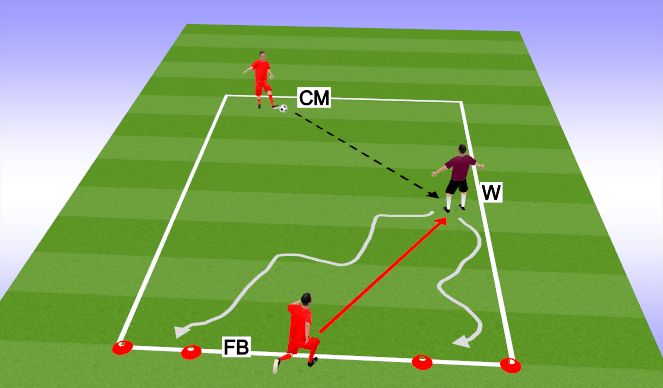
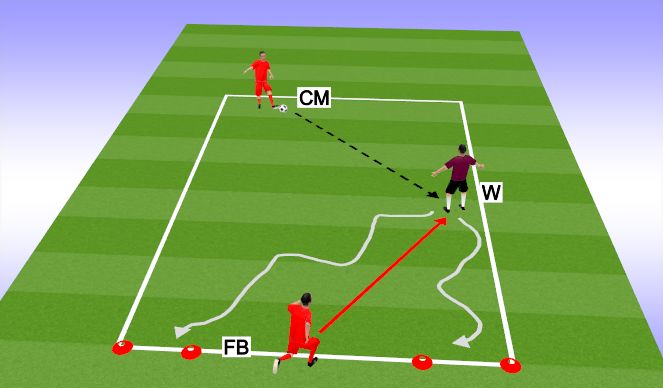
FB Applying pressure (10 mins)
Set up
In groups of at least 5. CM plays pass into W, the FB then applies pressure on the W. The winger must attempt to turn and beat the FB and dribble through a small goal. FB must try win the ball, and pass back to a waiting CM.
CM becomes W. W becomes FB. FB becomes CM
Coaching Points
- Attempt to arrive at the W before they get a chance to turn.
- FB apply pressure at the right time. As soon as you are positive the pass is going to the W, press quickly and directly.
- DO NOT DIVE IN, be patient in the challenge.
- Deny space. - Dictate Wingers direction (body shape)
Problem/Solutions
- Problem: Arriving to early/late Solution: Time run, arrive when the ball arrives
- Problem: Player keeps turning and beating defender. Solution: Be patient, slow down when arriving to the W. Dont dive in and wait for a mistake.
See the guidance at the top of this page to understand why you are not seeing interactive Football/Soccer images.
Specific Session (40 mins)
Key Factors
- Pressing fast
- Being narrow and compact to prevent being played through
- Forcing back
- Communincation
- Protecting space in behind
Opposition Principles
Organisation
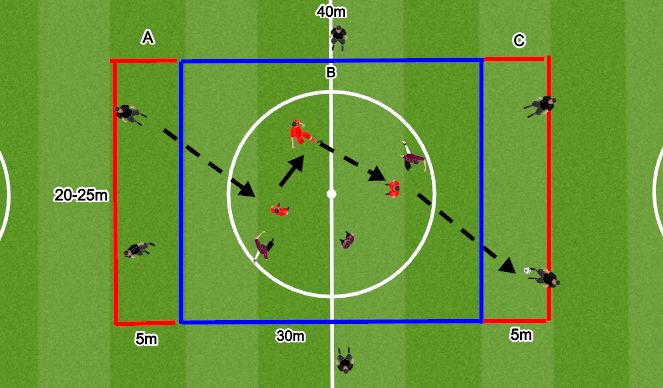
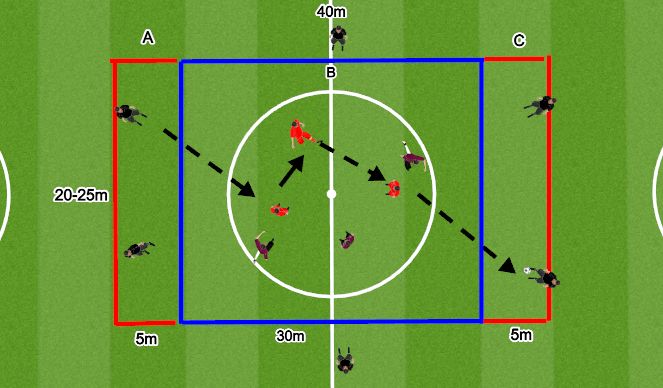
- Total time of 20mins
- Area size of 20-25m Wide by 30-40m Long (dependant on age of players)
- 12 players (can be 10 with one at each end, or worst case 8 with no wide players)
- 3 sets of bib, 3v3 within Blue zone
- Common players on outside play with team in possession
- Aim is to move the ball from Zone A to Zone C through Zone B with the minimum number of passes
- Once ball reaches the end zone then recylce back via wide players to the starting zone (allows recovery)
- Between breaks, get a player in each end zone to gather the balls ready to re-start
- 4 rounds in total; 3-4mins per round
Conditions
1. Max two touch for players outside blue square
2. Max of three touches for players inside (unless we are working on them beating a player)
3. No thrown ins
4. If possession is lost, then restart at the end where the ball came from in that phase
Scoring
5 points: if ball is moved from A to C through B in 2 passes
3 points: 3 passes or more
2 points: if passes requires players on outside
Progressions
1. Add forward player into defenders zone to put more pressure on CBs when in possession
Block A: Positioning On and Off The Ball
When CB has the ball, the CMs should not be moving towards them as this will close down space. They should look to play as high up as possible (especially the ACM). The two DCMs should be wide. The wide players outside should not be beyond the halfway line - in this session we operate them as FBs
CMs can take passes into feet where they are and therefore need to shield & protect the ball well. They can also push high and then look for passes into the space they have now created (push marker back and move to receive thus creating space)
Block B: Body Shape to Receive, First Touch, First Time Pass
Players need to be on their toes with open body to receive. Are they using body shape to play a quick pass or do they want to receive and take opposition on.
Block C: Passing Angles
Multiple angles
a. Square on = pass back to CBs
b. Sideways outside = pass to FB
c. Sideways inside = looking for option of combination play or seeking pass through
d.
Block D: Movement of all players and 3rd Man Movement
a. Can we play to a CM who plays to another CM who then makes that pass forward
See the guidance at the top of this page to understand why you are not seeing interactive Football/Soccer images.
2v2 to Goal
Organization:
Set up as shown.
Instructions:
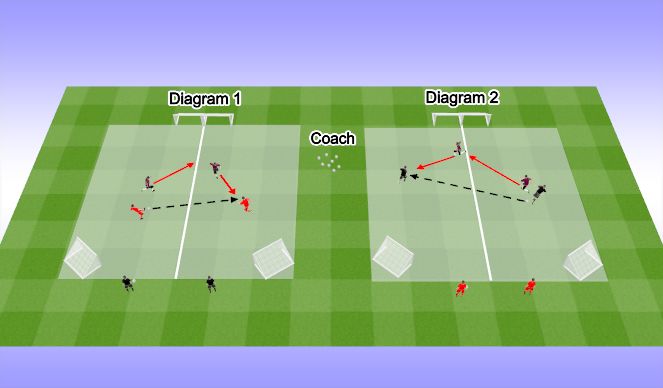
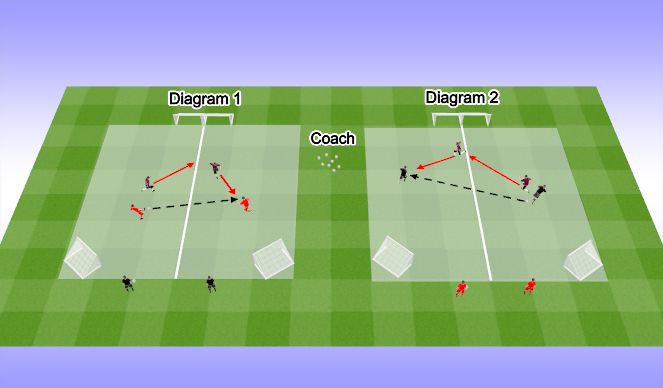
This is a competitive 2v2 practice that takes place in a small playing area, at the start of the exercise the players are divided into two groups in a mini team of twos.
• Exercise starts with two defensive players (reds) as shown in Diagram 1 – are confined to their own specific lane, as denoted by the line. The defenders are not permitted to cross lanes.
• The two attacking players (blues) in Diagram 1 – are allowed to switch lanes, although they must not be in the same line at the same time. They should attempt to score in the mini-goal, while the defenders must attempt to intercept, block, tackle and win back possession to score in the two counter goals. Once the attackers lose the ball or a goal is scored, the attack ends.
• Once the defending pair have defended against one pair of attackers, they move to the back of the attacking queue. At this point, the attacking pair become the defenders and a new pair of attackers enter the playing area.
Coaching Points (Defenders):
COVERING DEPTH
• The non-pressing player in the defending pair should ensure that they are positioned in such a way that they block the line between the ball and the goal (a constant reference point). They should be deep enough so that the ball cannot be played between them and their defensive partner. DEFINITE DECISIONS
• As the ball is played from one attacker to the other, the defending players should not hesitate in moving from being a covering defender to one who is pressing.
FRONT-FOOT DEFENDING
• The defenders should try to pinch a couple of yards as they anticipate the ball being switched from one player to the other.
• Their body position should be low and side-on, and enable them to react quickly and aggressively to as witch of play.
CUT THE GOAL OFF
• Both the pressing and covering defenders should use the goal as a reference point that dictates the position they take up relative to the ball.
• Their position should be such that the line between the ball and the goal is blocked for whichever attacker is in possession.
Coaching Points (Attackers):
CROSSOVERS
• The pair of attackers should be encouraged to cross lanes in order to present the defenders with a problem. This tests the defenders’ ability to communicate and remain disciplined.
• Speed of play i.e. ball speed, quick passes, quick moments on and off the ball e.t.c.
See the guidance at the top of this page to understand why you are not seeing interactive Football/Soccer images.
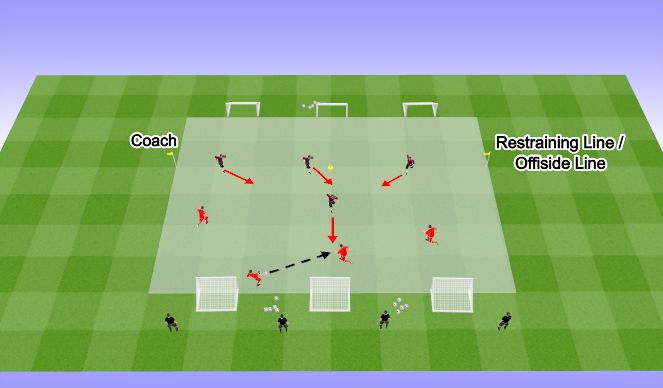
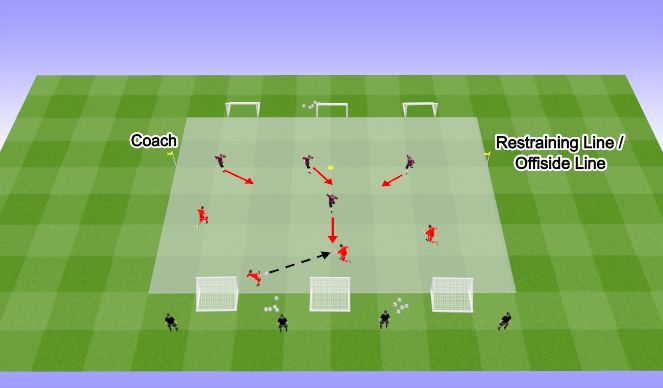
Defending 4v4
Organization:
Set up as shown.
Instructions:
This is a six-goal game set up as a 4v4. As a progression from the previous exercises, the players are divided into three teams of four with two teams playing and two teams resting.
• The focus is geared toward scrutinizing how well the four defenders are able to work as a collective unit to defend three goals.
• Each time a goal is scored or the ball goes out of play, a new game starts with the attacking team becoming the defending team while the original defending team returns to the starting line to wait their turn to play as the attacking team.
• The yellow cone & yellow flags represents the restraining line / offside line.
Coaching Points (Defenders):
PRESSURE, COVER AND BALANCE
• The defending player nearest the ball should apply aggressive pressure by getting to the ball as quickly as possible. The remaining three defenders should take up good positions that allow them to cover and balance but still be aware of the movement of the other three attacking players. They should not find themselves square of the pressing player.
COMMUNICATION
• The covering players should provide the pressing player with clear information as to which way they should attempt to force the attackers’ play. This helps the pressing player be decisive and make definite decisions.
DEALING WITH AN OVERLAPPING RUN
• Should a defender find themselves in a 2v1 situation –pressing the ball-carrier but noticing an overlapping run– they should prioritise tracking the movement of the runner or blocking the goal. This is a cue for the nearest covering defender to engage the ball-carrier.
CUTTING OFF PASSING LINES
• As well as taking up a position from which paths to goal can be blocked, players should also be encouraged to block passing lines to opposition players as they press the ball.
Coaching Points (Attackers):
• The pair of attackers should be encouraged to cross lanes in order to present the defenders with a problem. This tests the defenders’ ability to communicate and remain disciplined.
• Speed of play i.e. ball speed, quick passes, quick movements on and off the ball e.t.c.
• Variety of runs i.e. overlap, under-lap, third-man runs and decoy runs etc.
Progression:
1. 4v4+2GKs.
See the guidance at the top of this page to understand why you are not seeing interactive Football/Soccer images.
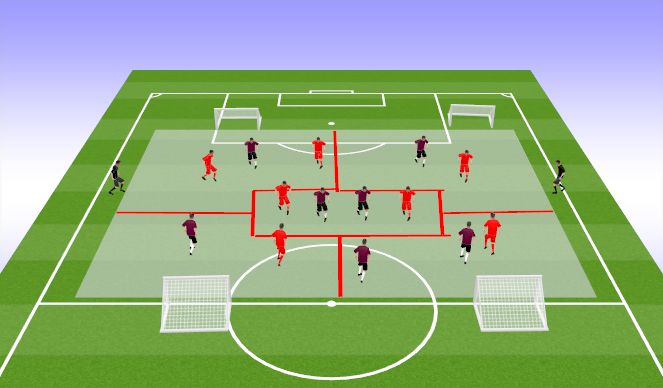
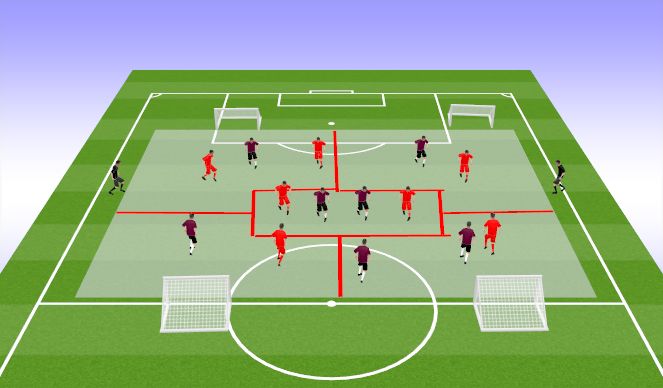
4 goal game 3-5-2
Intro to 3-5-2 movements.
1. Start with unopposed passing to teammates in the positions, different combos etc..
2. Drill procession - Team in possession has to stay in their zones, exceptions are if ball played in to a zone, that player can overload that zone. Defending team has no restrictions. Wide players are for both teams, and do not defend. The wide player cant score, he is there to facilitate circulation of the ball.
3. Progress to open 4 goal game.
'%3E%3Cpath id='path4169' d='M 11.4375,70.25 C 11.457031,38.394531 37.277344,13.242188 68.253906,13.050781 99.78125,12.855469 125.73047,38.351563 125.8125,70.078125 125.89844,101.62109 100.43359,127.14063 69.148438,127.42188 37.582031,127.70703 11.464844,102.23438 11.4375,70.25 m 6.425781,-0.08984 c 0.03516,28.421871 23.027344,50.69922 50.519532,50.82031 C 96.433594,121.10156 119.30469,98.367188 119.38281,70.359375 119.45313,42.878906 97.382813,19.714844 69.015625,19.496094 40.75,19.277344 17.964844,42.035156 17.863281,70.160156' style='clip-rule:nonzero;fill:%23333f48;fill-opacity:1;fill-rule:nonzero;stroke:none' /%3E%3Cpath style='fill:%23333f48;fill-opacity:1;fill-rule:nonzero;stroke:none' d='m 39.789063,108.62109 c 0.28125,0.14454 0.550781,0.32032 0.839843,0.4336 2.734375,1.05469 5.554688,1.78125 8.453125,2.23047 2.734375,0.42578 5.484375,0.64453 8.25,0.54297 3.988282,-0.15625 7.832032,-0.94922 11.445313,-2.69532 1.683594,-0.8164 3.246094,-1.82422 4.640625,-3.07422 3.265625,-2.92578 5.171875,-6.582027 5.796875,-10.906246 0.546875,-3.761719 0.04687,-7.425781 -1.09375,-11.019531 -1.4375,-4.523438 -3.730469,-8.582032 -6.703125,-12.265625 -1.03125,-1.277344 -2.082031,-2.535157 -3.113281,-3.808594 C 66.789063,66.1875 65.332031,64.269531 64.0625,62.21875 c -1.601562,-2.582031 -2.835937,-5.316406 -3.613281,-8.261719 -0.683594,-2.574218 -0.902344,-5.1875 -0.6875,-7.828125 0.214844,-2.617187 0.910156,-5.117187 2.152344,-7.441406 2.164062,-4.050781 5.503906,-6.710937 9.816406,-8.179687 1.890625,-0.640625 3.835937,-1.058594 5.832031,-1.195313 1.121094,-0.07813 2.242188,-0.152344 3.363281,-0.164062 4.28125,-0.02734 8.4375,0.734375 12.453125,2.175781 1.871094,0.671875 3.6875,1.496094 5.523438,2.257812 0.226562,0.09375 0.4375,0.230469 0.664062,0.351563 -0.164062,0.25 -0.371093,0.160156 -0.539062,0.164062 -2.824219,0.101563 -5.535156,0.703125 -8.132813,1.804688 -1.335937,0.570312 -2.570312,1.316406 -3.648437,2.296875 -2.527344,2.296875 -3.605469,5.15625 -3.34375,8.550781 0.140625,1.855469 0.722656,3.574219 1.550781,5.222656 0.648438,1.296875 1.414063,2.523438 2.292969,3.675782 0.953125,1.25 1.929687,2.484375 2.929687,3.699218 2.085938,2.523438 4.164063,5.054688 6.050782,7.738282 2.203125,3.136718 4.140627,6.417968 5.589847,9.980468 1.16406,2.867188 2.01562,5.820313 2.39843,8.894532 0.25,2.011718 0.30079,4.03125 0.11719,6.058593 -0.24219,2.640625 -0.79297,5.195313 -1.74609,7.667969 -1.29688,3.36328 -3.300784,6.22656 -5.972659,8.63281 -2.429687,2.19141 -5.171875,3.90625 -8.109375,5.3125 -2.695312,1.29297 -5.464843,2.40235 -8.34375,3.20313 -1.953125,0.54687 -3.945312,0.8789 -5.949218,1.15625 -3.035157,0.41797 -6.085938,0.48828 -9.132813,0.3125 -5.328125,-0.3125 -10.476562,-1.46094 -15.410156,-3.52344 -3.449219,-1.44141 -6.691406,-3.25781 -9.757813,-5.39453 -0.183593,-0.12891 -0.378906,-0.25 -0.53125,-0.41016 -0.07031,-0.0703 -0.05859,-0.22656 -0.08203,-0.34375 z m 0,0' id='path4175' /%3E%3Cpath style='fill:%23333f48;fill-opacity:1;fill-rule:nonzero;stroke:none' d='M 94.699219,29.390625 C 94.089844,29.21875 93.476563,29.054688 92.867188,28.875 90.183594,28.085938 87.46875,27.441406 84.703125,27.046875 c -3.976562,-0.566406 -7.945312,-0.59375 -11.863281,0.402344 -7.535156,1.914062 -12.386719,6.71875 -14.878906,13.996094 -0.894532,2.617187 -1.179688,5.328125 -0.953125,8.078125 0.203125,2.484375 0.867187,4.859375 1.816406,7.160156 0.933594,2.261719 2.117187,4.390625 3.4375,6.449219 1.4375,2.25 3.050781,4.371093 4.640625,6.511718 1.4375,1.933594 2.867187,3.871094 4.261719,5.835938 1.230468,1.730469 2.316406,3.546875 3.273437,5.445312 1.324219,2.625 2.265625,5.378907 2.703125,8.292969 0.433594,2.902344 0.292969,5.765625 -0.660156,8.5625 -0.9375,2.74609 -2.574219,5.00781 -4.777344,6.875 -2.417969,2.04688 -5.203125,3.39844 -8.246094,4.22266 -1.835937,0.5 -3.703125,0.75781 -5.609375,0.82031 -3.886718,0.13281 -7.679687,-0.47266 -11.421875,-1.46094 -2.261718,-0.59765 -4.488281,-1.33203 -6.695312,-2.11328 -0.207031,-0.0742 -0.40625,-0.16797 -0.597656,-0.25 -0.02344,-0.24609 0.148437,-0.19141 0.25,-0.20703 1.96875,-0.30469 3.921875,-0.67969 5.804687,-1.34766 1.367188,-0.48437 2.671875,-1.10156 3.855469,-1.94922 2.25,-1.61328 3.65625,-3.765621 4.0625,-6.515621 0.273437,-1.867188 0.09375,-3.710938 -0.429688,-5.527344 -0.472656,-1.648437 -1.171875,-3.199219 -2.109375,-4.628906 -0.792968,-1.207031 -1.636718,-2.382813 -2.523437,-3.519531 -0.921875,-1.195313 -1.921875,-2.328125 -2.890625,-3.484375 -2.753906,-3.273438 -5.351563,-6.660157 -7.523438,-10.355469 -2.042968,-3.480469 -3.667968,-7.136719 -4.597656,-11.078125 -0.640625,-2.699219 -0.980469,-5.4375 -0.832031,-8.214844 0.238281,-4.53125 1.476562,-8.78125 3.824219,-12.6875 1.082031,-1.800781 2.445312,-3.375 3.988281,-4.800781 2.742187,-2.527344 5.863281,-4.480469 9.257812,-5.992188 3.746094,-1.667968 7.652344,-2.769531 11.707032,-3.394531 3.152343,-0.488281 6.324218,-0.671875 9.507812,-0.519531 8.632813,0.410156 16.671875,2.792969 24,7.433594 0.08203,0.05078 0.152344,0.109375 0.230469,0.167968 -0.0039,0.04297 -0.0078,0.08984 -0.01563,0.136719' id='path4177' /%3E%3Cpath style='fill:%23333f48;fill-opacity:1;fill-rule:nonzero;stroke:none' d='m 31.699219,38.75 c -0.07813,0.238281 -0.152344,0.476563 -0.238281,0.710938 -1.460938,4.074218 -2.066407,8.28125 -1.808594,12.59375 0.4375,7.304687 2.808594,13.925781 7.277344,19.753906 3.714843,4.84375 7.441406,9.671875 11.167968,14.503906 1.113282,1.441406 1.953125,3.007813 2.414063,4.777344 0.332031,1.257812 0.425781,2.539062 0.273437,3.820312 -0.214843,1.832032 -1.070312,3.34375 -2.464843,4.546875 -0.984375,0.851559 -2.113282,1.449219 -3.316407,1.925779 -1.378906,0.54297 -2.8125,0.89063 -4.273437,1.1211 -2.226563,0.35547 -4.46875,0.46093 -6.722656,0.41015 -0.589844,-0.0156 -1.046875,-0.18359 -1.433594,-0.625 -0.636719,-0.72265 -1.335938,-1.39062 -1.9375,-2.14062 C 25.574219,93.800781 22.300781,86.621094 20.84375,78.636719 20.152344,74.835938 19.917969,71 20.15625,67.128906 20.796875,56.773438 24.390625,47.574219 30.859375,39.480469 c 0.21875,-0.273438 0.453125,-0.53125 0.679688,-0.796875 0.05469,0.02344 0.109375,0.04297 0.160156,0.06641' id='path4179' /%3E%3Cpath style='fill:%23333f48;fill-opacity:1;fill-rule:nonzero;stroke:none' d='m 105.41016,101.30078 c -0.13282,-0.3125 0.0234,-0.5039 0.0977,-0.69922 1.38672,-3.749997 1.98047,-7.628904 1.89844,-11.621091 -0.14453,-6.84375 -2.08594,-13.144531 -5.73437,-18.925781 C 99.890625,67.226563 97.917969,64.53125 95.835938,61.917969 94.4375,60.160156 92.988281,58.4375 91.582031,56.6875 90.632813,55.511719 89.6875,54.335938 88.792969,53.121094 c -0.835938,-1.144531 -1.488281,-2.398438 -1.953125,-3.742188 -0.523438,-1.515625 -0.695313,-3.070312 -0.511719,-4.652343 0.21875,-1.839844 1.082031,-3.339844 2.476563,-4.542969 1.039062,-0.890625 2.230468,-1.507813 3.503906,-1.980469 1.632812,-0.609375 3.320312,-0.960937 5.046875,-1.175781 1.917969,-0.238281 3.839841,-0.269531 5.769531,-0.230469 0.52734,0.01172 0.89453,0.203125 1.23828,0.585938 5.50391,6.113281 9.26172,13.144531 11.21875,21.132812 1.11719,4.554688 1.5625,9.179688 1.30469,13.855469 -0.58203,10.625 -4.23438,20.082031 -10.96094,28.339846 -0.15625,0.1914 -0.32812,0.375 -0.51562,0.58984' id='path4181' /%3E%3Cpath style='fill:%23333f48;fill-opacity:1;fill-rule:nonzero;stroke:none' d='m 39.796875,108.63281 c -0.05859,0.0117 -0.117187,0.0234 -0.175781,0.0352 0.05469,-0.0156 0.113281,-0.0312 0.167969,-0.0469 z m 0,0' id='path4183' /%3E%3C/g%3E%3C/svg%3E)
 Play animation
 Play step-by-step
 Repeat (toggle)
 Full Screen
 Pause
Pause Stop
Stop
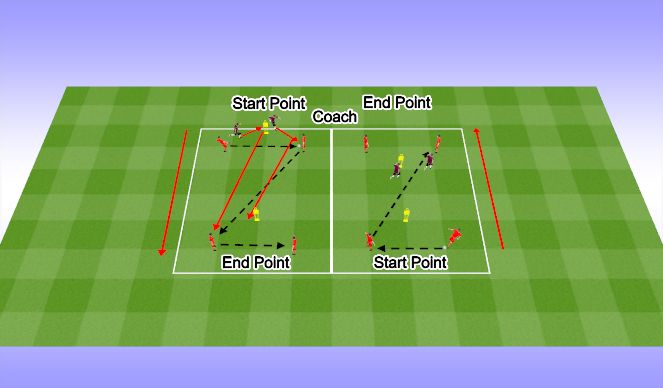
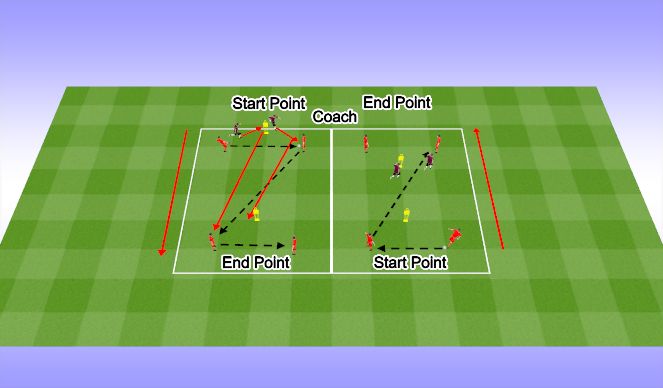
Technical Warmup.
Semi-Opposed Passing / Defending Practice (Pressure & Cover).
Organization:
Set up playing area as shown.
Instructions:
•The technical warm up exercise starts with a series of passes are played between the players as shown in the diagram with the ball progressing from the practice’s start point. Two passes are played between each pair of players (blues) before the ball is played to the pair next in line.
• As the ball is played from one player to another, the two defenders (reds) must adjust their defensive positions accordingly.
• The defenders are to work as a pivot; when one applies pressure (without making an attempt to win possession/tackle), the other must take up a covering position on the appropriate mannequin.
• As the ball changes sides, the two defensive players’ roles – as pressing player and covering player –changes.
• As the ball reaches the end point, the blue players should work the ball back toward the start point using a variety of straight and diagonal passes.
• As they do so, the two defensive players should adjust their positions accordingly, ensuring that one player is covering the appropriate mannequin. This simulates the recovery runs that centre-forwards might make in a game
• Once they have completed one set up and down the playing area, and returned to the start point, the defensive players change with a pair of blue players, who then become the defenders for the next set.
Coaching Points:
COMMUNICATION
• The second covering defender, who is generally positioned on a deeper line than the pressing player, should encourage the first defender to press the ball aggressively as it is switched from one side of the practice to the other.
DECISIVENESS
• Players should make quick decisions as to which player is best positioned to press the ball as it shifts from player to player.
• This decision should make it clear that the non-pressing player must take up a covering position behind theappropriate mannequin.
SHOWING INSIDE OR OUTSIDE
• The covering player should dictate to the pressing player whether they are to show inside or outside.
• This dictates how the pressing player positions themselves. Showing outside would cut off the passing line between the player in possession and the mannequin being covered. Showing inside would cut off a route down the outside.