


Football/Soccer Session (Academy Sessions): U16 Technical Session: Defensive Skills -Part 1 (Start Time: 2017-02-20 19:15:00)


Premier Users' Club
Paul Inns
Profile Summary

| Name: | Paul Inns |
|---|---|
| City: | Newtown |
| Country: | United Kingdom |
| Membership: | Adult Member |
| Sport: | Football/Soccer |

Description
Defensive skills
See the guidance at the top of this page to understand why you are not seeing interactive Football/Soccer images.
See the guidance at the top of this page to understand why you are not seeing interactive Football/Soccer images.
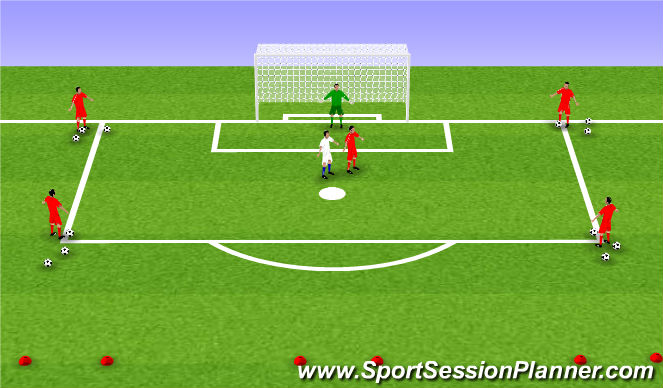
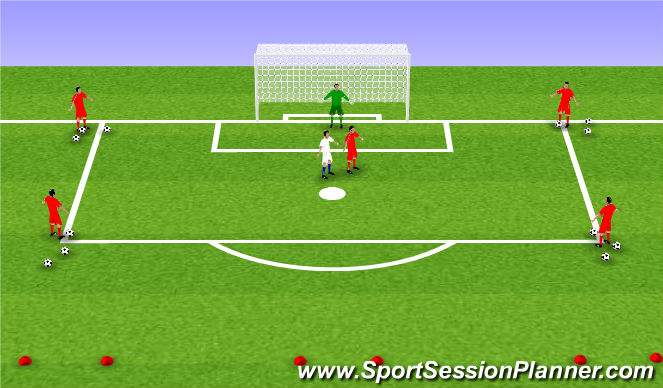
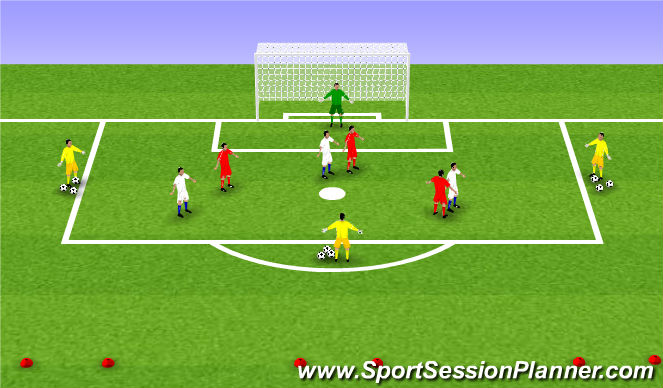
One v One Marking in Box
Purpose
To allow players to practice marking their opponent, specifically in the penalty area.
Organisation
Play within penaly area and also set up 3 coned goals as illustrated.
Four servers at each corner of the penalty area. Goalkeeper defends the goal.
One white defender v one red attacker.
Instructions
Servers take it in turns to pass the ball into the attacker who attempts to score, preferably with one or two touches. Defender must mark, intercept and defend as necessary.
TRANSITION If the defender wins the ball back, he can attack and scopre in any of the three smaller goals. All attackers can recover to srtop him doing so.
Change the player combinations regularly.
Attacker scores one point for each goal scored. The defender gets a point for scoring a counter-attacking goal.
Progressions
1. Servers pass the ball amongst themselves before playing into the striker, changing the postiojn of the defender in the process. If it's possible, the defender can intercept any on these passes.
2. The servers are now challenged to play a pass in the air to offer both the attacker and the defender a different challenge.
Coaching Points
When do you mark tight?
When do you allow space between you and the attacker to prioritize defending the goal?
If you are not 'touch tight' can you 'travel as the ball travels' - i.e. be able to make up the ground between you and the attacker as the ball is delivered.
Can you alter your defensive position in relation to the server, the ball, the attacker and the danger?
Can you critically defend to stop the striker scoring if he receives possession?
If you intercept, can you counter attack and score before the attacking team recovers?
NB Do not alllow the defender to just follow the attacker around the penalty area! Not only is this poor defending, as the defender will get away from him, players that do this tend to just foul the attacker in this training exercise.
See the guidance at the top of this page to understand why you are not seeing interactive Football/Soccer images.
Defending in & Around the Box
Purpose
Defenders learn to defend critically when playing in and around the penalty area.
Organisation
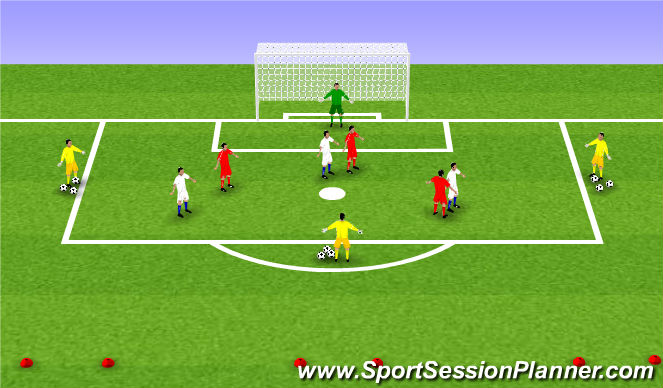
Three White defenders and a Goalkeeper defend the big goal.
Three red attackers receive the ball from any yellow server and try to score.
Three smaller coned goals are positioned outside the box to allow the white defenders to counter attack.
Instructions
Players play 3v3 in the penalty area.
Each attack is started by one of the yellow servers playing a pass into the red attackers. Red players attempt to score.
TRANSITION if the white defenders intercept the ball, can they score in any of the three smaller goals? Yellow and red players must recover and defend against this.
Switch players regularly.
Attacking team scores in usual manner. White team score when counter att acking by scoiring in any mini goal. The goalkeeper can score with hands, or feet, should he have possession.
Progressions
1. The yellow server who feeds the attacking teaqm can now join the attack, creating an overload.
2. All three yellow servers can join the attack.
Coaching Points
Can the three defenders defend compact?
Can you zonally defend the goal as a proprity, rather than man marking?
Can you detect when a player is shaping up to shoot and press the ball accordingly?
Can defenders be alive to any rebounds that come from the goalkeeper?
When outnumbered, can players prioiritise defending the goal compactly, recognising when it is critical to press the ball?
Upon regaining possession, can the white defenders counter attack quickly?
Can the attacking team react quickly to defend from any counter attack?
See the guidance at the top of this page to understand why you are not seeing interactive Football/Soccer images.
SSG - Defending Against Direct Play
Purpose
For players to practyice defending against long, direct passes towards the goal area.
Organisation
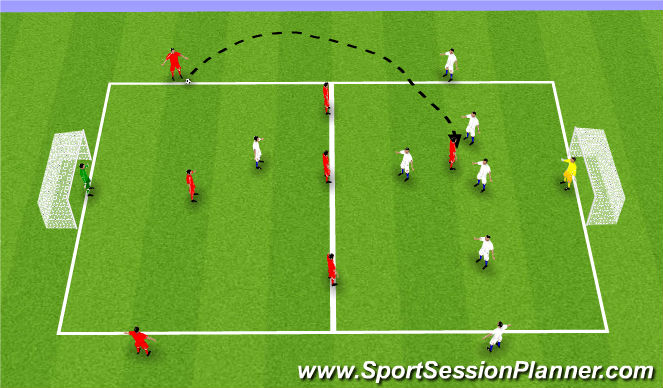
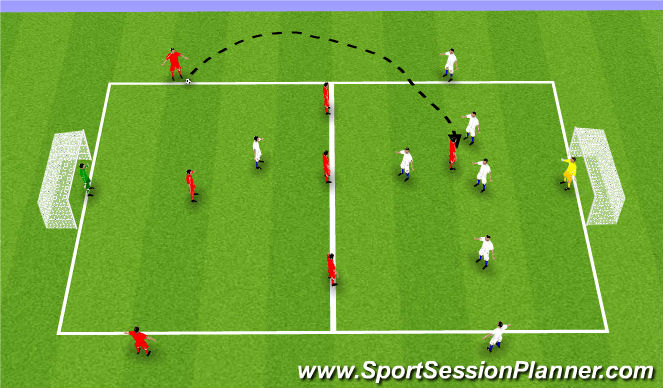
Divide players into two teams - 8 red v 8 white.
Two players from each team are placed outside the pitch in their own half.
Two goals (try to include a big goal for one of the goals) and two goalkeepers.
Instructions
Both teams play a small sided game and look to score as normal.
Whjen one of the outside players receives the ball, he must play a long direct pass towards the opponents goal area.
The opposition defend accordingly.
TRANSITION Natural transitions occur in the SSG.
Progressions
1. The outside players now play inside, as per normal.
Coaching Points
Can you pick up the visual cues of when a player is going to try a long, direct pass?
When a teammate is going to head/control the ball, can the other defenders narrow off and cover behind him?
Can you quickly 'squeeze' out of the scoring zone once the danger has passed?
Can you recover quickly into shape when possession is lost?
Can you stop strikers turning, or spoil the pass into their feet?
Can you defend critically to see off any danger?
Can you win headers, make blocks, and compete for knockdowns? Win the second ball?
Can you counter attack effectively and reorgnaise once disorganised?
NB Maintain a blance between encouraging long passes for the purposes of defending outcomes (i.e. to defend against direct play), and emphasising that this direct style may be in contrast to our normal attacking strategy.
'%3E%3Cpath id='path4169' d='M 11.4375,70.25 C 11.457031,38.394531 37.277344,13.242188 68.253906,13.050781 99.78125,12.855469 125.73047,38.351563 125.8125,70.078125 125.89844,101.62109 100.43359,127.14063 69.148438,127.42188 37.582031,127.70703 11.464844,102.23438 11.4375,70.25 m 6.425781,-0.08984 c 0.03516,28.421871 23.027344,50.69922 50.519532,50.82031 C 96.433594,121.10156 119.30469,98.367188 119.38281,70.359375 119.45313,42.878906 97.382813,19.714844 69.015625,19.496094 40.75,19.277344 17.964844,42.035156 17.863281,70.160156' style='clip-rule:nonzero;fill:%23333f48;fill-opacity:1;fill-rule:nonzero;stroke:none' /%3E%3Cpath style='fill:%23333f48;fill-opacity:1;fill-rule:nonzero;stroke:none' d='m 39.789063,108.62109 c 0.28125,0.14454 0.550781,0.32032 0.839843,0.4336 2.734375,1.05469 5.554688,1.78125 8.453125,2.23047 2.734375,0.42578 5.484375,0.64453 8.25,0.54297 3.988282,-0.15625 7.832032,-0.94922 11.445313,-2.69532 1.683594,-0.8164 3.246094,-1.82422 4.640625,-3.07422 3.265625,-2.92578 5.171875,-6.582027 5.796875,-10.906246 0.546875,-3.761719 0.04687,-7.425781 -1.09375,-11.019531 -1.4375,-4.523438 -3.730469,-8.582032 -6.703125,-12.265625 -1.03125,-1.277344 -2.082031,-2.535157 -3.113281,-3.808594 C 66.789063,66.1875 65.332031,64.269531 64.0625,62.21875 c -1.601562,-2.582031 -2.835937,-5.316406 -3.613281,-8.261719 -0.683594,-2.574218 -0.902344,-5.1875 -0.6875,-7.828125 0.214844,-2.617187 0.910156,-5.117187 2.152344,-7.441406 2.164062,-4.050781 5.503906,-6.710937 9.816406,-8.179687 1.890625,-0.640625 3.835937,-1.058594 5.832031,-1.195313 1.121094,-0.07813 2.242188,-0.152344 3.363281,-0.164062 4.28125,-0.02734 8.4375,0.734375 12.453125,2.175781 1.871094,0.671875 3.6875,1.496094 5.523438,2.257812 0.226562,0.09375 0.4375,0.230469 0.664062,0.351563 -0.164062,0.25 -0.371093,0.160156 -0.539062,0.164062 -2.824219,0.101563 -5.535156,0.703125 -8.132813,1.804688 -1.335937,0.570312 -2.570312,1.316406 -3.648437,2.296875 -2.527344,2.296875 -3.605469,5.15625 -3.34375,8.550781 0.140625,1.855469 0.722656,3.574219 1.550781,5.222656 0.648438,1.296875 1.414063,2.523438 2.292969,3.675782 0.953125,1.25 1.929687,2.484375 2.929687,3.699218 2.085938,2.523438 4.164063,5.054688 6.050782,7.738282 2.203125,3.136718 4.140627,6.417968 5.589847,9.980468 1.16406,2.867188 2.01562,5.820313 2.39843,8.894532 0.25,2.011718 0.30079,4.03125 0.11719,6.058593 -0.24219,2.640625 -0.79297,5.195313 -1.74609,7.667969 -1.29688,3.36328 -3.300784,6.22656 -5.972659,8.63281 -2.429687,2.19141 -5.171875,3.90625 -8.109375,5.3125 -2.695312,1.29297 -5.464843,2.40235 -8.34375,3.20313 -1.953125,0.54687 -3.945312,0.8789 -5.949218,1.15625 -3.035157,0.41797 -6.085938,0.48828 -9.132813,0.3125 -5.328125,-0.3125 -10.476562,-1.46094 -15.410156,-3.52344 -3.449219,-1.44141 -6.691406,-3.25781 -9.757813,-5.39453 -0.183593,-0.12891 -0.378906,-0.25 -0.53125,-0.41016 -0.07031,-0.0703 -0.05859,-0.22656 -0.08203,-0.34375 z m 0,0' id='path4175' /%3E%3Cpath style='fill:%23333f48;fill-opacity:1;fill-rule:nonzero;stroke:none' d='M 94.699219,29.390625 C 94.089844,29.21875 93.476563,29.054688 92.867188,28.875 90.183594,28.085938 87.46875,27.441406 84.703125,27.046875 c -3.976562,-0.566406 -7.945312,-0.59375 -11.863281,0.402344 -7.535156,1.914062 -12.386719,6.71875 -14.878906,13.996094 -0.894532,2.617187 -1.179688,5.328125 -0.953125,8.078125 0.203125,2.484375 0.867187,4.859375 1.816406,7.160156 0.933594,2.261719 2.117187,4.390625 3.4375,6.449219 1.4375,2.25 3.050781,4.371093 4.640625,6.511718 1.4375,1.933594 2.867187,3.871094 4.261719,5.835938 1.230468,1.730469 2.316406,3.546875 3.273437,5.445312 1.324219,2.625 2.265625,5.378907 2.703125,8.292969 0.433594,2.902344 0.292969,5.765625 -0.660156,8.5625 -0.9375,2.74609 -2.574219,5.00781 -4.777344,6.875 -2.417969,2.04688 -5.203125,3.39844 -8.246094,4.22266 -1.835937,0.5 -3.703125,0.75781 -5.609375,0.82031 -3.886718,0.13281 -7.679687,-0.47266 -11.421875,-1.46094 -2.261718,-0.59765 -4.488281,-1.33203 -6.695312,-2.11328 -0.207031,-0.0742 -0.40625,-0.16797 -0.597656,-0.25 -0.02344,-0.24609 0.148437,-0.19141 0.25,-0.20703 1.96875,-0.30469 3.921875,-0.67969 5.804687,-1.34766 1.367188,-0.48437 2.671875,-1.10156 3.855469,-1.94922 2.25,-1.61328 3.65625,-3.765621 4.0625,-6.515621 0.273437,-1.867188 0.09375,-3.710938 -0.429688,-5.527344 -0.472656,-1.648437 -1.171875,-3.199219 -2.109375,-4.628906 -0.792968,-1.207031 -1.636718,-2.382813 -2.523437,-3.519531 -0.921875,-1.195313 -1.921875,-2.328125 -2.890625,-3.484375 -2.753906,-3.273438 -5.351563,-6.660157 -7.523438,-10.355469 -2.042968,-3.480469 -3.667968,-7.136719 -4.597656,-11.078125 -0.640625,-2.699219 -0.980469,-5.4375 -0.832031,-8.214844 0.238281,-4.53125 1.476562,-8.78125 3.824219,-12.6875 1.082031,-1.800781 2.445312,-3.375 3.988281,-4.800781 2.742187,-2.527344 5.863281,-4.480469 9.257812,-5.992188 3.746094,-1.667968 7.652344,-2.769531 11.707032,-3.394531 3.152343,-0.488281 6.324218,-0.671875 9.507812,-0.519531 8.632813,0.410156 16.671875,2.792969 24,7.433594 0.08203,0.05078 0.152344,0.109375 0.230469,0.167968 -0.0039,0.04297 -0.0078,0.08984 -0.01563,0.136719' id='path4177' /%3E%3Cpath style='fill:%23333f48;fill-opacity:1;fill-rule:nonzero;stroke:none' d='m 31.699219,38.75 c -0.07813,0.238281 -0.152344,0.476563 -0.238281,0.710938 -1.460938,4.074218 -2.066407,8.28125 -1.808594,12.59375 0.4375,7.304687 2.808594,13.925781 7.277344,19.753906 3.714843,4.84375 7.441406,9.671875 11.167968,14.503906 1.113282,1.441406 1.953125,3.007813 2.414063,4.777344 0.332031,1.257812 0.425781,2.539062 0.273437,3.820312 -0.214843,1.832032 -1.070312,3.34375 -2.464843,4.546875 -0.984375,0.851559 -2.113282,1.449219 -3.316407,1.925779 -1.378906,0.54297 -2.8125,0.89063 -4.273437,1.1211 -2.226563,0.35547 -4.46875,0.46093 -6.722656,0.41015 -0.589844,-0.0156 -1.046875,-0.18359 -1.433594,-0.625 -0.636719,-0.72265 -1.335938,-1.39062 -1.9375,-2.14062 C 25.574219,93.800781 22.300781,86.621094 20.84375,78.636719 20.152344,74.835938 19.917969,71 20.15625,67.128906 20.796875,56.773438 24.390625,47.574219 30.859375,39.480469 c 0.21875,-0.273438 0.453125,-0.53125 0.679688,-0.796875 0.05469,0.02344 0.109375,0.04297 0.160156,0.06641' id='path4179' /%3E%3Cpath style='fill:%23333f48;fill-opacity:1;fill-rule:nonzero;stroke:none' d='m 105.41016,101.30078 c -0.13282,-0.3125 0.0234,-0.5039 0.0977,-0.69922 1.38672,-3.749997 1.98047,-7.628904 1.89844,-11.621091 -0.14453,-6.84375 -2.08594,-13.144531 -5.73437,-18.925781 C 99.890625,67.226563 97.917969,64.53125 95.835938,61.917969 94.4375,60.160156 92.988281,58.4375 91.582031,56.6875 90.632813,55.511719 89.6875,54.335938 88.792969,53.121094 c -0.835938,-1.144531 -1.488281,-2.398438 -1.953125,-3.742188 -0.523438,-1.515625 -0.695313,-3.070312 -0.511719,-4.652343 0.21875,-1.839844 1.082031,-3.339844 2.476563,-4.542969 1.039062,-0.890625 2.230468,-1.507813 3.503906,-1.980469 1.632812,-0.609375 3.320312,-0.960937 5.046875,-1.175781 1.917969,-0.238281 3.839841,-0.269531 5.769531,-0.230469 0.52734,0.01172 0.89453,0.203125 1.23828,0.585938 5.50391,6.113281 9.26172,13.144531 11.21875,21.132812 1.11719,4.554688 1.5625,9.179688 1.30469,13.855469 -0.58203,10.625 -4.23438,20.082031 -10.96094,28.339846 -0.15625,0.1914 -0.32812,0.375 -0.51562,0.58984' id='path4181' /%3E%3Cpath style='fill:%23333f48;fill-opacity:1;fill-rule:nonzero;stroke:none' d='m 39.796875,108.63281 c -0.05859,0.0117 -0.117187,0.0234 -0.175781,0.0352 0.05469,-0.0156 0.113281,-0.0312 0.167969,-0.0469 z m 0,0' id='path4183' /%3E%3C/g%3E%3C/svg%3E)
 Play animation
 Play step-by-step
 Repeat (toggle)
 Full Screen
 Pause
Pause Stop
Stop
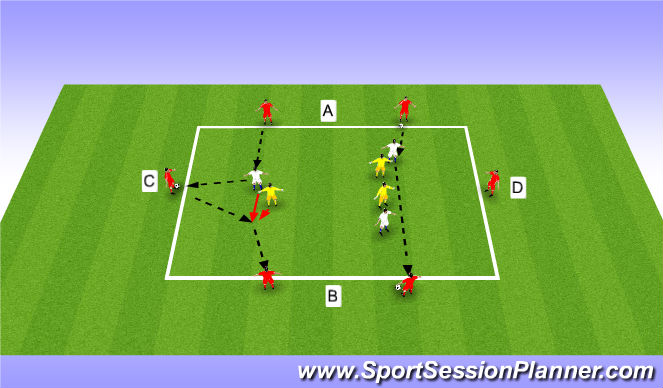
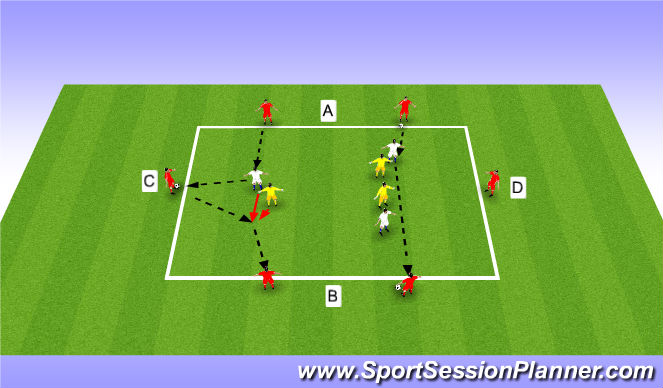
One v One Prevent Turning (15 mins)
Purpose
Players practice the art of marking, preventing their opponent turning and also when to screen a forward pass and when to mark tightly
Organisation
Create a square 20x20 yards.
Split players into 6 red, 3 yellow and 3 white.
Place red players on the outside of the square - inside the square players work in pairs - 1 Blue attacker and 1 white defender. Defenders mark 1v1.
3 Reds start play with a ball each.
Instructions
Outside Red player looks to play ball into white attacker.
White attacker attempts to get the ball to a free Red player on the other side of the square. (A/B)
Yellow defender tries to stop his opponent turning and shooting.
TRANSISTION - when the yellow gets the ball he tries to play the ball to a spare Red player.
Attackers score by getting the ball from one red to the opposite one. Defenders counter and score by winning the ball and finding a free red to pass to.
Change defenders, attackers and outside players periodically.
No red player can be in possession of more than one ball at a time.
Progressions
1. White attackers can lend the ball to a free Red on the adjacent side C or D and Yellow defender must track the ball a) to stop the attacker receiving the ball back or b) to stop him scoring.
2. Red players can now pass directly from one side of the square to the other side (C/D). Defenders must position themselves to screen/intercept this pass, as it is a priority rather than tight marking. Once the pass goes back to the White attacker from C or D, he can then press and complete - stopping the attacker receiving the ball and stopping the attacker scoring by getting the ball to a red player on A or B.
Coaching Points
Can you stop the attacker turning?
Can you decide when to mark the attacker tightly or when to mark him loosely and travel as the ball travels?
Can you see the attacker and the ball most of the time?
Can you prioritise when to screen and intercept passes, and when to mark the attacker tightly?
When critically defending, can you tackle, block, slide or disturb the ball or attacker?
When you regain possession, be clinical by finding a free red player with your pass.