
Football/Soccer Session (Beginner): Striking the Ball

Football Life
Louis Baron

Description
Session Objective: To give players a better understanding on how to strike/pass the ball using different parts of each foot.
Level:
- U8+
Principle of Play:
- Passing and Support
- Creating Space
- Penetration
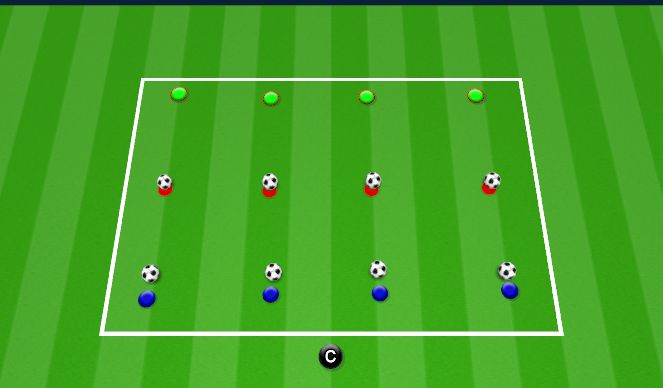
Part 1: Cone Strike (Engage - 10-15 mins)
- This is an unopposed skill practice/into designed to help players develop their passing/striking accuracy and technique, using different parts of each foot.
Part 2: Shooting Bingo (Educate - 15-20 mins)
- This is an unopposed skill practice designed to help players take what they've learned in the Cone Strike Game and apply it when striking at goal. This practice also helps players dribble, utilising different skill and tricks.
- With the bingo element of the game, this practice encourages players to develop striking the ball with different parts of each foot.
- This is an opposed (tackling allowed) small-sided game (4v4 or 5v5 plus goalkeepers) that gives players an opportunity to explore the core skill of 'striking the ball' in a proper game setting.
- This game challenges players to explore different actions when striking the ball e.g., first time shots, shooting with the inside or outside of the foot, shooting after dribbling past an opponent, etc.
See the guidance at the top of this page to understand why you are not seeing interactive Football/Soccer images.

See the guidance at the top of this page to understand why you are not seeing interactive Football/Soccer images.
20 mins
OVERVIEW:
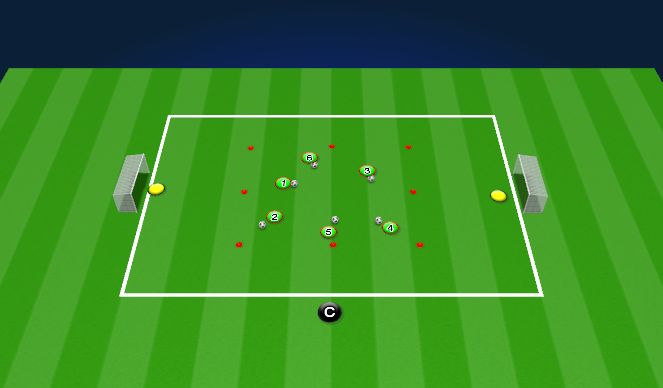
- Setup a 35 x 25 approx. pitch with two goals and an area in the middle (approx. 15 x 15). You can play with or without goalkeepers.
- Have all players with a ball each and each player is given a number (see diagram).
- Have players dribble the ball inside the middle area using different skills, dribbling at different speeds and changing direction often.
- After 15-20 seconds, the coach calls out two different number and these players dribble as fast as they can outside the middle area to attempt to score in one of the goals. Once they have taken their shot, they retrieve their ball and dribble back into the middle area. This cycle repeats for approx. 5-7 mins.
- Make sure all players get plenty of repetition.
- To add competition, set up the game to be based around the first player to score with their inside, outside and laces/instep on both feet to win!
- Use a whiteboard with each type of shot listed. For example: Right-foot: inside, outside, laces/instep, and Left-foot: inside, outside, laces/instep. Get players to tick off each one after they have scored that particular goal. If no player manages to score all the different goals, the player who manages to mark off the most win!
COACHING DETAILS:
Body Shape when Striking the Ball:
- Reiterate the same coaching points as before (Cone Strike) with the additional coaching details: when striking a moving ball, it's important to place your standing foot slightly in-front of the ball (still approx. 6 inches to the side of the ball). When players place their standing foot right next to a ball that's moving away from them, by the time they actually strike the ball the ball is out in-front of their striking foot (instead of next to their striking foot). This often results with players stretching/leaning back to compensate, thereby reducing the power & accuracy of the shot.
- Encourage players when
Scanning:
- Scanning is when players become aware of their surroundings by keeping their eyes up and by checking over each shoulder. By scanning players become aware of... space to run into or exploit, teammate(s) in space, defenders to avoid, goal-scoring opportunities etc. Scanning is super important but often neglected, so encourage players to scan constantly whilst dribbling in the middle area.
PROGRESSIONS:
- Add defenders in-front of each goal who can prevent the attacker from being able to score.
REGRESSIONS:
- Add more goals and don't have goalkeepers to make it easier for players to practice their ball striking technique. You might run the first round without goalkeepers and then the following round(s) with goalkeepers.
See the guidance at the top of this page to understand why you are not seeing interactive Football/Soccer images.
30 mins
OVERVIEW:
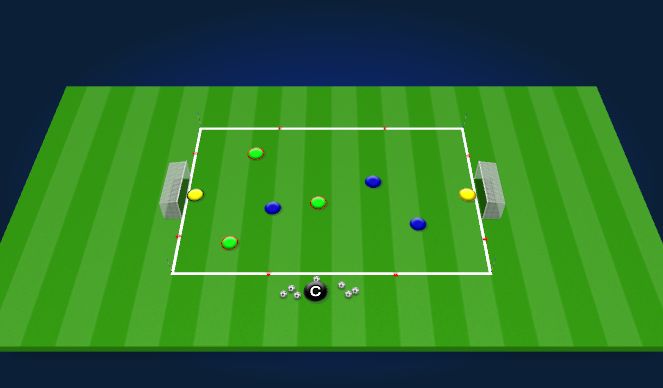
- Setup a small player area approx. 35 x 25 with goals either end.
- Have two even teams with either goalkeepers or rush defenders i.e. defenders that act like goalkeepers. This is 3v3 or 4v4 or 5v5 small-sided game.
- Have a whiteboard in the middle of the pitch with you (the coach) with different types of finishes/goals listed on it such as: power shot, curled shot, first-time shot, right-foot shot, left-foot shot, volley, half-volley, even headers.
- Each team has to try and tick off as many of these different finishes/goals throughout the game.
- Points: teams score 1 point for a goal. The team that manages to tick off the most goals listed on the whiteboard is awarded 3 bonus points at the end of the game. The team with the most points wins!
COACHING DETAILS: When playing proper small-sided games, it's important for coaches to 'coach on the run'. This means only stopping the flow of the game if it's absolutely necessary e.g., when wanting to stress a coaching point that's relevant to the objective of the training session. For example, if your training session is focusing on 'running with the ball', then you'd only interrupt the flow of the game when wanting to coach a key aspect of running with ball. Additionally, coaches shouldn't stop the game (approx. 25-30mins in duration) more than 2-3 times (approx. once every 10mins). Players just want to play the game! So let them play, offering the majority of your coaching points 'on the run'.
Body Shape when Striking the Ball &
Scanning.
- Reiterate the same coaching points as above.
Principles of Play: It's also important to coach kids the 'Principles of Play' (POP) during their small-sided games. Like every sport, Football (Soccer) is built on certain principles that should inform and shape our coaching sessions. For a helpful summary of the Principles of Play, please refer to your Club Coaching Handbook. For this session, focus on the following Principles:
Attacking Principle:
- Width: when coaching younger kids you will need to constantly teach them to not bunch up. All young players tend to follow the ball instead of look for pockets of space. This is why coaching the Attacking Principle of width or stretching the play –horizontally/laterally across the pitch & vertically up the pitch – is so important. The idea of width is to make the pitch big, which often creates gaps to play through. At this age group keep it simple by constantly (and patiently!) encouraging the team in possession of the ball to maintain good width and shape i.e., not bunching up. Tip: Before (and After if need be) each training session, use a mini white board or tactics board to help your players visualise the principle of width. A good visual aid says a thousand words.
Defending Principle:
- Press/Pressure: one of the key defensive principles in football (soccer) is pressing. Pressing is when the defending team (out of possession) applies pressure on the attacking team (in possession). At this age, encourage the closets defending player to press/apply pressure on the attacker who has the ball. Encourage them to follow the 3 'S' pressing approach: Speed / Surf / Steal. The pressing player is to approach the attacker with Speed. This will cause the attacking player to panic. Then the pressing player is to get into a Surfing body position (side on). This makes it harder for the attacker to dribble past them. As the pressing player then waits for an opportunity to Steal to ball from the attacking player.
YouTube Video

 Play animation
 Play step-by-step
 Repeat (toggle)
 Full Screen
 Pause
Pause Stop
Stop
10 mins
OVERVIEW:
COACHING DETAILS:
Body Shape when Passing/Striking the Ball:
- Players are to approach the ball on a slight angle, never straight on. This helps kids eliminate "toe-bashing".
- Players are to place their standing foot (none striking foot) approx. 6 inches next to the ball. Their standing foot is to point at their target – in this case the Target Cone.
- Players are to bend their standing leg to maintain good balance when passing/striking the ball.
- Players are to keep their chest over the ball with their eyes fixed on the ball throughout the passing movement.
- For beginners, players are to learn to pass/strike the ball using the inside of their foot. This increases pass accuracy.
- As coaches it's very important to repeat these coaching details over and over without becoming impatient. Make sure to encourage all players no matter their skill level.
PROGRESSIONS:- Have players use their weaker/less dominant foot. This is especially important for players who are more skilled at using their stronger/more dominant foot.
- Have players use different parts of their foot – inside, outside, laces/instep.
- Have players stand further from the Target Cone.
REGRESSIONS: