


Football/Soccer Session (Academy Sessions): Attacking in Attacking Half - Advance the Ball or Keep the Ball


Premier Users' Club
Stephen Reed
Profile Summary

| Name: | Stephen Reed |
|---|---|
| City: | Denver |
| Country: | United States of America |
| Membership: | Adult Member |
| Sport: | Football/Soccer |

Description
TRAINING SESSION OBJECTIVE: Increase players decision making and ability to maintain possession or advance the ball in the attacking half
Team Name/Age Group: U11-14 Girls Competitive
Coach Name:
Location: Outdoor Turf
Date:
Number of Players: 14-16
Equipment Needed: two big goals and mini goals
Weekly Structure: Countertopics
Session Duration: 75 minutes
What (Game Moment): Attacking
Where: Attacking half
When (Phase/Moment of the Game): Attacking - Creating Chances and Scoring
Who (Focus Roles): 7,9,11 & 6,8,10
Why (Objective): Advance the ball or keep the ball
Reference each Learning Plan for the definitions of the desired behaviors for Coaching Points (delete this when creating the session).
Main Principle 1: Create Attacking Shape
Sub-Principle 1: Create appropriate height, width, depth
Player Action 1: Scanning
CP's
What: Off the ball players identify pressure on ball carrier and space available to provide support
When: Make coaching points at planned stoppages. Look to reinforce in the flow. If CP's aren't able to paint picture you can freeze.
How: If introducing, you may need to demo and/or instruct. If it's review or you're trying to get them to recall, look to use guided questions.
Player Action 2: Supporting
What: After recognizing pressure on the ball, players in range of support should take action to provide support to help ball carrier escape pressure or provide support ahead of ball carrier if they can face forward with time and space
When: Make coaching points at planned stoppages. Look to reinforce in the flow. If CP's aren't able to paint picture you can freeze.
How: If introducing, you may need to demo and/or instruct. If it's review or you're trying to get them to recall, look to use guided questions.
Player Action 3: Adapting body shape
What: When players are able to get into an appropriate position to support, can they face their body in a direction that opens them up to the field or their options (ideally forward)
When: Make coaching points at planned stoppages. Look to reinforce in the flow. If CP's aren't able to paint picture you can freeze.
How: If introducing, you may need to demo and/or instruct. If it's review or you're trying to get them to recall, look to use guided questions.
See the guidance at the top of this page to understand why you are not seeing interactive Football/Soccer images.
See the guidance at the top of this page to understand why you are not seeing interactive Football/Soccer images.
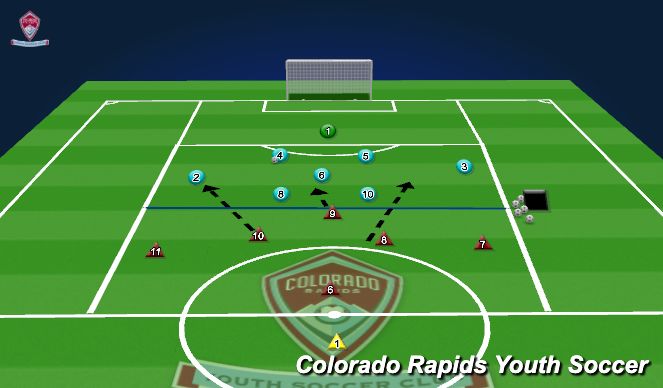
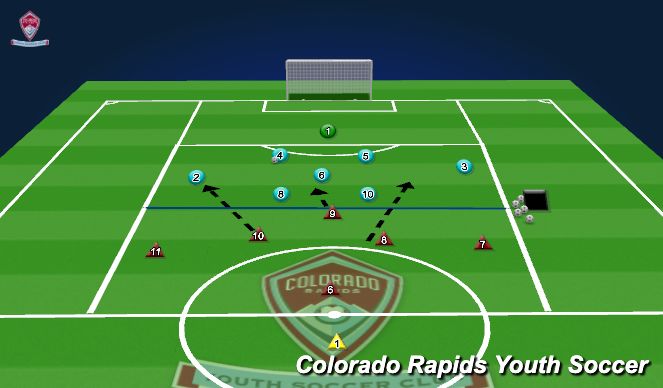
7v8 modified rondo to endline
Learning Activity: Modified Game Form
Activity Objective: Introduce CP's and principles in a directional setting.
Number of players/opponents: 7v8
Size/Shape of Field: 44w x 36 (top of 18 to half line)
Methods of Scoring: have to dribble across the endline to score
Total Activity Duration: 15 minutes
Active Duration: Rest Duration 2:30 on: 1:00 off
Number of Sets: 3-4
Activity Rules (KIS KIS): only three players can press in A 1/2 on out of possession team (they don't HAVE to) - team in possession can go in any grid
Restarts: loose lines or from coach
Additional Restraints/Constraints/Restrictions/Rewards: GK can only be used as support in possession
Formation & Player Roles: positional/relational - not field/game specific, you're just creating positional relationships
Coaching Points
Player Action 1: Scanning
What: Off the ball players identify pressure on ball carrier and space available to provide support
When: Make coaching points at planned stoppages. Look to reinforce in the flow. If CP's aren't able to paint picture you can freeze.
How: If introducing, you may need to demo and/or instruct. If it's review or you're trying to get them to recall, look to use guided questions.
Player Action 2: Supporting
What: After recognizing pressure on the ball, players in range of support should take action to provide support to help ball carrier escape pressure or provide support ahead of ball carrier if they can face forward with time and space
When: Make coaching points at planned stoppages. Look to reinforce in the flow. If CP's aren't able to paint picture you can freeze.
How: If introducing, you may need to demo and/or instruct. If it's review or you're trying to get them to recall, look to use guided questions.
Player Action 3: Adapting body shape
What: When players are able to get into an appropriate position to support, can they face their body in a direction that opens them up to the field or their options (ideally forward)
When: Make coaching points at planned stoppages. Look to reinforce in the flow. If CP's aren't able to paint picture you can freeze.
How: If introducing, you may need to demo and/or instruct. If it's review or you're trying to get them to recall, look to use guided questions.
See the guidance at the top of this page to understand why you are not seeing interactive Football/Soccer images.
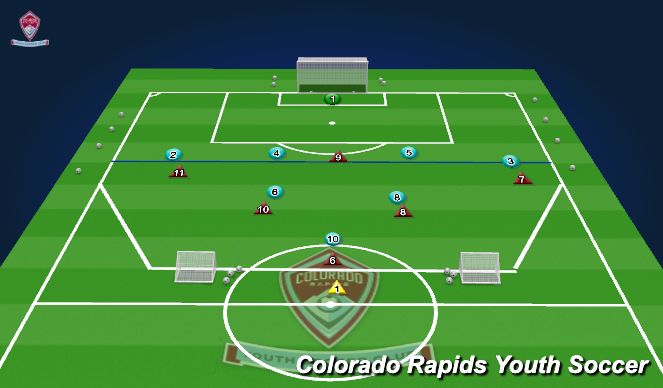
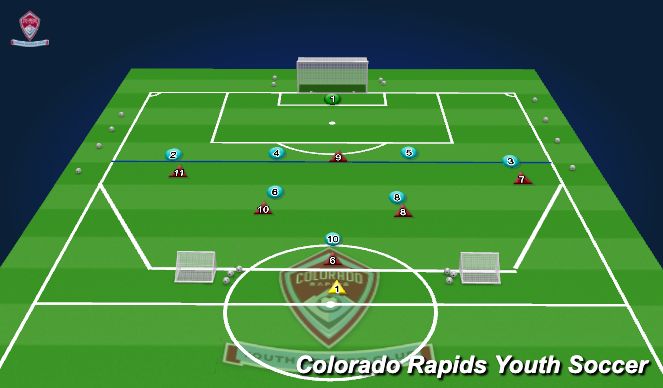
6v8
Learning Activity: Game Form
Activity Objective: Implementation of decision making to go forward or change the point of attack from players in a game like setting
Number of players/opponents: 6v8
Size/Shape of Field: 45x70 w/ blocking out wide channel slightly for missing players/roles
Methods of Scoring: If focus team gets a shot on frame from inside the 18, it's 1 point. If they score from inside 18, it's 3 points.
Total Activity Duration: 22 minutes
Active Duration: Rest Duration 4:00 on/ 2:00 off
Number of Sets: 4
Activity Rules (KIS KIS): Game rules w/ exception to scoring rules above
Offside line is where the blue line is set (roughly 25 yards out, adjust as needed, only for the focus team)
Restarts: Game rules
Formation & Player Roles: 4-3-3, focus team playing w/ midfield line and attacking line
non-focus team playing with back line and midfield
Rotations (substitutions): rotate midfield players between sets
rotate GK's between sets
Coaching Points
Player Action 1: Scanning
What: Off the ball players identify pressure on ball carrier and space available to provide support
When: Make coaching points at planned stoppages. Look to reinforce in the flow. If CP's aren't able to paint picture you can freeze.
How: If introducing, you may need to demo and/or instruct. If it's review or you're trying to get them to recall, look to use guided questions.
Player Action 2: Supporting
What: After recognizing pressure on the ball, players in range of support should take action to provide support to help ball carrier escape pressure or provide support ahead of ball carrier if they can face forward with time and space
When: Make coaching points at planned stoppages. Look to reinforce in the flow. If CP's aren't able to paint picture you can freeze.
How: If introducing, you may need to demo and/or instruct. If it's review or you're trying to get them to recall, look to use guided questions.
Player Action 3: Adapting body shape
What: When players are able to get into an appropriate position to support, can they face their body in a direction that opens them up to the field or their options (ideally forward)
When: Make coaching points at planned stoppages. Look to reinforce in the flow. If CP's aren't able to paint picture you can freeze.
How: If introducing, you may need to demo and/or instruct. If it's review or you're trying to get them to recall, look to use guided questions.
See the guidance at the top of this page to understand why you are not seeing interactive Football/Soccer images.
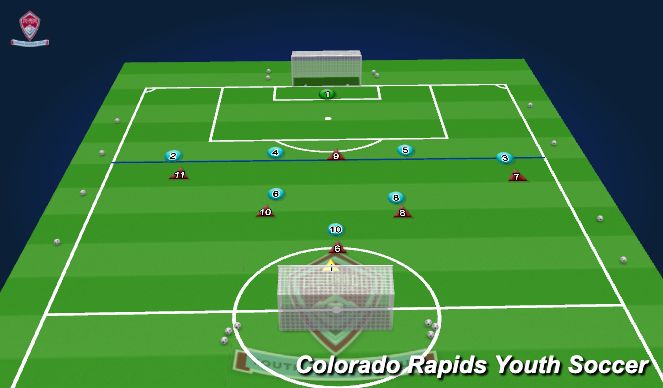
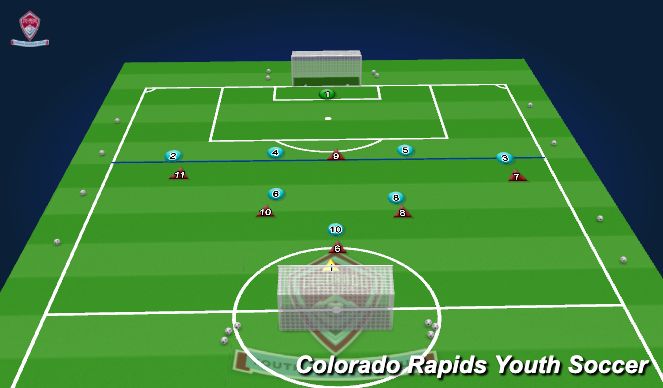
7v8
Learning Activity: Game Form
Activity Objective: Implementation of decision making to go forward or change the point of attack from players in a game like setting
Number of players/opponents: 6v8
Size/Shape of Field: 50x70 w/ blocking out wide channel slightly for missing players/roles
Methods of Scoring: game rules
Total Activity Duration: 22 minutes
Active Duration: Rest Duration 4:00 on/ 2:00 off
Number of Sets: 4
Activity Rules (KIS KIS): Game rules w/ exception to scoring rules above
Offside line is where the blue line is set (roughly 25 yards out, adjust as needed, only for the focus team)
Restarts: Game rules
Formation & Player Roles: 4-3-3, focus team playing w/ midfield line and attacking line
non-focus team playing with back line and midfield
Rotations (substitutions): rotate midfield players between sets
Coaching Points
Player Action 1: Scanning
What: Off the ball players identify pressure on ball carrier and space available to provide support
When: Make coaching points at planned stoppages. Look to reinforce in the flow. If CP's aren't able to paint picture you can freeze.
How: If introducing, you may need to demo and/or instruct. If it's review or you're trying to get them to recall, look to use guided questions.
Player Action 2: Supporting
What: After recognizing pressure on the ball, players in range of support should take action to provide support to help ball carrier escape pressure or provide support ahead of ball carrier if they can face forward with time and space
When: Make coaching points at planned stoppages. Look to reinforce in the flow. If CP's aren't able to paint picture you can freeze.
How: If introducing, you may need to demo and/or instruct. If it's review or you're trying to get them to recall, look to use guided questions.
Player Action 3: Adapting body shape
What: When players are able to get into an appropriate position to support, can they face their body in a direction that opens them up to the field or their options (ideally forward)
When: Make coaching points at planned stoppages. Look to reinforce in the flow. If CP's aren't able to paint picture you can freeze.
How: If introducing, you may need to demo and/or instruct. If it's review or you're trying to get them to recall, look to use guided questions.
'%3E%3Cpath id='path4169' d='M 11.4375,70.25 C 11.457031,38.394531 37.277344,13.242188 68.253906,13.050781 99.78125,12.855469 125.73047,38.351563 125.8125,70.078125 125.89844,101.62109 100.43359,127.14063 69.148438,127.42188 37.582031,127.70703 11.464844,102.23438 11.4375,70.25 m 6.425781,-0.08984 c 0.03516,28.421871 23.027344,50.69922 50.519532,50.82031 C 96.433594,121.10156 119.30469,98.367188 119.38281,70.359375 119.45313,42.878906 97.382813,19.714844 69.015625,19.496094 40.75,19.277344 17.964844,42.035156 17.863281,70.160156' style='clip-rule:nonzero;fill:%23333f48;fill-opacity:1;fill-rule:nonzero;stroke:none' /%3E%3Cpath style='fill:%23333f48;fill-opacity:1;fill-rule:nonzero;stroke:none' d='m 39.789063,108.62109 c 0.28125,0.14454 0.550781,0.32032 0.839843,0.4336 2.734375,1.05469 5.554688,1.78125 8.453125,2.23047 2.734375,0.42578 5.484375,0.64453 8.25,0.54297 3.988282,-0.15625 7.832032,-0.94922 11.445313,-2.69532 1.683594,-0.8164 3.246094,-1.82422 4.640625,-3.07422 3.265625,-2.92578 5.171875,-6.582027 5.796875,-10.906246 0.546875,-3.761719 0.04687,-7.425781 -1.09375,-11.019531 -1.4375,-4.523438 -3.730469,-8.582032 -6.703125,-12.265625 -1.03125,-1.277344 -2.082031,-2.535157 -3.113281,-3.808594 C 66.789063,66.1875 65.332031,64.269531 64.0625,62.21875 c -1.601562,-2.582031 -2.835937,-5.316406 -3.613281,-8.261719 -0.683594,-2.574218 -0.902344,-5.1875 -0.6875,-7.828125 0.214844,-2.617187 0.910156,-5.117187 2.152344,-7.441406 2.164062,-4.050781 5.503906,-6.710937 9.816406,-8.179687 1.890625,-0.640625 3.835937,-1.058594 5.832031,-1.195313 1.121094,-0.07813 2.242188,-0.152344 3.363281,-0.164062 4.28125,-0.02734 8.4375,0.734375 12.453125,2.175781 1.871094,0.671875 3.6875,1.496094 5.523438,2.257812 0.226562,0.09375 0.4375,0.230469 0.664062,0.351563 -0.164062,0.25 -0.371093,0.160156 -0.539062,0.164062 -2.824219,0.101563 -5.535156,0.703125 -8.132813,1.804688 -1.335937,0.570312 -2.570312,1.316406 -3.648437,2.296875 -2.527344,2.296875 -3.605469,5.15625 -3.34375,8.550781 0.140625,1.855469 0.722656,3.574219 1.550781,5.222656 0.648438,1.296875 1.414063,2.523438 2.292969,3.675782 0.953125,1.25 1.929687,2.484375 2.929687,3.699218 2.085938,2.523438 4.164063,5.054688 6.050782,7.738282 2.203125,3.136718 4.140627,6.417968 5.589847,9.980468 1.16406,2.867188 2.01562,5.820313 2.39843,8.894532 0.25,2.011718 0.30079,4.03125 0.11719,6.058593 -0.24219,2.640625 -0.79297,5.195313 -1.74609,7.667969 -1.29688,3.36328 -3.300784,6.22656 -5.972659,8.63281 -2.429687,2.19141 -5.171875,3.90625 -8.109375,5.3125 -2.695312,1.29297 -5.464843,2.40235 -8.34375,3.20313 -1.953125,0.54687 -3.945312,0.8789 -5.949218,1.15625 -3.035157,0.41797 -6.085938,0.48828 -9.132813,0.3125 -5.328125,-0.3125 -10.476562,-1.46094 -15.410156,-3.52344 -3.449219,-1.44141 -6.691406,-3.25781 -9.757813,-5.39453 -0.183593,-0.12891 -0.378906,-0.25 -0.53125,-0.41016 -0.07031,-0.0703 -0.05859,-0.22656 -0.08203,-0.34375 z m 0,0' id='path4175' /%3E%3Cpath style='fill:%23333f48;fill-opacity:1;fill-rule:nonzero;stroke:none' d='M 94.699219,29.390625 C 94.089844,29.21875 93.476563,29.054688 92.867188,28.875 90.183594,28.085938 87.46875,27.441406 84.703125,27.046875 c -3.976562,-0.566406 -7.945312,-0.59375 -11.863281,0.402344 -7.535156,1.914062 -12.386719,6.71875 -14.878906,13.996094 -0.894532,2.617187 -1.179688,5.328125 -0.953125,8.078125 0.203125,2.484375 0.867187,4.859375 1.816406,7.160156 0.933594,2.261719 2.117187,4.390625 3.4375,6.449219 1.4375,2.25 3.050781,4.371093 4.640625,6.511718 1.4375,1.933594 2.867187,3.871094 4.261719,5.835938 1.230468,1.730469 2.316406,3.546875 3.273437,5.445312 1.324219,2.625 2.265625,5.378907 2.703125,8.292969 0.433594,2.902344 0.292969,5.765625 -0.660156,8.5625 -0.9375,2.74609 -2.574219,5.00781 -4.777344,6.875 -2.417969,2.04688 -5.203125,3.39844 -8.246094,4.22266 -1.835937,0.5 -3.703125,0.75781 -5.609375,0.82031 -3.886718,0.13281 -7.679687,-0.47266 -11.421875,-1.46094 -2.261718,-0.59765 -4.488281,-1.33203 -6.695312,-2.11328 -0.207031,-0.0742 -0.40625,-0.16797 -0.597656,-0.25 -0.02344,-0.24609 0.148437,-0.19141 0.25,-0.20703 1.96875,-0.30469 3.921875,-0.67969 5.804687,-1.34766 1.367188,-0.48437 2.671875,-1.10156 3.855469,-1.94922 2.25,-1.61328 3.65625,-3.765621 4.0625,-6.515621 0.273437,-1.867188 0.09375,-3.710938 -0.429688,-5.527344 -0.472656,-1.648437 -1.171875,-3.199219 -2.109375,-4.628906 -0.792968,-1.207031 -1.636718,-2.382813 -2.523437,-3.519531 -0.921875,-1.195313 -1.921875,-2.328125 -2.890625,-3.484375 -2.753906,-3.273438 -5.351563,-6.660157 -7.523438,-10.355469 -2.042968,-3.480469 -3.667968,-7.136719 -4.597656,-11.078125 -0.640625,-2.699219 -0.980469,-5.4375 -0.832031,-8.214844 0.238281,-4.53125 1.476562,-8.78125 3.824219,-12.6875 1.082031,-1.800781 2.445312,-3.375 3.988281,-4.800781 2.742187,-2.527344 5.863281,-4.480469 9.257812,-5.992188 3.746094,-1.667968 7.652344,-2.769531 11.707032,-3.394531 3.152343,-0.488281 6.324218,-0.671875 9.507812,-0.519531 8.632813,0.410156 16.671875,2.792969 24,7.433594 0.08203,0.05078 0.152344,0.109375 0.230469,0.167968 -0.0039,0.04297 -0.0078,0.08984 -0.01563,0.136719' id='path4177' /%3E%3Cpath style='fill:%23333f48;fill-opacity:1;fill-rule:nonzero;stroke:none' d='m 31.699219,38.75 c -0.07813,0.238281 -0.152344,0.476563 -0.238281,0.710938 -1.460938,4.074218 -2.066407,8.28125 -1.808594,12.59375 0.4375,7.304687 2.808594,13.925781 7.277344,19.753906 3.714843,4.84375 7.441406,9.671875 11.167968,14.503906 1.113282,1.441406 1.953125,3.007813 2.414063,4.777344 0.332031,1.257812 0.425781,2.539062 0.273437,3.820312 -0.214843,1.832032 -1.070312,3.34375 -2.464843,4.546875 -0.984375,0.851559 -2.113282,1.449219 -3.316407,1.925779 -1.378906,0.54297 -2.8125,0.89063 -4.273437,1.1211 -2.226563,0.35547 -4.46875,0.46093 -6.722656,0.41015 -0.589844,-0.0156 -1.046875,-0.18359 -1.433594,-0.625 -0.636719,-0.72265 -1.335938,-1.39062 -1.9375,-2.14062 C 25.574219,93.800781 22.300781,86.621094 20.84375,78.636719 20.152344,74.835938 19.917969,71 20.15625,67.128906 20.796875,56.773438 24.390625,47.574219 30.859375,39.480469 c 0.21875,-0.273438 0.453125,-0.53125 0.679688,-0.796875 0.05469,0.02344 0.109375,0.04297 0.160156,0.06641' id='path4179' /%3E%3Cpath style='fill:%23333f48;fill-opacity:1;fill-rule:nonzero;stroke:none' d='m 105.41016,101.30078 c -0.13282,-0.3125 0.0234,-0.5039 0.0977,-0.69922 1.38672,-3.749997 1.98047,-7.628904 1.89844,-11.621091 -0.14453,-6.84375 -2.08594,-13.144531 -5.73437,-18.925781 C 99.890625,67.226563 97.917969,64.53125 95.835938,61.917969 94.4375,60.160156 92.988281,58.4375 91.582031,56.6875 90.632813,55.511719 89.6875,54.335938 88.792969,53.121094 c -0.835938,-1.144531 -1.488281,-2.398438 -1.953125,-3.742188 -0.523438,-1.515625 -0.695313,-3.070312 -0.511719,-4.652343 0.21875,-1.839844 1.082031,-3.339844 2.476563,-4.542969 1.039062,-0.890625 2.230468,-1.507813 3.503906,-1.980469 1.632812,-0.609375 3.320312,-0.960937 5.046875,-1.175781 1.917969,-0.238281 3.839841,-0.269531 5.769531,-0.230469 0.52734,0.01172 0.89453,0.203125 1.23828,0.585938 5.50391,6.113281 9.26172,13.144531 11.21875,21.132812 1.11719,4.554688 1.5625,9.179688 1.30469,13.855469 -0.58203,10.625 -4.23438,20.082031 -10.96094,28.339846 -0.15625,0.1914 -0.32812,0.375 -0.51562,0.58984' id='path4181' /%3E%3Cpath style='fill:%23333f48;fill-opacity:1;fill-rule:nonzero;stroke:none' d='m 39.796875,108.63281 c -0.05859,0.0117 -0.117187,0.0234 -0.175781,0.0352 0.05469,-0.0156 0.113281,-0.0312 0.167969,-0.0469 z m 0,0' id='path4183' /%3E%3C/g%3E%3C/svg%3E)
 Play animation
 Play step-by-step
 Repeat (toggle)
 Full Screen
 Pause
Pause Stop
Stop
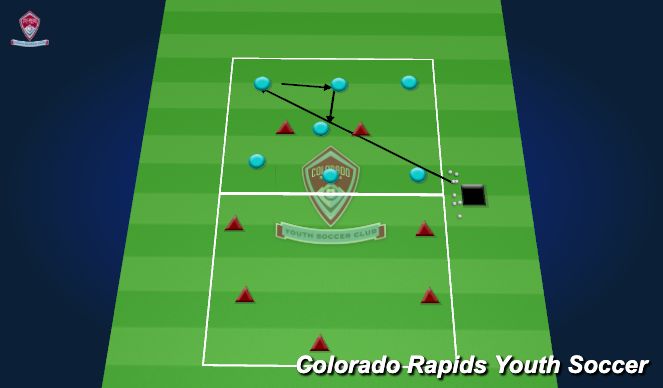
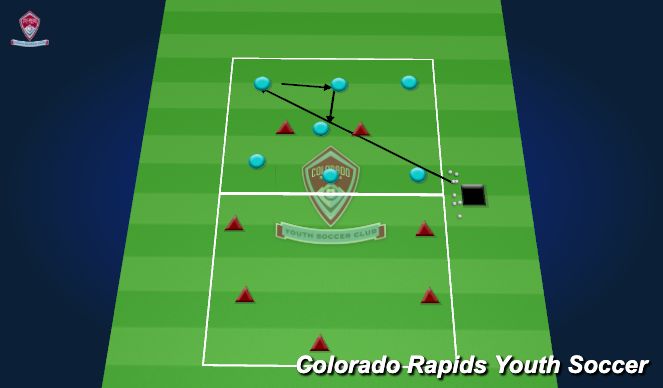
rondo warm up
Learning Activity: Non-Game Form
Activity Objective: Get players in good spirits and get their brain and bodies primed to train
Number of players/opponents: 7v7
Size/Shape of Field: 15x15 x 2 grids
Methods of Scoring: If you win the ball and connect your pass back to your team it's a point.
If you get 5 cumulative one touch passes it's a point. (cumulative, not consecutive)
Total Activity Duration: 15 minutes
Active Duration: Rest Duration pay attention to players attention - look for optimal work to rest ratios for focus
Number of Sets: 4-6
Activity Rules (KIS KIS): Play loose lines, if it's close, keep the ball rolling.
Scoring rules listed above.
Only two players can press. You can up this as needed or coach the pressing team appropriately if needed to progress or regress challenge.
Restarts: come from coach (again though, play loose lines)
Rotations (substitutions): ensure different players are "pressing"
Coaching Points
Player Action 1: Scanning
What: Off the ball players identify pressure on ball carrier and space available to provide support
When: Make coaching points at planned stoppages. Look to reinforce in the flow. If CP's aren't able to paint picture you can freeze.
How: If introducing, you may need to demo and/or instruct. If it's review or you're trying to get them to recall, look to use guided questions.
Player Action 2: Supporting
What: After recognizing pressure on the ball, players in range of support should take action to provide support to help ball carrier escape pressure
When: Make coaching points at planned stoppages. Look to reinforce in the flow. If CP's aren't able to paint picture you can freeze - shouldn't need to do this in the warm up though.
How: If introducing, you may need to demo and/or instruct. If it's review or you're trying to get them to recall, look to use guided questions.
Player Action 3: Adapting body shape
What: When players are able to get into an appropriate position to support, can they face their body in a direction that opens them up to the field or their options (away from pressure)
When: Make coaching points at planned stoppages. Look to reinforce in the flow. If CP's aren't able to paint picture you can freeze.
How: If introducing, you may need to demo and/or instruct. If it's review or you're trying to get them to recall, look to use guided questions.