
Football/Soccer Session (Academy Sessions): RHS Junior Boys Premier-Field Zoning-Analysis of Formation (Start Time: 2022-04-21 15:25:00)

Premier Users' Club
Chong Feng

Description
Session Objective: Understand how the pitch could be divided into different zones in relation to attacking and defending
People:
Equipment:
Environment:
See the guidance at the top of this page to understand why you are not seeing interactive Football/Soccer images.

See the guidance at the top of this page to understand why you are not seeing interactive Football/Soccer images.
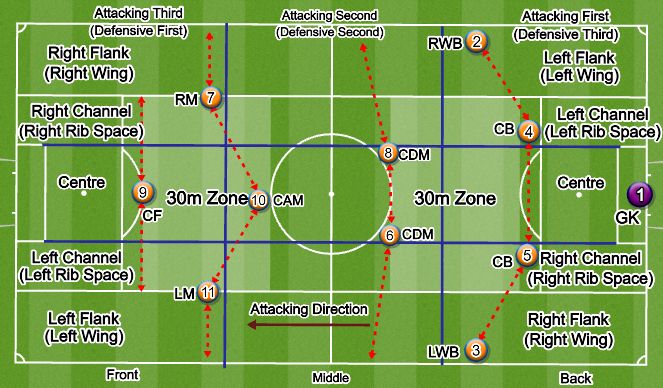
Organisation: Field Horizontal Zones
Explanation:
The two teams apply the flank and channel areas in direct diagonal angles respectively during attacks.
See the guidance at the top of this page to understand why you are not seeing interactive Football/Soccer images.
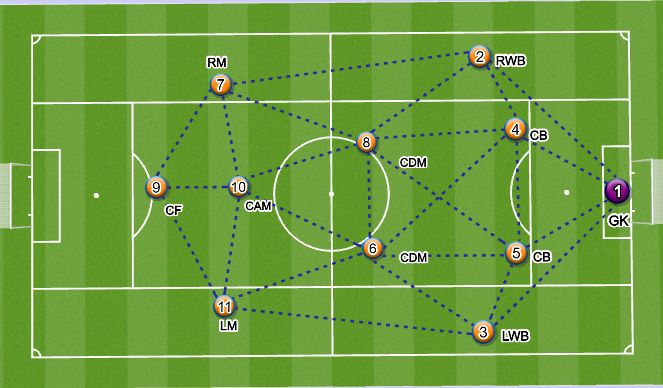
Organisation: The Four Lines of Team Formation: 4-2-3-1
Explanation: Analysis of Formation
The 4-2-3-1 formation is a very popular formation which has been used by many coaches around the world. It is a formation with a lot of advantages either for attacking or for defending.
There are four lines and distance between each line should maintain between 15m and18m.
See the guidance at the top of this page to understand why you are not seeing interactive Football/Soccer images.
Organisation: Strong Points (Advantages)
Explanation:
- Full cover of all spaces with many players;
- Sufficient attacking and defending organisation;
- Short distances between players;
- Pairs on the wings;
- Strong support to defence with two defensive midfielders;
- Triangle and diamond shaped passing links between players to create consistent overload.

See the guidance at the top of this page to understand why you are not seeing interactive Football/Soccer images.
Organisation: Zoning for Attacks
Explanation: What should the players in different zones do when having the ball. To improve the team's attacking play, each zone of the fieldhas specific instructions for the players:
- Flank Holding Zone: Players on both sides of thefield should aim to maintain possession of the ball and pass to players in thePrimary Attacking Zone or Flank Assisting Zones.
- Primary Holding Zone: Players in this zone shouldalso focus on maintaining possession and passing to players in the PrimaryAttacking Zone, Flank Assisting Zones or Score Zone 2.
- Flank Assisting Zone: Players in these zones shouldaim to distribute the ball to the Primary Attacking Zone or Score Zone 2/1. If the passing optionto the middle is not available, they can cut into the Primary Attacking Zone orpass to players in the Flank Attacking Zone.
- Primary Attacking Zone: Players in this zone shouldtry to pass the ball to players in Score Zone 2 or Score Zone 1 for scoring opportunities. Theycan also attempt long shots if they reach the area near the arc on Score Zone2.
- Flank Attacking Zone: Players in these zones shouldtry to pass to players in Score Zone 2 for scoring opportunities. If that isnot possible, they can pass to players in the Primary Assisting Zone or dribbletowards it. If there is space, they can cut into Score Zone 2 for a shot.
- Primary Assisting Zone: Players in these zones maynot have a clear shot angle, but they can cross the ball to players in ScoreZone 1 or Score Zone 2 for a better chance at scoring.
By following these instructions, the team can create morescoring opportunities and improve their overall attacking play.
See the guidance at the top of this page to understand why you are not seeing interactive Football/Soccer images.
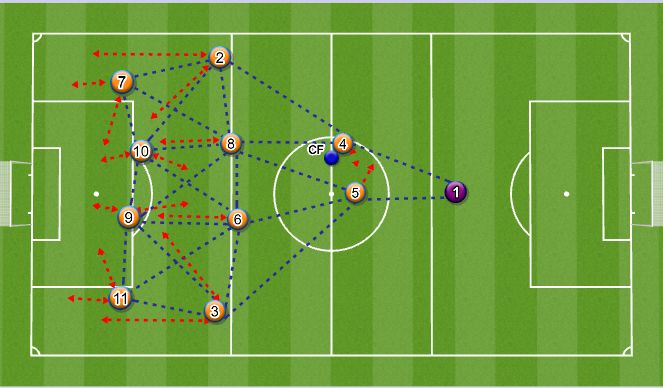
Organisation: Attack Transformation 2-4-4 (One Opposing Forward)
Explanation:
In the attacking phase, the 4-2-3-1 formation can switch to2-4-4 or 3-4-3, depending on the number of strikers in the opposing team. Ifthere is only one opposing striker, two defenders will stay back with the highpressing GK to create an overload and prevent counter-attacks.
The two CBs will remain compacted in the middle, with onemarking the opposing CF and the other dropping deeper at a staggered angle toprovide cover and stay closer to the GK. The CB marking the opposing CF shouldalways close down the path from the opposing CF to the wing side if the WB onhis side has pushed up to assist attacks. The man-marking CB will only allowthe opposing CF to stay in the middle space between himself and the covering CBproviding covers. Even if the ball is passed to the CF, the two CBs couldquickly close the space in the middle to stop the CF from running to the spacebehind the defensive line.
The two attacking midfielders on both flanks will pushhigher to the each side of the box and act more like attacking wingers, whilethe CAM will push higher to the front of the box as the second striker. The twoWBs will also push up to the opponent's half and become the second pair ofwingers to provide attacking reinforcement on both wings. This creates a formationwith two pairs on the wings.
The two pairs of wingers will constantly rotate and switchpositions vertically on both flanks to draw the defenders out from the middleand find opportunities to either cross the ball to the strikers in the middleor cut into the middle finding opportunities to shoot. The two CDMs will act astwo CAMs to distribute the balls to the sides or to the middle, and they canalso find opportunities to take long shots in the area near the arc on the topof the box.

See the guidance at the top of this page to understand why you are not seeing interactive Football/Soccer images.
Organisation: Attack Transformation 3-4-3 (Two Opposing Forwards)
Explanation:
In a scenario where there are two opposing forwards, a teamwill deploy three defenders in their own half to maintain an overload. Theholding CDM will drop in the middle of the two CBs to create a defensive linewith three CBs. By doing so, the CDM can create diagonal angles with the twoCBs and play as a sweeper to maintain a closer distance with the high pressingGK, providing protection to the space between the defensive line and the GK.
If one of the CBs loses a 1v1 duel, the CDM providing coverin the middle must step up and impose pressure on the opposing CF. The CB willrun to the back of the CDM to provide cover while the other CB slides to themiddle to prevent the ball from being passed through the gap to the back of thedefensive line.
On the attacking front, the two attacking midfielders onboth flanks push higher towards each side of the opponent's box, acting morelike attacking wingers. The CAM shifts to the other side of the CDM, usuallythe B2B player, creating two CAMs who can distribute the ball to the flanks orthe middle. They can also take long shots from the area near the arc on the topof the box.
The two WBs will push up to the opponent's half, becomingthe second pair of wingers to provide attacking reinforcement on both wings.The two pairs of wingers will rotate and constantly switch positions verticallyon both flanks to draw defenders out from the middle. This creates anopportunity to either cross the ball to the CF in the middle or cut into themiddle, finding opportunities to shoot.
The CF will need to drop deep to receive, hold anddistribute the ball. Running in a "fish hook" pattern can help avoidpossible offside traps.

See the guidance at the top of this page to understand why you are not seeing interactive Football/Soccer images.

Organisation: Defence Transformation from 2-4-4 to 4-2-3-1/4-5-1 (Animation)
Explanation:
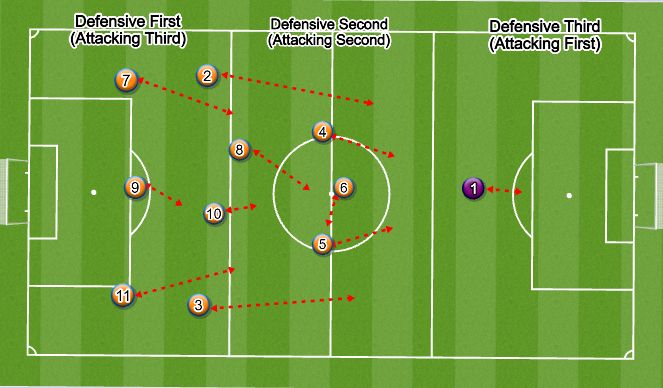
When transitioning from attacking to defending in the 2-4-4formation, the focus is on the Defensive First, Defensive Second, and DefensiveThird zones. If the team loses possession of the ball in the Defensive First ortop half of the Defensive Second, they should quickly switch to a 4-2-3-1formation to create four defensive lines and try to regain possession in thoseareas.
The CF should drop back and pressure the opponents as thefirst defensive line in the Defensive First area. The RM, LM, and CAM shoulddrop back to create the second defensive line at the top line of the DefensiveSecond. The two CDMs should drop back to create the third defensive line in themiddle line of the Defensive Second. The two WB and two CBs should drop back tocreate the fourth defensive line in the bottom half of the Defensive Second,with the WBs staying higher than the CBs and between the two CDMs and two CBsto prepare for possible counterattacks.
It's crucial for players in each defensive line to bestaggered and block the passing lanes through the gaps in each line.
See the guidance at the top of this page to understand why you are not seeing interactive Football/Soccer images.
Organisation: Defence Transformation from 3-4-3 to 4-2-3-1/4-5-1 (Animation)
Explanation:
When playing in a 3-4-3 formation, if the team losespossession in the Defensive First or the top half of the Defensive Secondduring an attacking phase, they could quickly switch to a 4-2-3-1formation.This will create four defensive lines to try and regain possession in the sameareas.
The player closest to the opponent with the ball shouldimmediately apply pressure to try and win the ball back, or at least slow downthe opponent's counter-attack. The CF will need to drop back and remain in the Defensive First to act as the first line of defence.
The RM, LM, and CAM should drop back to the top line of the Defensive Second, while the B2B CDM drops down and the holding CDM steps up to the middle line of the Defensive Second to create the third defensive line.
The two WB and the two CBs drop back to the bottom half ofthe Defensive Second to create the third defensive line. The WBs should stayhigher than the CBs to be ready for possible counterattacks.
It is crucial that each defensive line maintains staggeredpositions to block passing lanes through the gaps in the defence.

See the guidance at the top of this page to understand why you are not seeing interactive Football/Soccer images.
Organisation: Defence Transformation from 4-2-3-1 to 4-4-2 (Animation)
Explanation:
If the opposing team is in possession of the ball and hasadvanced into the bottom half of the Defensive Second, the team should quicklytransform to a 4-4-2 formation while dropping deeper to the bottom half of theDefensive Second and the top half of the Defensive Third. This will createthree defensive lines and help the team try to regain possession in the bottomhalf of the Defensive Second or the top half of the Defensive Third.
In this formation, the CF needs to drop back further to thehalfway line, while the CAM drops back to his side to create the firstdefensive line. The RM, LM, and the two CDMs should drop back to the top lineof the Defensive Third to create the second defensive line. The two WB and thetwo CBs need to drop back to the top half of the Defensive Third in front ofthe box to create the third defensive line.
It's important that the players in each defensive line stayin staggered positions to block passing lanes through the gaps in eachdefensive line.
This formation will allow the team to quickly initiatecounter attacks as soon as possession is regained in this area. The team canthen transform back to a 4-2-3-1 and then a 3-4-3 or a 2-4-4 while pushing upto the opponent's half to attack. If the team regains possession in the bottomhalf of the Defensive Second or the top half of the Defensive Third, theformation can be transformed back to 3-4-3 or 2-4-4 while pushing up to theopponent's half to attack. The CF can move forward to the top line of theattacking third and the CAM can move forward to support the CF. The RM and LMcan push up to the top line of the attacking third as well, while the B2B CDMcan move up to support the attack. The Holding CDM can stay back in the middleline of the Defensive Second to provide cover. The two WB and the two CBs canmove up to the middle line of the Defensive Second to provide width for theattack. It is important that the team maintains proper spacing and coordinationto create scoring opportunities while minimizing the risk of conceding acounter-attack.

 Play animation
 Play step-by-step
 Repeat (toggle)
 Full Screen
 Pause
Pause Stop
Stop
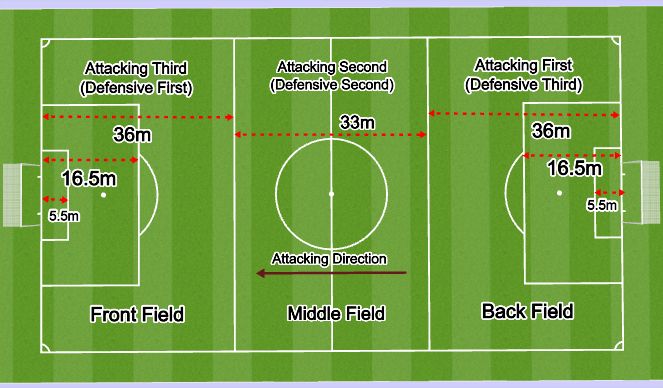
Organisation: Field Vertical Zones
Explanation:
The dimensions of football fields could be varied, especially the field for youth are normally smaller than the fields for adults. The dimension we are referring here is 105mx68m which is the standard size for World Cup matches.