
Football/Soccer Session (Academy Sessions): UEFA B Creating and Exploiting the Overload

Premier Users' Club
Kevin Leal

Description
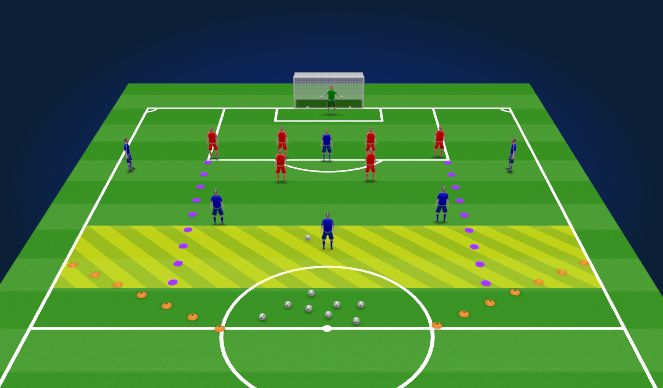
Organisation (Practice Layout & Transition)
See the guidance at the top of this page to understand why you are not seeing interactive Football/Soccer images.
See the guidance at the top of this page to understand why you are not seeing interactive Football/Soccer images.
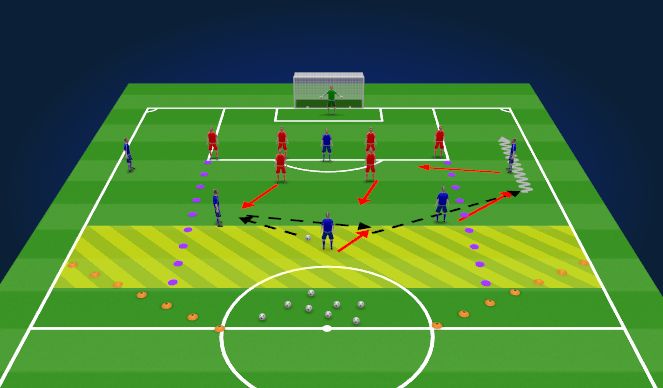
Screen 2
Example of Wide Overload
The midfielders on the opposite side of where the overloads exchange passes to drag the middle 2 defenders forward, and subsequently play a pass out wide to the midfielder who is creating an overload out wide due to their overlapping run and the wingers inverted run across the defending full-back.
See the guidance at the top of this page to understand why you are not seeing interactive Football/Soccer images.
Screen 3
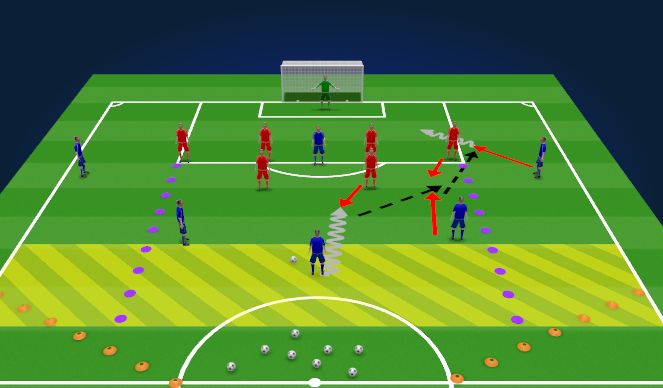
Creating and Exploiting the Overload Centrally
Traveling with the ball forward from the midfield can get the attention of the red defending midfielder nearest to the football. When the player is dragged out of position, the midfielder passes to the inside midfielder on the side where the team is creating a numeric advantage. Once the full-back is tasked with closing the space for the midfielders shot, the midfielder can instead make a pass to the winger who is making an inverted run to get inside the box to have a chance at goal.
See the guidance at the top of this page to understand why you are not seeing interactive Football/Soccer images.
Screen 4
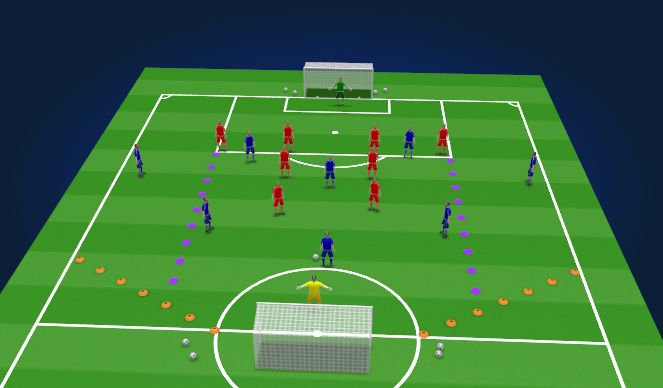
Creating and Exploiting the Overload
Small Sided Game
Task - Each team is tasked with creating and exploiting overloads, both centrally and out wide, in a small sided game as a primary method of chance creation. Subsequently, each team is also tasked with defending the overload when not in possession.
Problem - Each team has an equal starting number of players and no natural overloads exist.
Solution - Aim to create an overload centrally or out wide by focusing on player movement off of the ball, given trigger movements of teammates. Ie, if the winger inverts their run, the full-back makes an overlapping run around them.
What if - The defense aims to shut down the central zones forcing the attack in the wide spaces. Can the team recognize the space available and use this to their competitive advantage immediately?

 Play animation
 Play step-by-step
 Repeat (toggle)
 Full Screen
 Pause
Pause Stop
Stop
Screen 1
Creating and Exploiting Overloads
Session Specific Training
Task - The blue attacking team is tasked with creating overloads both centrally and out wide, in order to, create chances in the final third. If the red defending team regains possession of the ball following a turnover, they are tasked with trying to get the ball into the end zone by either dribbling or receiving a pass inside the zone. Subsequently, if blue loses possession, they transition into defense for this.
Problem - The red defending team have a numeric advantage with the goalkeeper, being 7v6.
Solution - Having the defenders commit to marking can drag them out of positions, use clever movements and scanning to recognize which overloads you can create and where. This can take form in overloads out wide, where a winger either inverts there or continues it out wide, where as, the respective full-back would subsequently perform an overlapping or underlapping run.
What if - The red defending team keep a compact low block on top of the box and do not over commit to pressing and man-marking but rather maintaining their shape and lines. Can we create and exploit overloads in the wide areas to adapt to this situation?