


Football/Soccer Session (Academy Sessions): 1v1's / Dealing with crosses S3


FAW Coach Ed
Lestyn Farley
Profile Summary

| Name: | Lestyn Farley |
|---|---|
| City: | Neath |
| Country: | United Kingdom |
| Membership: | Adult Member |
| Sport: | Football/Soccer |

See the guidance at the top of this page to understand why you are not seeing interactive Football/Soccer images.
See the guidance at the top of this page to understand why you are not seeing interactive Football/Soccer images.
Screen 2
Key Factors
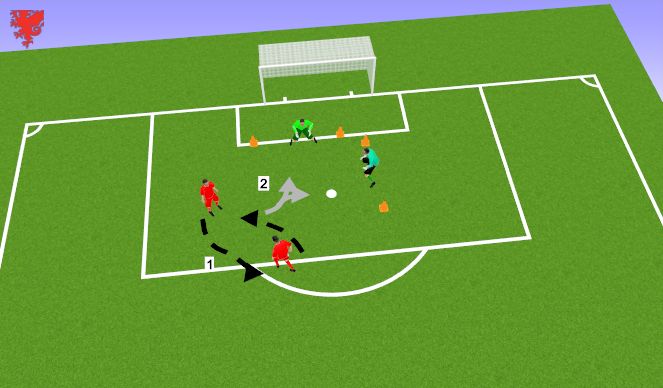
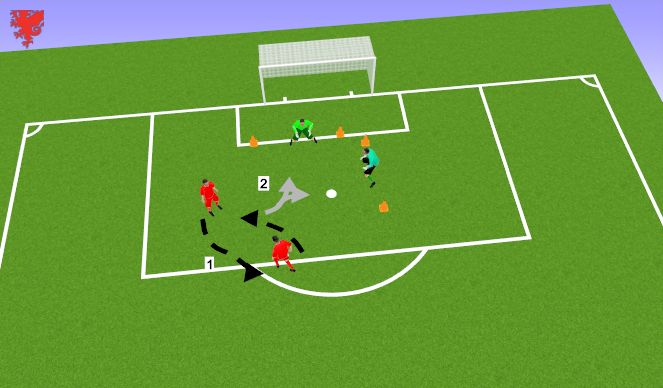
This exercise is set up as a competitive exercise and is similar to the warm up. However this time there are two working goalkeepers with two separate goals (8 yards in width). The two goalkeepers will be allowed to approach the two servers off of their line. The two servers will begin by passing amongst each other until the coach calls out either goal 1 or 2. The server who has the ball then has 5 seconds to dribble the ball around the chosen goalkeeper into the goal. In this exercise the GKs have a choice and are meant to judge for themselves whether they have to perform a block save or a diving at feet save.
Organisation
4 cones ( 2 goals, 8 yards apart)
2 working GKs
2 Servers
1 ball
See the guidance at the top of this page to understand why you are not seeing interactive Football/Soccer images.
Screen 3
Key Factors
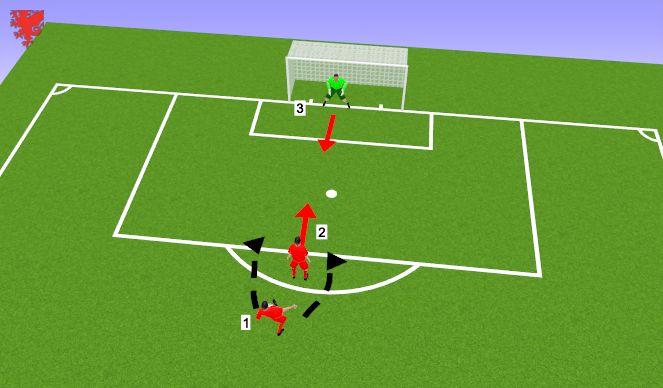
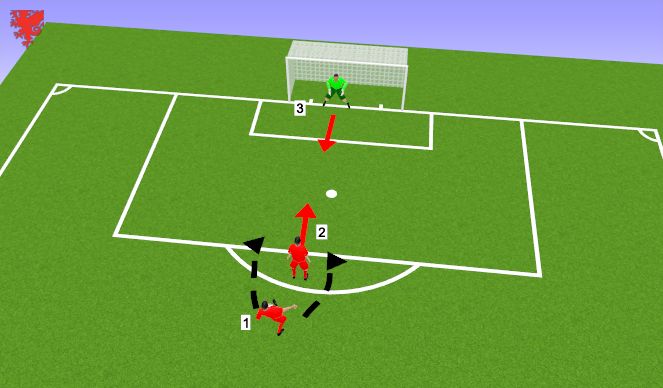
This exercise will be putting the working GK in a more match realistic environment where the whole goal and 18 yard box will be used. The exercise will begin with the ball in server 2’s hands, where the ball will then be slowly rolled past server 1 to begin the 1-on-1. For the first phase of the exercise, server 1 is only allowed to dribble the ball around the GK with only 8 seconds allowed. Once the ball is out of play, the working and resting GK will swap. The GK’s must perform this exercise 3 sets of 3 1-on-1’s.
Development
To further develop this exercise, server 1 will now be allowed to shoot the ball and is only allowed to have 5 seconds to score. This is to further enhance the match realism as it is unlikely for strikers to have a lot of time in a 1v1 situation as well as it is more than often that they would shoot on goal.
Organisation
2 servers outside 18 yard box
1 working GK
1 football

See the guidance at the top of this page to understand why you are not seeing interactive Football/Soccer images.
Screen 4
Key Factors
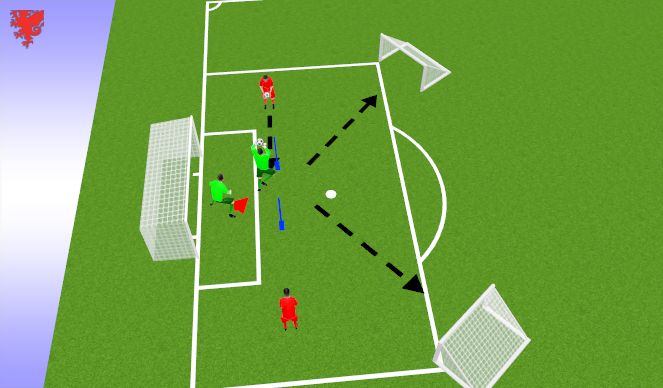
The working GK sets up for a cross as the server has the ball in their hands, the aim for the server is to throw the ball (mostly overarm to make the flight of the ball as realistic as possible) in between the mannequins placed 4 yards apart for the GK to claim before distributing the ball into either one of the small goals on the corners of the 18 yard box to simulate a quick restart. After this is done, the working GK resets in the other direction to repeat the exercise however the GK resets by using footwork to get back into the goals as if a winger was running down the wing before crossing, 1 cross from both servers will count as 1 rep, this will be performed for 4 reps.
Organisation
2 mannequins
1 working GK
2 servers
2 small goals
See the guidance at the top of this page to understand why you are not seeing interactive Football/Soccer images.
Screen 5
Key Factors
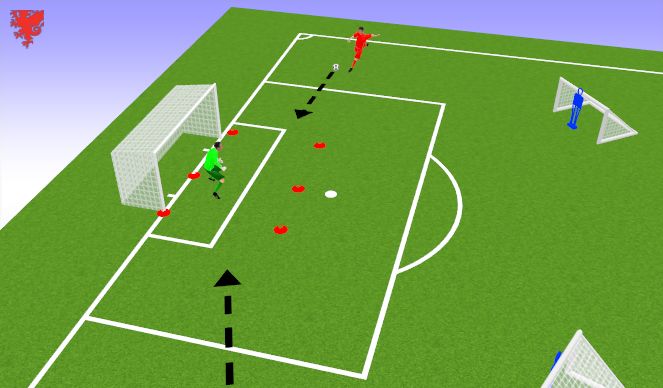
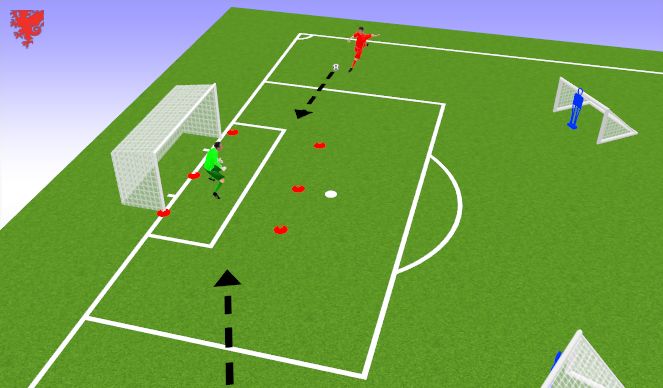
Working GK starts in set position ready to deal with a cross, the server is aiming to cross the ball into the rectangle made of cones in order for the GK to claim. As the ball is being delivered into the box the GK will have to call out whether they will claim the ball in the front half of the rectangle or the back half before distributing the to one of the small goals. This exercise is working on developing the GK's awareness of the box as well as reading the direction and flight of the ball in order to come claim it before distributing. The whole exercise is built up as a competitive session for the GKs where they will receive 1 point for claiming the ball in the half of the rectangle that they call out, then 1 point for distributing the ball accurately into the small goal, however, if they distribute the ball directly to the mannequin then they earn 2 points, any form of distribution is encouraged.
Organisation
6 cones
2 small goals
2 mannequins (placed in the middle of the small goals)
1 working GK
2 server
See the guidance at the top of this page to understand why you are not seeing interactive Football/Soccer images.
Screen 6
Key Factors
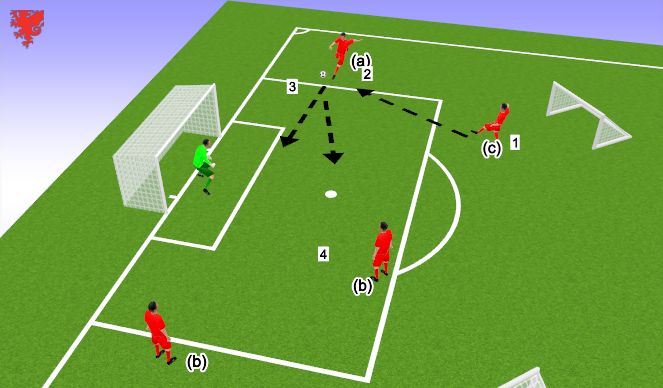
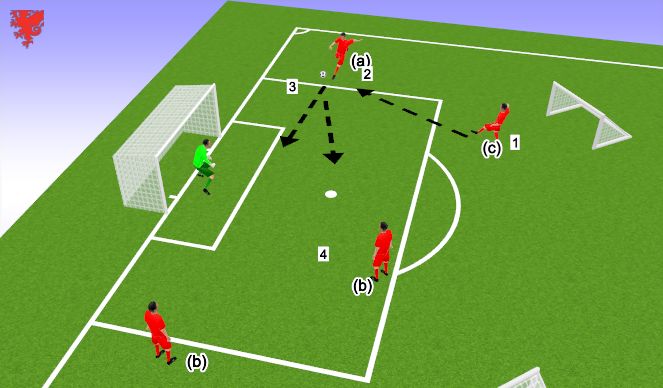
Working GK positions themselves in line with the playmaker who has the ball then as the playmaker passes the ball to the server the GK will drop into the goal and sets themselves to deal with the cross. As the ball is being delivered, the GK can choose whether to come claim/punch the ball or stay on the line to deal with a shot from either attacker. During this period the playmaker can also join in as an extra outlet. This is to simulate a real match scenario with surrounding attckers creating a realistic environment where the GK will have to make precise decisions in a short amount of time in order to protect the goal. If the GK claims the balls successfully, then will use any form of distribution to transfer the ball into one of the two small goals.
Organisation
1 working GK
1 Crosser (a)
2 Attackers (b)
1 playmaker (c)
2 small goals
'%3E%3Cpath id='path4169' d='M 11.4375,70.25 C 11.457031,38.394531 37.277344,13.242188 68.253906,13.050781 99.78125,12.855469 125.73047,38.351563 125.8125,70.078125 125.89844,101.62109 100.43359,127.14063 69.148438,127.42188 37.582031,127.70703 11.464844,102.23438 11.4375,70.25 m 6.425781,-0.08984 c 0.03516,28.421871 23.027344,50.69922 50.519532,50.82031 C 96.433594,121.10156 119.30469,98.367188 119.38281,70.359375 119.45313,42.878906 97.382813,19.714844 69.015625,19.496094 40.75,19.277344 17.964844,42.035156 17.863281,70.160156' style='clip-rule:nonzero;fill:%23333f48;fill-opacity:1;fill-rule:nonzero;stroke:none' /%3E%3Cpath style='fill:%23333f48;fill-opacity:1;fill-rule:nonzero;stroke:none' d='m 39.789063,108.62109 c 0.28125,0.14454 0.550781,0.32032 0.839843,0.4336 2.734375,1.05469 5.554688,1.78125 8.453125,2.23047 2.734375,0.42578 5.484375,0.64453 8.25,0.54297 3.988282,-0.15625 7.832032,-0.94922 11.445313,-2.69532 1.683594,-0.8164 3.246094,-1.82422 4.640625,-3.07422 3.265625,-2.92578 5.171875,-6.582027 5.796875,-10.906246 0.546875,-3.761719 0.04687,-7.425781 -1.09375,-11.019531 -1.4375,-4.523438 -3.730469,-8.582032 -6.703125,-12.265625 -1.03125,-1.277344 -2.082031,-2.535157 -3.113281,-3.808594 C 66.789063,66.1875 65.332031,64.269531 64.0625,62.21875 c -1.601562,-2.582031 -2.835937,-5.316406 -3.613281,-8.261719 -0.683594,-2.574218 -0.902344,-5.1875 -0.6875,-7.828125 0.214844,-2.617187 0.910156,-5.117187 2.152344,-7.441406 2.164062,-4.050781 5.503906,-6.710937 9.816406,-8.179687 1.890625,-0.640625 3.835937,-1.058594 5.832031,-1.195313 1.121094,-0.07813 2.242188,-0.152344 3.363281,-0.164062 4.28125,-0.02734 8.4375,0.734375 12.453125,2.175781 1.871094,0.671875 3.6875,1.496094 5.523438,2.257812 0.226562,0.09375 0.4375,0.230469 0.664062,0.351563 -0.164062,0.25 -0.371093,0.160156 -0.539062,0.164062 -2.824219,0.101563 -5.535156,0.703125 -8.132813,1.804688 -1.335937,0.570312 -2.570312,1.316406 -3.648437,2.296875 -2.527344,2.296875 -3.605469,5.15625 -3.34375,8.550781 0.140625,1.855469 0.722656,3.574219 1.550781,5.222656 0.648438,1.296875 1.414063,2.523438 2.292969,3.675782 0.953125,1.25 1.929687,2.484375 2.929687,3.699218 2.085938,2.523438 4.164063,5.054688 6.050782,7.738282 2.203125,3.136718 4.140627,6.417968 5.589847,9.980468 1.16406,2.867188 2.01562,5.820313 2.39843,8.894532 0.25,2.011718 0.30079,4.03125 0.11719,6.058593 -0.24219,2.640625 -0.79297,5.195313 -1.74609,7.667969 -1.29688,3.36328 -3.300784,6.22656 -5.972659,8.63281 -2.429687,2.19141 -5.171875,3.90625 -8.109375,5.3125 -2.695312,1.29297 -5.464843,2.40235 -8.34375,3.20313 -1.953125,0.54687 -3.945312,0.8789 -5.949218,1.15625 -3.035157,0.41797 -6.085938,0.48828 -9.132813,0.3125 -5.328125,-0.3125 -10.476562,-1.46094 -15.410156,-3.52344 -3.449219,-1.44141 -6.691406,-3.25781 -9.757813,-5.39453 -0.183593,-0.12891 -0.378906,-0.25 -0.53125,-0.41016 -0.07031,-0.0703 -0.05859,-0.22656 -0.08203,-0.34375 z m 0,0' id='path4175' /%3E%3Cpath style='fill:%23333f48;fill-opacity:1;fill-rule:nonzero;stroke:none' d='M 94.699219,29.390625 C 94.089844,29.21875 93.476563,29.054688 92.867188,28.875 90.183594,28.085938 87.46875,27.441406 84.703125,27.046875 c -3.976562,-0.566406 -7.945312,-0.59375 -11.863281,0.402344 -7.535156,1.914062 -12.386719,6.71875 -14.878906,13.996094 -0.894532,2.617187 -1.179688,5.328125 -0.953125,8.078125 0.203125,2.484375 0.867187,4.859375 1.816406,7.160156 0.933594,2.261719 2.117187,4.390625 3.4375,6.449219 1.4375,2.25 3.050781,4.371093 4.640625,6.511718 1.4375,1.933594 2.867187,3.871094 4.261719,5.835938 1.230468,1.730469 2.316406,3.546875 3.273437,5.445312 1.324219,2.625 2.265625,5.378907 2.703125,8.292969 0.433594,2.902344 0.292969,5.765625 -0.660156,8.5625 -0.9375,2.74609 -2.574219,5.00781 -4.777344,6.875 -2.417969,2.04688 -5.203125,3.39844 -8.246094,4.22266 -1.835937,0.5 -3.703125,0.75781 -5.609375,0.82031 -3.886718,0.13281 -7.679687,-0.47266 -11.421875,-1.46094 -2.261718,-0.59765 -4.488281,-1.33203 -6.695312,-2.11328 -0.207031,-0.0742 -0.40625,-0.16797 -0.597656,-0.25 -0.02344,-0.24609 0.148437,-0.19141 0.25,-0.20703 1.96875,-0.30469 3.921875,-0.67969 5.804687,-1.34766 1.367188,-0.48437 2.671875,-1.10156 3.855469,-1.94922 2.25,-1.61328 3.65625,-3.765621 4.0625,-6.515621 0.273437,-1.867188 0.09375,-3.710938 -0.429688,-5.527344 -0.472656,-1.648437 -1.171875,-3.199219 -2.109375,-4.628906 -0.792968,-1.207031 -1.636718,-2.382813 -2.523437,-3.519531 -0.921875,-1.195313 -1.921875,-2.328125 -2.890625,-3.484375 -2.753906,-3.273438 -5.351563,-6.660157 -7.523438,-10.355469 -2.042968,-3.480469 -3.667968,-7.136719 -4.597656,-11.078125 -0.640625,-2.699219 -0.980469,-5.4375 -0.832031,-8.214844 0.238281,-4.53125 1.476562,-8.78125 3.824219,-12.6875 1.082031,-1.800781 2.445312,-3.375 3.988281,-4.800781 2.742187,-2.527344 5.863281,-4.480469 9.257812,-5.992188 3.746094,-1.667968 7.652344,-2.769531 11.707032,-3.394531 3.152343,-0.488281 6.324218,-0.671875 9.507812,-0.519531 8.632813,0.410156 16.671875,2.792969 24,7.433594 0.08203,0.05078 0.152344,0.109375 0.230469,0.167968 -0.0039,0.04297 -0.0078,0.08984 -0.01563,0.136719' id='path4177' /%3E%3Cpath style='fill:%23333f48;fill-opacity:1;fill-rule:nonzero;stroke:none' d='m 31.699219,38.75 c -0.07813,0.238281 -0.152344,0.476563 -0.238281,0.710938 -1.460938,4.074218 -2.066407,8.28125 -1.808594,12.59375 0.4375,7.304687 2.808594,13.925781 7.277344,19.753906 3.714843,4.84375 7.441406,9.671875 11.167968,14.503906 1.113282,1.441406 1.953125,3.007813 2.414063,4.777344 0.332031,1.257812 0.425781,2.539062 0.273437,3.820312 -0.214843,1.832032 -1.070312,3.34375 -2.464843,4.546875 -0.984375,0.851559 -2.113282,1.449219 -3.316407,1.925779 -1.378906,0.54297 -2.8125,0.89063 -4.273437,1.1211 -2.226563,0.35547 -4.46875,0.46093 -6.722656,0.41015 -0.589844,-0.0156 -1.046875,-0.18359 -1.433594,-0.625 -0.636719,-0.72265 -1.335938,-1.39062 -1.9375,-2.14062 C 25.574219,93.800781 22.300781,86.621094 20.84375,78.636719 20.152344,74.835938 19.917969,71 20.15625,67.128906 20.796875,56.773438 24.390625,47.574219 30.859375,39.480469 c 0.21875,-0.273438 0.453125,-0.53125 0.679688,-0.796875 0.05469,0.02344 0.109375,0.04297 0.160156,0.06641' id='path4179' /%3E%3Cpath style='fill:%23333f48;fill-opacity:1;fill-rule:nonzero;stroke:none' d='m 105.41016,101.30078 c -0.13282,-0.3125 0.0234,-0.5039 0.0977,-0.69922 1.38672,-3.749997 1.98047,-7.628904 1.89844,-11.621091 -0.14453,-6.84375 -2.08594,-13.144531 -5.73437,-18.925781 C 99.890625,67.226563 97.917969,64.53125 95.835938,61.917969 94.4375,60.160156 92.988281,58.4375 91.582031,56.6875 90.632813,55.511719 89.6875,54.335938 88.792969,53.121094 c -0.835938,-1.144531 -1.488281,-2.398438 -1.953125,-3.742188 -0.523438,-1.515625 -0.695313,-3.070312 -0.511719,-4.652343 0.21875,-1.839844 1.082031,-3.339844 2.476563,-4.542969 1.039062,-0.890625 2.230468,-1.507813 3.503906,-1.980469 1.632812,-0.609375 3.320312,-0.960937 5.046875,-1.175781 1.917969,-0.238281 3.839841,-0.269531 5.769531,-0.230469 0.52734,0.01172 0.89453,0.203125 1.23828,0.585938 5.50391,6.113281 9.26172,13.144531 11.21875,21.132812 1.11719,4.554688 1.5625,9.179688 1.30469,13.855469 -0.58203,10.625 -4.23438,20.082031 -10.96094,28.339846 -0.15625,0.1914 -0.32812,0.375 -0.51562,0.58984' id='path4181' /%3E%3Cpath style='fill:%23333f48;fill-opacity:1;fill-rule:nonzero;stroke:none' d='m 39.796875,108.63281 c -0.05859,0.0117 -0.117187,0.0234 -0.175781,0.0352 0.05469,-0.0156 0.113281,-0.0312 0.167969,-0.0469 z m 0,0' id='path4183' /%3E%3C/g%3E%3C/svg%3E)
 Play animation
 Play step-by-step
 Repeat (toggle)
 Full Screen
 Pause
Pause Stop
Stop
Screen 1
Key Factors
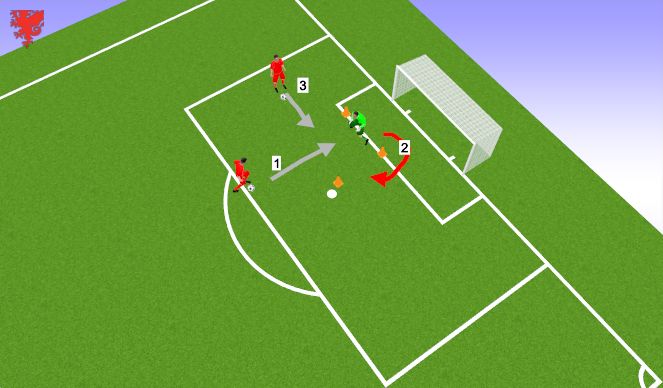
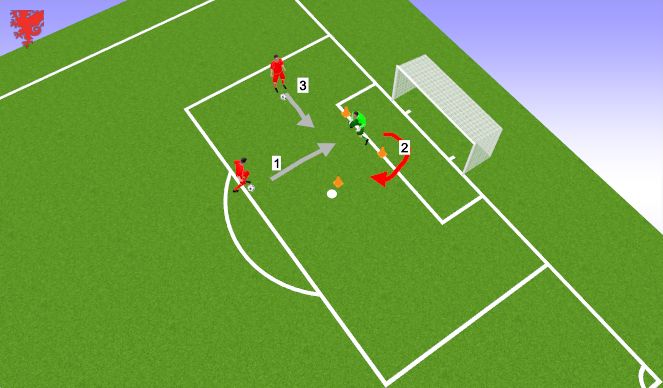
The exercise will have an area of This exercise will include two servers, one working goalkeeper, one resting goalkeeper and two small goals of about three feet in width structured as a 90 degree angle. To begin the exercise, the goalkeeper who is working will remain on the line in both goals, allowing the servers to approach the goal with the ball to block it with their body. After the first save is made in goal 1, the goalkeeper will instantly move and prepare themselves in goal 2 to prepare for server 2 who starts dribbling as soon as the goalkeeper sets themselves in goal 2. This will be warming up the goalkeeper by preparing their bodies to make movements to block the ball as well as ensuring to get the fundamentals of a block save correct. 4 block saves = 1 set, each goalkeeper will perform 3 sets each.
Mechanics
Block save -
- Make sure to get low to the ground when approaching the player, nose should be over your toes , palms should be just below the knees whilst facing the ball and shoulders & chest should be square to the ball at all times.
- As you make the decision to perform a block save, you would usually use this in a close situation where the striker is about to shoot towards goal, quickly lower your knee (that's closest to the center of the goal) inwards until it’s in a 90 degree angle (like an ‘L’) above the ground. This is to create a barrier as well as making the goal size for the striker as small as possible.
-The leg nearest to the ball will remain upright in a 90 degree angle, this is to give the body stability and balance to allow the goalkeeper to recover once the ball has been saved.
- Whilst spreading, place your arms in an effective position, the hand closer to the center of the goal should cover the area above the leg that’s closest to the ground. This is to cover any shot that can go across the body. The other arm should be placed higher than the upright knee in order to cover any shots that come in at head height.
- When the ball is shot towards you, make sure to keep your eyes open and not to close them as this would allow you to make any reaction/last second position adjustments in order to save the ball.
- After the ball has struck your body, be prepared to make a recovery save/any second balls as the ball is still in play. You can do this by using the upright standing leg to push the body quickly back into set position.
Diving at feet -
- Make sure to get low to the ground when approaching the player, nose should be over your toes , palms should be just below the knees whilst facing the ball and shoulders & chest should be square to the ball at all times.
- Have patience once you’ve met the striker and let them make the first move as this will apply extra pressure on them which can result in them making a mistake. Also have patience as you’re waiting to get the right time to dive at the feet. You should prepare to dive for the ball after the striker has touched the ball with his feet.
- As you dive towards the ball, dive slightly diagonally forward into the ball’s path and aim to land in this order: ankle, knee, hip, side, shoulders. This is to cushion the blow for your body and to prevent injury. You should stretch out your arms towards the ball and use your hands/arms to make contact with the ball. It would be recommended to use the ‘w’ hand technique as you can use it to scoop the ball into your body even if you don’t have control of the ball. If you lose the ball, make a long “barrier”, i.e. stretch the full body length to increase the chances of stopping a shot.
- When you bring the ball into your body make sure to tuck your head in also, this is to prevent any serious injuries from occurring as the striker may follow through if they were about to shoot.
Organisation
3 cones (In an 'L' position 4yds gap in between)
1 working GK
2 Servers