
Football/Soccer Session (Academy Sessions): attacking with overload (Start Time: 2025-06-12 18:20:00)

Premier Users' Club
Gary Evans

Description
Welsh Way Principle:
Attacking with Overloads
See the guidance at the top of this page to understand why you are not seeing interactive Football/Soccer images.

See the guidance at the top of this page to understand why you are not seeing interactive Football/Soccer images.
Organisation
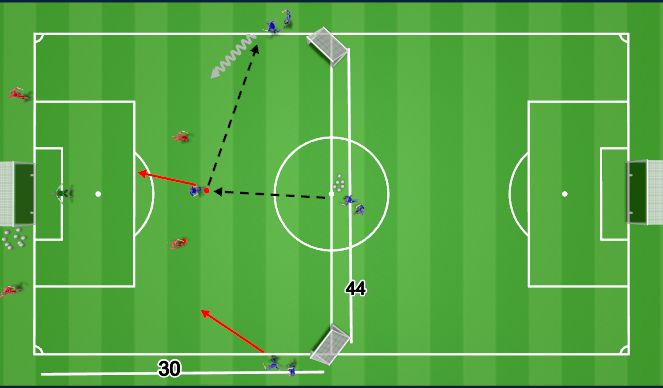
30 x 44yards
Multiple balls placed as shown above (at the start of the session, and a set of balls by the GK)
12 players + 1 GK
3 teams of 4
15mins in total (including breaks)
3 x 4min blocks
Aims
In phase 1, the red team will aim to affect the attack, slow down the momentum and hopefully defend the goal and gain possession. Once the first wave of attack is over (goal or the ball is out of play), the red team will begin the second phase of attack, starting with the keeper. The aim remains the same, however, the red team are to use the overload of 4v3 and score in the opposite two smaller goals as arranged above. The 2 red players that begin in the centre of the area will rotate with their other 2, and will defend for one block of 4 minutes before rotating with the blue team or the third team of 4.Coaching Points
- Key points when creating an overload, is utilising the space and width of the area. Can the 2 wider players remain wide to create space central for the higher attacking player.
- As well as width, can the 4 attacking players consider the depth of their positioning in relation to the pitch size and other players movements. (e.g. can the higher player make forward runs in behind, can the higher player make 2 opposing movements, move away to come in short for a potential 1-2 around the defender)
- As a result of various movements, can we create pockets and space in danger areas (behind or in front of the defence for shots on target)
- Creative movements, can the 4 attacking players vary their forward movements such as underlaps, overlaps, in to our or out to in movements
Adaptations (Progressions & Regressions):
Progression:
To progress the drill, an offside rule can be added when a team is attacking, this will encourage their decision making, weight of pass, types of runs and how they approach them to ensure they remain onside. Encourage or include an overlap/underlap movement in the next attacking movements to test the attacking 4 and avoid straight line runs.
Regression:
Avoid the offside rule, to provide the attacking side with more of an opportunity to become successful when moving forwards and attacking in the smaller goals.
Challenges, Conditions or Targets:
Set a time limit for the attacking players, as the keeper releases the ball, the attacking red team have 8 seconds to shoot/score in the 2 smaller mini goals. This will encourage higher intensity and speed for the session, and effecting the players to think positively whilst in possession. Set a target of a number of goals the red team can score in that transition of defence into attack.
Reflection:
The second phase began slow in regards to the transition of defending to attacking, due to the keeper having to react quick to bring a second ball into play. To support this, the assistant coach began with the ball by the goal, and fed the ball into the keepers hands after phase 1 to quicken the start for phase 2, this proved to be a lot more effective.
The blue attacking team required continuous reminding to transition from attack to defence quickly, as they'd forget leaving the red team to be score in the mini-goals too easily which then took away the task of creating/utilising the overload.

 Play animation
 Play step-by-step
 Repeat (toggle)
 Full Screen
 Pause
Pause Stop
Stop
20 mins
Organisation
30 x 44yards
Multiple balls placed as shown above (at the start of the session, and a set of balls by the GK)
12 players + 1 GK
3 teams of 4
15mins in total (including breaks)
3 x 4min blocks
Aims
The blue team will start with the ball, the initial pass will be played into the higher attacking player who will play it out wide to either of the wider players. The blue team will attack towards the goal, creating an overload of 3v2. The 2 central red players will aim to defend the overload and affect the attack, slow down the momentum and gain possession for a potential counter-attack into the 2 mini goals.. Once the first wave of attack is over (blues attacking reds), the red team will begin the second phase of attack, starting from the keeper and create a 4v3 overload against the 3 blues that began phase 1. The aim remains the same, however, the 3 blues will quickly transition from attack to defence, and defend the overload vs the red players. Once phase 2 play is done, the drill resets, and the 2 reds rotate with the other 2 so it's a different pair that begins the defensive duties vs a different attacking 3 blues.
Coaching Points
- Key points when defending an overload, is minimalising the space and gaps in the central areas of the pitch. Can the 2 defenders begin narrow, encouraging the opposition to play wide and around rather than through.
- It's important that the middle 2 defending players work together as a pair
- As a result of various movements, can we create pockets and space in danger areas (behind or in front of the defence for shots on target)
- Creative movements, can the 3 attacking players vary their forward movements such as underlaps, overlaps, in to our or out to in movements
Adaptations (Progressions & Regressions):
Progression:
From the initial first past, can the 2 defenders now not be passive and potentially squeeze to put pressure on the higher attacker as they receive the ball. This causes further realism into the practice as now the player can be intercepted if the initial pass is not good enough. This then allows the attacking player to potential play of 1 touch to a wider player which increases the intensity and speed of play. Encourage or include a overlap/underlap movement in the next attacking movements to test the attacking 3 and avoid straight line runs.
Regression:
Request that the 2 defenders remain stationary until the wider players receive the ball, this will provide the first 2 passes to be successful and provide the attackers more time for decision making
Challenges, Conditions or Targets:
Set a time limit for the attacking players, once the higher attacker receives the first pass, can they play forward quickly, and have a shot off within 8 seconds? This will encourage higher intensity and speed for the session, and effecting the players to think positively whilst in possession. Set a target of a number of goals for that 1 block of 4minutes?
Reflection: