


Football/Soccer Session (Beginner): 2016 White/Black: When to Pass/ When to Dribble (Start Time: 2025-12-01 14:40:00)
Profile Summary

| Name: | Juan Alberto Luna |
|---|---|
| City: | Prospect Heights |
| Country: | United States of America |
| Membership: | Adult Member |
| Sport: | Football/Soccer |

Description
Session Overview: When to Pass / When to Dribble (2016 Black/White)
This session teaches players to recognize when to dribble to keep or create space and when to pass to break pressure or exploit teammates’ positioning. The focus is on decision-making, first touch, and reacting quickly in transition moments. To maximize the hour and increase repetitions, both coaches will split the players into two groups, running activities in parallel.
Players will move through dribbling under pressure, finishing moments, and small-sided transition games that challenge them to scan, choose the best option, and execute with quality.
See the guidance at the top of this page to understand why you are not seeing interactive Football/Soccer images.
See the guidance at the top of this page to understand why you are not seeing interactive Football/Soccer images.
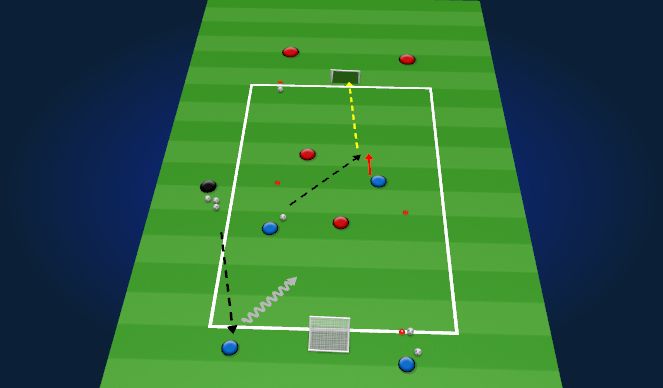
Transition Race to 2v2 (15 mins)
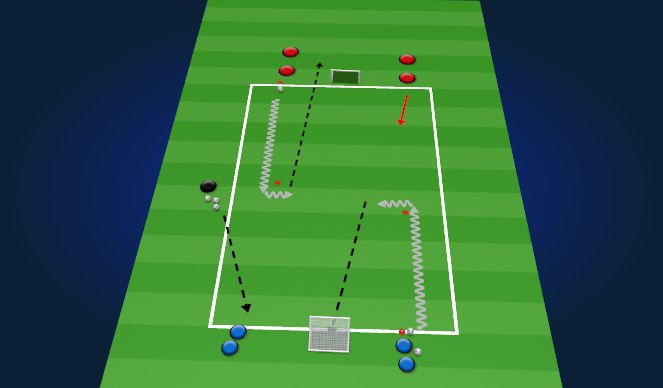
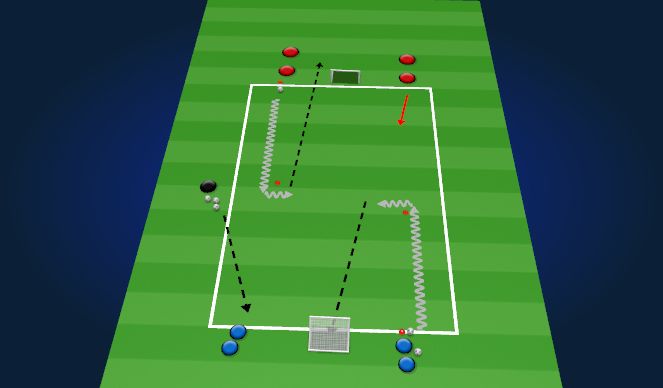
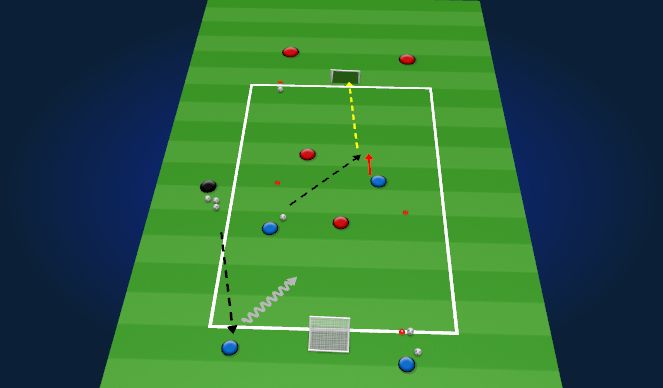
Activity 1 — 1v1 → 2v2 Transition Race to Mini Goals
Organization:
Set up two mini goals side-by-side.
Create two lines per team (Red and Blue), positioned opposite the goals:
One line has balls (attackers).
The other line has no balls (support players).
Place a cone 10 yards in front of each starting line.
Coach stands on the sideline with extra balls to trigger transitions.
Explanation:
On the coach’s command, one Red and one Blue player (both with balls) dribble forward and wrap around their cone.
After turning, each player drives quickly toward their mini goal and attempts to finish.
Coach may require a specific skill move before the shot (step-over, scissor, change of direction, etc.).
The first player to score wins the race.
Example: Blue scores first; Red misses.
Immediately after the finish, the coach plays a new ball to the next Blue player, and the next Red player joins too.
This creates an instant 2v2 transition game, with both teams now attacking the same pair of mini goals.
Play continues until the ball goes out or a goal is scored, then reset with the next pair.
Key Coaching Points:
High Tempo: Explode out of the turn and attack the goal with speed.
First Touch & Finish: Prep touch toward goal, strike cleanly, and be decisive.
Transition Recognition: Players must switch immediately from a finishing action into a live 2v2 moment.
Communication: Call for support, identify roles (pressure/cover or support/finish).
Decision-Making: Know when to dribble, pass, or combine in the 2v2.
Work Rate: React instantly — the team that transitions first often wins the 2v2.
See the guidance at the top of this page to understand why you are not seeing interactive Football/Soccer images.
Progression 3v2 (10 mins)
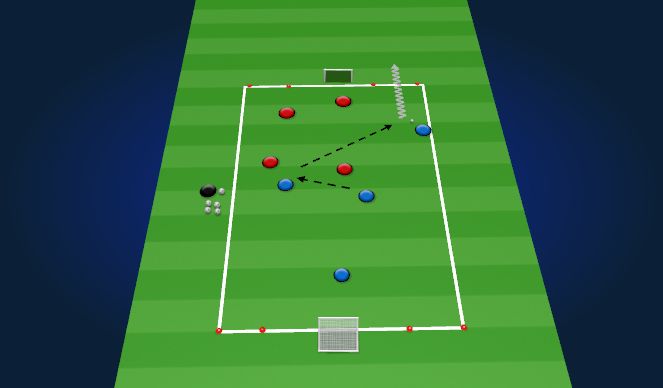
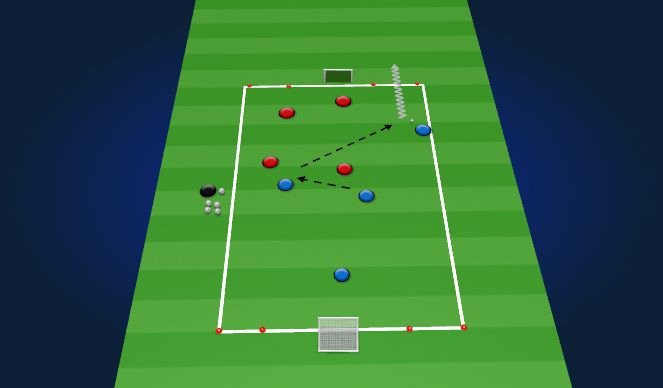
Progression — Level 3: 3v2 Continuation Phase
Organization:
Keep the exact same setup as Activity 1 (two mini goals, two lines per team, cones, coach with extra balls).
After the 2v2 phase finishes, the progression begins.
Explanation (Level 3):
The team that wins the 2v2 (example: Blue) immediately continues the attack.
As soon as the 2v2 ends, the coach plays a new ball to a Blue player waiting in line, as shown.
That Blue player enters the pitch, joining the two who just played — creating a 3v2 advantage for the winning team.
The defending team (Red) remains at 2 players and must organize quickly to defend the overload.
The 3v2 continues until the ball goes out, a goal is scored, or the coach stops the action.
Once the sequence ends, the coach resets the entire exercise back to Level 1 (1v1 race) on command.
Key Coaching Points:
Instant Recognition: Winning the 2v2 means reacting immediately to enter the 3v2 with purpose.
Overload Awareness: Attackers must decide quickly — dribble to commit, or pass early to exploit the extra player.
Body Shape to Play Forward: Receive facing the mini goals to connect at speed.
Support Angles: The new third attacker must enter with a useful angle and not crowd the ball.
Defensive Reaction: The 2 defenders must delay, protect the central lane, and force wide.
Game Management: Attack with composure but urgency — finish the overload efficiently.
See the guidance at the top of this page to understand why you are not seeing interactive Football/Soccer images.
4v4 Goal/Gate Game (20 mins)
Activity 3 — 4v4 Game with Mini Goal + Dribble Gates
Organization:
Set up a 4v4 field (approx. 30x25 yards).
Place one mini goal centered on each end line.
On each side of the mini goal, set up a dribble gate using two cones (one gate to the left, one gate to the right).
Both teams play 4v4 inside the field.
Coach stands on the sideline with extra balls to trigger transitions immediately.
Explanation:
Teams can score in two different ways:
1. Score in the mini goal (2 points).
2. Dribble through either gate (1 point).After any scoring action:
The coach immediately plays a new ball to the team that conceded, creating a built-in counter-attack moment.
If a team scores by dribbling through a gate, the coach quickly serves the next ball to the team that conceded to encourage them to take advantage of the natural overload and break quickly in transition.
Play is continuous, high tempo, and encourages split-second decisions on when to pass, dribble, or finish.
Key Coaching Points (KCP):
Decision-Making: Recognize if the defender is tight → dribble; if space opens → pass or finish early.
Transition Speed: Immediate reaction after scoring or conceding — organize quickly to defend or counter.
Awareness: Identify where the space is — central mini goal vs. the wide dribble gates.
Body Shape: Receive open to both sides so you can quickly switch play or attack the gate.
Spacing: Create width to stretch defenders and open lanes to goal or the gates.
Finishing Choice:
Mini goal = higher reward (2 points) → requires combination or decisive action.
Dribble gate = quicker option (1 point) → use when defenders close the middle.
'%3E%3Cpath id='path4169' d='M 11.4375,70.25 C 11.457031,38.394531 37.277344,13.242188 68.253906,13.050781 99.78125,12.855469 125.73047,38.351563 125.8125,70.078125 125.89844,101.62109 100.43359,127.14063 69.148438,127.42188 37.582031,127.70703 11.464844,102.23438 11.4375,70.25 m 6.425781,-0.08984 c 0.03516,28.421871 23.027344,50.69922 50.519532,50.82031 C 96.433594,121.10156 119.30469,98.367188 119.38281,70.359375 119.45313,42.878906 97.382813,19.714844 69.015625,19.496094 40.75,19.277344 17.964844,42.035156 17.863281,70.160156' style='clip-rule:nonzero;fill:%23333f48;fill-opacity:1;fill-rule:nonzero;stroke:none' /%3E%3Cpath style='fill:%23333f48;fill-opacity:1;fill-rule:nonzero;stroke:none' d='m 39.789063,108.62109 c 0.28125,0.14454 0.550781,0.32032 0.839843,0.4336 2.734375,1.05469 5.554688,1.78125 8.453125,2.23047 2.734375,0.42578 5.484375,0.64453 8.25,0.54297 3.988282,-0.15625 7.832032,-0.94922 11.445313,-2.69532 1.683594,-0.8164 3.246094,-1.82422 4.640625,-3.07422 3.265625,-2.92578 5.171875,-6.582027 5.796875,-10.906246 0.546875,-3.761719 0.04687,-7.425781 -1.09375,-11.019531 -1.4375,-4.523438 -3.730469,-8.582032 -6.703125,-12.265625 -1.03125,-1.277344 -2.082031,-2.535157 -3.113281,-3.808594 C 66.789063,66.1875 65.332031,64.269531 64.0625,62.21875 c -1.601562,-2.582031 -2.835937,-5.316406 -3.613281,-8.261719 -0.683594,-2.574218 -0.902344,-5.1875 -0.6875,-7.828125 0.214844,-2.617187 0.910156,-5.117187 2.152344,-7.441406 2.164062,-4.050781 5.503906,-6.710937 9.816406,-8.179687 1.890625,-0.640625 3.835937,-1.058594 5.832031,-1.195313 1.121094,-0.07813 2.242188,-0.152344 3.363281,-0.164062 4.28125,-0.02734 8.4375,0.734375 12.453125,2.175781 1.871094,0.671875 3.6875,1.496094 5.523438,2.257812 0.226562,0.09375 0.4375,0.230469 0.664062,0.351563 -0.164062,0.25 -0.371093,0.160156 -0.539062,0.164062 -2.824219,0.101563 -5.535156,0.703125 -8.132813,1.804688 -1.335937,0.570312 -2.570312,1.316406 -3.648437,2.296875 -2.527344,2.296875 -3.605469,5.15625 -3.34375,8.550781 0.140625,1.855469 0.722656,3.574219 1.550781,5.222656 0.648438,1.296875 1.414063,2.523438 2.292969,3.675782 0.953125,1.25 1.929687,2.484375 2.929687,3.699218 2.085938,2.523438 4.164063,5.054688 6.050782,7.738282 2.203125,3.136718 4.140627,6.417968 5.589847,9.980468 1.16406,2.867188 2.01562,5.820313 2.39843,8.894532 0.25,2.011718 0.30079,4.03125 0.11719,6.058593 -0.24219,2.640625 -0.79297,5.195313 -1.74609,7.667969 -1.29688,3.36328 -3.300784,6.22656 -5.972659,8.63281 -2.429687,2.19141 -5.171875,3.90625 -8.109375,5.3125 -2.695312,1.29297 -5.464843,2.40235 -8.34375,3.20313 -1.953125,0.54687 -3.945312,0.8789 -5.949218,1.15625 -3.035157,0.41797 -6.085938,0.48828 -9.132813,0.3125 -5.328125,-0.3125 -10.476562,-1.46094 -15.410156,-3.52344 -3.449219,-1.44141 -6.691406,-3.25781 -9.757813,-5.39453 -0.183593,-0.12891 -0.378906,-0.25 -0.53125,-0.41016 -0.07031,-0.0703 -0.05859,-0.22656 -0.08203,-0.34375 z m 0,0' id='path4175' /%3E%3Cpath style='fill:%23333f48;fill-opacity:1;fill-rule:nonzero;stroke:none' d='M 94.699219,29.390625 C 94.089844,29.21875 93.476563,29.054688 92.867188,28.875 90.183594,28.085938 87.46875,27.441406 84.703125,27.046875 c -3.976562,-0.566406 -7.945312,-0.59375 -11.863281,0.402344 -7.535156,1.914062 -12.386719,6.71875 -14.878906,13.996094 -0.894532,2.617187 -1.179688,5.328125 -0.953125,8.078125 0.203125,2.484375 0.867187,4.859375 1.816406,7.160156 0.933594,2.261719 2.117187,4.390625 3.4375,6.449219 1.4375,2.25 3.050781,4.371093 4.640625,6.511718 1.4375,1.933594 2.867187,3.871094 4.261719,5.835938 1.230468,1.730469 2.316406,3.546875 3.273437,5.445312 1.324219,2.625 2.265625,5.378907 2.703125,8.292969 0.433594,2.902344 0.292969,5.765625 -0.660156,8.5625 -0.9375,2.74609 -2.574219,5.00781 -4.777344,6.875 -2.417969,2.04688 -5.203125,3.39844 -8.246094,4.22266 -1.835937,0.5 -3.703125,0.75781 -5.609375,0.82031 -3.886718,0.13281 -7.679687,-0.47266 -11.421875,-1.46094 -2.261718,-0.59765 -4.488281,-1.33203 -6.695312,-2.11328 -0.207031,-0.0742 -0.40625,-0.16797 -0.597656,-0.25 -0.02344,-0.24609 0.148437,-0.19141 0.25,-0.20703 1.96875,-0.30469 3.921875,-0.67969 5.804687,-1.34766 1.367188,-0.48437 2.671875,-1.10156 3.855469,-1.94922 2.25,-1.61328 3.65625,-3.765621 4.0625,-6.515621 0.273437,-1.867188 0.09375,-3.710938 -0.429688,-5.527344 -0.472656,-1.648437 -1.171875,-3.199219 -2.109375,-4.628906 -0.792968,-1.207031 -1.636718,-2.382813 -2.523437,-3.519531 -0.921875,-1.195313 -1.921875,-2.328125 -2.890625,-3.484375 -2.753906,-3.273438 -5.351563,-6.660157 -7.523438,-10.355469 -2.042968,-3.480469 -3.667968,-7.136719 -4.597656,-11.078125 -0.640625,-2.699219 -0.980469,-5.4375 -0.832031,-8.214844 0.238281,-4.53125 1.476562,-8.78125 3.824219,-12.6875 1.082031,-1.800781 2.445312,-3.375 3.988281,-4.800781 2.742187,-2.527344 5.863281,-4.480469 9.257812,-5.992188 3.746094,-1.667968 7.652344,-2.769531 11.707032,-3.394531 3.152343,-0.488281 6.324218,-0.671875 9.507812,-0.519531 8.632813,0.410156 16.671875,2.792969 24,7.433594 0.08203,0.05078 0.152344,0.109375 0.230469,0.167968 -0.0039,0.04297 -0.0078,0.08984 -0.01563,0.136719' id='path4177' /%3E%3Cpath style='fill:%23333f48;fill-opacity:1;fill-rule:nonzero;stroke:none' d='m 31.699219,38.75 c -0.07813,0.238281 -0.152344,0.476563 -0.238281,0.710938 -1.460938,4.074218 -2.066407,8.28125 -1.808594,12.59375 0.4375,7.304687 2.808594,13.925781 7.277344,19.753906 3.714843,4.84375 7.441406,9.671875 11.167968,14.503906 1.113282,1.441406 1.953125,3.007813 2.414063,4.777344 0.332031,1.257812 0.425781,2.539062 0.273437,3.820312 -0.214843,1.832032 -1.070312,3.34375 -2.464843,4.546875 -0.984375,0.851559 -2.113282,1.449219 -3.316407,1.925779 -1.378906,0.54297 -2.8125,0.89063 -4.273437,1.1211 -2.226563,0.35547 -4.46875,0.46093 -6.722656,0.41015 -0.589844,-0.0156 -1.046875,-0.18359 -1.433594,-0.625 -0.636719,-0.72265 -1.335938,-1.39062 -1.9375,-2.14062 C 25.574219,93.800781 22.300781,86.621094 20.84375,78.636719 20.152344,74.835938 19.917969,71 20.15625,67.128906 20.796875,56.773438 24.390625,47.574219 30.859375,39.480469 c 0.21875,-0.273438 0.453125,-0.53125 0.679688,-0.796875 0.05469,0.02344 0.109375,0.04297 0.160156,0.06641' id='path4179' /%3E%3Cpath style='fill:%23333f48;fill-opacity:1;fill-rule:nonzero;stroke:none' d='m 105.41016,101.30078 c -0.13282,-0.3125 0.0234,-0.5039 0.0977,-0.69922 1.38672,-3.749997 1.98047,-7.628904 1.89844,-11.621091 -0.14453,-6.84375 -2.08594,-13.144531 -5.73437,-18.925781 C 99.890625,67.226563 97.917969,64.53125 95.835938,61.917969 94.4375,60.160156 92.988281,58.4375 91.582031,56.6875 90.632813,55.511719 89.6875,54.335938 88.792969,53.121094 c -0.835938,-1.144531 -1.488281,-2.398438 -1.953125,-3.742188 -0.523438,-1.515625 -0.695313,-3.070312 -0.511719,-4.652343 0.21875,-1.839844 1.082031,-3.339844 2.476563,-4.542969 1.039062,-0.890625 2.230468,-1.507813 3.503906,-1.980469 1.632812,-0.609375 3.320312,-0.960937 5.046875,-1.175781 1.917969,-0.238281 3.839841,-0.269531 5.769531,-0.230469 0.52734,0.01172 0.89453,0.203125 1.23828,0.585938 5.50391,6.113281 9.26172,13.144531 11.21875,21.132812 1.11719,4.554688 1.5625,9.179688 1.30469,13.855469 -0.58203,10.625 -4.23438,20.082031 -10.96094,28.339846 -0.15625,0.1914 -0.32812,0.375 -0.51562,0.58984' id='path4181' /%3E%3Cpath style='fill:%23333f48;fill-opacity:1;fill-rule:nonzero;stroke:none' d='m 39.796875,108.63281 c -0.05859,0.0117 -0.117187,0.0234 -0.175781,0.0352 0.05469,-0.0156 0.113281,-0.0312 0.167969,-0.0469 z m 0,0' id='path4183' /%3E%3C/g%3E%3C/svg%3E)
 Play animation
 Play step-by-step
 Repeat (toggle)
 Full Screen
 Pause
Pause Stop
Stop
Technical Warm Up: Chaos Box (10 mins)
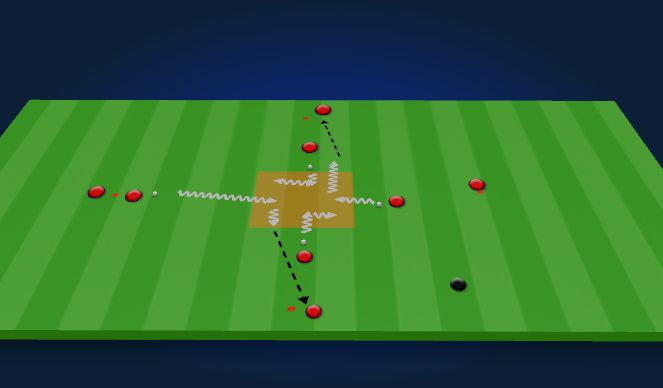
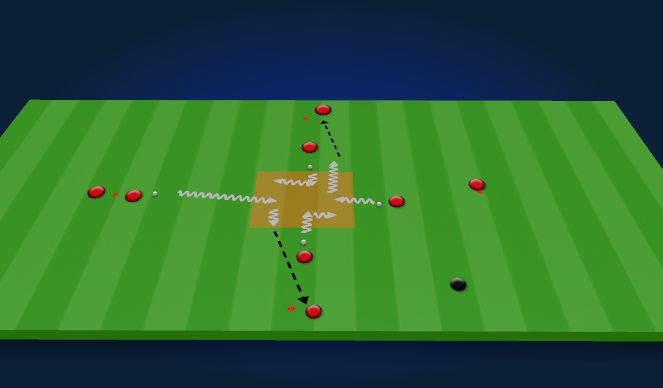
Activity 1: Chaos Box
Organization:
Set up a 15x15-yard square (“the box”) with four lines positioned evenly outside each side.
Each line has two players, and the first player in each line starts with a ball.
On the coach’s command, the first player from each line dribbles into the box, keeping control in tight space.
Inside the box, each player performs a skill move to their right (e.g., scissors, step-over, or body feint) to escape the box, then passes to the next teammate waiting in the line to their right, who joins that line’s queue.
The exercise restarts immediately with the next four players on the coach’s next signal.
Coach alternates between repetitions to the right and to the left to train both sides.
Progression:
On the next command, all four players dribble into the box at the same time, using lots of small touches to stay in control while avoiding collisions.
On the coach’s signal, players must quickly find the right time to pass to any player waiting in the outside lines, ensuring that no two players pass to the same teammate.
Encourage communication, awareness, and decision-making on whether to dribble or release the pass based on space and pressure.
Key Coaching Points (KCP):
When to dribble: When space is available or pressure is delayed — take small touches and protect the ball.
When to pass: When a defender (or another dribbler) closes in — use awareness to release early.
First touch: Keep the ball close and under control; prepare to change direction or escape quickly.
Scanning: Constantly check surroundings to avoid traffic and find passing options.
Body shape: Stay balanced and side-on to play either foot.
Decision-making: Recognize cues — if space opens, drive; if pressure comes, release.
Quality of pass: Crisp, accurate, and on target to the next teammate.