


Football/Soccer Session (Beginner): Small Sided Game with a focus on Compactness (4v4 + GKs)
Profile Summary

| Name: | Cole Souder |
|---|---|
| City: | Palmyra |
| Country: | United States of America |
| Membership: | Adult Member |
| Sport: | Football/Soccer |

Description
Learning Outcomes:
By the end of the session, players will be able to:
-
Demonstrate defensive compactness by maintaining appropriate distances (8–10 yards horizontally, 5–7 yards vertically) and adopting effective body shapes (side-on, low stance, showing play away from goal) to limit central penetration.
-
Work collectively as a defensive unit, shifting and covering together as the ball travels, communicating to maintain balance, delay play, and regain compact shape after transition.
-
Identify and exploit moments to break a compact defense by using scanning, quick combinations, and movement off the ball (third-man runs, overlaps, and rotations) to create and use space between or around defenders.
-
Execute forward or split passes with appropriate weight, disguise, and timing to penetrate defensive lines and create goal-scoring opportunities.
-
Show patience, discipline, and decision-making in both phases of play, with defending teams staying organized under pressure and attacking teams waiting for the right moment to play forward rather than forcing play.
Technical
Defending Team:
Body shape: Players adopt a side-on stance (half-turned) to see both the ball and the opponent. The front foot points slightly inward to show the attacker into a less dangerous space (usually wide or backward).
Distances: Maintain 8–10 yards horizontally between defenders and 5–7 yards vertically between lines to reduce central gaps.
Pressing mechanics: The first defender approaches with controlled speed, lowering their body height to stay balanced and ready to adjust their direction.
Covering & balance: Supporting defenders drop diagonally behind the presser, staying compact enough to defend through balls while remaining close enough to delay or double up if beaten.
Intercepting & tackling: Read cues (pass weight, receiver’s body shape) to step in and intercept; tackle only when balance and cover are secured.
Attacking Team:
First touch: Take the ball across the body and away from pressure to open passing lanes.
Body orientation: Face forward when receiving between lines to see both the goal and teammates.
Passing: Execute disguised passes (no-look or curved inside-foot passes) and split passes between defenders to break compact lines.
Movement: Use third-man runs, overlaps, and rotations to disrupt defensive shape. For example, a midfielder drops short to drag a defender out while a forward runs into the vacated space.
Tempo: Use one- or two-touch combinations to shift the block and create forward passing angles.
Tactical
Defending Team:
Stay compact centrally, forcing play wide and away from the goal.
Move as a unit; the back line and midfield slide together as the ball travels, keeping consistent distances.
Recognize pressing triggers (such as a bad touch, backward pass, or an isolated player) and press collectively while maintaining balance behind.
Delay attacks rather than dive in; defend with patience and communication.
Attacking Team:
Stretch the block by keeping wide players on touchlines and a high player between lines.
Create overloads in key zones (2v1 on the flanks or central 3v2s) to pull defenders out.
Recognize and exploit windows between defenders for penetrating passes.
See the guidance at the top of this page to understand why you are not seeing interactive Football/Soccer images.
See the guidance at the top of this page to understand why you are not seeing interactive Football/Soccer images.
Continued
Defending Coach – Compactness
1. Distances & Shape
-
Keep units 8–10 yards apart horizontally and 5–7 yards vertically to reduce gaps between lines.
-
Stay connected, if one steps, all adjust (slide, drop, or press together).
-
Stay narrow and compact between the ball and goal; protect the middle first.
2. Body Shape & Positioning
-
Adopt a side-on stance (half-turned), and see both the ball and opponent.
-
The front foot is angled toward the touchline to show play wide or backward.
-
Knees bent, body low, weight on balls of feet, ready to adjust or press.
-
Don’t turn back on the ball; always stay open to the game.
3. Communication & Unit Movement
-
Constant communication: “Hold!”, “Shift!”, “Press!”, “Cover!”
-
Shift as a compact block as the ball travels, not after it arrives.
-
Recognize pressing triggers: heavy touch, backwards pass, or isolated attacker.
-
If one defender presses, nearest players tuck in to cover and balance.
4. Delaying & Timing
-
Delay when outnumbered, slow the attack down to allow recovery.
-
Don’t dive in, maintain balance and patience.
-
Step in decisively when the ball is exposed or the attacker’s touch is loose.
5. Transition to Attack
-
On regaining possession, secure the first pass and expand shape.
-
First thought: can we play forward safely? If not, retain and reorganize.
Attacking Coach – Breaking Down a Compact Defense
1. Creating Space
-
Stretch the defense horizontally (use width) and vertically (players between lines).
-
Keep wide players on touchlines and one central player high to pin defenders.
-
Use rotation or movement away to drag defenders and open passing lanes.
2. Scanning & Decision-Making
-
Scan before receiving to know where space and pressure are.
-
Identify defenders’ body shape, can you play through or must you go around?
-
Recognize when to recycle possession, “If no forward option, go back to go forward.”
3. Passing & Combinations
-
Use quick, sharp combinations (1–2s, up–back–through) to unbalance the block.
-
Play disguised or split passes through gaps between defenders.
-
Focus on tempo changes, slow buildup to draw the block, then accelerate when space appears.
4. Movement Off the Ball
-
Make third-man runs after passing to create a new passing angle.
-
Time runs as the pass is played, not before, arrive in space, don’t wait there.
-
Rotate positions (e.g., wide player comes in, central player moves out) to confuse defenders.
-
Use decoy runs to drag defenders and free a teammate.
5. Finishing the Attack
-
Once the defense is broken, attack quickly, take minimal touches to shoot or cross.
-
Encourage composed finishing rather than power, find corners, not the keeper.
-
If the block recovers, reset and rebuild the attack intelligently.
Coach Behaviours
-
Use short, clear cues on the grass:
-
Defending: “Compact!”, “Slide!”, “Don’t dive in!”, “Show wide!”
-
Attacking: “Stretch them!”, “Play through!”, “Third-man run!”, “Recycle to go forward!”
-
'%3E%3Cpath id='path4169' d='M 11.4375,70.25 C 11.457031,38.394531 37.277344,13.242188 68.253906,13.050781 99.78125,12.855469 125.73047,38.351563 125.8125,70.078125 125.89844,101.62109 100.43359,127.14063 69.148438,127.42188 37.582031,127.70703 11.464844,102.23438 11.4375,70.25 m 6.425781,-0.08984 c 0.03516,28.421871 23.027344,50.69922 50.519532,50.82031 C 96.433594,121.10156 119.30469,98.367188 119.38281,70.359375 119.45313,42.878906 97.382813,19.714844 69.015625,19.496094 40.75,19.277344 17.964844,42.035156 17.863281,70.160156' style='clip-rule:nonzero;fill:%23333f48;fill-opacity:1;fill-rule:nonzero;stroke:none' /%3E%3Cpath style='fill:%23333f48;fill-opacity:1;fill-rule:nonzero;stroke:none' d='m 39.789063,108.62109 c 0.28125,0.14454 0.550781,0.32032 0.839843,0.4336 2.734375,1.05469 5.554688,1.78125 8.453125,2.23047 2.734375,0.42578 5.484375,0.64453 8.25,0.54297 3.988282,-0.15625 7.832032,-0.94922 11.445313,-2.69532 1.683594,-0.8164 3.246094,-1.82422 4.640625,-3.07422 3.265625,-2.92578 5.171875,-6.582027 5.796875,-10.906246 0.546875,-3.761719 0.04687,-7.425781 -1.09375,-11.019531 -1.4375,-4.523438 -3.730469,-8.582032 -6.703125,-12.265625 -1.03125,-1.277344 -2.082031,-2.535157 -3.113281,-3.808594 C 66.789063,66.1875 65.332031,64.269531 64.0625,62.21875 c -1.601562,-2.582031 -2.835937,-5.316406 -3.613281,-8.261719 -0.683594,-2.574218 -0.902344,-5.1875 -0.6875,-7.828125 0.214844,-2.617187 0.910156,-5.117187 2.152344,-7.441406 2.164062,-4.050781 5.503906,-6.710937 9.816406,-8.179687 1.890625,-0.640625 3.835937,-1.058594 5.832031,-1.195313 1.121094,-0.07813 2.242188,-0.152344 3.363281,-0.164062 4.28125,-0.02734 8.4375,0.734375 12.453125,2.175781 1.871094,0.671875 3.6875,1.496094 5.523438,2.257812 0.226562,0.09375 0.4375,0.230469 0.664062,0.351563 -0.164062,0.25 -0.371093,0.160156 -0.539062,0.164062 -2.824219,0.101563 -5.535156,0.703125 -8.132813,1.804688 -1.335937,0.570312 -2.570312,1.316406 -3.648437,2.296875 -2.527344,2.296875 -3.605469,5.15625 -3.34375,8.550781 0.140625,1.855469 0.722656,3.574219 1.550781,5.222656 0.648438,1.296875 1.414063,2.523438 2.292969,3.675782 0.953125,1.25 1.929687,2.484375 2.929687,3.699218 2.085938,2.523438 4.164063,5.054688 6.050782,7.738282 2.203125,3.136718 4.140627,6.417968 5.589847,9.980468 1.16406,2.867188 2.01562,5.820313 2.39843,8.894532 0.25,2.011718 0.30079,4.03125 0.11719,6.058593 -0.24219,2.640625 -0.79297,5.195313 -1.74609,7.667969 -1.29688,3.36328 -3.300784,6.22656 -5.972659,8.63281 -2.429687,2.19141 -5.171875,3.90625 -8.109375,5.3125 -2.695312,1.29297 -5.464843,2.40235 -8.34375,3.20313 -1.953125,0.54687 -3.945312,0.8789 -5.949218,1.15625 -3.035157,0.41797 -6.085938,0.48828 -9.132813,0.3125 -5.328125,-0.3125 -10.476562,-1.46094 -15.410156,-3.52344 -3.449219,-1.44141 -6.691406,-3.25781 -9.757813,-5.39453 -0.183593,-0.12891 -0.378906,-0.25 -0.53125,-0.41016 -0.07031,-0.0703 -0.05859,-0.22656 -0.08203,-0.34375 z m 0,0' id='path4175' /%3E%3Cpath style='fill:%23333f48;fill-opacity:1;fill-rule:nonzero;stroke:none' d='M 94.699219,29.390625 C 94.089844,29.21875 93.476563,29.054688 92.867188,28.875 90.183594,28.085938 87.46875,27.441406 84.703125,27.046875 c -3.976562,-0.566406 -7.945312,-0.59375 -11.863281,0.402344 -7.535156,1.914062 -12.386719,6.71875 -14.878906,13.996094 -0.894532,2.617187 -1.179688,5.328125 -0.953125,8.078125 0.203125,2.484375 0.867187,4.859375 1.816406,7.160156 0.933594,2.261719 2.117187,4.390625 3.4375,6.449219 1.4375,2.25 3.050781,4.371093 4.640625,6.511718 1.4375,1.933594 2.867187,3.871094 4.261719,5.835938 1.230468,1.730469 2.316406,3.546875 3.273437,5.445312 1.324219,2.625 2.265625,5.378907 2.703125,8.292969 0.433594,2.902344 0.292969,5.765625 -0.660156,8.5625 -0.9375,2.74609 -2.574219,5.00781 -4.777344,6.875 -2.417969,2.04688 -5.203125,3.39844 -8.246094,4.22266 -1.835937,0.5 -3.703125,0.75781 -5.609375,0.82031 -3.886718,0.13281 -7.679687,-0.47266 -11.421875,-1.46094 -2.261718,-0.59765 -4.488281,-1.33203 -6.695312,-2.11328 -0.207031,-0.0742 -0.40625,-0.16797 -0.597656,-0.25 -0.02344,-0.24609 0.148437,-0.19141 0.25,-0.20703 1.96875,-0.30469 3.921875,-0.67969 5.804687,-1.34766 1.367188,-0.48437 2.671875,-1.10156 3.855469,-1.94922 2.25,-1.61328 3.65625,-3.765621 4.0625,-6.515621 0.273437,-1.867188 0.09375,-3.710938 -0.429688,-5.527344 -0.472656,-1.648437 -1.171875,-3.199219 -2.109375,-4.628906 -0.792968,-1.207031 -1.636718,-2.382813 -2.523437,-3.519531 -0.921875,-1.195313 -1.921875,-2.328125 -2.890625,-3.484375 -2.753906,-3.273438 -5.351563,-6.660157 -7.523438,-10.355469 -2.042968,-3.480469 -3.667968,-7.136719 -4.597656,-11.078125 -0.640625,-2.699219 -0.980469,-5.4375 -0.832031,-8.214844 0.238281,-4.53125 1.476562,-8.78125 3.824219,-12.6875 1.082031,-1.800781 2.445312,-3.375 3.988281,-4.800781 2.742187,-2.527344 5.863281,-4.480469 9.257812,-5.992188 3.746094,-1.667968 7.652344,-2.769531 11.707032,-3.394531 3.152343,-0.488281 6.324218,-0.671875 9.507812,-0.519531 8.632813,0.410156 16.671875,2.792969 24,7.433594 0.08203,0.05078 0.152344,0.109375 0.230469,0.167968 -0.0039,0.04297 -0.0078,0.08984 -0.01563,0.136719' id='path4177' /%3E%3Cpath style='fill:%23333f48;fill-opacity:1;fill-rule:nonzero;stroke:none' d='m 31.699219,38.75 c -0.07813,0.238281 -0.152344,0.476563 -0.238281,0.710938 -1.460938,4.074218 -2.066407,8.28125 -1.808594,12.59375 0.4375,7.304687 2.808594,13.925781 7.277344,19.753906 3.714843,4.84375 7.441406,9.671875 11.167968,14.503906 1.113282,1.441406 1.953125,3.007813 2.414063,4.777344 0.332031,1.257812 0.425781,2.539062 0.273437,3.820312 -0.214843,1.832032 -1.070312,3.34375 -2.464843,4.546875 -0.984375,0.851559 -2.113282,1.449219 -3.316407,1.925779 -1.378906,0.54297 -2.8125,0.89063 -4.273437,1.1211 -2.226563,0.35547 -4.46875,0.46093 -6.722656,0.41015 -0.589844,-0.0156 -1.046875,-0.18359 -1.433594,-0.625 -0.636719,-0.72265 -1.335938,-1.39062 -1.9375,-2.14062 C 25.574219,93.800781 22.300781,86.621094 20.84375,78.636719 20.152344,74.835938 19.917969,71 20.15625,67.128906 20.796875,56.773438 24.390625,47.574219 30.859375,39.480469 c 0.21875,-0.273438 0.453125,-0.53125 0.679688,-0.796875 0.05469,0.02344 0.109375,0.04297 0.160156,0.06641' id='path4179' /%3E%3Cpath style='fill:%23333f48;fill-opacity:1;fill-rule:nonzero;stroke:none' d='m 105.41016,101.30078 c -0.13282,-0.3125 0.0234,-0.5039 0.0977,-0.69922 1.38672,-3.749997 1.98047,-7.628904 1.89844,-11.621091 -0.14453,-6.84375 -2.08594,-13.144531 -5.73437,-18.925781 C 99.890625,67.226563 97.917969,64.53125 95.835938,61.917969 94.4375,60.160156 92.988281,58.4375 91.582031,56.6875 90.632813,55.511719 89.6875,54.335938 88.792969,53.121094 c -0.835938,-1.144531 -1.488281,-2.398438 -1.953125,-3.742188 -0.523438,-1.515625 -0.695313,-3.070312 -0.511719,-4.652343 0.21875,-1.839844 1.082031,-3.339844 2.476563,-4.542969 1.039062,-0.890625 2.230468,-1.507813 3.503906,-1.980469 1.632812,-0.609375 3.320312,-0.960937 5.046875,-1.175781 1.917969,-0.238281 3.839841,-0.269531 5.769531,-0.230469 0.52734,0.01172 0.89453,0.203125 1.23828,0.585938 5.50391,6.113281 9.26172,13.144531 11.21875,21.132812 1.11719,4.554688 1.5625,9.179688 1.30469,13.855469 -0.58203,10.625 -4.23438,20.082031 -10.96094,28.339846 -0.15625,0.1914 -0.32812,0.375 -0.51562,0.58984' id='path4181' /%3E%3Cpath style='fill:%23333f48;fill-opacity:1;fill-rule:nonzero;stroke:none' d='m 39.796875,108.63281 c -0.05859,0.0117 -0.117187,0.0234 -0.175781,0.0352 0.05469,-0.0156 0.113281,-0.0312 0.167969,-0.0469 z m 0,0' id='path4183' /%3E%3C/g%3E%3C/svg%3E)
 Play animation
 Play step-by-step
 Repeat (toggle)
 Full Screen
 Pause
Pause Stop
Stop
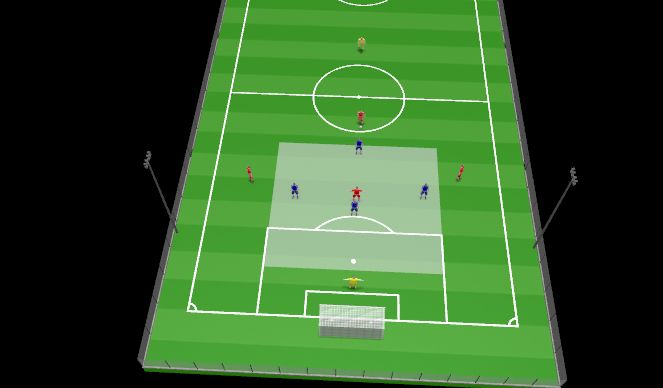
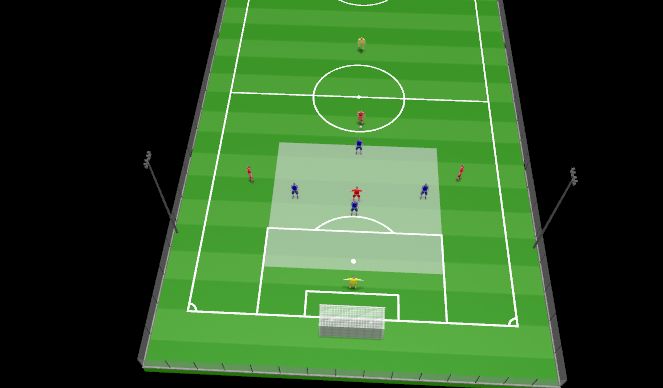
Small-Sided Game
36-44 yards in Length
26–32 yards in Width
Targets: both teams score in the opposing team's goal. Normal game, no corners.
Starting point: either end, no corners; play starts from the GKs.
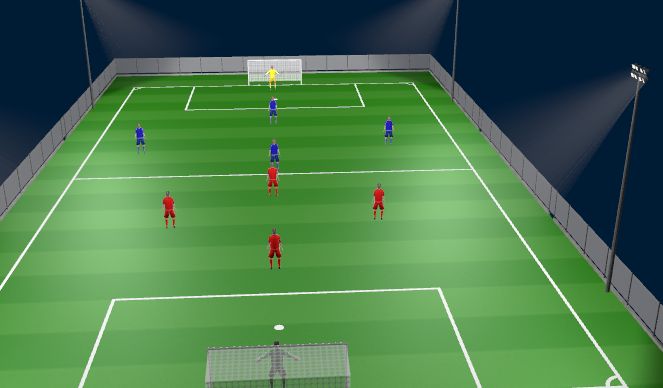
Problem: Opposition management - blue team to break lines through, around, and over. The blue team aims to drag the red team out of their shape, which allows for space behind the defensive unit. To do so, the STs need to move between the defensive units, in this case, the CMs and the CBs
Solution: coaching red team - coaching points: defend as a group, stay narrow and compact (5 to 10 yards max distances between players and units), protect the middle (squeeze and press covering the central split passes), protect the space behind (scan by looking around and understand what is happening around the ball, opposition movement and possible pass to the closest opponent in line with the ball ready to receive), fast pressure on the ball (trigger to a quick pressure on the ball when opponent struggled to control the ball or facing own goal and noticing the ball speed is slow). GK to communicate with the defensive line and alarm the CBs when to drop and challenge
What ifs...? - what if one of the blue STs turns and runs with the ball, attacking the box? CBs should step and engage, making themselves big and forcing the opponent wide. If ST beats one of the CB, is the other CB close enough to cover and intervene? Should he delay the press, allowing the rest of the team to support and defend?
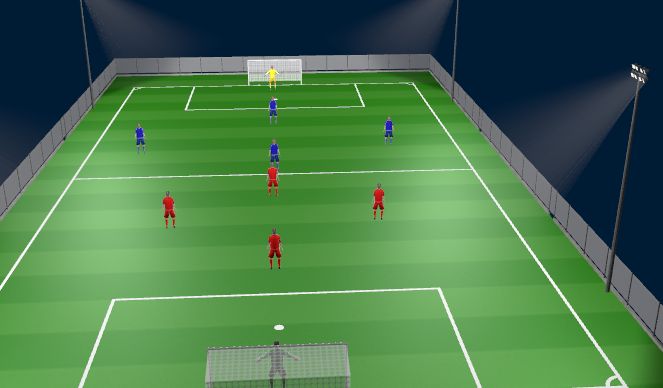
Problem: Opposition management—the blue team to break lines through, around, and over. Wingers to stay high and wide on the side white lines. The CMs are to move, create space, receive the ball if not marked, or create space for the STs to receive the ball, attempting to score or break the lines in wide areas for the Ws to cross, combine, and 1v1 challenges. Focus on ball speed and movement to spread and create gaps between the defensive units.
Solution: coaching the red team—coaching points: defend as a group, stay narrow and compact (5 to 10 yards max distances between players and units), protect the middle (squeeze and press covering the central split passes), protect the space behind (scan by looking around and understand what is happening around the ball, opposition movement, and possible pass to the closest opponent in line with the ball ready to receive), and apply fast pressure on the ball (trigger a quick pressure on the ball when the opponent struggles to control the ball or is facing their own goal and the ball speed is slow).
What ifs...? - What if one of the blue STs drops to create an overload in the midfield? Should one of the CBs follow? And if yes, what should the rest of the unit do? Narrow the gap left by the CB; leave the furthest opponents from the ball unmarked. Or should the CMs screen an eventual pass attempt to the blue ST or blue CMs?