


Football/Soccer Session (Beginner): Playing out from the back U8-U11
Profile Summary

| Name: | Christopher Ruiz |
|---|---|
| City: | Lutz |
| Country: | United States of America |
| Membership: | Adult Member |
| Sport: | Football/Soccer |

Description
PRINCIPLES OF PLAY
• Positioning between and behind opposition lines
• Finding the free player
UNOPPOSED TECHNICAL WARM-UP
• This practice is an unopposed technical warm-up, laying down the foundations of playing out from the back. • The practice sees a group of 14 players split into two groups of seven.
FUNCTION
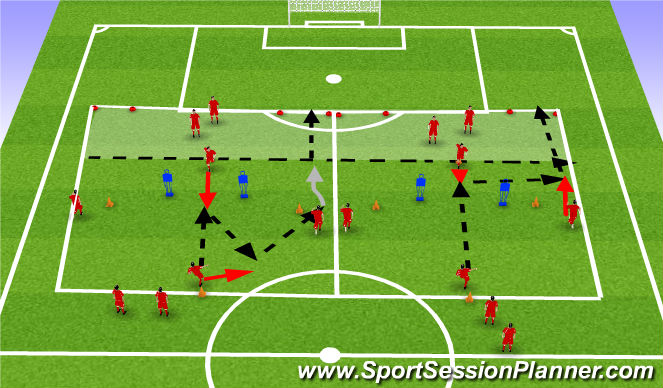
• This unopposed technical warm-up begins as pictured in Diagram 1.
• The ball begins with a player at Cone 1. As they touch the ball out of their feet, one of the players at Cone 3 drops to receive (Pass 1) and sets the ball with one touch (Pass 2) on an angle back to the original player at Cone 1, who has moved to receive.
• This player receives with the back foot to quickly play towards a third player – who is moving forward from Cone 2 – between the pole and the cone within 2 touches (Pass 3).
• The player at Cone 2 receives with the back foot, with the aim of crossing the dashed orange line with the ball under control before finishing in the small goal (Pass 4).
• Diagram 2 shows a variation where the ball is played into a player at Cone 3 (Pass 1), who moves to receive behind the mannequins with a side-on body shape.
• As the ball is travelling to the player at Cone 3, the player at Cone 2 begins to move forward to receive the pass outside (Pass 2).
• This player again receives with the back foot, to collect on the run and cross the dotted orange line before finishing in the small goal (Pass 3).
• In both sequences, the players will rotate from Cone 1 to Cone 2 to Cone 3.
• The practice can extend to playing the ball out in the same way before working it to a player at Cone 4 to finish in the small goal on the opposite side.
COACHING DETAIL: TECHNICAL
TIMING OF MOVEMENTS
• The players positioned on Cone 3 will ‘unmark’ themselves by initiating their movements in the opposite direction of where they would like to receive the ball. Players should use two or three steps to create appropriate space and move towards the ball as the player on the ball takes a touch out of their feet and lifts their head. This visual connection is important.
• The players at Cone 2 in Diagram 1 will move towards the player at Cone 1 as the ball is being set backwards. As the player at Cone 1 takes their first touch, they will quickly initiate their movement forward to receive between the cone and pole, in order to receive a forward pass. Pointing with the arm forward can help the ball-carrier know where the player at Cone 2 wants to receive the ball.
• In Diagram 2, players at Cone 2 will move towards the player at Cone 1 as they take their first touch out of their feet. As the ball travels into the player at Cone 3, the player at Cone 2 will quickly accelerate in order to receive a pass outside and behind the mannequin line.
WEIGHT AND ACCURACY OF PASS
• It is important that all passes are kept on the ground to allow the receivers to have the best opportunity to complete the next play.
• When playing to a teammate’s feet, a stronger weight of pass can be used towards the foot furthest from pressure.
• When passing into space towards a teammate’s movement, players should prioritise accuracy over power.
RECEIVING WITH A SIDE-ON BODY SHAPE
• When receiving and passing with two touches, the player receiving the ball must first move towards the space they want to move into. It is important to receive with the back foot, to remain facing forward and receive away from pressure.
RECEIVING ON THE RUN
• When receiving on the run, the receiver should move their body in a side-on manner. However, when the ball is approximately 2 metres away, they should lower their hips for better balance to push the ball towards the space they are moving into.
• That first touch will then ideally be 1 or 2 metres away from their body, to allow them to maintain their running speed.
See the guidance at the top of this page to understand why you are not seeing interactive Football/Soccer images.
Learning Objectives

|
Technical first touch weight of pass |

|
Tactical movement to create passing lane and combine |

|
Physical smooth movements to simulate game |

|
Psychological knowing where to open where to move according to teammates movements |

|
Social communication |
'%3E%3Cpath id='path4169' d='M 11.4375,70.25 C 11.457031,38.394531 37.277344,13.242188 68.253906,13.050781 99.78125,12.855469 125.73047,38.351563 125.8125,70.078125 125.89844,101.62109 100.43359,127.14063 69.148438,127.42188 37.582031,127.70703 11.464844,102.23438 11.4375,70.25 m 6.425781,-0.08984 c 0.03516,28.421871 23.027344,50.69922 50.519532,50.82031 C 96.433594,121.10156 119.30469,98.367188 119.38281,70.359375 119.45313,42.878906 97.382813,19.714844 69.015625,19.496094 40.75,19.277344 17.964844,42.035156 17.863281,70.160156' style='clip-rule:nonzero;fill:%23333f48;fill-opacity:1;fill-rule:nonzero;stroke:none' /%3E%3Cpath style='fill:%23333f48;fill-opacity:1;fill-rule:nonzero;stroke:none' d='m 39.789063,108.62109 c 0.28125,0.14454 0.550781,0.32032 0.839843,0.4336 2.734375,1.05469 5.554688,1.78125 8.453125,2.23047 2.734375,0.42578 5.484375,0.64453 8.25,0.54297 3.988282,-0.15625 7.832032,-0.94922 11.445313,-2.69532 1.683594,-0.8164 3.246094,-1.82422 4.640625,-3.07422 3.265625,-2.92578 5.171875,-6.582027 5.796875,-10.906246 0.546875,-3.761719 0.04687,-7.425781 -1.09375,-11.019531 -1.4375,-4.523438 -3.730469,-8.582032 -6.703125,-12.265625 -1.03125,-1.277344 -2.082031,-2.535157 -3.113281,-3.808594 C 66.789063,66.1875 65.332031,64.269531 64.0625,62.21875 c -1.601562,-2.582031 -2.835937,-5.316406 -3.613281,-8.261719 -0.683594,-2.574218 -0.902344,-5.1875 -0.6875,-7.828125 0.214844,-2.617187 0.910156,-5.117187 2.152344,-7.441406 2.164062,-4.050781 5.503906,-6.710937 9.816406,-8.179687 1.890625,-0.640625 3.835937,-1.058594 5.832031,-1.195313 1.121094,-0.07813 2.242188,-0.152344 3.363281,-0.164062 4.28125,-0.02734 8.4375,0.734375 12.453125,2.175781 1.871094,0.671875 3.6875,1.496094 5.523438,2.257812 0.226562,0.09375 0.4375,0.230469 0.664062,0.351563 -0.164062,0.25 -0.371093,0.160156 -0.539062,0.164062 -2.824219,0.101563 -5.535156,0.703125 -8.132813,1.804688 -1.335937,0.570312 -2.570312,1.316406 -3.648437,2.296875 -2.527344,2.296875 -3.605469,5.15625 -3.34375,8.550781 0.140625,1.855469 0.722656,3.574219 1.550781,5.222656 0.648438,1.296875 1.414063,2.523438 2.292969,3.675782 0.953125,1.25 1.929687,2.484375 2.929687,3.699218 2.085938,2.523438 4.164063,5.054688 6.050782,7.738282 2.203125,3.136718 4.140627,6.417968 5.589847,9.980468 1.16406,2.867188 2.01562,5.820313 2.39843,8.894532 0.25,2.011718 0.30079,4.03125 0.11719,6.058593 -0.24219,2.640625 -0.79297,5.195313 -1.74609,7.667969 -1.29688,3.36328 -3.300784,6.22656 -5.972659,8.63281 -2.429687,2.19141 -5.171875,3.90625 -8.109375,5.3125 -2.695312,1.29297 -5.464843,2.40235 -8.34375,3.20313 -1.953125,0.54687 -3.945312,0.8789 -5.949218,1.15625 -3.035157,0.41797 -6.085938,0.48828 -9.132813,0.3125 -5.328125,-0.3125 -10.476562,-1.46094 -15.410156,-3.52344 -3.449219,-1.44141 -6.691406,-3.25781 -9.757813,-5.39453 -0.183593,-0.12891 -0.378906,-0.25 -0.53125,-0.41016 -0.07031,-0.0703 -0.05859,-0.22656 -0.08203,-0.34375 z m 0,0' id='path4175' /%3E%3Cpath style='fill:%23333f48;fill-opacity:1;fill-rule:nonzero;stroke:none' d='M 94.699219,29.390625 C 94.089844,29.21875 93.476563,29.054688 92.867188,28.875 90.183594,28.085938 87.46875,27.441406 84.703125,27.046875 c -3.976562,-0.566406 -7.945312,-0.59375 -11.863281,0.402344 -7.535156,1.914062 -12.386719,6.71875 -14.878906,13.996094 -0.894532,2.617187 -1.179688,5.328125 -0.953125,8.078125 0.203125,2.484375 0.867187,4.859375 1.816406,7.160156 0.933594,2.261719 2.117187,4.390625 3.4375,6.449219 1.4375,2.25 3.050781,4.371093 4.640625,6.511718 1.4375,1.933594 2.867187,3.871094 4.261719,5.835938 1.230468,1.730469 2.316406,3.546875 3.273437,5.445312 1.324219,2.625 2.265625,5.378907 2.703125,8.292969 0.433594,2.902344 0.292969,5.765625 -0.660156,8.5625 -0.9375,2.74609 -2.574219,5.00781 -4.777344,6.875 -2.417969,2.04688 -5.203125,3.39844 -8.246094,4.22266 -1.835937,0.5 -3.703125,0.75781 -5.609375,0.82031 -3.886718,0.13281 -7.679687,-0.47266 -11.421875,-1.46094 -2.261718,-0.59765 -4.488281,-1.33203 -6.695312,-2.11328 -0.207031,-0.0742 -0.40625,-0.16797 -0.597656,-0.25 -0.02344,-0.24609 0.148437,-0.19141 0.25,-0.20703 1.96875,-0.30469 3.921875,-0.67969 5.804687,-1.34766 1.367188,-0.48437 2.671875,-1.10156 3.855469,-1.94922 2.25,-1.61328 3.65625,-3.765621 4.0625,-6.515621 0.273437,-1.867188 0.09375,-3.710938 -0.429688,-5.527344 -0.472656,-1.648437 -1.171875,-3.199219 -2.109375,-4.628906 -0.792968,-1.207031 -1.636718,-2.382813 -2.523437,-3.519531 -0.921875,-1.195313 -1.921875,-2.328125 -2.890625,-3.484375 -2.753906,-3.273438 -5.351563,-6.660157 -7.523438,-10.355469 -2.042968,-3.480469 -3.667968,-7.136719 -4.597656,-11.078125 -0.640625,-2.699219 -0.980469,-5.4375 -0.832031,-8.214844 0.238281,-4.53125 1.476562,-8.78125 3.824219,-12.6875 1.082031,-1.800781 2.445312,-3.375 3.988281,-4.800781 2.742187,-2.527344 5.863281,-4.480469 9.257812,-5.992188 3.746094,-1.667968 7.652344,-2.769531 11.707032,-3.394531 3.152343,-0.488281 6.324218,-0.671875 9.507812,-0.519531 8.632813,0.410156 16.671875,2.792969 24,7.433594 0.08203,0.05078 0.152344,0.109375 0.230469,0.167968 -0.0039,0.04297 -0.0078,0.08984 -0.01563,0.136719' id='path4177' /%3E%3Cpath style='fill:%23333f48;fill-opacity:1;fill-rule:nonzero;stroke:none' d='m 31.699219,38.75 c -0.07813,0.238281 -0.152344,0.476563 -0.238281,0.710938 -1.460938,4.074218 -2.066407,8.28125 -1.808594,12.59375 0.4375,7.304687 2.808594,13.925781 7.277344,19.753906 3.714843,4.84375 7.441406,9.671875 11.167968,14.503906 1.113282,1.441406 1.953125,3.007813 2.414063,4.777344 0.332031,1.257812 0.425781,2.539062 0.273437,3.820312 -0.214843,1.832032 -1.070312,3.34375 -2.464843,4.546875 -0.984375,0.851559 -2.113282,1.449219 -3.316407,1.925779 -1.378906,0.54297 -2.8125,0.89063 -4.273437,1.1211 -2.226563,0.35547 -4.46875,0.46093 -6.722656,0.41015 -0.589844,-0.0156 -1.046875,-0.18359 -1.433594,-0.625 -0.636719,-0.72265 -1.335938,-1.39062 -1.9375,-2.14062 C 25.574219,93.800781 22.300781,86.621094 20.84375,78.636719 20.152344,74.835938 19.917969,71 20.15625,67.128906 20.796875,56.773438 24.390625,47.574219 30.859375,39.480469 c 0.21875,-0.273438 0.453125,-0.53125 0.679688,-0.796875 0.05469,0.02344 0.109375,0.04297 0.160156,0.06641' id='path4179' /%3E%3Cpath style='fill:%23333f48;fill-opacity:1;fill-rule:nonzero;stroke:none' d='m 105.41016,101.30078 c -0.13282,-0.3125 0.0234,-0.5039 0.0977,-0.69922 1.38672,-3.749997 1.98047,-7.628904 1.89844,-11.621091 -0.14453,-6.84375 -2.08594,-13.144531 -5.73437,-18.925781 C 99.890625,67.226563 97.917969,64.53125 95.835938,61.917969 94.4375,60.160156 92.988281,58.4375 91.582031,56.6875 90.632813,55.511719 89.6875,54.335938 88.792969,53.121094 c -0.835938,-1.144531 -1.488281,-2.398438 -1.953125,-3.742188 -0.523438,-1.515625 -0.695313,-3.070312 -0.511719,-4.652343 0.21875,-1.839844 1.082031,-3.339844 2.476563,-4.542969 1.039062,-0.890625 2.230468,-1.507813 3.503906,-1.980469 1.632812,-0.609375 3.320312,-0.960937 5.046875,-1.175781 1.917969,-0.238281 3.839841,-0.269531 5.769531,-0.230469 0.52734,0.01172 0.89453,0.203125 1.23828,0.585938 5.50391,6.113281 9.26172,13.144531 11.21875,21.132812 1.11719,4.554688 1.5625,9.179688 1.30469,13.855469 -0.58203,10.625 -4.23438,20.082031 -10.96094,28.339846 -0.15625,0.1914 -0.32812,0.375 -0.51562,0.58984' id='path4181' /%3E%3Cpath style='fill:%23333f48;fill-opacity:1;fill-rule:nonzero;stroke:none' d='m 39.796875,108.63281 c -0.05859,0.0117 -0.117187,0.0234 -0.175781,0.0352 0.05469,-0.0156 0.113281,-0.0312 0.167969,-0.0469 z m 0,0' id='path4183' /%3E%3C/g%3E%3C/svg%3E)
 Play animation
 Play step-by-step
 Repeat (toggle)
 Full Screen
 Pause
Pause Stop
Stop
Unopposed technical warm up (20 mins)
PRINCIPLES OF PLAY
• Positioning between and behind opposition lines
• Finding the free player
UNOPPOSED TECHNICAL WARM-UP
• This practice is an unopposed technical warm-up, laying down the foundations of playing out from the back. • The practice sees a group of 14 players split into two groups of seven.
FUNCTION
• This unopposed technical warm-up begins as pictured in Diagram 1.
• The ball begins with a player at Cone 1. As they touch the ball out of their feet, one of the players at Cone 3 drops to receive (Pass 1) and sets the ball with one touch (Pass 2) on an angle back to the original player at Cone 1, who has moved to receive.
• This player receives with the back foot to quickly play towards a third player – who is moving forward from Cone 2 – between the pole and the cone within 2 touches (Pass 3).
• The player at Cone 2 receives with the back foot, with the aim of crossing the dashed orange line with the ball under control before finishing in the small goal (Pass 4).
• Diagram 2 shows a variation where the ball is played into a player at Cone 3 (Pass 1), who moves to receive behind the mannequins with a side-on body shape.
• As the ball is travelling to the player at Cone 3, the player at Cone 2 begins to move forward to receive the pass outside (Pass 2).
• This player again receives with the back foot, to collect on the run and cross the dotted orange line before finishing in the small goal (Pass 3).
• In both sequences, the players will rotate from Cone 1 to Cone 2 to Cone 3.
• The practice can extend to playing the ball out in the same way before working it to a player at Cone 4 to finish in the small goal on the opposite side.