
Football/Soccer Session (Beginner): OLQP Coaching Workshop U6-U8 (Start Time: 2024-03-23 08:30:00)

Football Life
Louis Baron

Description
Session Objective: Using some classic games, this session teaches players how to dribble and run with the ball at speed, using good technique.
Level: U6-U8
Principles of Play:
Part 1: Warm up: (Engage 10-15mins)
Part 2: Practice: (Educate 20-25mins)
Part 3: Game: (Explore 25-30mins)
See the guidance at the top of this page to understand why you are not seeing interactive Football/Soccer images.

Learning Objectives

|
Technical The art of dribbling and Running with the Ball at speed |

|
Tactical N/A |

|
Physical This is a high energy game that requires and develops good cardio fitness |

|
Psychological This game is easy to grasp |

|
Social This game is highly social as it works on team dynamics |
See the guidance at the top of this page to understand why you are not seeing interactive Football/Soccer images.
Learning Objectives
|
|
Technical This game helps player dribble and RWB at high speed and using changes of direction and speed |
|
|
Tactical N/A |
|
|
Physical This game requires and develops good cardio fitness and game conditioning |
|
|
Psychological This game is very simple to understand |
|
|
Social This game is highly social and great for team-building |
20 mins
OVERVIEW:
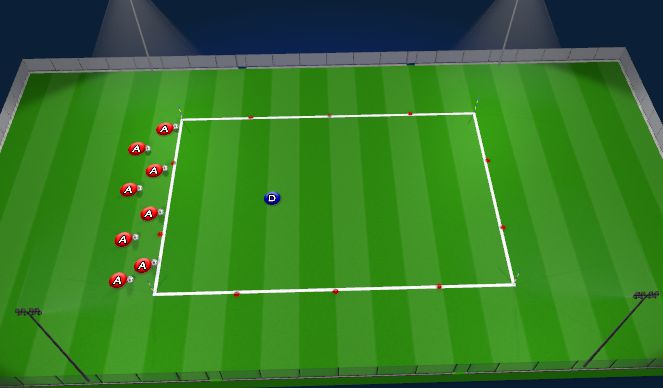
- Setup an area approx. 30 x 30
- As per the diagram/video nominate 1 player to be the defender and ask all other players to start behind the same end-line.
- When the coach shouts "Ball Rush" attacking players aim to make it to the opposite end-line without having their ball knocked out of the playing area.
- The defender's job is to knock attackers balls out of the playing area. When they do this, attackers then become defenders.
- The last attacker to have their ball knocked out the playing area wins.
Attackers:
- Encourage players to run using the outside of their foot. This is to maximise ball control and speed.
- Encourage players to get their heads up while running with the ball. This is to teach them the importance of being aware of their surroundings e.g., space to exploit and opponents/defenders to avoid.
- Encourage attacking players to use different skills to beat defenders in 1 v 1 duels e.g., body-feints/dropping the shoulder to unbalance defenders; quick change of direction and speed to get past defenders.
- Challenge defenders to be brave by applying early pressure (pressing) on attackers. This is to force attackers into making mistakes, thereby giving defenders an opportunity to steal the ball off them or knock the ball out of the playing area.
- In summary, encourage defenders with the 4 'S's when pressing attackers:
Slow: once the defender is approx. 2-3 meters from the attacker, they slow up with their legs bent and on their toes.
Surf: as defenders slow up they get into a 'surfing' body stance (i.e., side on body position) so that they're ready to block or intercept.
Steal: as defenders maintain a 'surfing' body position, they wait to 'steal' the ball from the attacker. This is all about good timing, being prepared to tackle the attacker. Some tackling/stealing triggers are...
- when the attacker takes a bad or heavy touch
- when the attacker drops his/her eyes or head to look at the ball
- when the attacker gets forced towards the side-line
- when the attacker turns his/her back on the defender
PRINCIPLES OF PLAY:
Attacking:
- Penetration: players learn the importance of running with the ball at speed.
- Mobility: players learn how to use their body movements (change of direction/speed) to out smart and unbalance defenders.
- Pressing: players learn the art of applying early/brave pressure on attackers.
PROGRESSIONS:
- Instead of defenders knocking attackers' balls out of the playing area, you could ask them to dribble the ball out of the playing area. This will gives attackers the opportunity to 'counter-press' and win the ball back to run across the opposite end-line.
- You could setup mini goals each end and ask defenders to score in any of the goals after they've won the ball off attackers.
- Play without balls.
See the guidance at the top of this page to understand why you are not seeing interactive Football/Soccer images.
Learning Objectives
|
|
Technical This game develops players dribbling and defending skills |
|
|
Tactical As more defenders are added to the game, they will need to think about tactics/strategies to win the ball off attackers |
|
|
Physical This game requires and develops good cardio fitness and game conditioning |
|
|
Psychological This game is very simple to understand |
|
|
Social This game is highly social and great for team-building |
ADDITIONAL COACHING DETAILS:
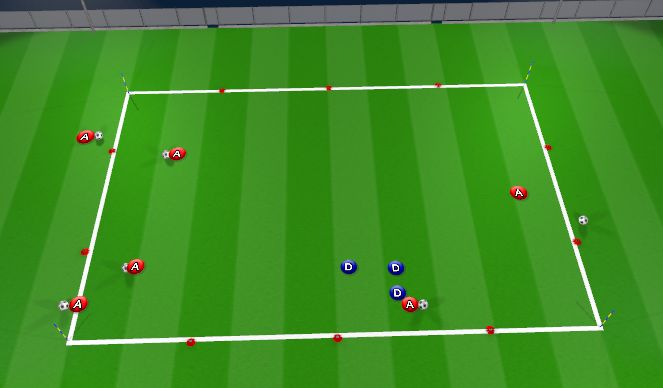
Defenders: As the number of defenders increase, encourage them to consider operating as a team. Here is a perfect opportunity to introduce players to the following Defending Principles of Play:
- Pressure/Pressing: 1st defender. This is the defender closest to the attacker being defended. see details above under Ball Rush (A)
- Cover/Support: 2nd defender. This is the defender that supports the 1st defender, providing cover in order to trap the attacker or limit the attackers options.
- Balance/Depth: 3rd defender. This is the defender(s) that take up intelligent positions behind the 1st and 2nd defenders. They might position themselves to cut out passing lanes/options OR to be ready to tackle if the attacker beats the 1st and 2nd defender.
See the guidance at the top of this page to understand why you are not seeing interactive Football/Soccer images.
Learning Objectives
|
|
Technical |
|
|
Tactical |
|
|
Physical |
|
|
Psychological |
|
|
Social |
30 mins
OVERVIEW:
End Line Conditioned Game.
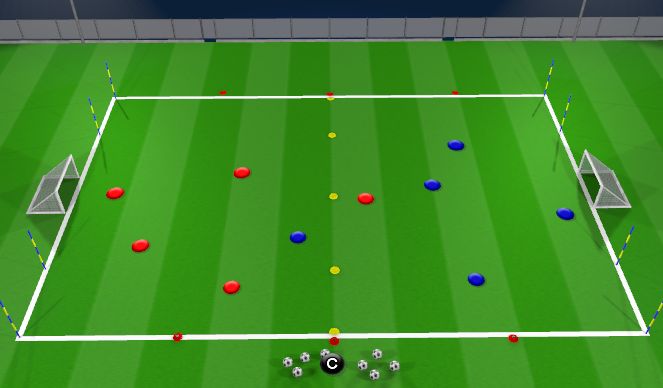
- Setup a rectangular playing area suitable for the number of players e.g., not too small, not too big.
- As per the diagram, divide the playing area in half (shown by the yellow disc markers).
- Place training x2 poles OR cones in each of the four corners of the pitch. Place them 3-4 yards apart, creating four gates (see diagram/video).
- Place a mini goal at each end.
- Place all balls with the coach (see diagram/video).
- Game starts with the coach passing the ball into play.
- To keep a high level of intensity and game tempo, the coach plays a fresh ball into play whenever the ball goes out of play. Ask players to NOT retrieve balls that go out of play. This is a waste of time. Once all the balls have been used, pause for a quick drink break and reset the balls to restart the game.
- 1 point is awarded for scoring in the mini goal
- 2 points are awarded for dribbling the ball through one of your opponents two gates. The ball MUST be dribbled through the gates, NOT kicked or passed through.
- 3 points are awarded when the dribble begins in your own half.
- Award a bonus point if a player successfully dribbles through the gate whilst using their weaker foot.
- Seek to coach on-the-run as much as possible. It's totally fine to pause the game if there's an important coaching point to make (must be something related to the main objective(s) of the training session). However, try not to interrupt the flow of the game too often as this is frustrating for players who just want to play the game.
- Praise players who are continually aiming to dribble and RWB.
- Praise players who make good decisions e.g., when to dribble and when to not to dribble but pass instead (see additional notes below).
- Praise players for applying the defending Principles of Play: Pressure/Cover/Balance.
Width/Space: encourage players to not all follow the ball (bunching). This is something as coaches you'll need to repeat again and again and again!! But be patient. This conditioned game is a perfect opportunity to coach the Principle of width. Therefore: encourage players to make well-timed runs off the ball in wide areas (watch video for an example of this).
Courage: dribbling/RWB demands courage, so praise players for attempting to dribble with the ball. Some players will be apprehensive, but encourage them to be brave and give dribbling a go. They might be pleasantly surprised!

 Play animation
 Play step-by-step
 Repeat (toggle)
 Full Screen
 Pause
Pause Stop
Stop
10 mins
OVERVIEW:
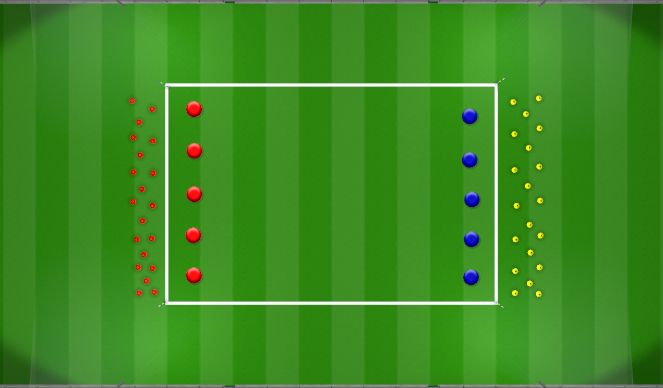
- Setup an area approx. 30 x 25
- As per the diagram/video place a number of different coloured cones each side of the playing area (a different colour for each team).
- The aim of the game is for each team to pick up as many of their opponents cones as possible within a specified time period (2-3mins per round is ideal).
- Each player can only pick up ONE cone at a time.
- This is a great warm-up game. The first round can be played without a ball. The second round should be played with each player running with a ball at their feet, thus working on the core skill of dribbling and RWB.
- Play 2 or 3 rounds.
COACHING DETAILS:
PRINCIPLES OF PLAY:
- Penetration: players learn the importance of running with the ball at speed.
PROGRESSIONS: - Ask players to use their weaker, less dominant foot (typically their left foot) when running with the ball.
REGRESSION: