


Football/Soccer Session (Moderate): Youth - Session 5: Expansive Football (Part 1) (Start Time: 2018-03-02 15:30:00)


Premier Users' Club
Paul Inns
Profile Summary

| Name: | Paul Inns |
|---|---|
| City: | Newtown |
| Country: | United Kingdom |
| Membership: | Adult Member |
| Sport: | Football/Soccer |

Description
Expansive Football
See the guidance at the top of this page to understand why you are not seeing interactive Football/Soccer images.
See the guidance at the top of this page to understand why you are not seeing interactive Football/Soccer images.
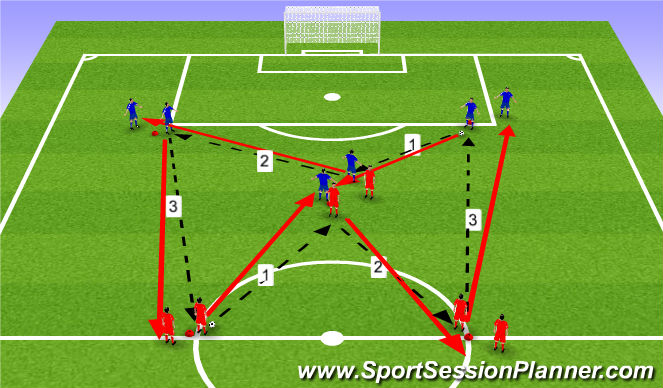
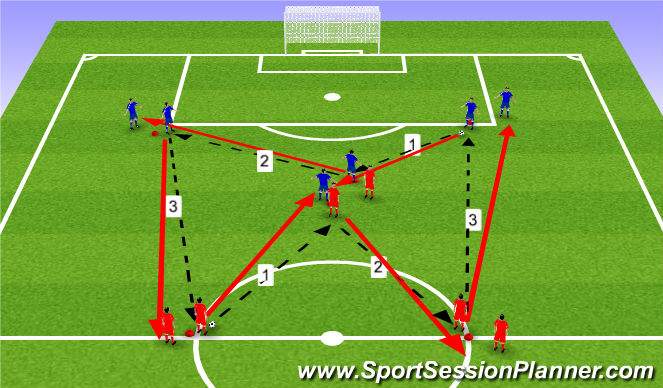
Drill - Positional Passing Square with Short and Long Support Play
Objective
To improve short/long passing, combination play and timing of movement to provide support.
Description
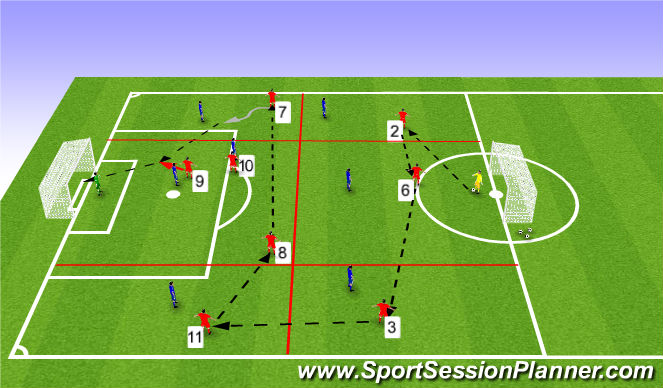
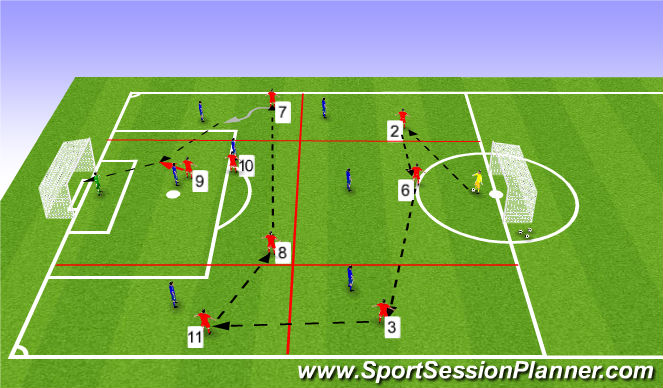
Segt up area as above. Create two teams - 6 x red and 6 x blue, working in a passing combination exercise. The players start in the positions shown.
Use two balls simultaneously in opposite corners.
Coaching Points
1. For this passing sequence to be quick and flow efficiently, players should check away before moving to receive the pass which makes it easier to play with one touch.
2. The players and the ball should be constantly moving.
Progressions
1. 2 touch only on all passes
2. 2 touch on long passes, one touch passing on shorter lengths.
See the guidance at the top of this page to understand why you are not seeing interactive Football/Soccer images.
Function - Building Up Play in a 6 Zone 9v9
Instructions
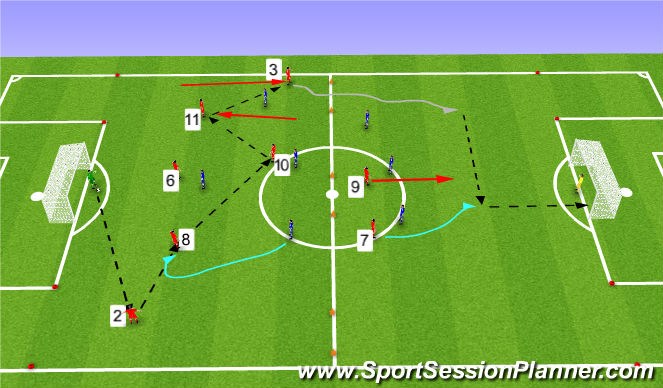
Use half a full sized pitch, divided with cones into 6 equal areas.
Split players into 2 teams - 9 x red and 8 x blue, including GKs.
Red team play in a 2-2-3-1 formation. Blue team play in a 4-3 formation.
Players are not restricted to any one area.
Objective
To develop possession play with intelligent tactical movement and explosive physical movements (acceleration).
Instructions
Ball starts with the Red team each time. Before they can score, the ball must be played through all 3 zones in the defensive half before being able to progress into the oppositions half, where again, the red team must play the ball through all 3 zones before attempting to score.
If the blue team gain possession, they have 10 secs to score.
Coaching Points
Effect the Outfield Players:
1. Players must offer support to the player in possession - providing continuity and security. The players nearest the player with the ball should be continuously moving within passing range of the player in possession.
2. Try to create overloads - create a numerical suprtiority in and around the ball zone. Stagger players diagonally so as to create passing lines; triangles of play. Positioning of players around the ball is all important. Players must be in the correct positions and oriented correctly so that they are always available in every situation to be effective and efficient during every move.
Effect the GK: The collaboration of the goalkeeper is very important as he can serve as an additional outfield player at any moment and always provides us with a numerical advantage at the back.
Effect No.9: Should always stay high up the pitch, providing attacking depth as a spear head.
Objectives are:
1. Create Space
2. Open up the pitch vertically (forward movement to stretch the opposition).
3. Constantly move, trying to lose his marker.
4. Be free to break into open space in behind the defensive line.
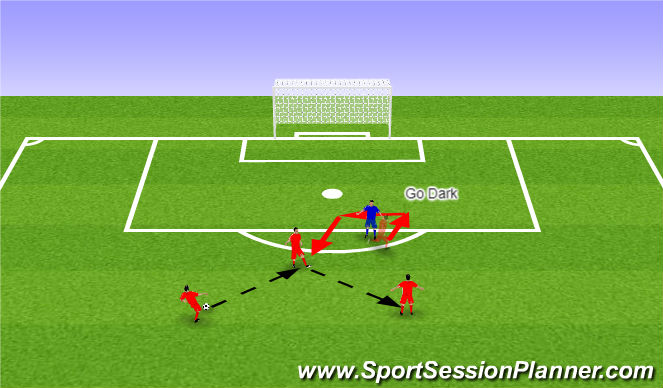
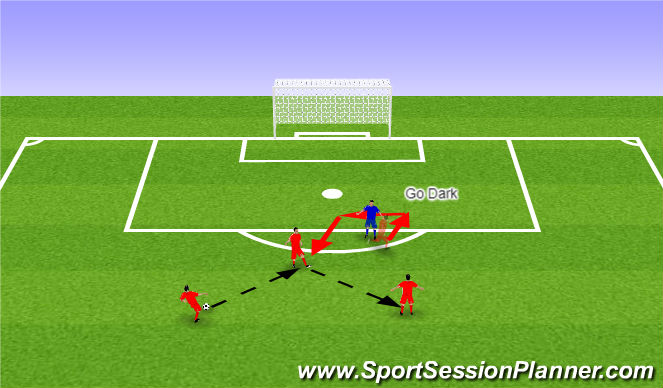
One movement that the centre forward should perform before he receives the ball is to 'go dark', looking to receive the ball in an area where his marker is unable to see both him and the ball simultaneously. The forward should move around behind his marker as shown in the previous illustration, or look to run onto a ball played over his shoulder.
Effect No.6: Remain behind the ball; Provide support and be an 'escape valve' if play becomes too congested. Look to switch play to make use of open areas and numerical superiority.
Effect No.2&3: It is important that full backs push forward when the ball is out wide, to give us a numerical advantage with the support of the No.8 and LMF or RMF.
See the guidance at the top of this page to understand why you are not seeing interactive Football/Soccer images.
SSG - Attacking from back to Front in an 9v8 Game with Cone Gates
Organisation
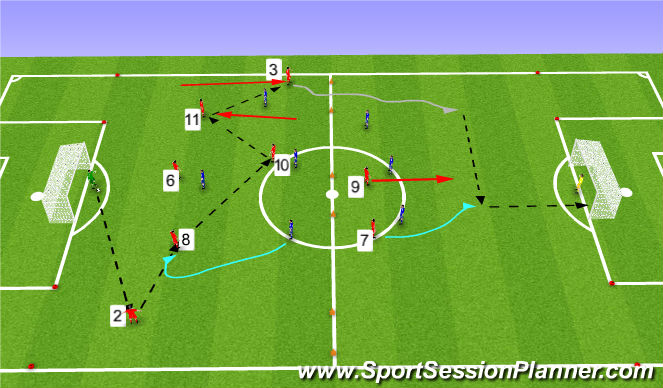
Set up a pitch playing penalty area to penalty area, full width. Create 3 coned gates on the half way line as illustrated.
Divide players into two team - 9 x red and 8 x blue - including 2 GK's.
Red team to be coached.
Red team play in a 2-2-3-1 formation - no CB's.
Blue team play in a 3-3-1 formation.
Instructions
Before being allowed to try and score in the goal, team in possession must first play the ball through one of the 3 coned gates - either by passing or dribbling. The ball cannot be played directly from LMF to RMF - the players in the centre must be used.
The defending team seek to try and block them.
Coaching Points
1. The attacking team should use the FB's to create 2v1 situations out wide.
2. Red no.9 stays in the opposition half and acts as an outlet - provides depth to the attack.
3. Circulate the ball quickly.
4. Keep possession of the ball even if it means going backwards.
5. If there is an equality in numbers of players in and around the ball zone, move the ball to the opposite side of the pitch (switch play) - search for a space where we do have a numerical advantage and can create a 2v1, 3v1 or 3v2 situation. We need to find the easiest way to progress towards the opponents goal, whether that be through the centre of the pitch or down the flanks.
6. It is important to pass to a player facing you if you have your back to goal, for two reasons - it may not be easy to turn as there is probably an opponent behind you; the receipient has a better view of the whole of the pitch and can play to a 'third man'.
7. Dribbling is a key element in a positional game as ity increases player density in some areas and creates space in others. Retaining the ball draws the opposition into space around the player with the ball, to free teammates in other areas. Players must retain the ball to draw specific opponents to specific areas so teammates are free to run into space. It also gives time to your teammates so that they are in their natural positions and can begin to be or continue to be dangerous.
'%3E%3Cpath id='path4169' d='M 11.4375,70.25 C 11.457031,38.394531 37.277344,13.242188 68.253906,13.050781 99.78125,12.855469 125.73047,38.351563 125.8125,70.078125 125.89844,101.62109 100.43359,127.14063 69.148438,127.42188 37.582031,127.70703 11.464844,102.23438 11.4375,70.25 m 6.425781,-0.08984 c 0.03516,28.421871 23.027344,50.69922 50.519532,50.82031 C 96.433594,121.10156 119.30469,98.367188 119.38281,70.359375 119.45313,42.878906 97.382813,19.714844 69.015625,19.496094 40.75,19.277344 17.964844,42.035156 17.863281,70.160156' style='clip-rule:nonzero;fill:%23333f48;fill-opacity:1;fill-rule:nonzero;stroke:none' /%3E%3Cpath style='fill:%23333f48;fill-opacity:1;fill-rule:nonzero;stroke:none' d='m 39.789063,108.62109 c 0.28125,0.14454 0.550781,0.32032 0.839843,0.4336 2.734375,1.05469 5.554688,1.78125 8.453125,2.23047 2.734375,0.42578 5.484375,0.64453 8.25,0.54297 3.988282,-0.15625 7.832032,-0.94922 11.445313,-2.69532 1.683594,-0.8164 3.246094,-1.82422 4.640625,-3.07422 3.265625,-2.92578 5.171875,-6.582027 5.796875,-10.906246 0.546875,-3.761719 0.04687,-7.425781 -1.09375,-11.019531 -1.4375,-4.523438 -3.730469,-8.582032 -6.703125,-12.265625 -1.03125,-1.277344 -2.082031,-2.535157 -3.113281,-3.808594 C 66.789063,66.1875 65.332031,64.269531 64.0625,62.21875 c -1.601562,-2.582031 -2.835937,-5.316406 -3.613281,-8.261719 -0.683594,-2.574218 -0.902344,-5.1875 -0.6875,-7.828125 0.214844,-2.617187 0.910156,-5.117187 2.152344,-7.441406 2.164062,-4.050781 5.503906,-6.710937 9.816406,-8.179687 1.890625,-0.640625 3.835937,-1.058594 5.832031,-1.195313 1.121094,-0.07813 2.242188,-0.152344 3.363281,-0.164062 4.28125,-0.02734 8.4375,0.734375 12.453125,2.175781 1.871094,0.671875 3.6875,1.496094 5.523438,2.257812 0.226562,0.09375 0.4375,0.230469 0.664062,0.351563 -0.164062,0.25 -0.371093,0.160156 -0.539062,0.164062 -2.824219,0.101563 -5.535156,0.703125 -8.132813,1.804688 -1.335937,0.570312 -2.570312,1.316406 -3.648437,2.296875 -2.527344,2.296875 -3.605469,5.15625 -3.34375,8.550781 0.140625,1.855469 0.722656,3.574219 1.550781,5.222656 0.648438,1.296875 1.414063,2.523438 2.292969,3.675782 0.953125,1.25 1.929687,2.484375 2.929687,3.699218 2.085938,2.523438 4.164063,5.054688 6.050782,7.738282 2.203125,3.136718 4.140627,6.417968 5.589847,9.980468 1.16406,2.867188 2.01562,5.820313 2.39843,8.894532 0.25,2.011718 0.30079,4.03125 0.11719,6.058593 -0.24219,2.640625 -0.79297,5.195313 -1.74609,7.667969 -1.29688,3.36328 -3.300784,6.22656 -5.972659,8.63281 -2.429687,2.19141 -5.171875,3.90625 -8.109375,5.3125 -2.695312,1.29297 -5.464843,2.40235 -8.34375,3.20313 -1.953125,0.54687 -3.945312,0.8789 -5.949218,1.15625 -3.035157,0.41797 -6.085938,0.48828 -9.132813,0.3125 -5.328125,-0.3125 -10.476562,-1.46094 -15.410156,-3.52344 -3.449219,-1.44141 -6.691406,-3.25781 -9.757813,-5.39453 -0.183593,-0.12891 -0.378906,-0.25 -0.53125,-0.41016 -0.07031,-0.0703 -0.05859,-0.22656 -0.08203,-0.34375 z m 0,0' id='path4175' /%3E%3Cpath style='fill:%23333f48;fill-opacity:1;fill-rule:nonzero;stroke:none' d='M 94.699219,29.390625 C 94.089844,29.21875 93.476563,29.054688 92.867188,28.875 90.183594,28.085938 87.46875,27.441406 84.703125,27.046875 c -3.976562,-0.566406 -7.945312,-0.59375 -11.863281,0.402344 -7.535156,1.914062 -12.386719,6.71875 -14.878906,13.996094 -0.894532,2.617187 -1.179688,5.328125 -0.953125,8.078125 0.203125,2.484375 0.867187,4.859375 1.816406,7.160156 0.933594,2.261719 2.117187,4.390625 3.4375,6.449219 1.4375,2.25 3.050781,4.371093 4.640625,6.511718 1.4375,1.933594 2.867187,3.871094 4.261719,5.835938 1.230468,1.730469 2.316406,3.546875 3.273437,5.445312 1.324219,2.625 2.265625,5.378907 2.703125,8.292969 0.433594,2.902344 0.292969,5.765625 -0.660156,8.5625 -0.9375,2.74609 -2.574219,5.00781 -4.777344,6.875 -2.417969,2.04688 -5.203125,3.39844 -8.246094,4.22266 -1.835937,0.5 -3.703125,0.75781 -5.609375,0.82031 -3.886718,0.13281 -7.679687,-0.47266 -11.421875,-1.46094 -2.261718,-0.59765 -4.488281,-1.33203 -6.695312,-2.11328 -0.207031,-0.0742 -0.40625,-0.16797 -0.597656,-0.25 -0.02344,-0.24609 0.148437,-0.19141 0.25,-0.20703 1.96875,-0.30469 3.921875,-0.67969 5.804687,-1.34766 1.367188,-0.48437 2.671875,-1.10156 3.855469,-1.94922 2.25,-1.61328 3.65625,-3.765621 4.0625,-6.515621 0.273437,-1.867188 0.09375,-3.710938 -0.429688,-5.527344 -0.472656,-1.648437 -1.171875,-3.199219 -2.109375,-4.628906 -0.792968,-1.207031 -1.636718,-2.382813 -2.523437,-3.519531 -0.921875,-1.195313 -1.921875,-2.328125 -2.890625,-3.484375 -2.753906,-3.273438 -5.351563,-6.660157 -7.523438,-10.355469 -2.042968,-3.480469 -3.667968,-7.136719 -4.597656,-11.078125 -0.640625,-2.699219 -0.980469,-5.4375 -0.832031,-8.214844 0.238281,-4.53125 1.476562,-8.78125 3.824219,-12.6875 1.082031,-1.800781 2.445312,-3.375 3.988281,-4.800781 2.742187,-2.527344 5.863281,-4.480469 9.257812,-5.992188 3.746094,-1.667968 7.652344,-2.769531 11.707032,-3.394531 3.152343,-0.488281 6.324218,-0.671875 9.507812,-0.519531 8.632813,0.410156 16.671875,2.792969 24,7.433594 0.08203,0.05078 0.152344,0.109375 0.230469,0.167968 -0.0039,0.04297 -0.0078,0.08984 -0.01563,0.136719' id='path4177' /%3E%3Cpath style='fill:%23333f48;fill-opacity:1;fill-rule:nonzero;stroke:none' d='m 31.699219,38.75 c -0.07813,0.238281 -0.152344,0.476563 -0.238281,0.710938 -1.460938,4.074218 -2.066407,8.28125 -1.808594,12.59375 0.4375,7.304687 2.808594,13.925781 7.277344,19.753906 3.714843,4.84375 7.441406,9.671875 11.167968,14.503906 1.113282,1.441406 1.953125,3.007813 2.414063,4.777344 0.332031,1.257812 0.425781,2.539062 0.273437,3.820312 -0.214843,1.832032 -1.070312,3.34375 -2.464843,4.546875 -0.984375,0.851559 -2.113282,1.449219 -3.316407,1.925779 -1.378906,0.54297 -2.8125,0.89063 -4.273437,1.1211 -2.226563,0.35547 -4.46875,0.46093 -6.722656,0.41015 -0.589844,-0.0156 -1.046875,-0.18359 -1.433594,-0.625 -0.636719,-0.72265 -1.335938,-1.39062 -1.9375,-2.14062 C 25.574219,93.800781 22.300781,86.621094 20.84375,78.636719 20.152344,74.835938 19.917969,71 20.15625,67.128906 20.796875,56.773438 24.390625,47.574219 30.859375,39.480469 c 0.21875,-0.273438 0.453125,-0.53125 0.679688,-0.796875 0.05469,0.02344 0.109375,0.04297 0.160156,0.06641' id='path4179' /%3E%3Cpath style='fill:%23333f48;fill-opacity:1;fill-rule:nonzero;stroke:none' d='m 105.41016,101.30078 c -0.13282,-0.3125 0.0234,-0.5039 0.0977,-0.69922 1.38672,-3.749997 1.98047,-7.628904 1.89844,-11.621091 -0.14453,-6.84375 -2.08594,-13.144531 -5.73437,-18.925781 C 99.890625,67.226563 97.917969,64.53125 95.835938,61.917969 94.4375,60.160156 92.988281,58.4375 91.582031,56.6875 90.632813,55.511719 89.6875,54.335938 88.792969,53.121094 c -0.835938,-1.144531 -1.488281,-2.398438 -1.953125,-3.742188 -0.523438,-1.515625 -0.695313,-3.070312 -0.511719,-4.652343 0.21875,-1.839844 1.082031,-3.339844 2.476563,-4.542969 1.039062,-0.890625 2.230468,-1.507813 3.503906,-1.980469 1.632812,-0.609375 3.320312,-0.960937 5.046875,-1.175781 1.917969,-0.238281 3.839841,-0.269531 5.769531,-0.230469 0.52734,0.01172 0.89453,0.203125 1.23828,0.585938 5.50391,6.113281 9.26172,13.144531 11.21875,21.132812 1.11719,4.554688 1.5625,9.179688 1.30469,13.855469 -0.58203,10.625 -4.23438,20.082031 -10.96094,28.339846 -0.15625,0.1914 -0.32812,0.375 -0.51562,0.58984' id='path4181' /%3E%3Cpath style='fill:%23333f48;fill-opacity:1;fill-rule:nonzero;stroke:none' d='m 39.796875,108.63281 c -0.05859,0.0117 -0.117187,0.0234 -0.175781,0.0352 0.05469,-0.0156 0.113281,-0.0312 0.167969,-0.0469 z m 0,0' id='path4183' /%3E%3C/g%3E%3C/svg%3E)
 Play animation
 Play step-by-step
 Repeat (toggle)
 Full Screen
 Pause
Pause Stop
Stop
Introduction to Expansive Football
Expansive Football
1. In seeking width, we must always look to progess forwards, in depth.
2. Aim to keep possession of the ball with the secondary objective of scoring a goal.
3. In order to play Expansive Football efficiently, the ball must be circulated quickly - which means that we must have a good positional game.
4. Look to attack the passive areas, where the space is, moving the ball from one side to the other - find space and gaps created by the movement, in order to progress and penetrate.
5. Expansive football is a type of positional attack that takes the movement of players into account more than the system adopted (eg. 4-2-3-1).
6. We must focus on depth as well as width. The full back must connect with the LMF or RMF; overlapping/underlapping runs; No.8 provides support from a deep defensive position, No.6 provides support and security; No.9 moves vertically, providing deep attacking support.
7. Keep possession of the ball, even if it means going backwards.
8. Players must stay the optimum distance away from the player in possession - so as not to draw their marker too close to the player with the ball and reduce his space.
9. Switch of play is a key concept. By moving the ball from one side to the other we will create an imbalance in the opponents defensive unit. Through moving the ball from one flank to the other and back to the middle we can begin to penetrate, using a series of movements to look for the attacking pass in behind the defensive line.
10. Do not play horizontal passes as they are easy for the opponent to intercept. players must be staggered and diagonal.
11. Passes must be technically correct, accurate and played with the necessary strength to facilitate a quick passing game. 'A pass is successful if it is received by the intended recipient, who must receive a gift of a pass, not a problem of a pass'.
12. If there is an equality in numbers of players in and around the ball zone, move the ball to the opposite side of the pitch (switch play) - search for a space where we do have a numerical advantage and can create a 2v1, 3v1 or 3v2 situation. We need to find the easiest way to progress towards the opponents goal, whether that be through the centre of the pitch or down the flanks.
13. It is important to pass to a player facing you if you have your back to goal, for two reasons - it may not be easy to turn as there is probably an opponent behind you; the receipient has a better view of the whole of the pitch and can play to a 'third man'.
14. A wide game does not mean playing down the flanks, but moving the ball from one side to the other.
15. Play between the opponent's defensive and midfield lines (especially the central players)
16. Dribbling is a key element in a positional game as ity increases player density in some areas and creates space in others. Retaining the ball draws the opposition into space around the player with the ball, to free teammates in other areas. Players must retain the ball to draw specific opponents to specific areas so teammates are free to run into space. It also gives time to your teammates so that they are in their natural positions and can begin to be or continue to be dangerous.
17. 'Compensatory Movements' are very important and balance the team to make sure taht the team retains its shape and there are sufficient numbers at back in case the ball is lost.
18. We should always try to retain a defensive traingle behind the ball between the CBs and No.6.