
Football/Soccer Session (Academy Sessions): Breaking lines Attacking SSG

FAW Coach Ed
Tyler Hamilton

Description
Organisation (Practice Layout & Transition)
See the guidance at the top of this page to understand why you are not seeing interactive Football/Soccer images.
See the guidance at the top of this page to understand why you are not seeing interactive Football/Soccer images.
small sided game
Category: Tactical: Midfield Progression & Zone Breaking
Skill Level: U16
Pro-Club: FAW
Practice Title: Controlled Build-Up & Zonal Progression (Attacking Through the Thirds)
Topic: Playing Through the Thirds – Breaking Lines with Control and Timing
Social Skills Focus: Patience, communication, decision-making
Organisation
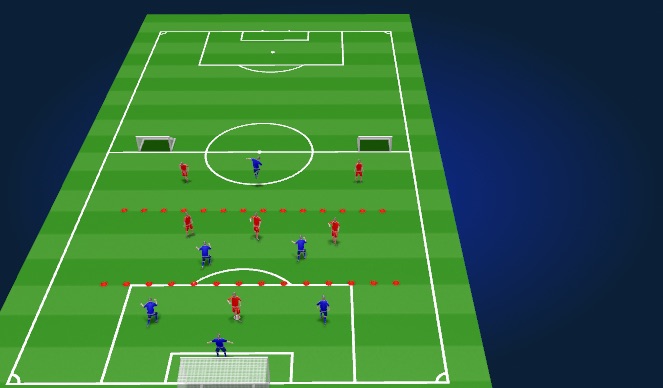
Divide the pitch into three horizontal zones using flat markers (defensive, midfield, and attacking thirds).
Each third has designated players – they must remain in their zone unless otherwise stated.
One main goal defended by the blue team (with a goalkeeper), and two small goals defended by the red team.
Ball starts with either team depending on the phase.
Each player is limited to three touches maximum.
To move from one zone to the next, teams must find a pass into a teammate already positioned in the next zone.
Initially, teams must go through all three zones in order before attacking.
How the Practice Works
Start with the red team in possession in their defensive third.
They must play through the zones in sequence by finding a player in the next third.
Once they reach the attacking third, they aim to score in the two mini-goals.
The blue team starts in a compact shape, pressing in their zones and aiming to intercept and transition to attack.
When the blue team wins the ball, they must progress through the zones and then attack the large goal.
Both teams switch attacking direction halfway through the activity to experience defending and attacking both sets of goals.
Coaching Points
Timing of movement to receive in the next zone
Body shape when receiving under pressure
Passing angles and combinations to progress through thirds
Encourage quick scanning and decisions under a 3-touch limit
Teams must remain composed and build gradually, not force play
Progressions
Allow one player to break into the next zone once the ball is played forward (create overloads).
Add a floating neutral player who can move freely across zones.
After one successful switch, allow teams to skip a zone with a direct forward pass if space is identified.
Regressions
Remove touch restriction if players struggle to maintain flow.
Increase zone size to give more time on the ball.
Allow support from coach to play the first ball into the next zone if players hesitate.
Challenges, Conditions & Targets
Challenge: Can you progress through all zones using no more than 2 passes per zone?
Condition: 3-touch maximum per player in all zones.
Target: First team to score 3 structured goals (after full zone progression).
Social: Can players communicate clearly and give visual cues to receive?
Team Switch & Timing
Total session: 25 minutes
Block 1 (10–12 mins): Red team attacks small goals, blue defends large goal
Block 2 (10–12 mins): Switch roles – blue attacks small goals, red defends large goal
Final 1–2 mins: Open reflection or player-led analysis
Ensure equal opportunity for both teams to experience different attacking/defending strategies
See the guidance at the top of this page to understand why you are not seeing interactive Football/Soccer images.
Instructions & Game Rules
See the guidance at the top of this page to understand why you are not seeing interactive Football/Soccer images.
ssg
Category: Game – Tactical Focus on Overloads & Zone Progression
Skill Level: U16
Practice Title: Breaking Zones & Creating Overloads – Small-Sided Game
Topic: Progression Through Zones – Breaking Lines to Create Attacking Opportunities
Social Pillar Focus: Communication, team coordination, game intelligence
Organisation
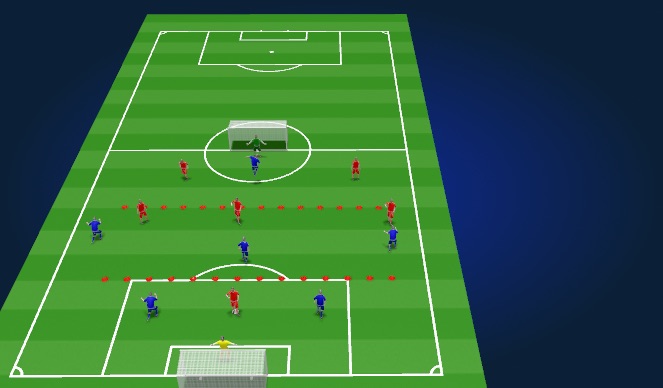
Pitch divided into 3 horizontal zones using flat markers
Teams: 7v7 including goalkeepers
Each team has 2 players in each third and 1 floating midfielder who can join either middle or attacking third
Players must remain in their zones unless conditions are met
Rules & Objectives (First 10–15 Minutes)
Players are locked into their zone initially.
A player may enter the next zone only:
After passing forward into it
After dribbling into it successfully
This movement creates an overload (e.g. 3v2 in the next zone)
You must build your attack through each zone — no direct long passes skipping zones
Encourage quick circulation and support runs when progressing forward
Defensive team must recover compactly when the opposition enters their third
Scoring System
Normal goals = 1 point
If a team scores after successfully creating an overload (e.g. 3v2 or 4v3 in final third), award 2 points
Progression (Final 8–10 Minutes)
Unlock all players: Free movement across zones
Play normal match rules, but maintain awareness of zone control and overloads
Encourage players to transfer what they learned (line-breaking, support play, timing)
Coaching Points
Pass or dribble with purpose to break into next zone
Movement off the ball after playing forward
Communication between lines: who supports? Who sits?
Transition moments – can you quickly get numbers into the next zone?
Defensive reaction – can you recover or delay when outnumbered?
Challenges, Conditions & Targets
Challenge: Can your team create an overload and score within 10 seconds of entering the final third?
Condition: Entry into a new zone must be followed by a pass or shot within 5 seconds
Target: Create 3 overloads that lead to a shot per block
Social: Emphasise leadership and communication from the central midfielder
Timing: 20–25 Minutes
Block 1 (10–15 minutes): Structured rules using zones + overload condition
Block 2 (8–10 minutes): Free play with focus on retaining tactical discipline
Use final minutes for reflection or player-led analysis ("Where did we create the most danger?")

 Play animation
 Play step-by-step
 Repeat (toggle)
 Full Screen
 Pause
Pause Stop
Stop
Warm-Up
Category: Physical & Technical Activation – Warm-Up with Ball
Skill Level: U16
Practice Title: Dynamic Warm-Up & Rondo-Based Positional Play
Topic: Warm-Up Activation – Movement Preparation & Midfield Awareness
Social Focus: Communication, focus, and teamwork during warm-up routines
Organisation
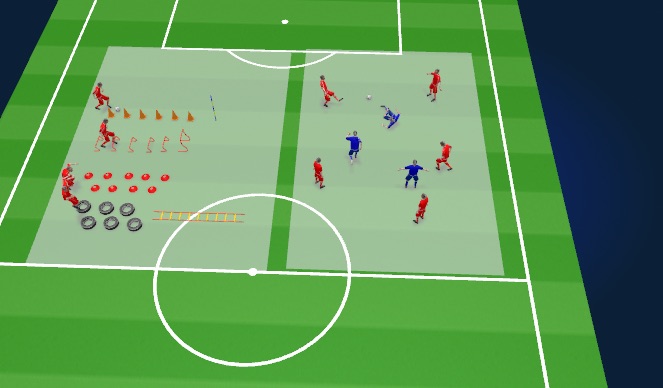
Total area: 30m x 30m
Two working zones:
Left side: Dynamic physical warm-up circuit (cones, ladders, agility rings, mini-hurdles)
Right side: 2 small rondo grids for 5v3 possession games
14 players split into 2 groups of approx. 7players
Structure & Flow (15 Minutes Total)
Phase 1 – Physical Warm-Up (5 minutes)
Players rotate through 4–6 activation stations (ladder work, cone turns, short sprints, hurdle jumps, and reaction gates)
Emphasis on:
Jogging with changes of direction
Reaction to coach cues (e.g., clap = sprint, call = change direction)
Light ball work at the end (dribble and pass to next player)
Phase 2 – Positional Rondo (10 minutes)
5 attackers vs 3 defenders in small grids (adjusted based on space)
Attackers aim to retain possession, using 2–3 touches
Defenders rotate every 60–90 seconds
Focus on quick movement, awareness of space, creating angles
Coaching Points
Phase 1 – Physical Activation:
High energy and sharp reactions from the start
Controlled body mechanics: knees up, low center of gravity
Encourage rhythm and fluidity during ladder and cone drills
Positive mindset entering the technical phase
Phase 2 – Rondo Positional Play:
Always create angles and passing lanes
One or two-touch max where possible
Constant