
Football/Soccer Session (Advanced): Possession Under Pressure - Finding the best way to penetrate

Highland Football Club
Hasani McKenzie

Build 3D sessions in seconds
Access to 1000’s of sessions
Professionalise and modernise your coaching
Used by the world’s best coaches
US$
85
per year
Join today
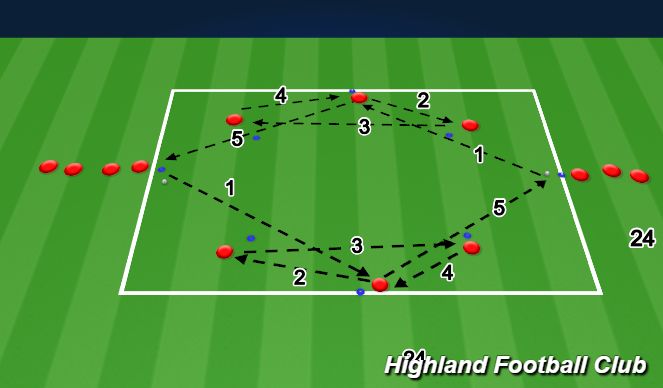
See the guidance at the top of this page to understand why you are not seeing interactive Football/Soccer images.
See the guidance at the top of this page to understand why you are not seeing interactive Football/Soccer images.
20 mins
Set Up:
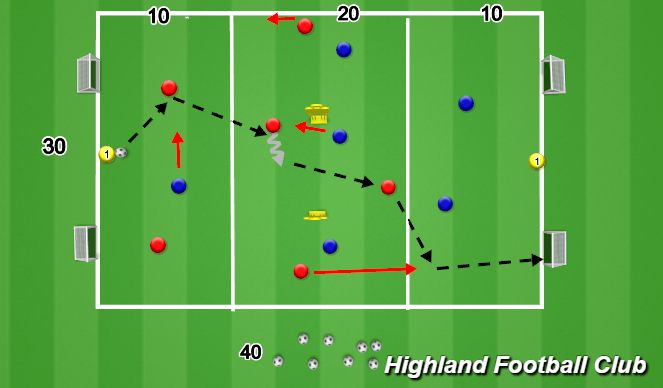
- This game begins as a 6v6, plus goalkeepers.
- It is played on a pitch measuring 40 yards by 30 yards, split into three zones, with two mini-goals at either end.
- Offsides apply in the two end zones. Two mannequins are located centrally to form a gate, as in the diagram.
- The coach (C) will start and restart the game, which is directional – both teams attack one way.
- Both teams have three ways to score a point: make 10 consecutive passes, play a pass through the two mannequins, or score in either of their target mini-goals.
- The diagram shows the red team scoring in a mini-goal, after also scoring a point by playing through the mannequins.
- Goalkeepers can play for their team when in possession, but should stay on the goal line. They are allowed to enter the playing area to make saves in either mini-goal.
- If player numbers are not even, or players drop out in the session, the coach can alter the scoring options for each team. For example, if a team has a player advantage, they can only score in the mini-goals.
- The practice runs for four working blocks, with the coach adapting the practice in each block, to set different challenges.
- This can be done by increasing the number of points a team is awarded for a particular method of scoring, or by changing the number of players on a team.
- For example, awarding five points for a successful pass through the central gate should force the defending team to narrow and block the central spaces.
- By taking a player from one team to create a 7v5 (plus goalkeepers), the underloaded team should react by dropping into a low block and looking to counter-attack with long passes.
- The team of five can still score in three ways, while the team of seven can only score in the mini-goals.
Coaching Points
In Possession
- Inviting pressure - Teams should be comfortable inviting pressure into the defensive third, in order to create space in the middle and final thirds.
- Making the pitch as big as possible - The coach should instruct the in-possession team to make the pitch as big as possible. This will create space for them to combine in between the opposition’s units.
- Change of ball speed - Changing the ball speed from slow to quick will draw the opposition in, to create space in other areas for the attacking team to exploit.
- Keep the ball moving - The coach should stress the importance of keeping the ball moving. This will give the in-possession team constant opportunities to move the opposition’s defensive shape around.
- Quick passing combinations - During the game, players must look to combine quickly, using a limited amount of touches. This will enhance the chances of disrupting the opposition’s shape. Ball speed here must also be quick.
- Narrow and compact - To restrict central passes through the mannequins, the out-of-possession team should stay as narrow and compact as possible, to force play outside.
- Pressing triggers - The coach should challenge players to recognize pressing opportunities. Triggers may include poor passes from the opposition, slow ball speed and miscontrolled passes.
- Pressure and counter-pressure - Players/the team should recognize chances to apply aggressive pressure, in order to disrupt possession or steal the ball.
See the guidance at the top of this page to understand why you are not seeing interactive Football/Soccer images.
20 mins
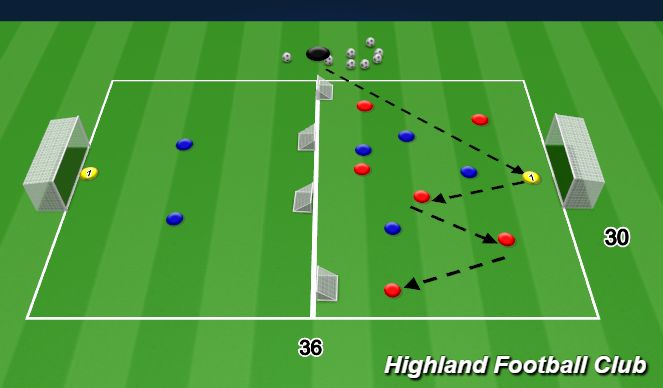
Set Up:- This possession-based game is set up using two teams of six and two goalkeepers.
- The pitch measures 36 yards by 30 yards and is split into two halves. Four mini-goals are placed along the middle – two facing either way – with two full-sized goals at either end, as shown in the diagram
- The game begins with teams in their own halves, and the coach (C) passing into a designated in-possession team – Red in the diagram.
- This will trigger four pressing players from the Blue team to sprint into the possession team’s half.
- The in-possession team has two different ways to score a point: make five consecutive passes in order to open up their two mini-goals to pass into, or make 10 consecutive passes.
- If the pressing team steals the ball, they can score in the big goal, or play back into their half – where their two spare players are – to maintain possession.
- If they play backwards, the practice will continue in the opposite half; four players from the now out-of-possession team will advance into that half to press.
- Play for four blocks of three minutes.
- Teams should swap halves after two blocks.
In Possession
- Breaking lines - The coach should stress the importance of recognizing chances to play piercing passes, to break lines when under high pressure. These passes should be played into space, to help relieve pressure.
- Switching play - If the pressing four players have halved the pitch, making it difficult to play short passes, the player in possession should look to switch play to break the press.
- Penetrating through central areas - The coach should encourage the players to use penetrative passes through central areas, which can help them to gain more points. Here, they can use a switch of play to draw the defending team out wide, before using quick combinations to play centrally.
- Locking it in - Restricting space and locking play into small areas will enhance the chances of winning possession. This can be done by forcing the ball into wide areas and ensuring players are around the ball to steal possession.
- Pressing together - The four pressing players – who with the opposition goalkeeper are underloaded 7v4 – must ensure they are pressing together. This will help when trying to restrict space, but will also make it more difficult for the in-possession team to play through them.
Build 3D sessions in seconds
Access to 1000’s of sessions
Professionalise and modernise your coaching
Used by the world’s best coaches
US$
85
per year
Join today

 Play animation
 Play step-by-step
 Repeat (toggle)
 Full Screen
 Pause
Pause Stop
Stop
15 mins
Set Up:
Coaching Points: