
Football/Soccer Session (Academy Sessions): FAW UEFA B OA3 Specific Practice & LSG - Breaking Lines (Attacking) (Start Time: 2025-11-07 12:40:00)

FAW Coach Ed
Othmane Kabbadj

Description
Breaking Lines (Attacking)
Category: Tactical — Penetration
Format: Specific Practice (SP) → Large Sided Game (LSG)
Derived from: 3-5-2 (condensed to GK (server) + CB, RWB, CM, LWB, CAM, RS, LS)
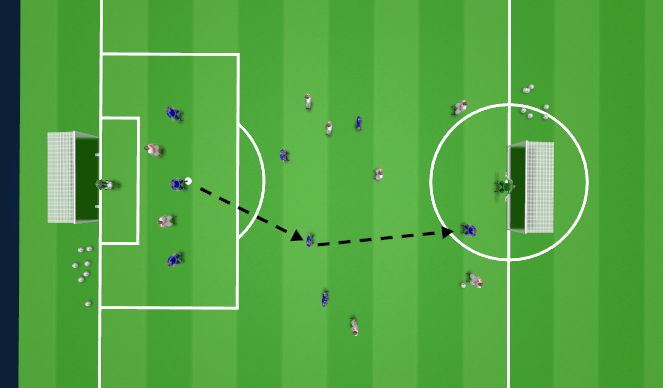
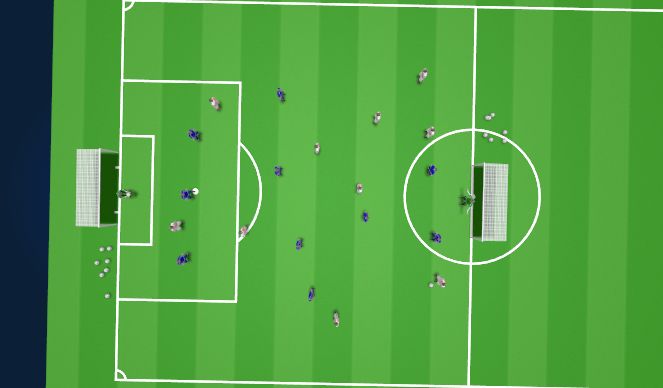
Pitch: 60m × 40m
Total session time (core): SP Block 1 = 10' (3 × 3' + 60″ terminal break) → Transition 2' → LSG Block 2 = 10' (2 × 4½' + 60″ terminal break)
Players: 8 (server GK + 7 outfield)
Session Objective (Primary — tactical)
Develop collective behaviours to break defensive lines by practising: timely positional rotations, vertical & diagonal penetration, swift switches of play and immediate collective pressing on loss. Use the GK as the server to initiate realistic build-up scenarios.
Pitch Geography & Layout
Defensive third (20m) — GK & CB start here.
Transitional third (20m) — CM & CAM operate here.
Attacking third (20m) — RS & LS occupy this space, with RWB/LWB in wide corridors.
Timings
-
SP Block 1: 10′ total = 3 × 3 mins of specific practice + 60 secs terminal break at end of Block 1
-
Transition
-
LSG Block 2: 10′ total = 2 × 4½ mins of LSG + 60 secs terminal break at end of Block 2
Roles & Responsibilities (tactical focus — what to look for & coach)
CB
-
Anchor; scan for vertical diagonal passes to CAM or wing-backs.
-
After passing: rotate laterally to create angles; if pressed, step into midfield to form temporary 3rd line.
-
On loss: organise cover, call pressing triggers.
RWB / LWB
-
Provide width and direct passing outlet from build-up; overlap RS/LS; make diagonal runs behind the last line.
-
After pass: invert into half-space (support CM/CAM) to create 2v1s.
-
On loss: recover quickly to block channels; press if opposition is unbalanced.
CM
-
Primary link; screen vertical passing lanes; release line breaks to CAM/strikers.
-
After pass: rotate into vacated space to support switch.
-
On loss: first line of press; cut passing lanes.
CAM
-
Pockets between lines — receive under pressure, play line-breaking passes (through balls / 1–2s).
-
After pass: rotate wide/drop to allow striker to run into space.
-
On loss: immediate counter-press if in attacking third.
RS / LS
-
Occupy last defenders: make decoy/vertical runs to drag defenders and create channels.
-
After pass: drop into half-space or swap roles with teammate to open lanes.
-
On loss: press nearest defender, close passing lanes; then recover.
GK as server
-
Initiates build-up (short to CB or to wing-back). Vary tempo & delivery (short / switch long diagonal) to create different decision-making pressures.
See the guidance at the top of this page to understand why you are not seeing interactive Football/Soccer images.
See the guidance at the top of this page to understand why you are not seeing interactive Football/Soccer images.
10 mins
LSG Block 2 — Transfer to Game (2 × 4½′ mins + 60″ terminal break)
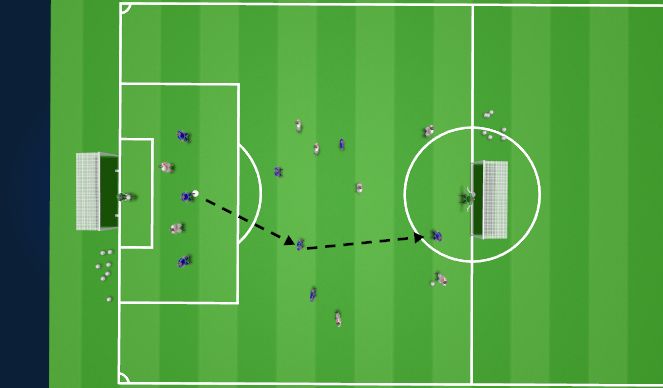
Purpose: Apply the SP behaviours in an LSG environment with opposition pressure and immediate consequences.
Rules / Conditions
-
GK steps into normal play.
-
Rotation enforcement: after a completed line-break, attacking player must rotate position (striker drops / wingback inverts).
-
Free-kick condition: after successful line break into final third or 3+ passes inside the attacking third → award a 20–25m free kick as immediate set-piece practice (simulate transitional restart).
-
Targets: team to attempt ≥3 line-breaking sequences across both LSG bouts.
Terminal break (60″ at end of LSG Block 2)
-
Coach highlights 1 successful pattern and 1 corrective action. Quick tactical micro-task for next session.
See the guidance at the top of this page to understand why you are not seeing interactive Football/Soccer images.
Technical & Tactical Emphasis
Tactical (primary): timing of rotations, when to penetrate vs switch, creating numerical advantages via rotations, pressing triggers.
Technical (support): first touch under pressure, weight/timing of through passes & diagonals, accurate receiving on half-turns, quick one-two passes.
Pressing Triggers (collective)
Triggers: opponent poor first touch, backward pass, facing own goal, pass under pressure.
Collective response: nearest player engages, teammates shift to cut passing lanes; CB & CM coordinate cover.
On / Around / Away from the Ball — Practical "What ifs"
On the ball: If CAM receives and faces pressure → immediate layoff to CM to recycle → CM plays diagonal to wing.
Around the ball: If RWB is pressed, CM must drift to offer 2nd option; CB can step into midfield to create overload.
Away from the ball: Strikers’ runs drag centre-backs; if RS is doubled, LS drifts inside to occupy the vacated CB, enabling CAM to exploit half-space.
GK role: If build-up breaks down, GK must remain available for reset or play long diagonal as a pressure relief.
Set-Piece Integration — Free kicks (SP & LSG)
SP; After a successful line break and goal scored, reset with a a 20–25m free kick.
LSG; Fouls will be called (equally) but opposition will be encouraged to bring down attacking team, for example if a run behind is on, to create the realistic opportunity of implementing the set piece that was worked on in the SP.
Routines:
Short free to CAM → layoff to overlapping wing-back for low driven ball across goal.
Direct driven ball to near post for striker’s run behind CB.
Follow-up: immediate transition practice — must organise quickly if free-kick cleared.
Problems & Solutions (2 key examples)
Problem: CAM gets isolated & immediately turned under pressure → no penetration.
Solution: Pre-planned 1-2 with CM (CAM lays off to CM who then plays diagonal to wing-back). Enforce in SP (coach cue: “one-two now”).Problem: Wing-back receives switch but is isolated (no immediate support).
Solution: Enforce rotation rule: striker drops into half-space or CM rotates wide instantly; coach uses terminal break to call out missed rotations.
Coaching Interventions & Micro-teaching
During 3′ bouts: minimal intervention — short cueing from side-line.
60″ terminal breaks: focused tactical points (1 improvement, 1 reinforcement). Use demo / quick whiteboard or live re-run.
In LSG: stop only for crucial teaching moments; use whistle to reset for free-kick.
Progressions & Regression
Regress: widen time on ball, remove active defender, increase touches allowed for wingbacks.
Progress: add second active defender, impose 1-touch in central channel, reduce allowed time on GK release (simulate press).
Success Criteria / Evidence of Effect
Team completes target number of line-breaking passes/switches per block.
Observable improvements: quicker CAM receipt & release, wing-backs supported by rotations, reduced turnover-to-counter time.
Free-kick sequences executed cleanly on at least 50% of awarded opportunities.

 Play animation
 Play step-by-step
 Repeat (toggle)
 Full Screen
 Pause
Pause Stop
Stop
10 mins
Breaking Lines Specific Practice – High-Intensity Passing & Rotation
(3 sets of 3 minutes with 60-second recovery);
Setup & Pitch-to-Player Ratio:SP Block 1 — Specific Practice (3 × 3 mins + 60″ terminal break)
Purpose: Rehearse structured combinations to penetrate the line with rapid rotations and targeted switching; GK starts every sequence.
Rules / Constraints
GK starts every sequence (server).
RWB/LWB: max 2 touches in wide corridors (challenge).
CAM must receive at least once before finishing sequence (condition).
Targets: per 3′ bout aim for: ≥2 line-breaking passes OR ≥1 successful 20m+ diagonal switch.
Progression across 3 bouts:
Set 1 — Passive opposition (focus on roles & rotations, decision under light pressure).
Set 2 — Active/Aggressive Opposition (Real Pressure, 1v1s etc).
Set 3 — After a successful line break and goal scored, begin resets with a 20–25m free kick.
Terminal break (60″ at end of SP Block 1)
Coach gives 60s focused cue: show 1 tactical point, correct 1 common error, set target for LSG Block 2.