


Football/Soccer Session (Academy Sessions): Match Prep - Building Against a High Press 4-4-2-D Using Wide Overloads


FAW Coach Ed
Matthew Evans
Profile Summary

| Name: | Matthew Evans |
|---|---|
| City: | Windsor |
| Country: | United Kingdom |
| Membership: | Adult Member |
| Sport: | Football/Soccer |

Description
Session Theme:
"Building From the Back – Exploiting Wide Overloads Against an Aggressive Front Screen"
Session Format:
Pitch Size: ¾ Pitch
Structure: 3 x 6-minute blocks with 2-minute tactical coaching interventions
Ball Restart: Always from the Blue GK
Team Objectives:
Blue Team (In Possession): Build through pressure and progress beyond halfway, then score against a goalkeeper
Red Team (Out of Possession): Regain and score within 10 seconds of winning the ball
Session Framing:
Begin with tactical set-up on a whiteboard or tactics board
Clearly frame the in-possession team roles, then allow the pressing team to organise and problem-solve based on the set-up
In Possession Tactical Principles:
Ball Speed: Play quickly to disorganise the opponent
Forward First: If a progressive pass is on, take it
Switch Play: Recognise when to circulate to access space opposite
Defensive Transition Principles:
Immediate Counter-Press: On close regains
Delay and Recover: If pressure isn’t possible, retreat into a compact structure
Condition: If the in-possession team loses the ball, the opposition has 10 seconds to score
See the guidance at the top of this page to understand why you are not seeing interactive Football/Soccer images.
See the guidance at the top of this page to understand why you are not seeing interactive Football/Soccer images.
Block 2
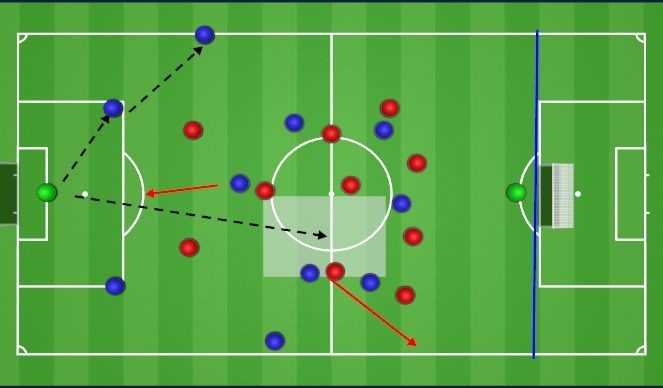
See the guidance at the top of this page to understand why you are not seeing interactive Football/Soccer images.
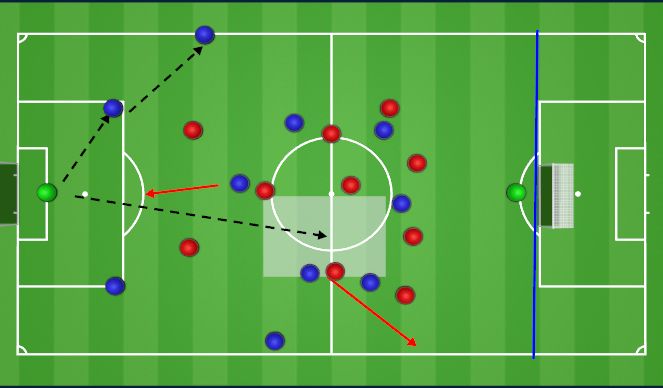
Block 3
Block 3:
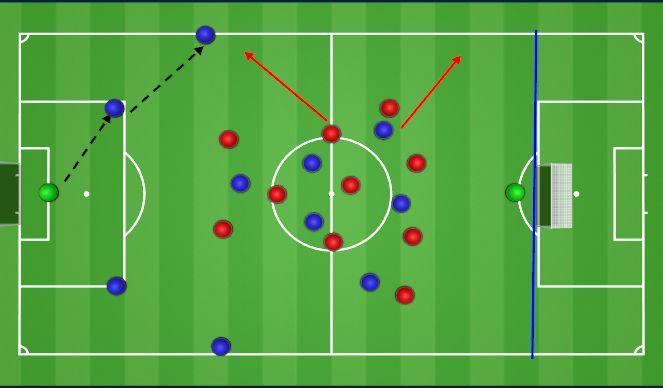
The opposition transitions to a full-pitch man-for-man press, matching players all over the pitch:
Full-backs press full-backs,
The CDM from the opposition diamond drops onto the deepest line,
All midfield options are tightly marked, restricting short build-up options.
Red Team Tactical Solution:
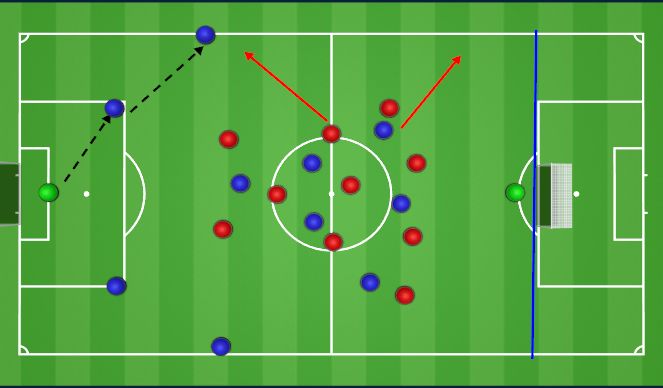
Use vertical stretching and movement off the ball to unbalance the press and create a central target for the striker (ST) to receive directly:
Stretch central midfielders wide and high to vacate space centrally.
Allow GK or CB to clip directly into the ST dropping short to link.
Use wingers on the outside of full-backs to offer penetrating runs beyond the press on the set.
Tactical Detail (Red Team – 3-4-1-2 Structure):
???? Goalkeeper (GK):
Positioned centrally on the 6-yard box.
Identify early which side presents the better exit route based on body shape and pressure.
If passing to a CB, support with an immediate angle for a first-time clipped pass into the ST.
Centre-Backs (CBs):
Right CB: Deeper (aligned with top of 6-yard box), open body shape, ready to play first-time clipped pass into ST using inside foot.
Left CB: Positioned just outside the box, in line with the penalty spot, keeping enough depth to draw pressure from the ST and manipulate the opposition press.
Work in tandem with GK to disguise and execute direct vertical play.
Full-Backs (RB/LB):
Start high — aligned with the bottom edge of the centre circle, dragging their markers away and vacating the zone in front of the ST.
Encourage vertical separation between units to increase space for central progression.
CDM (6):
Start high at the top of the ‘D’, positioned opposite the ball-side CB.
The goal is to lure the opposition CAM into a tighter marking role, increasing space centrally.
Operates as part of a 4v3 overload including GK and CBs.
Attacking Midfielders (CAMs):
Both positioned high and wide (bottom edge of the circle, width of 18-yard box).
Their role is to pull central markers wide, freeing the lane into the ST.
Prepare to receive the second phase or rotate inside once the press is broken.
Striker (ST):
Pin both CBs as high as possible — remain central and in-between.
Drop into the vacated space to receive the clipped pass from GK or CB.
On receiving, set the ball for wide progression or play into the opposite winger's run.
Wingers (RW & LW):
RW: Positioned channel-side of the opposition FB, ready to time forward runs across the ST to link play or receive on the second phase.
LW: Also channel-side of the opposition FB, ready to exploit the space left by the ST dropping in — runs in-behind must be timed to match the ST’s movement and draw.
Key Coaching Points:
Manipulate individual markers by stretching the pitch vertically and horizontally.
Timing of movements critical — ST drop must be coordinated with clipped pass.
'%3E%3Cpath id='path4169' d='M 11.4375,70.25 C 11.457031,38.394531 37.277344,13.242188 68.253906,13.050781 99.78125,12.855469 125.73047,38.351563 125.8125,70.078125 125.89844,101.62109 100.43359,127.14063 69.148438,127.42188 37.582031,127.70703 11.464844,102.23438 11.4375,70.25 m 6.425781,-0.08984 c 0.03516,28.421871 23.027344,50.69922 50.519532,50.82031 C 96.433594,121.10156 119.30469,98.367188 119.38281,70.359375 119.45313,42.878906 97.382813,19.714844 69.015625,19.496094 40.75,19.277344 17.964844,42.035156 17.863281,70.160156' style='clip-rule:nonzero;fill:%23333f48;fill-opacity:1;fill-rule:nonzero;stroke:none' /%3E%3Cpath style='fill:%23333f48;fill-opacity:1;fill-rule:nonzero;stroke:none' d='m 39.789063,108.62109 c 0.28125,0.14454 0.550781,0.32032 0.839843,0.4336 2.734375,1.05469 5.554688,1.78125 8.453125,2.23047 2.734375,0.42578 5.484375,0.64453 8.25,0.54297 3.988282,-0.15625 7.832032,-0.94922 11.445313,-2.69532 1.683594,-0.8164 3.246094,-1.82422 4.640625,-3.07422 3.265625,-2.92578 5.171875,-6.582027 5.796875,-10.906246 0.546875,-3.761719 0.04687,-7.425781 -1.09375,-11.019531 -1.4375,-4.523438 -3.730469,-8.582032 -6.703125,-12.265625 -1.03125,-1.277344 -2.082031,-2.535157 -3.113281,-3.808594 C 66.789063,66.1875 65.332031,64.269531 64.0625,62.21875 c -1.601562,-2.582031 -2.835937,-5.316406 -3.613281,-8.261719 -0.683594,-2.574218 -0.902344,-5.1875 -0.6875,-7.828125 0.214844,-2.617187 0.910156,-5.117187 2.152344,-7.441406 2.164062,-4.050781 5.503906,-6.710937 9.816406,-8.179687 1.890625,-0.640625 3.835937,-1.058594 5.832031,-1.195313 1.121094,-0.07813 2.242188,-0.152344 3.363281,-0.164062 4.28125,-0.02734 8.4375,0.734375 12.453125,2.175781 1.871094,0.671875 3.6875,1.496094 5.523438,2.257812 0.226562,0.09375 0.4375,0.230469 0.664062,0.351563 -0.164062,0.25 -0.371093,0.160156 -0.539062,0.164062 -2.824219,0.101563 -5.535156,0.703125 -8.132813,1.804688 -1.335937,0.570312 -2.570312,1.316406 -3.648437,2.296875 -2.527344,2.296875 -3.605469,5.15625 -3.34375,8.550781 0.140625,1.855469 0.722656,3.574219 1.550781,5.222656 0.648438,1.296875 1.414063,2.523438 2.292969,3.675782 0.953125,1.25 1.929687,2.484375 2.929687,3.699218 2.085938,2.523438 4.164063,5.054688 6.050782,7.738282 2.203125,3.136718 4.140627,6.417968 5.589847,9.980468 1.16406,2.867188 2.01562,5.820313 2.39843,8.894532 0.25,2.011718 0.30079,4.03125 0.11719,6.058593 -0.24219,2.640625 -0.79297,5.195313 -1.74609,7.667969 -1.29688,3.36328 -3.300784,6.22656 -5.972659,8.63281 -2.429687,2.19141 -5.171875,3.90625 -8.109375,5.3125 -2.695312,1.29297 -5.464843,2.40235 -8.34375,3.20313 -1.953125,0.54687 -3.945312,0.8789 -5.949218,1.15625 -3.035157,0.41797 -6.085938,0.48828 -9.132813,0.3125 -5.328125,-0.3125 -10.476562,-1.46094 -15.410156,-3.52344 -3.449219,-1.44141 -6.691406,-3.25781 -9.757813,-5.39453 -0.183593,-0.12891 -0.378906,-0.25 -0.53125,-0.41016 -0.07031,-0.0703 -0.05859,-0.22656 -0.08203,-0.34375 z m 0,0' id='path4175' /%3E%3Cpath style='fill:%23333f48;fill-opacity:1;fill-rule:nonzero;stroke:none' d='M 94.699219,29.390625 C 94.089844,29.21875 93.476563,29.054688 92.867188,28.875 90.183594,28.085938 87.46875,27.441406 84.703125,27.046875 c -3.976562,-0.566406 -7.945312,-0.59375 -11.863281,0.402344 -7.535156,1.914062 -12.386719,6.71875 -14.878906,13.996094 -0.894532,2.617187 -1.179688,5.328125 -0.953125,8.078125 0.203125,2.484375 0.867187,4.859375 1.816406,7.160156 0.933594,2.261719 2.117187,4.390625 3.4375,6.449219 1.4375,2.25 3.050781,4.371093 4.640625,6.511718 1.4375,1.933594 2.867187,3.871094 4.261719,5.835938 1.230468,1.730469 2.316406,3.546875 3.273437,5.445312 1.324219,2.625 2.265625,5.378907 2.703125,8.292969 0.433594,2.902344 0.292969,5.765625 -0.660156,8.5625 -0.9375,2.74609 -2.574219,5.00781 -4.777344,6.875 -2.417969,2.04688 -5.203125,3.39844 -8.246094,4.22266 -1.835937,0.5 -3.703125,0.75781 -5.609375,0.82031 -3.886718,0.13281 -7.679687,-0.47266 -11.421875,-1.46094 -2.261718,-0.59765 -4.488281,-1.33203 -6.695312,-2.11328 -0.207031,-0.0742 -0.40625,-0.16797 -0.597656,-0.25 -0.02344,-0.24609 0.148437,-0.19141 0.25,-0.20703 1.96875,-0.30469 3.921875,-0.67969 5.804687,-1.34766 1.367188,-0.48437 2.671875,-1.10156 3.855469,-1.94922 2.25,-1.61328 3.65625,-3.765621 4.0625,-6.515621 0.273437,-1.867188 0.09375,-3.710938 -0.429688,-5.527344 -0.472656,-1.648437 -1.171875,-3.199219 -2.109375,-4.628906 -0.792968,-1.207031 -1.636718,-2.382813 -2.523437,-3.519531 -0.921875,-1.195313 -1.921875,-2.328125 -2.890625,-3.484375 -2.753906,-3.273438 -5.351563,-6.660157 -7.523438,-10.355469 -2.042968,-3.480469 -3.667968,-7.136719 -4.597656,-11.078125 -0.640625,-2.699219 -0.980469,-5.4375 -0.832031,-8.214844 0.238281,-4.53125 1.476562,-8.78125 3.824219,-12.6875 1.082031,-1.800781 2.445312,-3.375 3.988281,-4.800781 2.742187,-2.527344 5.863281,-4.480469 9.257812,-5.992188 3.746094,-1.667968 7.652344,-2.769531 11.707032,-3.394531 3.152343,-0.488281 6.324218,-0.671875 9.507812,-0.519531 8.632813,0.410156 16.671875,2.792969 24,7.433594 0.08203,0.05078 0.152344,0.109375 0.230469,0.167968 -0.0039,0.04297 -0.0078,0.08984 -0.01563,0.136719' id='path4177' /%3E%3Cpath style='fill:%23333f48;fill-opacity:1;fill-rule:nonzero;stroke:none' d='m 31.699219,38.75 c -0.07813,0.238281 -0.152344,0.476563 -0.238281,0.710938 -1.460938,4.074218 -2.066407,8.28125 -1.808594,12.59375 0.4375,7.304687 2.808594,13.925781 7.277344,19.753906 3.714843,4.84375 7.441406,9.671875 11.167968,14.503906 1.113282,1.441406 1.953125,3.007813 2.414063,4.777344 0.332031,1.257812 0.425781,2.539062 0.273437,3.820312 -0.214843,1.832032 -1.070312,3.34375 -2.464843,4.546875 -0.984375,0.851559 -2.113282,1.449219 -3.316407,1.925779 -1.378906,0.54297 -2.8125,0.89063 -4.273437,1.1211 -2.226563,0.35547 -4.46875,0.46093 -6.722656,0.41015 -0.589844,-0.0156 -1.046875,-0.18359 -1.433594,-0.625 -0.636719,-0.72265 -1.335938,-1.39062 -1.9375,-2.14062 C 25.574219,93.800781 22.300781,86.621094 20.84375,78.636719 20.152344,74.835938 19.917969,71 20.15625,67.128906 20.796875,56.773438 24.390625,47.574219 30.859375,39.480469 c 0.21875,-0.273438 0.453125,-0.53125 0.679688,-0.796875 0.05469,0.02344 0.109375,0.04297 0.160156,0.06641' id='path4179' /%3E%3Cpath style='fill:%23333f48;fill-opacity:1;fill-rule:nonzero;stroke:none' d='m 105.41016,101.30078 c -0.13282,-0.3125 0.0234,-0.5039 0.0977,-0.69922 1.38672,-3.749997 1.98047,-7.628904 1.89844,-11.621091 -0.14453,-6.84375 -2.08594,-13.144531 -5.73437,-18.925781 C 99.890625,67.226563 97.917969,64.53125 95.835938,61.917969 94.4375,60.160156 92.988281,58.4375 91.582031,56.6875 90.632813,55.511719 89.6875,54.335938 88.792969,53.121094 c -0.835938,-1.144531 -1.488281,-2.398438 -1.953125,-3.742188 -0.523438,-1.515625 -0.695313,-3.070312 -0.511719,-4.652343 0.21875,-1.839844 1.082031,-3.339844 2.476563,-4.542969 1.039062,-0.890625 2.230468,-1.507813 3.503906,-1.980469 1.632812,-0.609375 3.320312,-0.960937 5.046875,-1.175781 1.917969,-0.238281 3.839841,-0.269531 5.769531,-0.230469 0.52734,0.01172 0.89453,0.203125 1.23828,0.585938 5.50391,6.113281 9.26172,13.144531 11.21875,21.132812 1.11719,4.554688 1.5625,9.179688 1.30469,13.855469 -0.58203,10.625 -4.23438,20.082031 -10.96094,28.339846 -0.15625,0.1914 -0.32812,0.375 -0.51562,0.58984' id='path4181' /%3E%3Cpath style='fill:%23333f48;fill-opacity:1;fill-rule:nonzero;stroke:none' d='m 39.796875,108.63281 c -0.05859,0.0117 -0.117187,0.0234 -0.175781,0.0352 0.05469,-0.0156 0.113281,-0.0312 0.167969,-0.0469 z m 0,0' id='path4183' /%3E%3C/g%3E%3C/svg%3E)
 Play animation
 Play step-by-step
 Repeat (toggle)
 Full Screen
 Pause
Pause Stop
Stop
Block 1
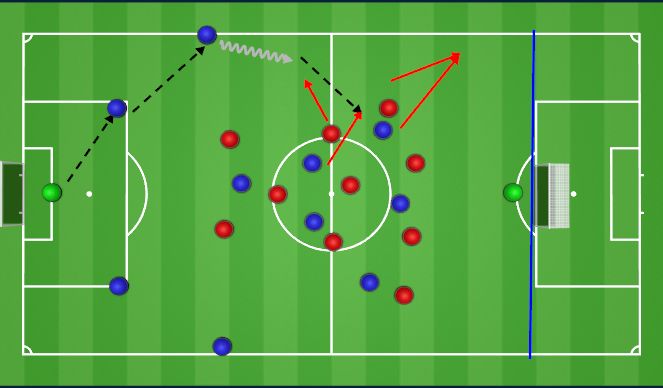
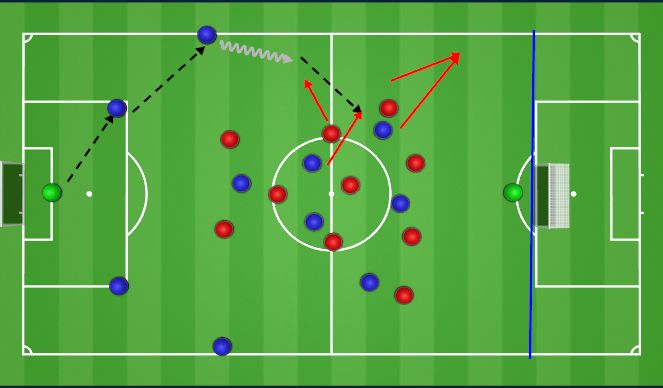
Block 1: Opposition Forcing Predictable Build – Locking One Side
The opposition uses their front two to screen and direct play to one side, with the nearest midfielder jumping out to press the full-back, reducing options and increasing pressure on the ball.
Tactical Solution: Use of Overloads and Rotations to Escape Pressure
Blue Team Tactical Detail (3-4-1-2):
Goalkeeper:
Start centrally in the 6-yard box
Read opposition pressing cues
Identify strong side vs weak side based on positioning of opposition front two and diamond
Play quickly to exploit unbalanced pressure
Back Three:
LCB: Open body shape to receive and play outside the press, combining into the advancing LB
RCB: Maintain full width for switch of play if LCB is locked
CB: Central option for rotation and switch if needed
Full-Backs:
LB: High and wide on the touchline, offering a progressive passing lane
RB: Hold width for second-phase switch, capitalising on delayed opposite side pressure
CDM:
Start high near the top of the box ("top of the D")
Lure the opposition 10 forward, creating a deeper space behind
Act as part of a 4v3 build-up overload including GK and CBs
LCAM/RCAM (Advanced Midfielders):
LCAM: Stay high and narrow, pinning the opposition wide midfielder and offering a bounce option
RCAM: Drift centrally into the circle to occupy opposition diamond’s far side and open switch option to RB
Front Three:
ST: Pin both CBs by staying high, centrally between them
LW: Pin the opposition full-back. If that FB jumps inside to press, creates a channel for the 9 to attack
RW: Inside shoulder of the opposition FB — ready to make a run beyond if space opens on the near side
Coaching Points:
Recognise the overload: 4v3 at the base — use GK and CBs to provoke pressure
Timing of the release: Full-backs must receive beyond pressure with body shape to drive
Third-man runs: If opposition cut direct pass, use bounce into CAMs to release FBs
Stretch the pitch: Ensure FBs and RCB/LCB maintain width to force the block to shift
Trigger the switch: CAM movement into central zones should trigger diagonal switches into RB
Final third entries: When wide entry is made, ST and opposite winger must arrive in the box; CAM supports edge
Coach Interventions:
“Can we provoke the press, then play out through the free full-back?”
“CBs — how are we using our positioning to manipulate the first line?”
“CAM — recognise when to hold and when to bounce to release wide players.”
“Wingers — pin the FB and create the space we want to exploit.”