
Football/Soccer Session (Academy Sessions): Passing, Touch, and Possession

Premier Users' Club
Marty Golightly

Description
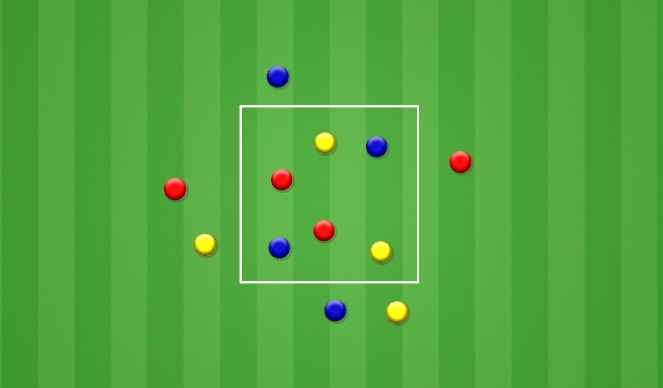
Organisation (Practice Layout & Transition)
See the guidance at the top of this page to understand why you are not seeing interactive Football/Soccer images.
See the guidance at the top of this page to understand why you are not seeing interactive Football/Soccer images.
Progression 1 – Same-Color Passing (Rapport & Rhythm)
· Each color group (red, blue, yellow) has its own ball.
· Players can only pass to the same color.
· Focus: first touch, constant scanning, spacing, and establishing rhythm inside a crowded area.
· Goal: get comfortable receiving under pressure and moving the ball quickly.
Progression 2 – Color-to-Color Sequencing (Scanning & Decision-Making)
· Still one ball per color, but now each group must follow a passing pattern:
Red → Blue → Yellow → Red
· Players must scan early to identify the next target color while avoiding traffic.
· Focus: awareness, anticipation, movement off the ball.
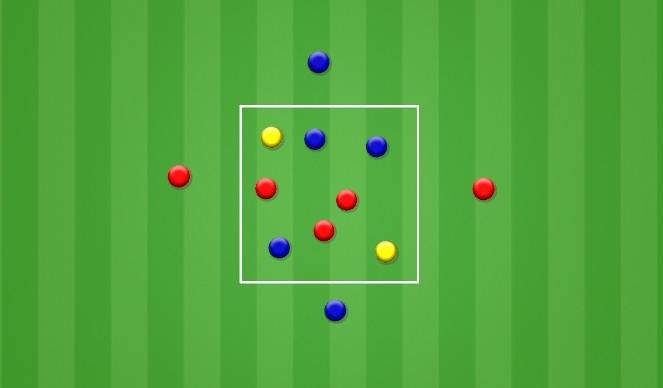
Progression 3 – Single Ball, Multi-Team Possession (Chaos into Control)
· Now there is only one ball in play.
· Coach calls two colors that become the possessing team, while the other color becomes the pressing team.
· If the defenders win the ball, the coach calls new colors to transition possession.
· Focus: quick transition, communication, defensive coordination, spatial awareness.
See the guidance at the top of this page to understand why you are not seeing interactive Football/Soccer images.
Rules
1. Possession Objective
Red and Blue compete to keep the ball using the yellow neutrals as extra passing options (always +2 for the team in possession).
2. Inner Box Restriction
Inside the small box = one-touch play only
All Reds and Blues must play one-touch when receiving the ball in the inner zone.
Neutrals (Yellow) are always allowed 2 touches, even inside the inner box.
This provides a stabilizing outlet and encourages teams to find them to break pressure.
3. Outside the Box
Free play: players can use any number of touches.
4. Transitions
If possession changes, the neutrals instantly switch to assist the new team with the ball.
Encouraging quick reaction and compact pressing to win the ball before opponents can find a neutral.

 Play animation
 Play step-by-step
 Repeat (toggle)
 Full Screen
 Pause
Pause Stop
Stop
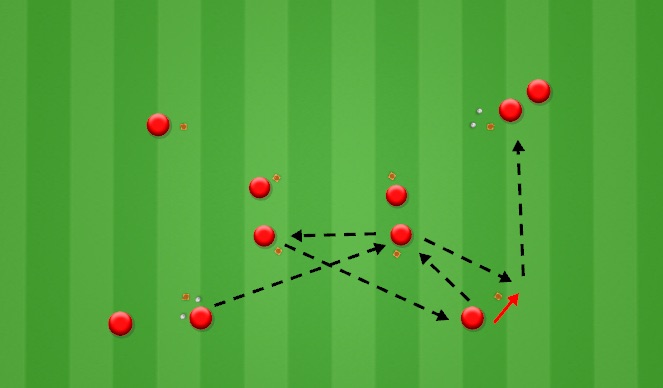
Passing Pattern: “Square Inside the Square” Combination Play
This pattern is built around a small square of central players operating inside a larger perimeter of supporting players. The goal is to develop quick combinations, angled support, and third-man timing.
Setup
Outer square: Four perimeter players positioned on the outside.
Inner square: Four central players positioned in a compact diamond or small square.
Multiple passing lanes and support angles are created between the inner and outer groups.