


Football/Soccer Session (Academy Sessions): Session 1 Week 38. Combination play Building with Balance (Start Time: 2025-03-17 19:00:00)


FAW Coach Ed
Dave Cavanagh
Profile Summary

| Name: | Dave Cavanagh |
|---|---|
| City: | Caernarfon |
| Country: | United Kingdom |
| Membership: | Adult Member |
| Sport: | Football/Soccer |

Description
This is a session comprising of a Drill into a Match Preparation practice which will include 3 What If scenarios. The practice will focus on playing out from the back in a 3-5-2 against a team set up in a 4-2-3-1 who play in a high press. Using elements from our game model to build up from the back to find the spare player, breaking lines and using quick combinations to switch play and create wide overloads.
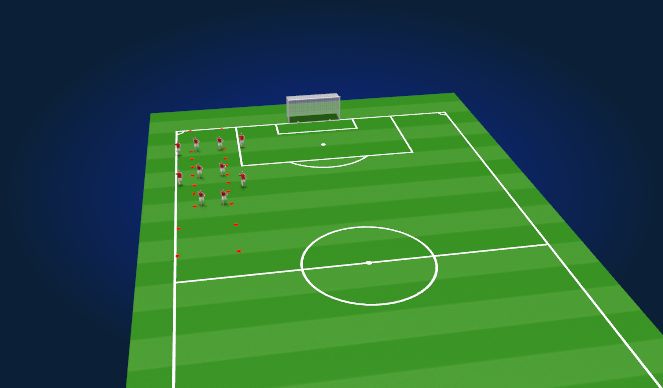
See the guidance at the top of this page to understand why you are not seeing interactive Football/Soccer images.
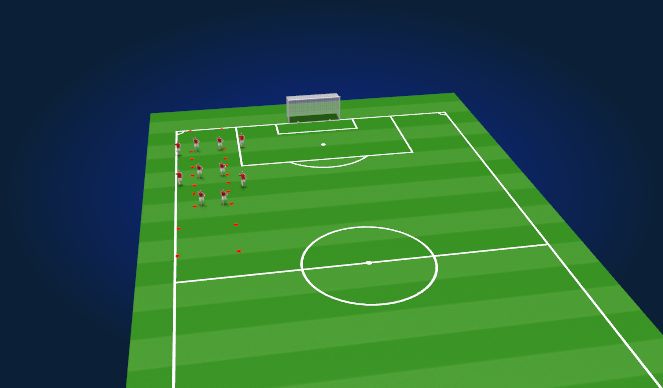
See the guidance at the top of this page to understand why you are not seeing interactive Football/Soccer images.
Learning Objectives

|
Technical Forward Passing, Angles of support |

|
Tactical Securing the first pass, Creating overloads. |

|
Physical Strength, Movement, Timing |

|
Psychological Decision Making. |

|
Social Communication. Support. |
Combination Technical Drill. (10 mins)
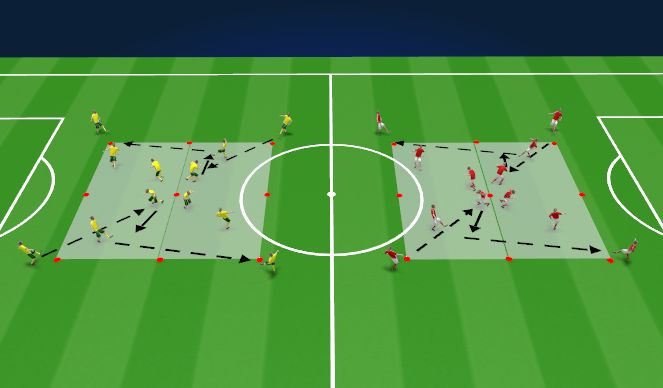
Objective - Creating passing combinations to enter the final third when the defence is narrow and compact.
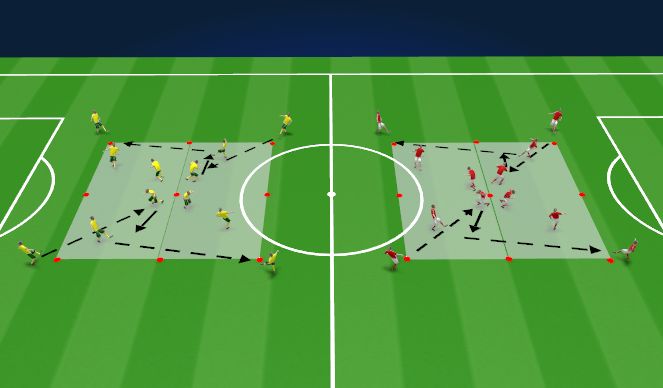
Organisation - 12 players, cones and a good supply of balls. Mark out and area 20 x 20 and divide this into 4 x 10 boxes. Place 2 players in each box and the remaining 4 players on the outside corners of the 20 x 20 area.The practice will start at two opposite corners of the area. The player on the outside will have the ball and on the whistle will play the ball into the first player who will set the second player who will then pass the ball out anti clockwise to the furthers outside player at the corner of the area. The player on the outside then goes into the area and the player who plays the final pass out leaves the area and becomes the server.
Challenge - To work small combination patterns to move the ball quickly out of the area by using minimal touches of the ball and circulate the ball back to the starting position before the other ball.
Conditions - Players can only use a maximum of 3 touches on the ball.
Progressions - #1 Players play a revers 1-2 back to the server before playing to partner who then plays out.
#2 - Play around the corner into the next sector where the receiving player sets back to the original sector and the receiving player plays out.
#3 - Switch to clockwise and one touch only.
Work Rate - 3 sets of 3 minutes with 30 seconds recovery.
Physical Output - Game day -2 Moderate intensity 75 - 85%
Feedback - Con Current.
Coaching Points -
- Body Shape.
- Movement to receive.
- Weight of pass.
- Angles and distances to receive.
See the guidance at the top of this page to understand why you are not seeing interactive Football/Soccer images.
Learning Objectives
|
|
Technical Forward Passing, Angles of support |
|
|
Tactical Securing the first pass, Creating overloads. |
|
|
Physical Strength, Movement, Timing |
|
|
Psychological Decision Making. |
|
|
Social Communication. Support. |
Objective. (15 mins)
Objective. - To play out from the back into the wide areas where we will create numerical overloads and move the ball into the final third.
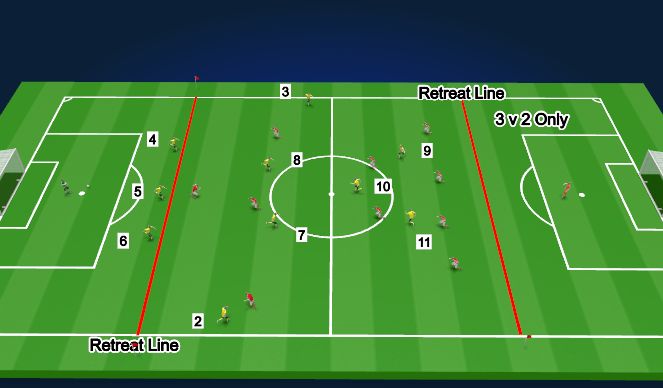
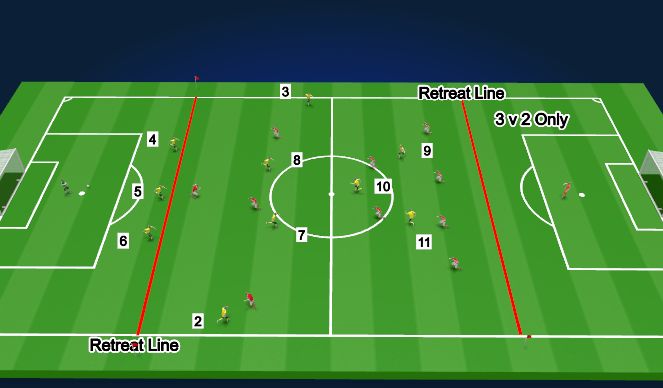
Organisation - Full pitch players play 11 v 11. Yellows set up in a 3-5-2 formation against the Reds who are set up in a 4-2-3-1 formation.
Challenge - Yellows to play out from the back in a 3-5-2 and look to play through the thirds by creating overloads.
Conditions - Two flags are placed on the touchline 30 meters from the goal line at both ends of the pitch as an indicator of a retreat line for both teams strikers to drop off to when the opposite team are playing out and in possession of the ball. The strikers may press once a defender has touched the ball.
The Yellow team can only use 3 attackers into the final third and only 2 defenders can retreat into the area to create a 3 v 2 attacking overload, both teams will have 6 seconds to make an attempt at goal when i the final third. If the defending Red GK gains possession the ball must be played out to a central defender who will play a long ball up to the forwards who will allow the ball to run through to the GK to start another phase of play for the Yellow team..
See the guidance at the top of this page to understand why you are not seeing interactive Football/Soccer images.
Learning Objectives
|
|
Technical Forward Passing, Angles of support |
|
|
Tactical Securing the first pass, Creating overloads. |
|
|
Physical Strength, Movement, Timing |
|
|
Psychological Decision Making. |
|
|
Social Communication. Support. |
Scenario #1 Play Out (15 mins)
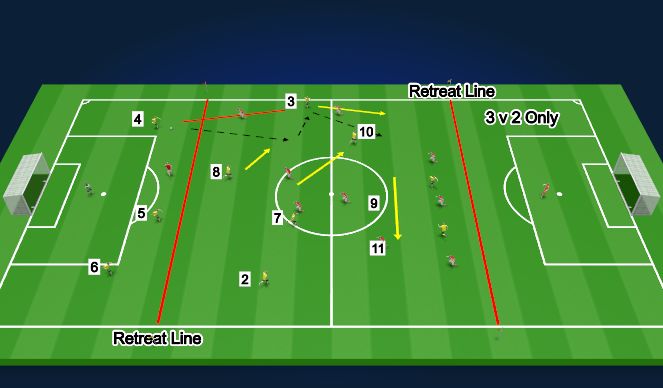
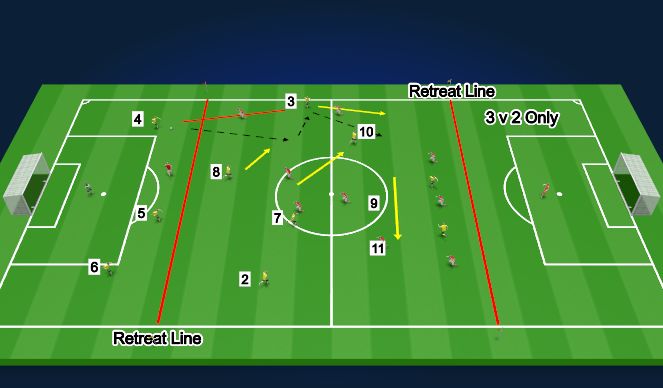
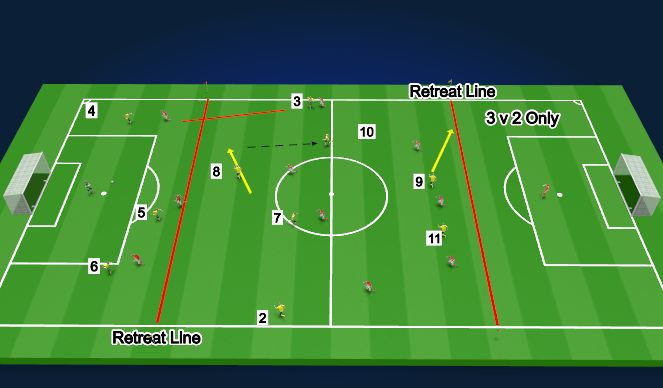
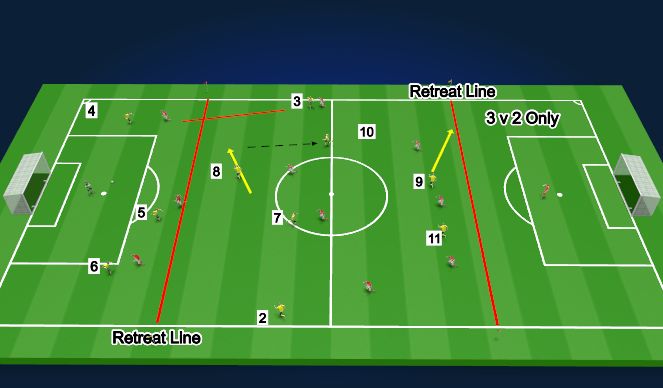
What If - The opposition wide player #7 closes down the ball carrier (#4) in the passing lane between the #4 and the #3 to cut off any pass out wide to the full back #3 ?
Objective. - To play out from the back in a 3-5-2 to move the ball through the thirds of the pitch and create numerical overloads and move the ball into the final third
Challenge - Yellows to play out from the back in a 3-5-2 and look to play through the thirds by creating overloads and goal scoring opportunities.
Conditions - Remain the same as above.
Work Rate - 2 x 7 mins with 2 mins recovery.
Physical Output - Game day -2 Moderate intensity 85 - 90%
Feedback - Direct, Con current - Guided Discovery
As our GK drops the ball at his feet and steps back in readiness to play the ball both our center backs #4 & #5 drop off to the outside of the 18 yard box with an open body ready to receive the ball and play forward if possible. Our #6 the defender positioned in the middle of the three will move to the right hand side in line with the outside of the six yard box to open up the field of play. In this instance we will play out to the left hand side (#4). If the strikers do not press all the way with our CB's the #4 can receive the ball into his back foot and play out.
It is important that our #3 has a good starting position and recognises the physical aspect of what we are trying to achieve, and the remaining players ensure that they are on the front foot and ball side on our opponents to give them the best possible opportunity to get to screen the pass with their body and prevent interception.
Our aim is to create as much space as possible by making the pitch as big as we can (Attacking Principles) to enable us to pass the ball quickly around the opposition. Our #3 must then go as high as possible out wide and his position must be 10m from the half way line. We are looking to get in the eye line of the opposition #7 to distract him and break his concentration on the ball. If the #7 retreats to cover our #3 then our # 3 must move higher up the pitch behind the #7 to keep his number in view to disguise the movement. This will give our #4 space in front to carry the ball out.
Our #8 will move inside off the back shoulder of the opposition to the right to drag the opposition midfield away from the ball area to open up a passing lane into the #10. The #8 will then perform double movement back to the left to create the right hand side of the diamond.
Our #10 will use this as a trigger to sprint forward in line with the edge of the penalty are and 15 meters into the opposition half into the half space to create a tip of a diamond.
Our #4 will drill a pass inside the wing back into the feet of the #8, as the ball passes our #3 he will open up his body off the opposition #7 on his outside shoulder and on the outside of our #10 to provide width and an overload on the opposition full back.
Our #8 can play a first time pass wide to our advancing full back #3 who has now run in behind the opposition wing back and created a wide overload on the left.
Our #9 who started high and in between the two central defenders will now move across onto the left in lie with the edge of the 6 yard box while our #11 who is positioned on the inside shoulder of the defender can penetrate centrally. Our #2 can tuck in to provide defensive balance across the middle of the pitch.
Once the pass is made the #4 will push out in a narrow position on the left to provide cover for the #3, the #5 will narrow up to cover the central area in line with the penalty spot. The #6 will also slide around for defensive cover and protection against the counter attack.
Coaching Points -
- Attackers stay high up the pitch in between and on the back shoulders of the defenders to create width and depth in the game.
- Attacker stay ball side, timing and movem
See the guidance at the top of this page to understand why you are not seeing interactive Football/Soccer images.
Learning Objectives
|
|
Technical Forward Passing, Angles of support |
|
|
Tactical Securing the first pass, Creating overloads. |
|
|
Physical Strength, Movement, Timing |
|
|
Psychological Decision Making. |
|
|
Social Communication. Support. |
Scenario #2 High Press (15 mins)
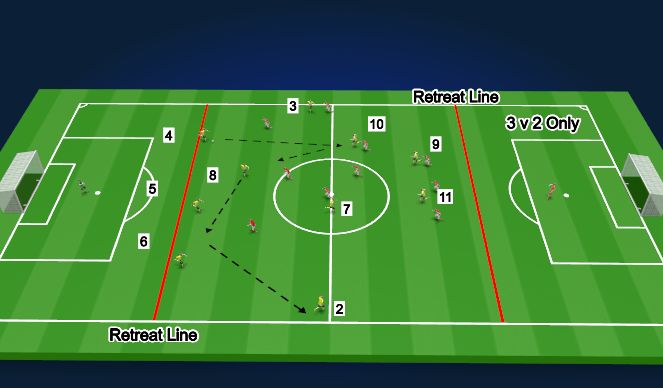
What If - The opposition now employ a full high press to prevent our defenders from receiving a pass from our GK?
Objective. - To play out from the back in a 3-5-2 to move the ball through the thirds of the pitch and create numerical overloads and move the ball into the final third.
Organisation - Full pitch players play 11 v 11. Yellows set up in a 3-5-2 formation against the Reds who are set up in a 4-2-3-1 formation.
Challenge - Yellows to play out from the back in a 3-5-2 against a high press and find the spare man in midfield in order to play through the thirds by creating overloads.
Conditions - Remain the same as above.
Work Rate - 2 x 7 mins with 2 mins recovery.
Physical Output - Game day -2 Moderate intensity 85 - 90%
Feedback - Con current - Guided Discovery
As our GK drops the ball at his feet and steps back in readiness to play the ball both our center backs #4 & #5 drop off to the outside of the 18 yard box with an open body ready to receive the ball and play forward if possible. Our #6 the defender positioned in the middle of the three will move to the right hand side in line with the outside of the six yard box to open up the field of play. In this instance we will play out to the left hand side (#4). If the strikers do not press all the way with our CB's the #4 can receive the ball into his back foot and play out. If the strikers do go high and wide to press then the Center Backs can drop deeper half way down the penalty area to stretch the opposition and create more space to play in. If the strikers do press high on our #4,#5, & #6 then the available space to play out will appear in the midfield and the GK will look to play a pass that breaks the first line of pressure.
Players ensure that they are on the front foot and ball side on our opponents to give them the best possible opportunity to get to screen the pass with their body and prevent interception.
Our aim is to drag the opposition in and under the ball to enable us to pass the ball quickly around them in the wide areas. Our #3 can drop into the eye line of the opposition #7 to distract him and break his concentration on the ball, however as our #3 advances up the field the opposition full back comes wide to engage him and prevent the pass outside. Our #10 will use this as a trigger to move forward in line with the edge of the penalty area and 15 meters into the opposition half into the half space to create a tip of a diamond. Simultaneously our #9 who has been positioned on the weak side of the ball will move across the forward line off the back shoulder of the center back and bet in front of the defender. Our #9 will drop in the half space to receive a drilled pass from our #8. This will trigger our #10 to sprint into a wide position and create a 2v1 in our favour in the wide area. Our #8 will move left in line with the edge of the 18 yard box to receive a pass from the GK and play forward past the opposition wide player and inside the full back to create the inside passing opportunity for our #9 if needs be but at the same time move inside to take the opposition midfield away from the wide area. As the ball passes our #3 he will make a movement forward passed the opposition #7 on his inside shoulder and on the inside of our #10 to provide width and an overload inside the opposition full back.
Our #11 will now move across onto the left in lie with the edge of the 6 yard box while our #7 can penetrate centrally from midfield and into the attacking line.. Our #2 can tuck in to provide defensive balance across the middle of the pitch.
Once the pass is made the #4 will push out in a narrow position on the left to provide cover for the #3, the #5 will narrow up to cover the central area in line with the penalty spot. The #6 will also slide around for defensive cover and protection against the counter attack.
Coaching Points -
&nb
See the guidance at the top of this page to understand why you are not seeing interactive Football/Soccer images.
Learning Objectives
|
|
Technical Forward Passing, Angles of support |
|
|
Tactical Securing the first pass, Creating overloads. |
|
|
Physical Strength, Movement, Timing |
|
|
Psychological Decision Making. |
|
|
Social Communication. Support. |
Scenario #3 The Switch. (15 mins)
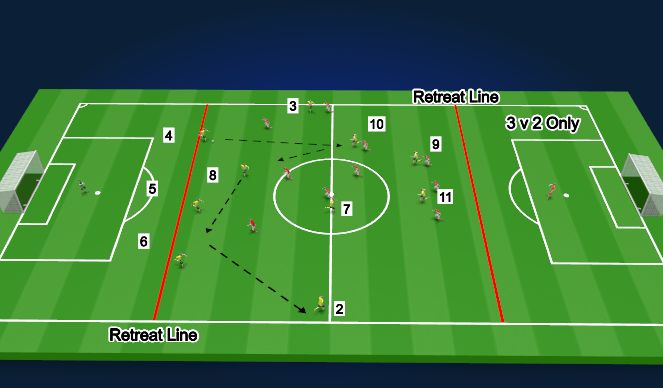
What If - The opposition now track and screen in front of our #10 preventing a ball being played into #10 or the #9 ?
Objective. - To play out from the back in a 3-5-2 to move the ball through the thirds of the pitch and create numerical overloads and move the ball into the final third.
Organisation - Full pitch players play 11 v 11. Yellows set up in a 3-5-2 formation against the Reds who are set up in a 4-2-3-1 formation.
Challenge - Yellows must play out from the back in a 3-5-2 against a high press and find the spare man in midfield and create quick switches of play to move the opposition and play through the thirds by creating overloads.
Conditions - Remain the same as above.
Work Rate - 2 x 7 mins with 2 mins recovery.
Physical Output - Game day -2 Moderate intensity 85 - 90%
Feedback - Con current - Guided Discovery
As our GK drops the ball at his feet and steps back in readiness to play the ball both our center backs #4 & #5 drop off to the outside of the 18 yard box with an open body ready to receive the ball and play forward if possible. Our #6 the defender positioned in the middle of the three will move to the right hand side in line with the outside of the six yard box to open up the field of play. In this instance we will play out to the left hand side (#4). If the strikers do not press all the way with our CB's the #4 can receive the ball into his back foot and play out. If the strikers do go high and wide to press then the Center Backs can drop deeper half way down the penalty area to stretch the opposition and create more space to play in. If the strikers do press high on our #4,#5, & #6 then the available space to play out will appear in the midfield and the GK will look to play a pass that breaks the first line of pressure.
Our objective will be to switch play quickly to the opposite side to create wide overloads and pull defenders out of position. Central midfielders need to be aware and read the game that is developing in front of them. Our central midfielders #7 and #8 will split and drop in under the ball dragging the opposition midfield under and away from the ball. The objective will be to drill a pass into the #9 or the #10 who are being marked tightly and will set to play a bounce pass. As the ball is drilled in this will trigger our #8 central midfielder to move off the shoulder of the defensive midfielder and move forward to receive the bounce pass from #10. Our right hand central defender #6 will split wide and the #8 will open up his body to receive the bounce pass and play wide to the #5. Our central defender #5 will carry the ball out and the wing back our #2 will go high and wide ensuring he can view the opposition wing backs number to stay in behind him. From here our #2 now can perform a double movement and drop down to become available off a bounce pass back to the #6.
Our #11 will move across the forward line to create the tip of the diamond and the #7 will move outside and take up a position inside the wing back. #9 and #10 will take up central positions on the back shoulder of the central defenders on the edge of the penalty area ready to attack the penalty area. Repeating the attacking structure from the opposite side.
Coaching Points -
- Attackers stay high up the pitch on the back shoulders of the defenders to create width and depth in the game.
- Attacker stay ball side, timing and movement off the ball.
- Distances to run, starting positions. Physical effort to get there needed.
- Movement of our midfielders to drop in and away to drag opposition in and under the ball to create space behind for the attackers to operate in.
- Open body to receive the ball on the back foot and play forward.
- Allow the press to create space in behind for third man runs off the shoulder of the defending midfielders.
- Wing back to push high and wide.
'%3E%3Cpath id='path4169' d='M 11.4375,70.25 C 11.457031,38.394531 37.277344,13.242188 68.253906,13.050781 99.78125,12.855469 125.73047,38.351563 125.8125,70.078125 125.89844,101.62109 100.43359,127.14063 69.148438,127.42188 37.582031,127.70703 11.464844,102.23438 11.4375,70.25 m 6.425781,-0.08984 c 0.03516,28.421871 23.027344,50.69922 50.519532,50.82031 C 96.433594,121.10156 119.30469,98.367188 119.38281,70.359375 119.45313,42.878906 97.382813,19.714844 69.015625,19.496094 40.75,19.277344 17.964844,42.035156 17.863281,70.160156' style='clip-rule:nonzero;fill:%23333f48;fill-opacity:1;fill-rule:nonzero;stroke:none' /%3E%3Cpath style='fill:%23333f48;fill-opacity:1;fill-rule:nonzero;stroke:none' d='m 39.789063,108.62109 c 0.28125,0.14454 0.550781,0.32032 0.839843,0.4336 2.734375,1.05469 5.554688,1.78125 8.453125,2.23047 2.734375,0.42578 5.484375,0.64453 8.25,0.54297 3.988282,-0.15625 7.832032,-0.94922 11.445313,-2.69532 1.683594,-0.8164 3.246094,-1.82422 4.640625,-3.07422 3.265625,-2.92578 5.171875,-6.582027 5.796875,-10.906246 0.546875,-3.761719 0.04687,-7.425781 -1.09375,-11.019531 -1.4375,-4.523438 -3.730469,-8.582032 -6.703125,-12.265625 -1.03125,-1.277344 -2.082031,-2.535157 -3.113281,-3.808594 C 66.789063,66.1875 65.332031,64.269531 64.0625,62.21875 c -1.601562,-2.582031 -2.835937,-5.316406 -3.613281,-8.261719 -0.683594,-2.574218 -0.902344,-5.1875 -0.6875,-7.828125 0.214844,-2.617187 0.910156,-5.117187 2.152344,-7.441406 2.164062,-4.050781 5.503906,-6.710937 9.816406,-8.179687 1.890625,-0.640625 3.835937,-1.058594 5.832031,-1.195313 1.121094,-0.07813 2.242188,-0.152344 3.363281,-0.164062 4.28125,-0.02734 8.4375,0.734375 12.453125,2.175781 1.871094,0.671875 3.6875,1.496094 5.523438,2.257812 0.226562,0.09375 0.4375,0.230469 0.664062,0.351563 -0.164062,0.25 -0.371093,0.160156 -0.539062,0.164062 -2.824219,0.101563 -5.535156,0.703125 -8.132813,1.804688 -1.335937,0.570312 -2.570312,1.316406 -3.648437,2.296875 -2.527344,2.296875 -3.605469,5.15625 -3.34375,8.550781 0.140625,1.855469 0.722656,3.574219 1.550781,5.222656 0.648438,1.296875 1.414063,2.523438 2.292969,3.675782 0.953125,1.25 1.929687,2.484375 2.929687,3.699218 2.085938,2.523438 4.164063,5.054688 6.050782,7.738282 2.203125,3.136718 4.140627,6.417968 5.589847,9.980468 1.16406,2.867188 2.01562,5.820313 2.39843,8.894532 0.25,2.011718 0.30079,4.03125 0.11719,6.058593 -0.24219,2.640625 -0.79297,5.195313 -1.74609,7.667969 -1.29688,3.36328 -3.300784,6.22656 -5.972659,8.63281 -2.429687,2.19141 -5.171875,3.90625 -8.109375,5.3125 -2.695312,1.29297 -5.464843,2.40235 -8.34375,3.20313 -1.953125,0.54687 -3.945312,0.8789 -5.949218,1.15625 -3.035157,0.41797 -6.085938,0.48828 -9.132813,0.3125 -5.328125,-0.3125 -10.476562,-1.46094 -15.410156,-3.52344 -3.449219,-1.44141 -6.691406,-3.25781 -9.757813,-5.39453 -0.183593,-0.12891 -0.378906,-0.25 -0.53125,-0.41016 -0.07031,-0.0703 -0.05859,-0.22656 -0.08203,-0.34375 z m 0,0' id='path4175' /%3E%3Cpath style='fill:%23333f48;fill-opacity:1;fill-rule:nonzero;stroke:none' d='M 94.699219,29.390625 C 94.089844,29.21875 93.476563,29.054688 92.867188,28.875 90.183594,28.085938 87.46875,27.441406 84.703125,27.046875 c -3.976562,-0.566406 -7.945312,-0.59375 -11.863281,0.402344 -7.535156,1.914062 -12.386719,6.71875 -14.878906,13.996094 -0.894532,2.617187 -1.179688,5.328125 -0.953125,8.078125 0.203125,2.484375 0.867187,4.859375 1.816406,7.160156 0.933594,2.261719 2.117187,4.390625 3.4375,6.449219 1.4375,2.25 3.050781,4.371093 4.640625,6.511718 1.4375,1.933594 2.867187,3.871094 4.261719,5.835938 1.230468,1.730469 2.316406,3.546875 3.273437,5.445312 1.324219,2.625 2.265625,5.378907 2.703125,8.292969 0.433594,2.902344 0.292969,5.765625 -0.660156,8.5625 -0.9375,2.74609 -2.574219,5.00781 -4.777344,6.875 -2.417969,2.04688 -5.203125,3.39844 -8.246094,4.22266 -1.835937,0.5 -3.703125,0.75781 -5.609375,0.82031 -3.886718,0.13281 -7.679687,-0.47266 -11.421875,-1.46094 -2.261718,-0.59765 -4.488281,-1.33203 -6.695312,-2.11328 -0.207031,-0.0742 -0.40625,-0.16797 -0.597656,-0.25 -0.02344,-0.24609 0.148437,-0.19141 0.25,-0.20703 1.96875,-0.30469 3.921875,-0.67969 5.804687,-1.34766 1.367188,-0.48437 2.671875,-1.10156 3.855469,-1.94922 2.25,-1.61328 3.65625,-3.765621 4.0625,-6.515621 0.273437,-1.867188 0.09375,-3.710938 -0.429688,-5.527344 -0.472656,-1.648437 -1.171875,-3.199219 -2.109375,-4.628906 -0.792968,-1.207031 -1.636718,-2.382813 -2.523437,-3.519531 -0.921875,-1.195313 -1.921875,-2.328125 -2.890625,-3.484375 -2.753906,-3.273438 -5.351563,-6.660157 -7.523438,-10.355469 -2.042968,-3.480469 -3.667968,-7.136719 -4.597656,-11.078125 -0.640625,-2.699219 -0.980469,-5.4375 -0.832031,-8.214844 0.238281,-4.53125 1.476562,-8.78125 3.824219,-12.6875 1.082031,-1.800781 2.445312,-3.375 3.988281,-4.800781 2.742187,-2.527344 5.863281,-4.480469 9.257812,-5.992188 3.746094,-1.667968 7.652344,-2.769531 11.707032,-3.394531 3.152343,-0.488281 6.324218,-0.671875 9.507812,-0.519531 8.632813,0.410156 16.671875,2.792969 24,7.433594 0.08203,0.05078 0.152344,0.109375 0.230469,0.167968 -0.0039,0.04297 -0.0078,0.08984 -0.01563,0.136719' id='path4177' /%3E%3Cpath style='fill:%23333f48;fill-opacity:1;fill-rule:nonzero;stroke:none' d='m 31.699219,38.75 c -0.07813,0.238281 -0.152344,0.476563 -0.238281,0.710938 -1.460938,4.074218 -2.066407,8.28125 -1.808594,12.59375 0.4375,7.304687 2.808594,13.925781 7.277344,19.753906 3.714843,4.84375 7.441406,9.671875 11.167968,14.503906 1.113282,1.441406 1.953125,3.007813 2.414063,4.777344 0.332031,1.257812 0.425781,2.539062 0.273437,3.820312 -0.214843,1.832032 -1.070312,3.34375 -2.464843,4.546875 -0.984375,0.851559 -2.113282,1.449219 -3.316407,1.925779 -1.378906,0.54297 -2.8125,0.89063 -4.273437,1.1211 -2.226563,0.35547 -4.46875,0.46093 -6.722656,0.41015 -0.589844,-0.0156 -1.046875,-0.18359 -1.433594,-0.625 -0.636719,-0.72265 -1.335938,-1.39062 -1.9375,-2.14062 C 25.574219,93.800781 22.300781,86.621094 20.84375,78.636719 20.152344,74.835938 19.917969,71 20.15625,67.128906 20.796875,56.773438 24.390625,47.574219 30.859375,39.480469 c 0.21875,-0.273438 0.453125,-0.53125 0.679688,-0.796875 0.05469,0.02344 0.109375,0.04297 0.160156,0.06641' id='path4179' /%3E%3Cpath style='fill:%23333f48;fill-opacity:1;fill-rule:nonzero;stroke:none' d='m 105.41016,101.30078 c -0.13282,-0.3125 0.0234,-0.5039 0.0977,-0.69922 1.38672,-3.749997 1.98047,-7.628904 1.89844,-11.621091 -0.14453,-6.84375 -2.08594,-13.144531 -5.73437,-18.925781 C 99.890625,67.226563 97.917969,64.53125 95.835938,61.917969 94.4375,60.160156 92.988281,58.4375 91.582031,56.6875 90.632813,55.511719 89.6875,54.335938 88.792969,53.121094 c -0.835938,-1.144531 -1.488281,-2.398438 -1.953125,-3.742188 -0.523438,-1.515625 -0.695313,-3.070312 -0.511719,-4.652343 0.21875,-1.839844 1.082031,-3.339844 2.476563,-4.542969 1.039062,-0.890625 2.230468,-1.507813 3.503906,-1.980469 1.632812,-0.609375 3.320312,-0.960937 5.046875,-1.175781 1.917969,-0.238281 3.839841,-0.269531 5.769531,-0.230469 0.52734,0.01172 0.89453,0.203125 1.23828,0.585938 5.50391,6.113281 9.26172,13.144531 11.21875,21.132812 1.11719,4.554688 1.5625,9.179688 1.30469,13.855469 -0.58203,10.625 -4.23438,20.082031 -10.96094,28.339846 -0.15625,0.1914 -0.32812,0.375 -0.51562,0.58984' id='path4181' /%3E%3Cpath style='fill:%23333f48;fill-opacity:1;fill-rule:nonzero;stroke:none' d='m 39.796875,108.63281 c -0.05859,0.0117 -0.117187,0.0234 -0.175781,0.0352 0.05469,-0.0156 0.113281,-0.0312 0.167969,-0.0469 z m 0,0' id='path4183' /%3E%3C/g%3E%3C/svg%3E)
 Play animation
 Play step-by-step
 Repeat (toggle)
 Full Screen
 Pause
Pause Stop
Stop
Warm Up. (15 mins)
Organisation. Dynamic warm up with stretches.
Exercises:
Running straight ahead -Jog straight to the last cone. Run slightly more quickly on the way back. Do the exercise twice.
Running hip out- Jog to the first cone. Stop and lift your knee forwards. Rotate your knee to the side and put your foot down. Jog to the cone and do the exercise on the other leg. When you have finished the course, jog back. Do the exercise twice.
Running hip in- Jog to the first cone. Stop and lift your knee to the side. Rotate your knee forwards and put your foot down. Jog to the next cone and do the exercise on the other leg. When you have finished the course, jog back. Do the exercise twice.
Running circling partner- Jog forwards to the first cone. Shuffle sideways at a 90-degree angle towards your partner, shuffle an entire circle around one another (without changing the direction you are looking in) and back to the first cone. Jog to the next cone and repeat the exercise. When you have finished the course, jog back. Do the exercise twice.
Running jumping with shoulder contact- Jog to the first cone. Shuffle sideways at a 90-degree angle towards your partner. In the middle, jump sideways towards each other to make shoulder-to-shoulder contact. Shuffle back to the first cone. Then jog to the next cone and repeat the exercise. When you have finished the course, jog back. Do the exercise twice.
Running quick forwards and backwards sprints- Run quickly to the second cone then run backwards quickly to the first cone, keeping your hips and knees slightly bent. Repeat, running two cones forwards and one cone backwards. When you have finished the course, jog back. Do the exercise twice.