


Football/Soccer Session (Advanced): ⚽ CFD GK - Defending The Space ⚽ ✔️
Profile Summary
| Name: | Antonio Ramos |
|---|---|
| City: | Wimbledon |
| Country: | United Kingdom |
| Membership: | Adult Member |
| Sport: | Football/Soccer |

Description
1- To develop quick goalkeeper movement and set position in response to an external trigger, improving speed of adjustment, body control, and readiness to defend shots within the space. Progressing into technical outcomes (handling, low blocks, volleys) immediately after the movement.
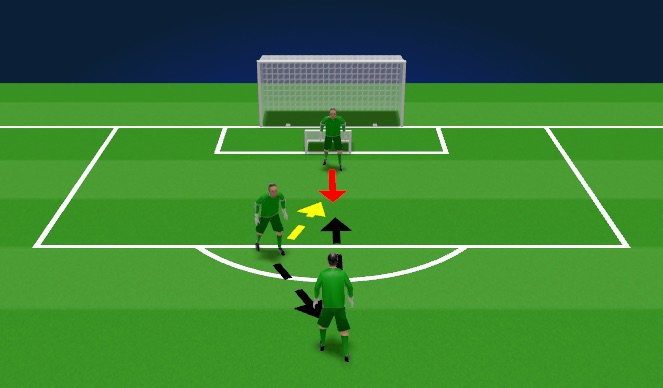
2- Developing goalkeepers ability to read cues from a passing exchange and decide how to defend space (hold, step, close angle, or adjust depth/line) while protecting a mini-goal. Emphasis is on decision-making, timing of movement, and controlling space rather than reacting late.
3- Connecting distribution actions with immediate defensive responsibility, developing the goalkeeper’s ability to pass with quality, recover quickly to protect space (blocking mini-goals), then solve the next picture through decision-making (central option, wide option, or ball into space).
4- Developing the goalkeeper’s ability to defend the cut-back zone by reading cues, deciding whether to intercept/cut the pass, and if not possible, managing space and angle to defend a first-time finish. Secondary focus on recovery and dealing with rebounds.
See the guidance at the top of this page to understand why you are not seeing interactive Football/Soccer images.
Learning Objectives

|
Technical The drill develops technical habits through set position quality and, in the progressed version, correct execution of handling and blocking techniques immediately after movement. The saving action is secondary early, then becomes more important as service is added. |

|
Tactical The goalkeeper is learning to defend the space by arriving in the correct position quickly, understanding body orientation, and preparing for the likely ball line. With partner service and varied angles, the GK must adjust and select the correct technique based on ball height and distance. |

|
Physical This is physically significant due to repeated accelerations, decelerations, and short sharp movements, plus the ability to stabilise quickly into a strong base. The physical demand increases with faster calls and more repetitions. |

|
Psychological The drill demands concentration, fast reaction to external cues, and composure to arrive and execute without rushing. As calls get faster and service becomes unpredictable, decision speed and confidence are tested. |

|
Social Social demand is present through pairing, timing, and basic communication (ready cues, consistent service, feedback). However, it remains mainly an individual movement and execution task. |
See the guidance at the top of this page to understand why you are not seeing interactive Football/Soccer images.
Learning Objectives
|
|
Technical The technical content is mainly in footwork, set position quality, approach mechanics, and clean interception/clearance technique when committing. Any shot-stopping/handling is present but secondary to the space decision. |
|
|
Tactical This is primarily a tactical decision-making exercise. The GK must manage depth, angle, and timing, recognise cues (body shape, first touch, scan), and decide whether to hold, step, or attack the ball based on the developing picture. |
|
|
Physical Physical demand is moderate: repeated small adjustments, accelerations to close space, and controlled decelerations. The emphasis is movement quality and timing rather than high-volume running. |
|
|
Psychological The drill requires concentration, speed of decision, and confidence to commit at the right time. Mistakes often come from hesitation or over-commitment, so composure and clarity are key. |
|
|
Social Limited social demand beyond working with a partner, serving accurately, and basic communication. The primary outcomes are individual reading and decision-making. |
Defending the Space central areas (15 mins)
Organisation and set-up
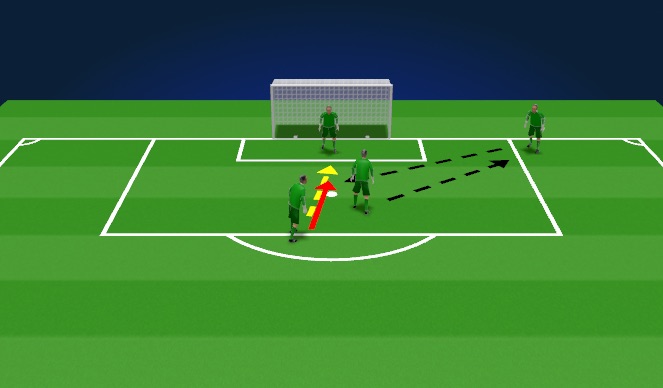
Set a mini-goal for the working GK to defend. Two goalkeepers (or GK + coach) stand outside the mini-goal area at a suitable distance (typically 8–15m depending on level) and exchange simple passes. The defending GK starts set in front of the mini-goal, adjusting position in relation to the ball as it moves. At any moment, one of the passers triggers an “attack” by either turning to face goal (suggesting they will play forward) or by playing a ball into space that can be attacked (suggesting a through ball/dribble scenario). The defending GK must recognise the trigger and make an appropriate decision to protect the mini-goal and space.
Action detail
The exercise begins with two goalkeepers exchanging passes at a controlled tempo. The defending GK stays active, moving with the ball and maintaining correct depth and alignment to protect the mini-goal. On the trigger, the attacker either turns to threaten the mini-goal directly or plays a ball into space. The defending GK must scan, recognise the cue, and decide whether to hold position, step to close space, narrow angle, or move to intercept/clear depending on ball speed, distance, and the attacker’s body shape. The action ends with either a shot/finish into the mini-goal, an interception/clearance, or the GK successfully holding and forcing a poor outcome. Reset and repeat, rotating roles.
Equipment
Mini-goal, footballs, cones/markers to define starting zones and distance, goalkeeper gloves, optional bibs to identify attacker/defender.
Coaching points
- Starting position and movement with the ball
• Stay active: small set movements as the ball travels.
• Align with the ball: stay “between ball and goal” with correct angle.
• Manage depth: don’t sit too deep; don’t overstep early.
Reading cues (trigger recognition)
• Watch the attacker’s body shape: open to play forward vs closed receiving.
• First touch direction tells you intent: forward touch = threat, sideways/back = less threat.
• Head/scan of the attacker: looking up early often signals through ball or shot.
Decision-making: how to defend the space
• If the ball is controlled and attacker is facing goal: close the angle, hold balance, be ready to react.
• If the ball is played into space: decide early can you get there first? If yes, attack the ball; if no, drop and set to defend the finish.
• Timing is key: arrive on the ball under control, not diving in.
Execution detail (when committing)
• Approach in control: slow down in the last steps to stay balanced.
• Set before the action: be ready for shot, touch around you, or pass.
• If clearing/intercepting: make contact clean and decisive to a safe area.
Communication
• Clear trigger words if needed (“hold”, “step”, “away”), especially if rotating and working in pairs.
Progressions
Add finishing outcome
After the trigger, attacker must finish within 2–3 seconds (forces realism and speed of decision).
Add a second space option
Create two different “space lanes” so the attacker can play into either, forcing the GK to scan and adjust quickly.
Touch constraints on attacker
• 2-touch max before triggering (increases tempo)
• Must trigger on certain passes (coach call) to prevent predictability
Add a recovery action
After the initial decision (intercept/hold), coach serves a second ball immediately to test reset and re-set.
Make the cue less obvious
Attacker disguises: shapes to play forward but slips into space late, or turns then delays.
See the guidance at the top of this page to understand why you are not seeing interactive Football/Soccer images.
Learning Objectives
|
|
Technical The exercise repeatedly demands clean distribution (first and second pass), correct receiving and body shape on the return, and stable set positions before defensive actions. Execution quality is a key outcome throughout. |
|
|
Tactical The main tactical component is reading transitions and defending space: choosing where to recover, managing angle and depth, and responding to the second-ball picture (central, wide, or space) with the correct decision at the correct time. |
|
|
Physical There is moderate physical load due to repeated accelerations, decelerations, lateral recovery movements, and quick resets. The physical output supports the speed of transition rather than being the primary focus. |
|
|
Psychological The drill requires focus, composure under quick transitions, and confidence to commit to decisions immediately after passing. The second-ball variability increases cognitive load and stress. |
|
|
Social Some coordination and communication with servers/players is needed (timing, triggers, quality of service), but the key learning remains individual execution and decision-making. |
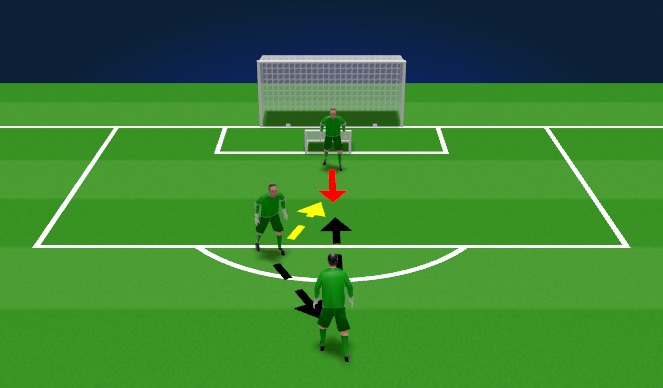
Defending the Space wide areas (15 mins)
Organisation and set-up
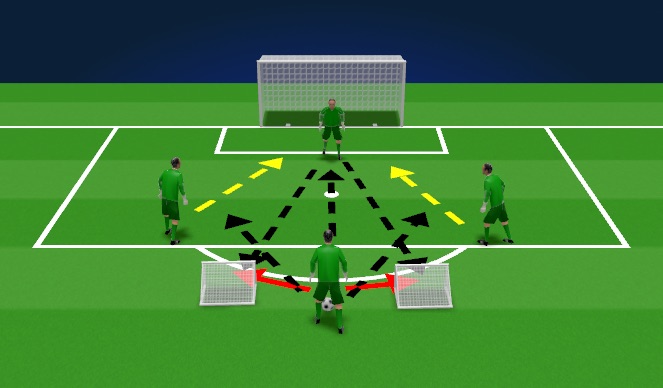
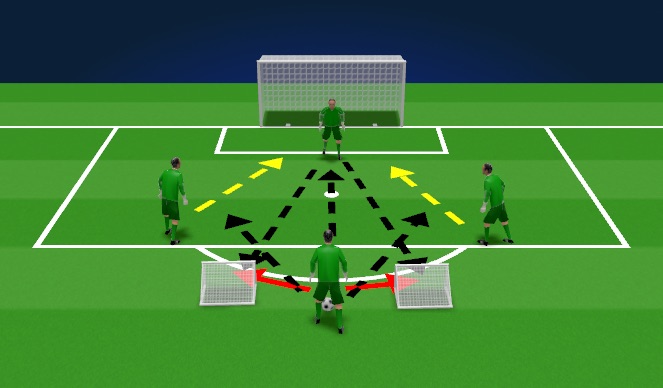
Set two mini-goals (or target gates) in front of the working area, positioned left and right (distance appropriate to level). The working GK starts centrally between them. A central server (coach or GK) is positioned in front of the GK to receive an opening pass. Two wide players (or servers) can be positioned outside the mini-goals as additional outlets for the next ball. The sequence begins with the central server playing a pass into the GK, then immediately go to block one of the mini-goals (coach decides which side). The GK must then receive a pass and distribute into the opposite mini-goal. After that distribution, a new ball is introduced by the coach: into a wide player, or into space behind/around the mini-goals, forcing the GK to read and decide how to defend the space.
Action detail
The GK begins in a neutral set position and plays a firm, accurate pass into the central server. On release, the GK immediately transitions into a defensive movement, recovering at speed to protect the nominated mini-goal, arriving balanced and set to defend the “finish” into that target. The central server then returns the ball to the GK. The GK must open body shape, scan, and distribute into the opposite mini-goal with correct technique and weight. Immediately after the pass, the coach introduces a second ball into a live scenario (central, wide, or space). The GK must recognise the new picture, adjust line and depth, and either hold, step, intercept, or set to defend the next action. Reset and repeat with alternating sides and varying second-ball scenarios.
Equipment
2 mini-goals (or cones for target gates), footballs (good supply), cones/markers for starting positions and lanes, bibs (optional to identify roles), goalkeeper gloves.
Coaching points
- First pass (distribution link)
• Head up early: identify target before you play.
• Good body shape to pass: open hips where possible, stable base.
• Pass quality: firm, accurate, correct weight into the server.
Transition to defend mini-goal
• Immediate reaction after the pass: first step quick.
• Recover with control: accelerate, then decelerate into a set position.
• Arrive balanced: do not overrun the mini-goal line.
- Second pass (into opposite mini-goal)
• Scan on the return: know the opposite target early.
• First touch (if used) sets the pass away from pressure and into line.
• Match technique to distance: clean contact, correct weight, hit the target.
- Second-ball scenario (decision to defend space)
• Recognise the trigger: central, wide, or ball into space changes the priority.
• If ball goes wide: adjust angle and depth to protect the central space and cut-back line.
• If ball goes central: stay set and manage the shot line; don’t get caught moving.
• If ball goes into space: decide early can you arrive first? If yes, attack; if no, drop and set.
- Composure and reset
• After every action: recover quickly, re-set, and be ready for the next ball.
• Commit to decisions: avoid hesitation between stepping and dropping.
Progressions
Touch constraints
• 2 touch max on the return pass (control + play)
• 1 touch pass into the opposite mini-goal when “time” is given
Add pressure
A presser closes the GK after the first pass or during the return pass, forcing faster scanning and cleaner body shape.
Vary distances/angles
Move one mini-goal further back or wider to change the distribution demand and defensive recovery line.
Increase realism of second ball
Second ball becomes live with a finish/cross/cut-back option from wide, or a through ball into space that must be managed.
Score the outcomes
Point system: correct target + execution, plus successful defence of the second-ball scenario.
See the guidance at the top of this page to understand why you are not seeing interactive Football/Soccer images.
Learning Objectives
|
|
Technical The exercise demands high technical quality in set position, footwork, and saving technique for first-time finishes, plus clean contact when intercepting. Rebound actions also test handling and recovery mechanics. |
|
|
Tactical This is a strong tactical scenario: the GK must read the wide player, recognise the cut-back, decide whether interception is achievable, and if not, manage space, depth, and angle to defend the most dangerous outcome. |
|
|
Physical Physical demand is moderate: lateral adjustments, short accelerations to the cut-back line, rapid set, and quick recoveries for rebounds. Movement quality and timing are more important than volume. |
|
|
Psychological Requires composure and clarity under a high-threat moment. The GK must avoid hesitation, commit when appropriate, and stay confident after rebounds or near-misses. |
|
|
Social Limited social component through coordination with servers/finishers and basic communication. The primary outcomes remain individual decision-making and execution. |
Defending the Space from cutbacks (15 mins)
Organisation and set-up
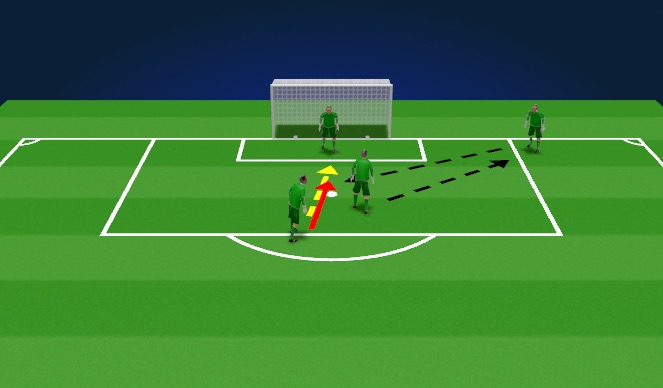
Create a cut-back situation from a wide area. Set a wide “end line” or channel where the ball will be delivered from, and a central finishing zone (cut-back zone) where the first-time finish will occur. One goalkeeper is the working GK defending the goal/target, and a second goalkeeper is positioned as a rebound/second-action GK (or can act as a rebound server/finisher depending on your format). A server plays the ball into the wide player, who drives toward the end line and cuts the ball back into the finishing zone for a first-time strike. If the first shot results in a rebound, the second GK is active to finish the rebound immediately, forcing the working GK to recover, reset, and defend the second action. Rotate roles regularly.
Equipment
Football goal (or mini-goal depending on space), cones/markers to define wide channel and cut-back finishing zone, footballs (good supply), goalkeeper gloves, optional mannequins/poles to represent defenders, bibs.
Coaching points
- Recognising the cut-back moment
• Scan early: identify the wide player and the likely cut-back lane.
• Read body shape: head up and open hips often signals the cut-back.
• Move early but controlled: arrive in the correct space without over-committing.
- Decision: can you cut the pass?
• If the ball speed and distance allow, attack the cut-back line decisively.
• Commit only when you can arrive first or make clear contact.
• When stepping to intercept, stay low and balanced to adjust if the pass is delayed or disguised.
- If you cannot intercept: manage the space
• Hold a controlled position: protect the goal, do not overstep the cut-back.
• Set on the ball line: be square enough to react to first-time finish.
• Manage depth: not too deep (gives too much goal), not too high (gets exposed).
• Stay “alive” on feet: small adjustments as the ball travels.
- Defending the first-time finish
• Set before the strike: stable base, hands ready, eyes fixed on contact.
• Expect speed and low finishes: be prepared to drop quickly.
• Stay patient: do not guess early react to the strike.
- Rebound management (second GK)
• Recover immediately after the first action: reset and regain balance.
• Reposition quickly to cover the next shot angle.
• Stay composed: second action is often chaotic simple, strong technique.
Progressions
Variable cut-back lane
Change the cut-back angle (behind, across the six, deeper to edge) so the GK must adjust decision-making and starting position.
Disguise and delay
Wide player can fake the cut-back, take an extra touch, or drill it earlier to challenge timing.
Finisher movement
Finisher can start central then arrive late, or arrive from different angles, increasing scanning demand.
Rebound intensity
Second GK must finish rebounds first time within a set time ( 2 seconds), increasing recovery speed and realism.
Add pressure to the cut-back
Introduce a passive defender/mannequin to force the pass to be quicker or into a tighter lane.
'%3E%3Cpath id='path4169' d='M 11.4375,70.25 C 11.457031,38.394531 37.277344,13.242188 68.253906,13.050781 99.78125,12.855469 125.73047,38.351563 125.8125,70.078125 125.89844,101.62109 100.43359,127.14063 69.148438,127.42188 37.582031,127.70703 11.464844,102.23438 11.4375,70.25 m 6.425781,-0.08984 c 0.03516,28.421871 23.027344,50.69922 50.519532,50.82031 C 96.433594,121.10156 119.30469,98.367188 119.38281,70.359375 119.45313,42.878906 97.382813,19.714844 69.015625,19.496094 40.75,19.277344 17.964844,42.035156 17.863281,70.160156' style='clip-rule:nonzero;fill:%23333f48;fill-opacity:1;fill-rule:nonzero;stroke:none' /%3E%3Cpath style='fill:%23333f48;fill-opacity:1;fill-rule:nonzero;stroke:none' d='m 39.789063,108.62109 c 0.28125,0.14454 0.550781,0.32032 0.839843,0.4336 2.734375,1.05469 5.554688,1.78125 8.453125,2.23047 2.734375,0.42578 5.484375,0.64453 8.25,0.54297 3.988282,-0.15625 7.832032,-0.94922 11.445313,-2.69532 1.683594,-0.8164 3.246094,-1.82422 4.640625,-3.07422 3.265625,-2.92578 5.171875,-6.582027 5.796875,-10.906246 0.546875,-3.761719 0.04687,-7.425781 -1.09375,-11.019531 -1.4375,-4.523438 -3.730469,-8.582032 -6.703125,-12.265625 -1.03125,-1.277344 -2.082031,-2.535157 -3.113281,-3.808594 C 66.789063,66.1875 65.332031,64.269531 64.0625,62.21875 c -1.601562,-2.582031 -2.835937,-5.316406 -3.613281,-8.261719 -0.683594,-2.574218 -0.902344,-5.1875 -0.6875,-7.828125 0.214844,-2.617187 0.910156,-5.117187 2.152344,-7.441406 2.164062,-4.050781 5.503906,-6.710937 9.816406,-8.179687 1.890625,-0.640625 3.835937,-1.058594 5.832031,-1.195313 1.121094,-0.07813 2.242188,-0.152344 3.363281,-0.164062 4.28125,-0.02734 8.4375,0.734375 12.453125,2.175781 1.871094,0.671875 3.6875,1.496094 5.523438,2.257812 0.226562,0.09375 0.4375,0.230469 0.664062,0.351563 -0.164062,0.25 -0.371093,0.160156 -0.539062,0.164062 -2.824219,0.101563 -5.535156,0.703125 -8.132813,1.804688 -1.335937,0.570312 -2.570312,1.316406 -3.648437,2.296875 -2.527344,2.296875 -3.605469,5.15625 -3.34375,8.550781 0.140625,1.855469 0.722656,3.574219 1.550781,5.222656 0.648438,1.296875 1.414063,2.523438 2.292969,3.675782 0.953125,1.25 1.929687,2.484375 2.929687,3.699218 2.085938,2.523438 4.164063,5.054688 6.050782,7.738282 2.203125,3.136718 4.140627,6.417968 5.589847,9.980468 1.16406,2.867188 2.01562,5.820313 2.39843,8.894532 0.25,2.011718 0.30079,4.03125 0.11719,6.058593 -0.24219,2.640625 -0.79297,5.195313 -1.74609,7.667969 -1.29688,3.36328 -3.300784,6.22656 -5.972659,8.63281 -2.429687,2.19141 -5.171875,3.90625 -8.109375,5.3125 -2.695312,1.29297 -5.464843,2.40235 -8.34375,3.20313 -1.953125,0.54687 -3.945312,0.8789 -5.949218,1.15625 -3.035157,0.41797 -6.085938,0.48828 -9.132813,0.3125 -5.328125,-0.3125 -10.476562,-1.46094 -15.410156,-3.52344 -3.449219,-1.44141 -6.691406,-3.25781 -9.757813,-5.39453 -0.183593,-0.12891 -0.378906,-0.25 -0.53125,-0.41016 -0.07031,-0.0703 -0.05859,-0.22656 -0.08203,-0.34375 z m 0,0' id='path4175' /%3E%3Cpath style='fill:%23333f48;fill-opacity:1;fill-rule:nonzero;stroke:none' d='M 94.699219,29.390625 C 94.089844,29.21875 93.476563,29.054688 92.867188,28.875 90.183594,28.085938 87.46875,27.441406 84.703125,27.046875 c -3.976562,-0.566406 -7.945312,-0.59375 -11.863281,0.402344 -7.535156,1.914062 -12.386719,6.71875 -14.878906,13.996094 -0.894532,2.617187 -1.179688,5.328125 -0.953125,8.078125 0.203125,2.484375 0.867187,4.859375 1.816406,7.160156 0.933594,2.261719 2.117187,4.390625 3.4375,6.449219 1.4375,2.25 3.050781,4.371093 4.640625,6.511718 1.4375,1.933594 2.867187,3.871094 4.261719,5.835938 1.230468,1.730469 2.316406,3.546875 3.273437,5.445312 1.324219,2.625 2.265625,5.378907 2.703125,8.292969 0.433594,2.902344 0.292969,5.765625 -0.660156,8.5625 -0.9375,2.74609 -2.574219,5.00781 -4.777344,6.875 -2.417969,2.04688 -5.203125,3.39844 -8.246094,4.22266 -1.835937,0.5 -3.703125,0.75781 -5.609375,0.82031 -3.886718,0.13281 -7.679687,-0.47266 -11.421875,-1.46094 -2.261718,-0.59765 -4.488281,-1.33203 -6.695312,-2.11328 -0.207031,-0.0742 -0.40625,-0.16797 -0.597656,-0.25 -0.02344,-0.24609 0.148437,-0.19141 0.25,-0.20703 1.96875,-0.30469 3.921875,-0.67969 5.804687,-1.34766 1.367188,-0.48437 2.671875,-1.10156 3.855469,-1.94922 2.25,-1.61328 3.65625,-3.765621 4.0625,-6.515621 0.273437,-1.867188 0.09375,-3.710938 -0.429688,-5.527344 -0.472656,-1.648437 -1.171875,-3.199219 -2.109375,-4.628906 -0.792968,-1.207031 -1.636718,-2.382813 -2.523437,-3.519531 -0.921875,-1.195313 -1.921875,-2.328125 -2.890625,-3.484375 -2.753906,-3.273438 -5.351563,-6.660157 -7.523438,-10.355469 -2.042968,-3.480469 -3.667968,-7.136719 -4.597656,-11.078125 -0.640625,-2.699219 -0.980469,-5.4375 -0.832031,-8.214844 0.238281,-4.53125 1.476562,-8.78125 3.824219,-12.6875 1.082031,-1.800781 2.445312,-3.375 3.988281,-4.800781 2.742187,-2.527344 5.863281,-4.480469 9.257812,-5.992188 3.746094,-1.667968 7.652344,-2.769531 11.707032,-3.394531 3.152343,-0.488281 6.324218,-0.671875 9.507812,-0.519531 8.632813,0.410156 16.671875,2.792969 24,7.433594 0.08203,0.05078 0.152344,0.109375 0.230469,0.167968 -0.0039,0.04297 -0.0078,0.08984 -0.01563,0.136719' id='path4177' /%3E%3Cpath style='fill:%23333f48;fill-opacity:1;fill-rule:nonzero;stroke:none' d='m 31.699219,38.75 c -0.07813,0.238281 -0.152344,0.476563 -0.238281,0.710938 -1.460938,4.074218 -2.066407,8.28125 -1.808594,12.59375 0.4375,7.304687 2.808594,13.925781 7.277344,19.753906 3.714843,4.84375 7.441406,9.671875 11.167968,14.503906 1.113282,1.441406 1.953125,3.007813 2.414063,4.777344 0.332031,1.257812 0.425781,2.539062 0.273437,3.820312 -0.214843,1.832032 -1.070312,3.34375 -2.464843,4.546875 -0.984375,0.851559 -2.113282,1.449219 -3.316407,1.925779 -1.378906,0.54297 -2.8125,0.89063 -4.273437,1.1211 -2.226563,0.35547 -4.46875,0.46093 -6.722656,0.41015 -0.589844,-0.0156 -1.046875,-0.18359 -1.433594,-0.625 -0.636719,-0.72265 -1.335938,-1.39062 -1.9375,-2.14062 C 25.574219,93.800781 22.300781,86.621094 20.84375,78.636719 20.152344,74.835938 19.917969,71 20.15625,67.128906 20.796875,56.773438 24.390625,47.574219 30.859375,39.480469 c 0.21875,-0.273438 0.453125,-0.53125 0.679688,-0.796875 0.05469,0.02344 0.109375,0.04297 0.160156,0.06641' id='path4179' /%3E%3Cpath style='fill:%23333f48;fill-opacity:1;fill-rule:nonzero;stroke:none' d='m 105.41016,101.30078 c -0.13282,-0.3125 0.0234,-0.5039 0.0977,-0.69922 1.38672,-3.749997 1.98047,-7.628904 1.89844,-11.621091 -0.14453,-6.84375 -2.08594,-13.144531 -5.73437,-18.925781 C 99.890625,67.226563 97.917969,64.53125 95.835938,61.917969 94.4375,60.160156 92.988281,58.4375 91.582031,56.6875 90.632813,55.511719 89.6875,54.335938 88.792969,53.121094 c -0.835938,-1.144531 -1.488281,-2.398438 -1.953125,-3.742188 -0.523438,-1.515625 -0.695313,-3.070312 -0.511719,-4.652343 0.21875,-1.839844 1.082031,-3.339844 2.476563,-4.542969 1.039062,-0.890625 2.230468,-1.507813 3.503906,-1.980469 1.632812,-0.609375 3.320312,-0.960937 5.046875,-1.175781 1.917969,-0.238281 3.839841,-0.269531 5.769531,-0.230469 0.52734,0.01172 0.89453,0.203125 1.23828,0.585938 5.50391,6.113281 9.26172,13.144531 11.21875,21.132812 1.11719,4.554688 1.5625,9.179688 1.30469,13.855469 -0.58203,10.625 -4.23438,20.082031 -10.96094,28.339846 -0.15625,0.1914 -0.32812,0.375 -0.51562,0.58984' id='path4181' /%3E%3Cpath style='fill:%23333f48;fill-opacity:1;fill-rule:nonzero;stroke:none' d='m 39.796875,108.63281 c -0.05859,0.0117 -0.117187,0.0234 -0.175781,0.0352 0.05469,-0.0156 0.113281,-0.0312 0.167969,-0.0469 z m 0,0' id='path4183' /%3E%3C/g%3E%3C/svg%3E)
 Play animation
 Play step-by-step
 Repeat (toggle)
 Full Screen
 Pause
Pause Stop
Stop
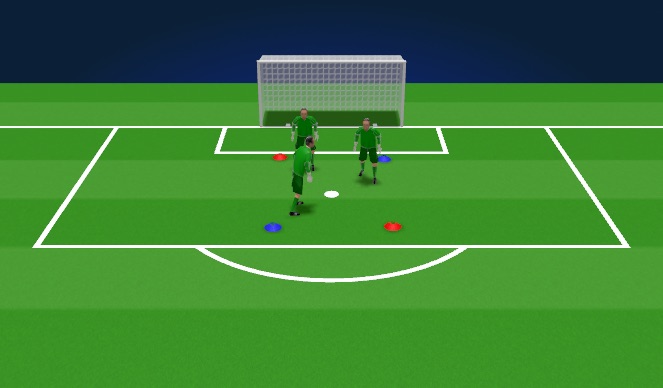
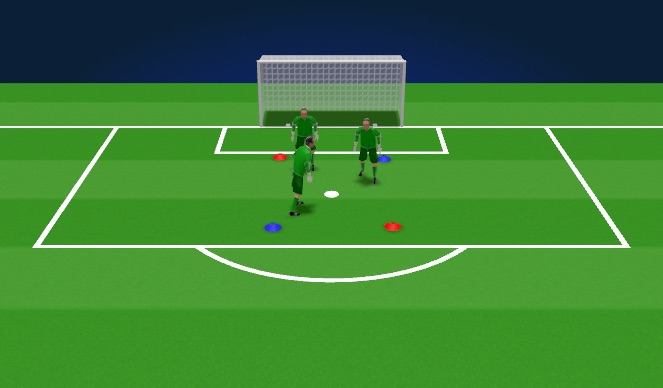
Activation Exercise (10 mins)
Organisation and set-up
Create a square using cones (size dependent on age/level; typically 8x8m to 12x12m). Use two different cone colours to mark designated “set points” (two red and two blue placed on corners or specific points within the square). All GKs start inside the square in a neutral ready stance. The coach stands outside the square with a clear view of all GKs and calls a colour. On the call, each GK moves quickly to the nearest cone of that colour and arrives in a correct set position. For the progression, GKs pair up within the square (or just outside it) so that after the colour movement and set, a partner serves a ball (volley, low block, etc.) to the GK.
Action detail
On the coach’s command (colour call), the GK reacts immediately, moves efficiently to the indicated colour cone, and arrives balanced in a strong set position (feet set, hips loaded, hands in a ready shape). The emphasis is on speed of reaction and quality of arrival (controlled deceleration and stable base). In the progressed version, once the GK has set on the colour cone, the paired server delivers the ball using the chosen service (volley into hands, low block range, or other agreed action). The GK executes the appropriate defending technique, then resets and returns to the centre (or starts position) ready for the next call.
Equipment
Cones/flat markers (two colours), footballs (enough for partner work), goalkeeper gloves.
Coaching points
- Reaction and movement
• React on the call immediately: first step quick.
• Move with control: fast feet, no wasted steps.
• Decelerate into the cone: arrive under control, not flying past it.
• Adjust early: small steps as you approach the set point.
- Set position (arrival quality)
• Balanced base: feet just outside hip width, knees soft, hips loaded.
• Chest forward, head steady, eyes up.
• Hands in front and ready (not by the sides).
• Get set before the ball arrives in progressions.
- Scanning and awareness
• Quick check of space and partner position before setting.
• Stay “alive” after setting: micro-adjust, don’t freeze.
Progressions
Pair work with technical outcome
After the colour call and set, partner serves:
• Volley to hands (handling focus)
• Low block range service (low block technique)
• Half-volley or bounce service (timing and body shape)
Service variety and realism
• Mix height and line: straight, slight angle, across body.
• Coach calls the service type as well (“blue + low” / “red + volley”).
Increase speed of trigger
• Faster calls, double calls (red then blue), or late call as GK is moving.
Constraint on return action
• After the save/block, quick return pass to partner (adds transition habit).