
Football/Soccer Session (Advanced): 11 v 11 Soccer Formations

See the guidance at the top of this page to understand why you are not seeing interactive Football/Soccer images.
See the guidance at the top of this page to understand why you are not seeing interactive Football/Soccer images.
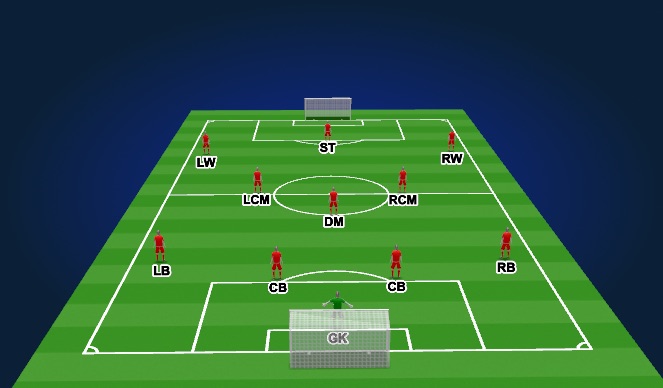
Formation: 11 vs. 11 = 1 - 4 - 3 - 3
GK = Goalkeeper
Defenders:
RB = Right Defender
LB = Left Defender
CB = Central Defender
Midfielders:
DM = Defensive Midfielder
RCM = Right Center Midfielder
LCM = Left Center Midfielder
Forwards:
RW = Right Winger
LW = Left WingerST = Striker
The 4-3-3 formation is a popular soccer formation that's well-suited to attacking teams. Here are some attacking tactics for the 4-3-3 formation:
- Midfield
The three midfielders should create passing lanes, make diagonal runs, and set the tempo of the game. They should also be able to quickly play wide or forward to relieve pressure. - Forwards
The three forwards should provide width and look to make runs inside. The center forward should attack the near post on crosses, while the weak side winger should run to the far post. - Outside defenders
The outside defenders should be technically competent and tactically aware of when to overlap into the attack. - Defensive line
Defend far up the pitch to force the opposition back and limit their passing options. - Pressing
Press high up the pitch with the wingers starting narrow to block the central areas. The center-forward can aim to block any switch of play. - Attacking movements
Use offensive movements like having the number 10 fade into a wide area while the winger inverts. This pins the fullback of the other team in a narrow position.
See the guidance at the top of this page to understand why you are not seeing interactive Football/Soccer images.
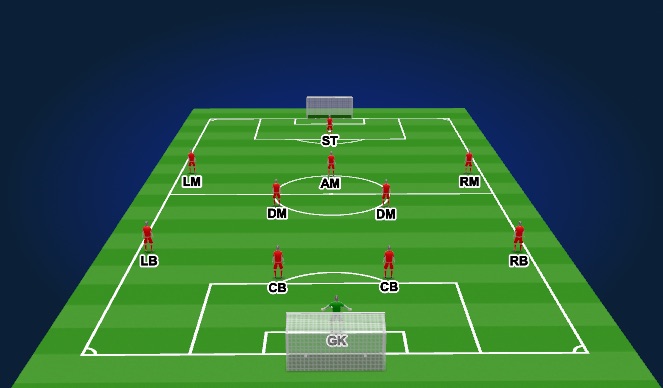
Formation: 11 vs. 11 = 1 - 4 - 2 - 3 - 1
GK = Goalkeeper
Defenders:
RB = Right Defender
LB = Left Defender
CB = Central Defender
Midfielders:
DM = Defensive Midfielder
AM = Attacking Midfielder
RM = Right Midfielder
LM = Left Midfielder
Forwards:
ST = Striker
The 4-2-3-1 soccer formation is known for its balance of defense and attack, and is often used by top international teams. Here's how the formation's defense and attack work:- Defense
The 4-2-3-1 formation has a back four of two center backs and two full backs. The two defensive midfielders, also known as the double pivot, are positioned in front of the defense and create a deep block to protect it. - Attack
The attacking responsibility is shared between the three attacking midfielders and the lone striker. The attacking midfielder's primary role is to find open spaces, make plays, and get behind the defense. They also get into the box and take shots from around the 18. The left and right midfielders can also get involved in the attack, moving to the opposite sideline to get a shot off.
See the guidance at the top of this page to understand why you are not seeing interactive Football/Soccer images.
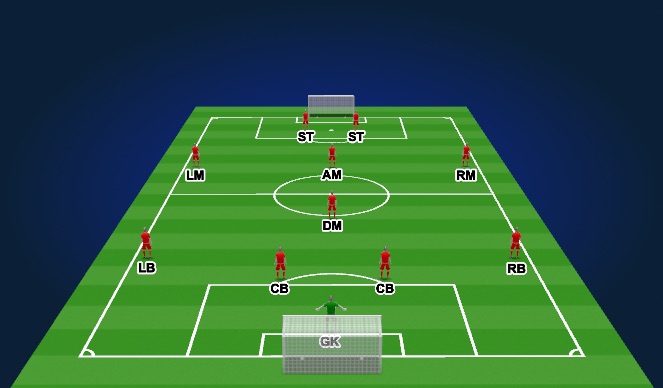
Formation: 11 vs. 11 = 1 - 4 - 1 - 2 - 1 - 2
GK = Goalkeeper
Defenders:
RB = Right Defender
LB = Left Defender
CB = Central Defender
Midfielders:
DM = Defensive Midfielder
AM = Attacking Midfielder
RM = Right Midfielder
LM = Left Midfielder
Forwards:
ST = Striker
The 4-1-2-1-2 soccer formation, also known as the 4-4-2 diamond, is a popular formation that can be used for both attacking and defending:- Defense
The defensive midfielder provides cover in front of the defense and helps with ball retention. The midfield four drops back to help the defense when the team doesn't have possession, while the strikers are free to counterattack. - Attack
The central attacking midfielder is the creative player who distributes the ball to the full-backs or strikers. The full-backs push forward to provide width, while the two strikers are the focal point for scoring.
See the guidance at the top of this page to understand why you are not seeing interactive Football/Soccer images.
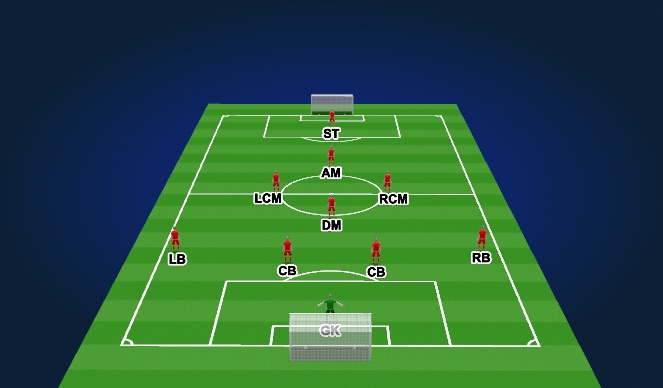
Formation: 11 vs. 11 = 1 - 4 - 3 - 1 - 2
GK = Goalkeeper
Defenders:
RB = Right Defender
LB = Left Defender
CB = Central Defender
Midfielders:
DM = Defensive Midfielder
AM = Attacking Midfielder
RCM = Right Center Midfielder
LCM = Left Center Midfielder
Forwards:
ST = Striker
The 4-3-2-1 soccer formation is a tactical method that emphasizes a strong defense, a cohesive midfield, and dynamic attacking options. Here's how the formation is structured:- Back line: Two center-backs and two full-backs protect the goalkeeper
- Midfield: Three central midfielders with defensive duties, and two more advanced creative midfielders
- Front: A single center-forward as the only striker
See the guidance at the top of this page to understand why you are not seeing interactive Football/Soccer images.
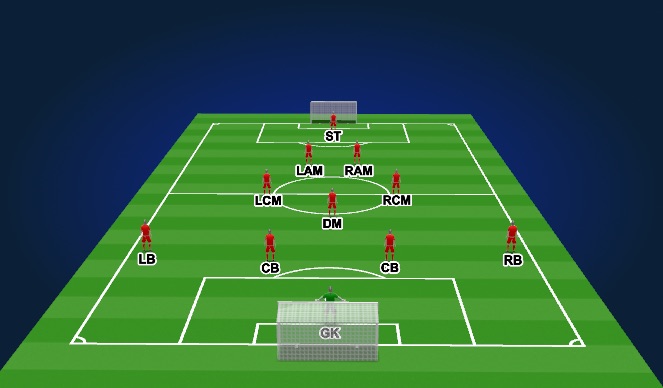
Formation: 11 vs. 11 = 1 - 4 - 3 - 2 - 1
GK = Goalkeeper
Defenders:
RB = Right Defender
LB = Left Defender
CB = Central Defender
Midfielders:
DM = Defensive Midfielder
RCM = Right Center Midfielder
LCM = Left Center Midfielder
RAM = Right Attacking Midfielder
LAM = Left Attacking Midfielder
Forwards:
ST = Striker
The 4-3-2-1 soccer formation is known for its attacking capabilities and ability to create scoring opportunities. It's also known as the "Christmas Tree" formation because of its shape on the field.Here are some of the roles and responsibilities of the players in the 4-3-2-1 formation:
- Defenders
The back line consists of two center-backs and two full-backs. The center-backs mark the opposition's attackers and protect the goal. The full-backs provide width and support in attacks by overlapping with the midfield. - Midfielders
The midfield has three central midfielders and two attacking midfielders. The central midfielders link defense and attack, distribute the ball, and maintain possession. The attacking midfielders, also known as number 10s, add versatility to the offense. - Forwards
The forward line has a left forward, a central striker, and a right forward. The central striker is the only striker.
See the guidance at the top of this page to understand why you are not seeing interactive Football/Soccer images.
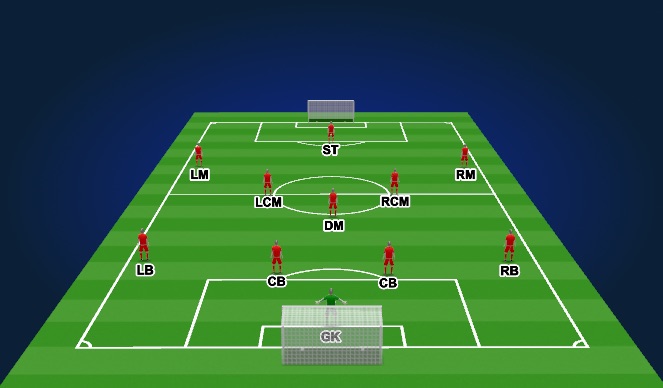
Formation: 11 vs. 11 = 1 - 4 - 5 - 1
GK = Goalkeeper
Defenders:
RB = Right Defender
LB = Left Defender
CB = Central Defender
Midfielders:
DM = Defensive Midfielder
RCM = Right Center Midfielder
LCM = Left Center Midfielder
RM = Right Midfielder
LM = Left Midfielder
Forwards:
ST = Striker
The 4-5-1 soccer formation is a strategic setup that can be used for both defense and attack:- Defense
The 4-5-1 formation is known for its defensive strength and stability. The back line consists of two full-backs and two center-backs, who are responsible for organizing the defense and marking opposing attackers. The midfield is the primary source of strength for this formation, with a defensive midfielder who guards the defense and initiates counter-attacks. - Attack
The 4-5-1 formation can be used to attack with some simple tweaks. The third center midfielder is usually the attacking playmaker, coordinating the team's offensive moves and creating scoring opportunities. The full-backs can also contribute to attacking phases by providing width, overlapping runs, and crossing into the box.
See the guidance at the top of this page to understand why you are not seeing interactive Football/Soccer images.
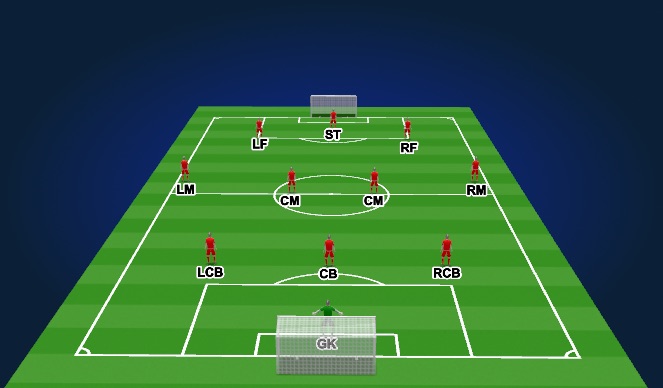
Formation: 11 vs. 11 = 1 - 3 - 4 - 3
GK = Goalkeeper
Defenders:
RCB = Right Center Defender
LCB = Left Center Defender
CB = Central Defender
Midfielders:
CM = Center Midfielder
RM = Right Midfielder
LM = Left Midfielder
Forwards:
RF = Right Forward
LF = Left Forward
ST = Striker
The 3-4-3 soccer formation is a well-balanced tactical setup that combines a strong defense with a potent attack:- Defense
The 3-4-3 formation has three central defenders who form a solid line to protect the goal. The formation can also use a low block to protect central areas and restrict access to dangerous areas. - Attack
The 3-4-3 formation has three forwards who are the primary goal scorers and provide a constant threat in the opposition half. The formation can also use a compact offensive trio, with two attacking midfielders supporting a lone striker. - Midfield
The 4 midfielders in the 3-4-3 formation control the game and provide defensive cover and attacking support. - Flexibility
The 3-4-3 formation can be adapted to suit different styles of play. For example, wide midfielders can be replaced with wing-backs, which can create a wide front line of five.
- Good balance between attack and defense
- Can dominate the midfield
- Can create overloads against the opposition midfield
- Can pin opposing full-backs in deep positions
- The back line of three covers less space across the pitch than a back four, making wide areas vulnerable to counter-attacks
- The central midfield pair can be overloaded after a defensive transition
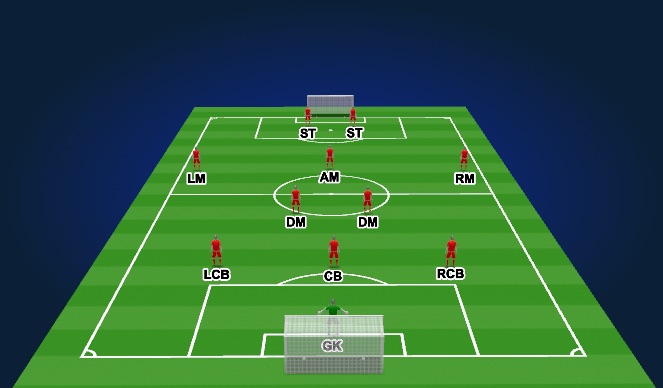
See the guidance at the top of this page to understand why you are not seeing interactive Football/Soccer images.
Formation: 11 vs. 11 = 1 - 3 - 5 - 2
GK = Goalkeeper
Defenders:
RCB = Right Center Defender
LCB = Left Center Defender
CB = Central Defender
Midfielders:
DM = Defensive Midfielder
RM = Right Midfielder
LM = Left Midfielder
AM = Attacking Midfielder
Forwards:
ST = Striker
The 3-5-2 soccer formation is known for its balance between defense and attack. Here are some of the key features of the 3-5-2 formation and how it's used in both attacking and defending:- Defense
The 3-5-2 formation uses a modern back three of central defenders, supported by two wing-backs. The wing-backs can drop back to become part of a back five when defending deep. The central midfielders can also focus on defense and hold their ground, while the wingers track back to reinforce the defense line. - Attack
The 3-5-2 formation uses the wings to provide width and support. The wingers are the active attackers, and can also play as fullbacks when they're further advanced. The central midfielders can be organized in different ways, but they often provide plenty of passing options. The attacking partnership of two forwards can create breaks and gaps in the opposition. - Versatility
The 3-5-2 formation can be adjusted to a 5-3-2 formation when necessary.
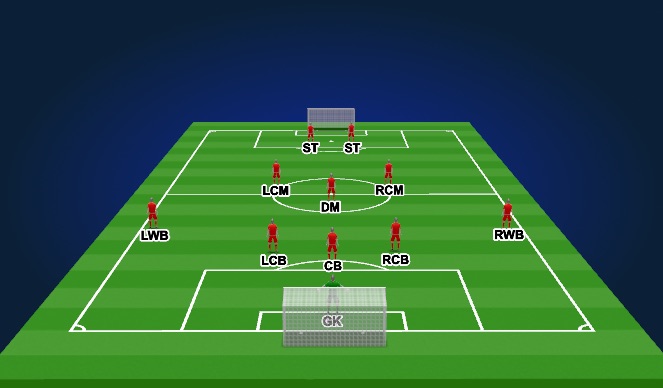
See the guidance at the top of this page to understand why you are not seeing interactive Football/Soccer images.
Formation: 11 vs. 11 = 1 - 5 - 3 - 2
GK = Goalkeeper
Defenders:
RCB = Right Center Defender
LCB = Left Center Defender
CB = Central Defender
RWB = Right Wing Back
LWB = Left Wing Back
Midfielders:
DM = Defensive Midfielder
RCM = Right Center Midfielder
LCM = Left Center Midfielder
Forwards:
ST = Striker
In a 5-3-2 soccer formation, the primary focus is on strong defense with the five defenders creating a solid backline, while the attacking strategy revolves around quick counter-attacks utilizing the two strikers to exploit space left by the opposition when they push forward, with the three midfielders providing support in both phases of the game by controlling the center of the pitch and transitioning smoothly between attack and defense; essentially, it's designed to limit the opponent's attacking opportunities while capitalizing on counter-attacking chances with pace and directness.Key points about the 5-3-2 formation:
Defensive strengths:
- Five defenders provide a strong defensive block, making it difficult for opponents to break through.
- Wing-backs can tuck in to create a compact defensive shape when defending deep.
- The three central midfielders can cover large areas and disrupt opposition build-up play.
- Two fast strikers can quickly exploit space left behind by the opposition defense during counter-attacks.
- Wing-backs can push forward to provide width and create attacking opportunities on the flanks.
- The central midfielders can provide support with quick passes to initiate attacks.
Potential weaknesses:
Limited possession play:
- With only two attacking players, maintaining sustained possession in the opponent's half can be challenging.
- Vulnerability to wide attacks:
- If wing-backs are caught too high up the field, the defense can be stretched and exposed.
- Requires high fitness levels:
- Players need to be able to cover large distances both defensively and attacking to be effective in this formation.

 Play animation
 Play step-by-step
 Repeat (toggle)
 Full Screen
 Pause
Pause Stop
Stop
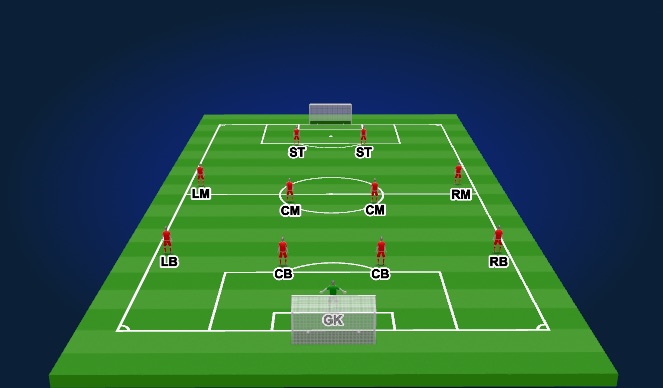
Formation: 11 vs. 11 = 1 - 4 - 4 - 2
GK = Goalkeeper
Defenders:
RB = Right Defender
LB = Left Defender
CB = Central Defender
Midfielders:
CM = Center Midfielder
RM = Right Midfielder
LM = Left Midfielder
Forwards:
ST = Striker
The 4-4-2 flat is a football formation that uses a flat midfield, and is made up of four defenders, four midfielders, and two strikers:
Here are some things to know about the 4-4-2 flat:
The 4-4-2 flat can create a strong double defense wall, and the fullbacks and midfielders can put pressure on the sidelines.
The 4-4-2 flat can be outnumbered in central if the opposition has three or more players in their midfield. The gap between the midfield and attack can also be exploited by the opposition.
The 4-4-2 has several variations, including the 4-4-2 diamond, the 4-4-1-1, and the 4-5-1.
The 4-4-2 has seen a resurgence among teams that want to contain their opponents.It's also the most common formation in British football.